


Therapy is defined as a structured clinical process that changes the underlying systems producing your behaviors and emotions, not just the symptoms you notice on the surface. That distinction matters more than most people realize when they first consider seeking help. The importance of therapy lies not in talking through problems until you feel better temporarily, but in rewiring how your nervous system responds, how your unconscious beliefs operate, and how you relate to others. Major clinical bodies endorse therapy as a first-line treatment for depression, anxiety, and PTSD. When you understand what therapy actually does, the decision to pursue it becomes much clearer.
Why therapy matters: the science of how it changes you
Therapy works on three interconnected levels at once: physiological, cognitive, and relational. That is what separates it from self-help strategies or informal support. Each level reinforces the others, which is why the effects tend to be durable rather than temporary.
Nervous system regulation
Your nervous system determines whether you feel safe enough to think clearly, connect with others, or examine painful experiences. When it is chronically dysregulated, you stay stuck in fight-or-flight patterns that no amount of willpower can override. The therapeutic relationship provides a co-regulatory environment where your nervous system gradually stabilizes through consistent, predictable, safe interaction with another person. This is not a metaphor. It is a measurable physiological process that creates the foundation for deeper psychological work.

Private logic and unconscious belief systems
Private logic refers to the unconscious belief systems you formed early in life to make sense of your experiences. These beliefs run silently in the background, shaping every decision, reaction, and relationship pattern you have. Most people are entirely unaware of them. Therapy brings these beliefs into view so you can examine whether they still serve you. Insight into private logic enables durable behavioral change that goes well beyond symptom management.
The relational vehicle of change
Techniques matter in therapy, but the relationship between you and your therapist matters more. The clinical relationship is the actual vehicle of change, not just the container for it. When a therapist consistently responds with honesty, curiosity, and care, you experience something that may be genuinely new. That experience reshapes your relational templates over time.
Pro Tip: If you feel nothing is happening in therapy after several weeks, that feeling itself is worth bringing into the session. It often signals something important about your relational patterns.
What does clinical evidence say about therapy’s effectiveness?
The clinical evidence for therapy is strong, though it comes with important nuance. A 2026 meta-analysis of 75 studies found that combined therapy and pharmacotherapy produces significantly greater symptom reduction than medication alone at both 6-month and 12-month follow-ups. That finding alone reframes the question from “should I try therapy?” to “what combination of care gives me the best outcome?”
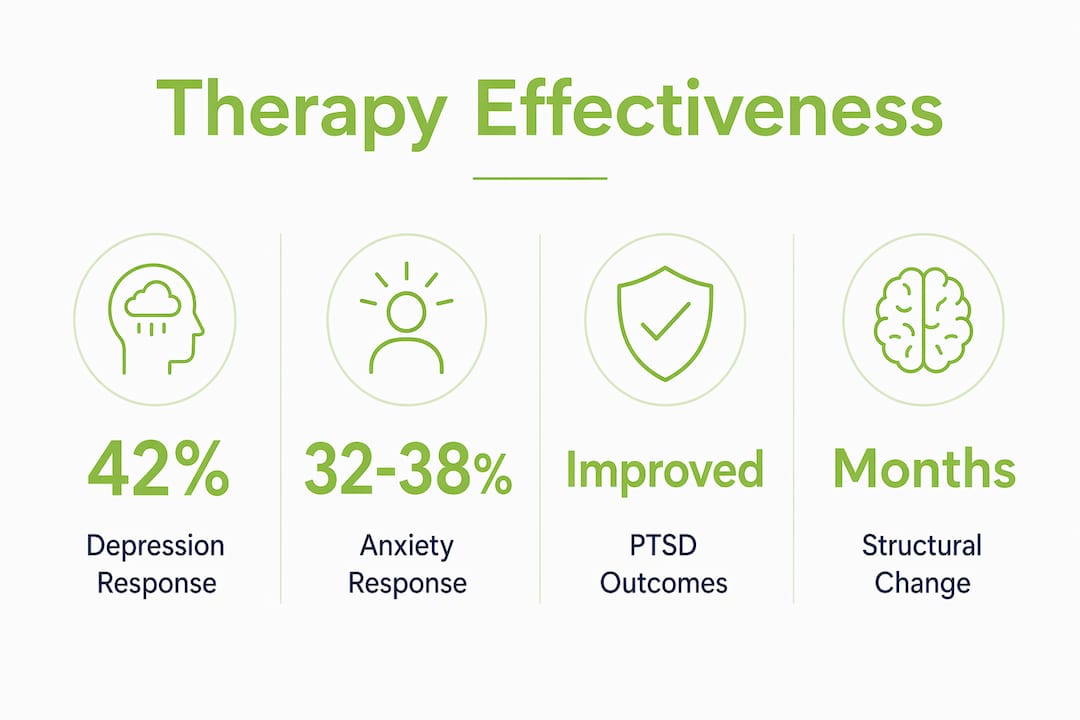
Therapy shows approximately a 42% response rate for depression and 32–38% for anxiety disorders. Response rates for PTSD and OCD run roughly 38%, while borderline personality disorder sits around 24%. These numbers reflect the reality that therapy is incremental and condition-specific, not a universal quick fix. They also underscore why tailored, evidence-based matching between patient and approach matters so much.
| Condition | Therapy response rate | Notes |
|---|---|---|
| Depression | ~42% | Strongest when combined with medication |
| Anxiety disorders | 32–38% | CBT and exposure-based approaches show consistent results |
| PTSD / OCD | ~38% | Requires sustained engagement over months |
| Borderline personality disorder | ~24% | Dialectical Behavior Therapy is the primary evidence-based option |
Therapy is not a passive or instant process. Significant structural changes in how you think and respond take months of consistent work. Short-term symptom reduction is often modest. The deeper gains accumulate over time, which is why sustained engagement is one of the strongest predictors of lasting improvement.
Motivation and fit also shape outcomes directly. A patient who attends sessions reluctantly and withholds important material will see limited progress regardless of the therapist’s skill. Therapy requires active participation from you, not just attendance.
What should you expect in your first therapy sessions?
The first session is not about solving anything. It is about establishing enough safety and clarity to begin. Your therapist will focus on understanding your history, your current concerns, and what you hope to change. Goal setting and collaboration from the start help both of you track whether the work is moving in the right direction.
Here is what tends to happen in the early weeks, and how to approach each stage effectively:
- Show up with honesty, not a performance. You do not need to have your thoughts organized or your story polished. Raw and uncertain is exactly right for a first session.
- Name what you want, even if it feels vague. “I want to feel less anxious” or “I want to stop reacting the way I do in arguments” gives your therapist something concrete to work with.
- Expect to feel tired afterward. Many patients experience what is sometimes called a “therapy hangover” after early sessions. Physical and emotional exhaustion after initial sessions is a normal reaction to the new vulnerability required, not a sign that therapy is failing.
- Notice your reactions to the therapist. Do you feel heard? Slightly uncomfortable? Completely at ease? All of these reactions carry information worth tracking.
- Communicate your preferences early. If something in the session does not feel right, say so. The therapeutic alliance is the single strongest predictor of outcome, and it is built through honest exchange, not politeness.
Pro Tip: Write down two or three things you noticed after each session, including what felt useful and what felt off. This habit accelerates your progress and gives you material to bring back the following week.
Common challenges in therapy and how to work through them
Therapy gets uncomfortable before it gets easier. That is not a design flaw. It is how the process works.
The most common challenges patients face, and what they actually mean:
- The urge to quit before a breakthrough. Many patients feel a strong pull to stop therapy right when they are on the edge of meaningful change. This urge is a recognized pattern in the change process, not a signal that therapy is wrong for you. Naming it to your therapist is often the most productive thing you can do at that moment.
- Emotional exhaustion after sessions. Processing difficult material takes real energy. Feeling drained, irritable, or emotionally raw after a session is temporary and normal. It does not mean you are getting worse.
- Feeling like nothing is changing. Progress in therapy is rarely linear. Weeks of apparent stagnation often precede significant shifts. The Anxiety and Depression Association of America recognizes that evidence-based therapy requires time and consistent effort before measurable gains appear.
- Uncertainty about whether your therapist is the right fit. This is one of the most important things to address directly and early. Disclosing hesitation about fit allows your therapist to adjust their approach or refer you to someone better suited to your needs. Staying silent about it costs you time and progress.
- Expecting therapy to do the work for you. Therapy is collaborative. What happens between sessions, how you reflect on what was discussed, and whether you attempt new behaviors outside the room, all of this shapes your outcomes as much as the sessions themselves.
The impact of mental health on every area of your life is significant enough that working through these challenges is worth it. Discomfort in therapy is usually a sign you are close to something real.
Key Takeaways
Therapy produces lasting change by modifying the nervous system, unconscious belief patterns, and relational dynamics that drive behavior, not by managing symptoms alone.
| Point | Details |
|---|---|
| Therapy changes underlying systems | It targets nervous system regulation, private logic, and relational patterns for durable results. |
| Clinical evidence supports therapy | A 2026 meta-analysis shows combined therapy and medication outperforms medication alone at 6 and 12 months. |
| The therapeutic alliance predicts outcomes | The quality of your relationship with your therapist matters more than the specific technique used. |
| Early discomfort is normal and expected | Emotional exhaustion and the urge to quit are recognized phases of the change process, not signs of failure. |
| Active participation accelerates progress | Open communication, honest goal setting, and reflection between sessions shape your results significantly. |
What I have learned about why therapy actually works
From years of working with patients across a wide range of conditions, the thing that surprises people most about therapy is how much the relationship itself does the work. They come in expecting techniques, worksheets, or a structured program. Those things have their place. But the moments that actually shift something tend to happen when a patient says something they have never said out loud before and the therapist responds without alarm, without judgment, and with genuine curiosity.
That experience is rarer than it should be in daily life. Most of us have learned to manage how we present ourselves, even with people we trust. Therapy is one of the few spaces where that management can come down, slowly and safely. That is not a soft or vague benefit. It is a specific, repeatable mechanism of change.
What I also notice is that patients who struggle most with therapy are often the ones who need it most. The same patterns that make their lives difficult show up in the therapy room. Avoidance, distrust, the need to appear fine. A skilled therapist does not try to work around those patterns. They work with them, directly, because that is where the real material is.
If you are considering therapy for the first time, the most useful thing I can tell you is this: go in willing to be wrong about yourself. Not in a self-critical way. In an open, curious way. The patients who make the most progress are not the ones who arrive with the most insight. They are the ones who are willing to look.
— Felix
Mental health care at Nortexpsychiatry: a practical next step
At Nortexpsychiatry, we work with adults across Allen, Frisco, McKinney, Plano, and the broader North Dallas area who are ready to take their mental health seriously. Our approach integrates psychiatric evaluation, medication management when appropriate, and coordinated care that supports whatever therapeutic work you are doing. If you are unsure where to start, our guide for adults seeking psychiatric care walks through what to expect and how to prepare. We also offer telehealth options for patients who need flexibility. Whether you are managing anxiety, depression, ADHD, or a mood disorder, we are here to help you build a care plan that fits your life.
FAQ
What is therapy, exactly?
Therapy is a structured clinical process in which a trained professional helps you examine and change the underlying beliefs, behaviors, and relational patterns driving your symptoms. It is an evidence-based treatment endorsed by major clinical bodies for conditions including depression, anxiety, and PTSD.
How long does therapy take to work?
Symptom reduction is often modest in the short term, with significant structural changes accumulating over months of consistent engagement. A 2026 meta-analysis found meaningful gains at both 6-month and 12-month follow-ups, particularly when therapy is combined with medication.
What if I do not connect with my therapist?
Disclosing discomfort about fit early allows your therapist to adjust their approach or refer you to someone better suited to your needs. The therapeutic alliance is the strongest predictor of outcome, so addressing fit directly is one of the most productive steps you can take.
Is therapy enough on its own, or do I need medication too?
For many conditions, combined therapy and pharmacotherapy produces better outcomes than either approach alone. The right combination depends on your specific diagnosis, history, and goals, which is why a psychiatric evaluation is a useful starting point.
Why do I feel worse after therapy sessions sometimes?
Emotional exhaustion after early sessions is a recognized and temporary reaction to the vulnerability and effort required. It is not a sign that therapy is failing. Most patients find this effect decreases as they build tolerance for the emotional work involved.