


If a life transition is destabilizing your mental health right now, start here: do a quick safety check, ground yourself with one slow breath, reset one small routine today, complete a single manageable task, and contact one trusted person within the next 24 hours. That five-step sequence is not a cure, but it interrupts the spiral. NAMI’s crisis guidance and the American Psychiatric Association both emphasize that early outreach, before things reach a breaking point, consistently reduces the risk of escalation. Nortexpsychiatry offers same-week psychiatric evaluations for adults across North Dallas who need more than self-care.
Three red flags that require immediate professional contact:
- Suicidal ideation or thoughts of self-harm — call 988 (Suicide and Crisis Lifeline) or go to your nearest emergency room now.
- Marked functional decline — unable to work, care for yourself, or leave home for several days.
- Psychosis or severe dissociation — hearing or seeing things others cannot, or feeling completely detached from reality.
If none of those apply, keep reading. The guidance below is organized so you can move from immediate stabilization through day-to-day coping to professional care, at whatever pace you need.
Table of Contents
- Why do major life changes affect mental health so deeply?
- What mental-health challenges come up most during transitions, and when are they serious?
- What coping strategies actually restore stability during a transition?
- How do you apply these strategies to specific transitions?
- When should you contact a clinician, and what does treatment look like?
- How do you use mental-health apps and online tools without making things worse?
- How Nortexpsychiatry approaches evaluations for people in transition
- Key Takeaways
- What most people get wrong about recovering during a transition
- Nortexpsychiatry is ready when self-care is not enough
- Useful sources and further reading
- FAQ
Why do major life changes affect mental health so deeply?
The short answer: transitions disrupt three things at once. Routine, role demands, and predictability all shift simultaneously, and that combination explains most of the distress we see in clinical practice.
When your daily structure disappears, your brain loses the low-level scaffolding it uses to regulate mood and energy. Role demands change what is expected of you and what you expect of yourself, which touches identity directly. Unpredictability keeps the stress-response system activated longer than it was designed to run. Together, these three forces create a window of genuine vulnerability.
Research on valence and amount of change shows something worth knowing: it is not only negative transitions that create risk. A modest accumulation of positive changes can be protective, but a large accumulation of rapid changes, positive or negative, raises the likelihood of depressive symptoms. Getting married, moving cities, and starting a new job in the same three months can overwhelm adaptation even when each event is welcome.
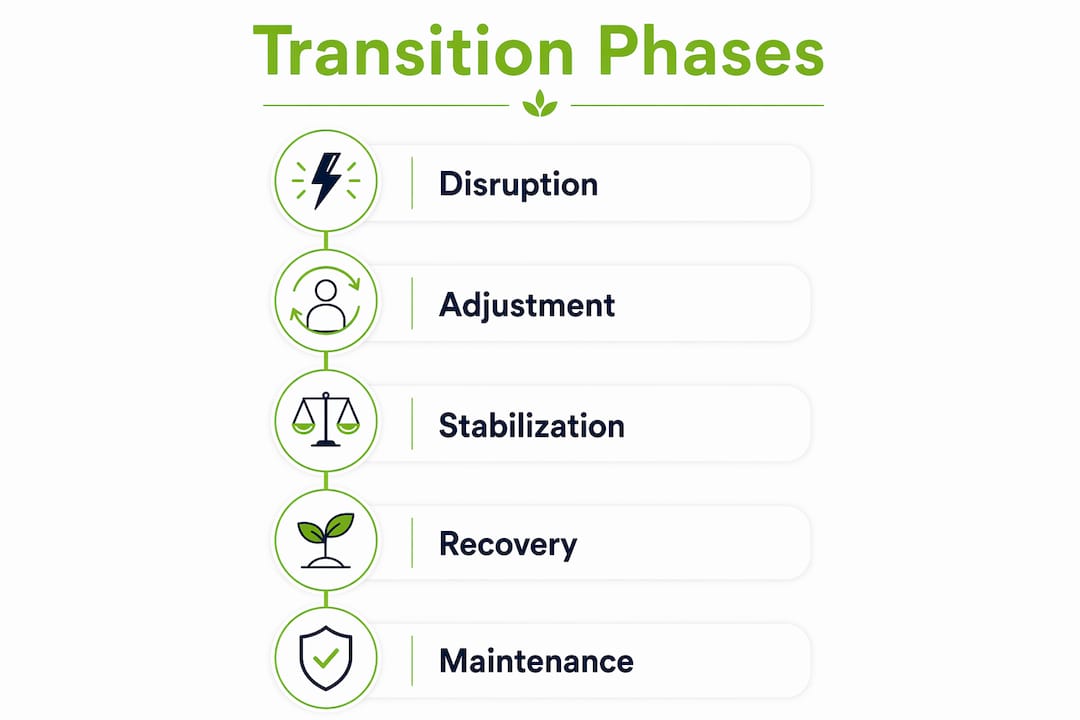
The same research tradition shows that prior role stress shapes outcomes as much as the transition itself. Someone leaving a chronically stressful job may actually feel better after the change, not worse. Context matters more than the event.
Typical adjustment takes a few months after a stressor ends. When distress persists well beyond that period, or when it severely impairs functioning from the start, that is when a clinical assessment becomes necessary rather than optional.
What mental-health challenges come up most during transitions, and when are they serious?
The symptoms we most often see are anxiety, depressed mood, sleep disturbance, irritability, and a pull toward alcohol or other substances as a way to manage discomfort. Each one looks slightly different day to day.

Anxiety during a transition tends to show up as constant “what if” thinking, physical tension, and difficulty concentrating on anything unrelated to the change. Depressed mood often looks less like sadness and more like flatness, loss of interest, and low motivation. Sleep disturbance is almost universal: either racing thoughts at night or sleeping far more than usual. Substance use is the one people most often minimize, but it is worth watching carefully.
According to the MSD Manual’s clinical summary, adjustment disorder is defined by emotional or behavioral symptoms beginning within a few months of an identifiable stressor, typically resolving a short time after the stressor ends. If symptoms persist beyond that window, clinicians need to reassess for major depressive disorder, generalized anxiety disorder, or another condition.
Warning-sign checklist for non-clinicians: Contact your clinician or call 988 if you notice any of the following: symptoms lasting more than four weeks with no improvement; inability to perform basic daily tasks (work, hygiene, eating); using alcohol or substances daily to cope; thoughts of suicide or self-harm; or a feeling that reality is distorted or unreal.
Immediate steps if you are in crisis:
- Call or text 988 (Suicide and Crisis Lifeline, available 24/7)
- Text “NAMI” to 741741 (Crisis Text Line)
- Go to your nearest emergency room if you feel unsafe
The distinction between a transient adjustment reaction and a DSM-level disorder comes down to timing, severity, and functional impairment. Feeling sad and anxious for two weeks after a divorce is expected. Feeling unable to leave your home or care for yourself after two months warrants a clinical conversation.
What coping strategies actually restore stability during a transition?
The most reliable tools, based on both clinical experience and the evidence base, are routine stabilization, behavioral activation, and targeted social connection. Use these first, before anything more complex.
Building a stabilizing daily routine
Routine is not about productivity. It is about giving your nervous system predictable anchors. A morning anchoring routine can be as simple as: wake at the same time, drink water, step outside for five minutes, and write down one thing you will do today. That sequence takes under ten minutes and signals to your brain that the day has structure.
A 15-minute activation plan works on the same principle. Pick one small physical or social action you have been avoiding, and do it for exactly 15 minutes. Behavioral activation, a core component of cognitive behavioral therapy (CBT), consistently shows that action precedes motivation during low periods, not the other way around.
For sleep, a wind-down routine starting 45 minutes before bed, no screens, dim light, and a consistent bedtime, does more for sleep quality than most supplements or sleep aids.
CBT-based techniques for worry and reframing
When intrusive worry dominates, a scheduled “worry window” of 15 minutes per day can contain it. Write the worry down, ask what is actually within your control, and identify one concrete step. That is the CBT core: identify the thought, evaluate it, and redirect toward action.
For relationship-related transitions, interpersonal therapy (IPT) techniques are worth knowing. IPT focuses on role disputes and role transitions directly, helping you grieve what was lost in a relationship or role while building new ones. Many therapists can teach these skills in a short course of sessions.
Pro Tip: When your capacity is genuinely low, prioritize in this order: sleep first, then one social contact, then one physical movement. Those three, done minimally, protect against the deepest drops in mood. Everything else is secondary.
Tracking your response
PHQ-9 and GAD-7 are brief, validated questionnaires for depression and anxiety that you can complete in under three minutes. Scoring them weekly gives you an objective read on whether things are improving, stable, or worsening. A score that climbs over two consecutive weeks is a clear signal to contact a clinician. Both tools are freely available online.
Self-care and a daily schedule are consistently identified in clinical literature as core to recovery from adjustment-related distress, particularly when social supports are intact. The Merck Manual frames routine maintenance not as a luxury but as a clinical recommendation.
How do you apply these strategies to specific transitions?
General coping tools need to be adapted to the actual transition you are facing. Here is how we think about the most common ones.
Job change or job loss
The single most helpful action is protecting your daily routine and financial clarity simultaneously. Keep a consistent wake time even when you have nowhere to be. Within the first week, create a simple budget so financial uncertainty does not compound emotional uncertainty. Reach out to one professional contact every two days, not for job leads necessarily, but for social continuity.

Moving to a new city or home
Establish one “anchor location” quickly: a coffee shop, a park, a gym. Familiarity with one place reduces the disorientation of everything being new. Give yourself a realistic timeline: most people need three to six months before a new place feels like home.
Relationship ending or divorce
Allow for grief without a timeline. The clinical distinction here matters: grief after a relationship loss is expected and healthy. If low mood, sleep disruption, and loss of interest persist beyond two months and impair daily function, that warrants evaluation for major depression rather than adjustment disorder alone.
Bereavement
Social support is the single most protective factor. Peer support groups, whether in-person or online, reduce isolation and normalize the experience. NAMI’s resource pages and community grief groups are good starting points. Bereavement that becomes complicated grief, persistent, intense, and functionally impairing beyond six months, may benefit from specialized therapy.
Parenthood (new baby)
Postpartum depression affects a meaningful proportion of new parents and is distinct from the “baby blues” that typically resolve within two weeks. If low mood, anxiety, or difficulty bonding persists beyond two weeks postpartum, contact a clinician. This applies to both mothers and fathers.
Retirement
Loss of professional identity is the underestimated challenge here. Build structure intentionally before you retire, not after. Volunteering, part-time work, or a new learning commitment can replace the role-based identity that work provided.
Chronic illness diagnosis
Medication interactions with psychiatric symptoms are a real clinical concern. If you are starting a new medication regimen, review medication management considerations with your prescriber. Depression is common after a new diagnosis and often goes untreated because both patient and clinician attribute it to the illness itself.
| Transition | First action | Two-week goal | Clinician trigger |
|---|---|---|---|
| Job change | Protect routine and budget | One professional contact every two days | Persistent low mood beyond four weeks |
| Move | Find one anchor location | Establish one regular social activity | Isolation and functional decline |
| Relationship end | Allow grief, maintain basics | Reconnect with two close supports | Symptoms beyond two months |
| Bereavement | Seek social support | Join a peer group | Complicated grief beyond six months |
| New parenthood | Screen for postpartum symptoms | Maintain sleep in shifts | Low mood or bonding difficulty past two weeks |
| Retirement | Build structure before leaving | Identify one new role or commitment | Identity loss with functional decline |
| Chronic illness | Review medication interactions | Establish care coordination | Depression attributed only to illness |
When should you contact a clinician, and what does treatment look like?
Seek professional care when safety is at risk, when functioning declines significantly, or when symptoms persist or worsen beyond the expected adjustment window of three to six months. Those are the three clinical thresholds. You do not need to wait until you are in crisis.
Clinical guideline consensus: Psychotherapy, specifically CBT, interpersonal therapy, and solution-focused approaches, is the primary treatment for adjustment-related distress. Medication is considered when symptoms are moderate to severe or when they impair functioning and do not respond to therapy alone.
Before any medication is started, best practice requires a differential diagnostic assessment and formal risk evaluation. That step matters because transition-related distress can mask or overlap with major depressive disorder, generalized anxiety disorder, or other conditions that need different treatment.
Telehealth and practical access
Telehealth psychiatry increases access to timely care, particularly for adults managing demanding schedules. An initial evaluation via telehealth can include a full psychiatric history, medication review, and standardized screening. The main limitation is that some clinical presentations, particularly those requiring a physical exam or in-person observation, are better assessed face to face.
When choosing a provider, look for someone who uses measurement-based care (asking you to complete PHQ-9 or GAD-7 regularly), has a clear crisis plan, and can coordinate with your primary care physician. Insurance coverage for telepsychiatry has expanded significantly, but verifying your specific plan’s mental health benefits before booking is worth the call.
NAMI advises that if your mental health worsens during a transition, contact your clinician promptly rather than waiting for a crisis. Adjusting an existing treatment plan early consistently reduces the risk of escalation.
How do you use mental-health apps and online tools without making things worse?
Digital tools can help with skills practice, mood tracking, and brief psychoeducation. They are not a substitute for clinical care when symptoms are severe or safety is a concern.
Safe uses for digital mental-health tools:
- Guided relaxation and breathing exercises (apps like Calm or Headspace)
- Mood journaling and symptom tracking
- CBT-based thought records and behavioral activation prompts
- Psychoeducation about anxiety, depression, and adjustment
Red lines: stop using an app and seek live care when:
- You are using it to manage suicidal thoughts or a safety concern
- Symptoms are worsening despite consistent use
- The app is replacing, not supplementing, a clinician relationship you need
- You are using it to avoid a conversation with a professional
Evaluating a digital tool before you use it
- Privacy: Does the app share your data with third parties? Read the privacy policy.
- Evidence base: Is there published research supporting the specific techniques used?
- Crisis features: Does it provide emergency contacts and a clear escalation path?
- Clinician involvement: Is there any licensed professional oversight of the content?
- Measurement tracking: Can you export your mood or symptom data to share with a clinician?
Online therapy platforms can be a reasonable first step for mild-to-moderate symptoms, but they vary widely in clinician quality and scope of practice. Telepsychiatry through a licensed psychiatric practice, rather than a general wellness app, is the appropriate level of care when medication evaluation or a formal diagnosis is needed.
How Nortexpsychiatry approaches evaluations for people in transition
In our practice, we start every new patient encounter with a focused safety and functional assessment. That comes before anything else. From there, we co-create a short-term stabilizing plan and a six-to-twelve-week treatment roadmap together.
A first evaluation at Nortexpsychiatry typically covers: full psychiatric history, current medication review, standardized screening with PHQ-9 and GAD-7, and a formal risk assessment. We want to understand not just your symptoms but the context of the transition you are in, because that context shapes the treatment plan directly.
What to bring to your first appointment: A list of current medications and dosages, any prior psychiatric diagnoses or treatment history, a brief description of the life change you are managing, and your insurance card. The more context you can share, the more useful that first session will be.
Treatment options at Nortexpsychiatry include medication management, coordination with psychotherapy providers for CBT or interpersonal therapy, Transcranial Magnetic Stimulation (TMS) for treatment-resistant depression, ketamine infusion therapy, and Spravato (esketamine) for adults who have not responded to standard antidepressants. Telehealth appointments are available for patients across North Dallas, including Allen, Frisco, McKinney, and Plano.
[Felix’s professional credentials and experience specific to psychiatry or mental health to be inserted here.] [Case studies or patient testimonials demonstrating proven treatment outcomes to be inserted here.]
Key Takeaways
Coping with mental health during life transitions requires immediate stabilization, consistent daily structure, and timely professional care when symptoms persist or worsen beyond the expected adjustment window.
| Point | Details |
|---|---|
| Safety comes first | If you have suicidal thoughts or cannot care for yourself, call 988 or go to an emergency room immediately. |
| Adjustment has a timeline | Symptoms typically resolve shortly after a stressor ends; persistence beyond that requires clinical reassessment. |
| Routine is clinical, not optional | Daily structure, behavioral activation, and social contact are evidence-based tools, not just good advice. |
| Therapy before medication | CBT and interpersonal therapy are first-line treatments; medication is added when symptoms are moderate to severe or functionally impairing. |
| Nortexpsychiatry offers a clear path | Psychiatric evaluations, medication management, TMS, and telehealth are available for adults across North Dallas managing transition-related distress. |
What most people get wrong about recovering during a transition
Recovery during a major life change is rarely linear, and that is the part most people are not prepared for. We often notice that patients come in expecting to feel progressively better week by week, and when they have a hard day after a good week, they interpret it as failure. It is not. It is how adjustment actually works.
What the research and clinical experience both suggest is that the people who do best are not the ones who feel the least distress. They are the ones who maintain a few basic anchors, routine, one or two close relationships, and some form of physical movement, even when motivation is low. Those anchors do not eliminate the difficulty. They prevent the difficulty from compounding.
The other thing worth saying plainly: asking for help earlier rather than later is not a sign that the transition is too much for you. It is a sign that you understand how the process works. The benefits of psychiatric care during a transition are not about being “fixed.” They are about having a structured, informed support alongside you while you adapt.
Nortexpsychiatry is ready when self-care is not enough
If you have worked through the strategies in this article and still feel like you are not getting traction, that is a meaningful signal. Nortexpsychiatry offers timely psychiatric evaluations, medication management, and evidence-based treatment options for adults across North Dallas, including Allen, Frisco, McKinney, and Plano, with telehealth available for those who prefer remote care.
A first visit covers a full psychiatric history, standardized screening, and a clear treatment plan. You do not need a referral to book. Insurance is accepted, and telehealth appointments are available for patients who cannot come in person. For adults ready to move from reading to care, a psychiatric evaluation is the concrete next step.
Useful sources and further reading
- NAMI: What to Do in a Crisis — Step-by-step safety planning and crisis contacts, including the 988 Lifeline.
- NAMI: Managing Stress — Practical guidance on building a daily coping toolbox and when to contact your clinician.
- MSD Manual: Adjustment Disorders — Professional-level clinical summary of diagnostic criteria, timelines, and treatment.
- Merck Manual: Adjustment Disorders — Parallel consumer and professional resource on self-care, routine, and social support in recovery.
- Life Changes and Depressive Symptoms (Springer/BMC) — Peer-reviewed research on how valence and amount of change both influence depression risk.
- Life Transitions, Role Histories, and Mental Health (ASR) — Classic social-role study showing prior context shapes whether a transition helps or harms.
- Clinical Care Guideline: Adjustment Disorder (Rula) — Evidence-based treatment guidelines covering psychotherapy, medication thresholds, and measurement tools.
- Navigating Life Transitions and Mental Wellbeing (PMC) — Peer-reviewed article on mental wellbeing and life transitions in the digital age.
- Nortexpsychiatry: Psychiatric Evaluations — What to expect at a first psychiatric evaluation and how the process works.
- Nortexpsychiatry: Telehealth Setup Guide — Practical guide to telehealth logistics, privacy, and what to prepare.
FAQ
What are the first signs that a life transition is affecting your mental health?
Persistent sleep disruption, difficulty concentrating, low motivation, and increased irritability within the first few weeks of a major change are the most common early signs. If these symptoms last more than four weeks without improvement, contact a clinician.
How long does it take to adjust to a major life change?
Most people adapt within three to six months after a stressor ends, according to clinical guidelines for adjustment disorder. Symptoms that persist or worsen beyond that window warrant a formal evaluation to rule out major depression or generalized anxiety disorder.
When does normal stress become a mental health condition?
The clinical threshold involves timing, severity, and functional impairment. When distress prevents you from working, maintaining relationships, or caring for yourself, and persists beyond the expected adjustment window, it has moved from a normal reaction to a condition that benefits from professional treatment.
Can telehealth psychiatry help with transition-related mental health concerns?
Yes. Telehealth psychiatry is effective for initial evaluation, medication management, and ongoing monitoring, and it increases access for adults with demanding schedules. Nortexpsychiatry offers telehealth appointments across North Dallas for adults managing transition-related distress.
What is the difference between adjustment disorder and major depression?
Adjustment disorder begins within a few months of an identifiable stressor and typically resolves a short time after the stressor ends. Major depression does not require a specific trigger, tends to be more severe, and requires a different treatment approach. A clinician can distinguish between the two through a structured diagnostic assessment.
This article is general information, not professional medical advice. For guidance specific to your situation, consult a qualified mental health professional or your primary care physician.