


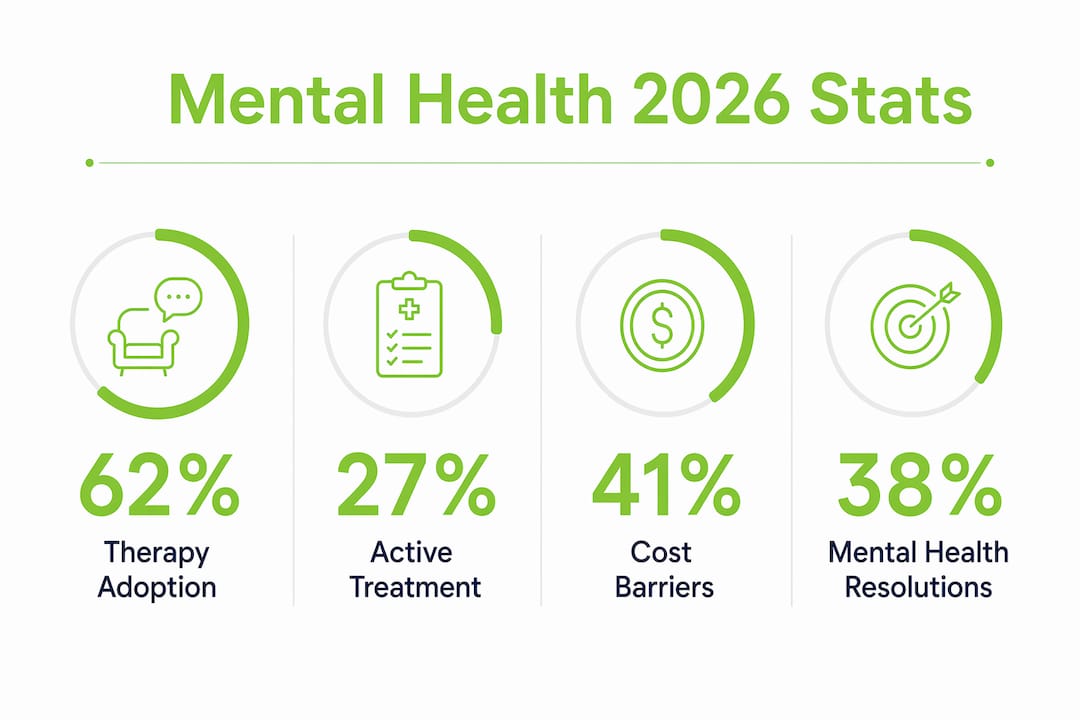
Mental health trends in 2026 mark a turning point. Therapy adoption has reached record highs, with 62% of Americans having consulted a mental health professional in their lifetime, up from 48% just one year prior. AI has entered clinical settings not as a replacement for therapists, but as a working tool that supports documentation, monitoring, and training. Cultural attitudes have shifted enough that nearly 9 in 10 adults now say mental health conditions carry no shame. These changes are real, and they affect how you find care, what that care looks like, and how much it costs.
What are the leading mental health trends in 2026 for care access and treatment?
Access to mental health care has changed more in the past two years than in the previous decade. Hybrid treatment models, which combine in-person sessions with telehealth appointments, have become the standard rather than the exception. This shift matters because it gives patients more flexibility without sacrificing the therapeutic relationship that makes treatment effective.
Insurance coverage still varies widely by region, and that variability directly affects whether patients can maintain consistent care. Providers are responding by adopting measurement-based care practices, using standardized symptom scales to document progress and meet payer requirements. Without that documentation, reimbursement becomes uncertain. That uncertainty falls on patients.
The mental health tech market is consolidating around employer and insurance distribution platforms rather than direct-to-consumer apps. This means more people may access care through workplace benefits than through app stores. For adults in employer-sponsored plans, this is worth knowing. Your benefits package may now include more than you expect.
Barriers remain real despite the progress. Cost, geographic access, and difficulty finding the right therapeutic fit all slow treatment engagement. A step-by-step approach to mental health care can help you work through those obstacles systematically rather than giving up after one difficult search.
Key access challenges adults face in 2026:
- Cost: 41% of Americans cite financial barriers as their primary obstacle to care
- Therapeutic fit: Many patients try one provider and stop, rather than continuing to search
- Insurance gaps: Regional Medicaid and private insurance rules still create uneven access
- Awareness: Many adults do not know their employer plan now covers behavioral health visits
Pro Tip: Before assuming you cannot afford therapy, call your insurance provider and ask specifically about behavioral health benefits. Many plans added telehealth mental health coverage in 2024 and 2025 that patients have not yet used.
How is AI shaping mental health support and clinical practice in 2026?
AI’s role in mental health is best understood as a clinical copilot. More than 1 in 5 Americans now use AI chatbots for mental health support, motivated primarily by anonymity, lower intimidation, and affordability. That number is significant. It tells us that a large portion of people who want support are not yet in formal care, and AI is filling a gap.

The Annual Review of Clinical Psychology published in may 2026 makes the clinical picture clear. AI supports documentation, therapist training, and treatment monitoring. It does not replace the clinical judgment of a trained psychiatrist or therapist. The distinction matters because public perception often lags behind clinical reality.
Investor behavior confirms this direction. Capital in 2026 flows heavily toward clinical infrastructure tools, including AI scribes and psychiatry copilots, rather than wellness apps. Provider efficiency is the target, not consumer entertainment. That focus benefits patients indirectly by reducing administrative burden on clinicians and giving them more time for actual care.
Risks deserve honest attention:
- Algorithmic bias: AI systems trained on non-representative data may perform poorly for certain demographic groups
- Data privacy: Mental health conversations with AI tools may not carry the same legal protections as sessions with licensed providers
- Public skepticism: Older adults remain particularly cautious about AI-assisted care, and that caution is not unreasonable
Pro Tip: If you use an AI chatbot for mental health support, treat it as a supplement, not a substitute. Use it between sessions to track your mood or organize your thoughts, then bring that information to your actual provider.
What cultural shifts are driving mental health normalization in 2026?
Mental health is now discussed the way physical fitness was discussed a decade ago. 38% of Americans entered 2026 with a mental health resolution, and 83% say they feel comfortable discussing mental health openly. These are not small numbers. They represent a genuine shift in how adults relate to their own emotional well-being.
Mental health has also risen in national health priority rankings. 14% of Americans now identify it as the second most important health issue in the country, up from 12% in 2025. That ranking reflects both increased awareness and the lingering effects of COVID-19 on population mental health. The pandemic accelerated conversations that might have taken another decade to normalize.
Here is how that normalization shows up in daily life in 2026:
- Workplace wellness programs now routinely include mental health days, employee assistance programs, and access to employee mental health resources as standard benefits rather than perks.
- Social media has shifted from stigmatizing mental health struggles to creating communities around shared experiences with anxiety, depression, and ADHD.
- Primary care integration means more family doctors screen for depression and anxiety at routine visits, catching issues earlier.
- Proactive wellness practices like journaling, mindfulness, and therapy check-ins are increasingly common among adults who do not have a diagnosed condition.
Adopting mental health self-care practices as a routine, rather than a crisis response, reflects this broader cultural shift. The goal is maintenance, not just recovery.
What challenges remain in mental health care engagement and equity?
The engagement gap is the most important unresolved problem in mental health care right now. Only 27% of Americans are currently in active treatment, despite 62% having sought care at some point in their lives. That gap represents millions of people who started the process and stopped.
Financial stress is the leading cause of that dropout. 41% of Americans cite cost as their primary barrier to care in 2026, a figure that has risen sharply from prior years. High deductibles, out-of-network providers, and limited session coverage all contribute. The problem is structural, not personal.
| Challenge | Who it affects most | Current scale |
|---|---|---|
| Cost barriers | Adults without employer coverage | 41% cite cost as primary obstacle |
| Therapeutic fit | First-time patients | Many stop after one unsuccessful match |
| Regional insurance gaps | Rural and lower-income adults | Medicaid rules vary by state |
| Racial disparities | Black and Hispanic adults | Lower rates of mental health prioritization |
| Engagement drop-off | Adults aged 35–55 | High lifetime use, low current treatment rates |
Racial disparities in mental health care remain underaddressed. Black and Hispanic adults report lower rates of mental health prioritization and face additional barriers including cultural stigma, provider representation gaps, and insurance access issues. Progress in normalization has not reached all communities equally.
The engagement gap signals the importance of ongoing support and patient-therapist fit. Finding the right provider takes persistence. That persistence is worth it, and it is something we encourage every patient to maintain.
Key Takeaways
Mental health care in 2026 is more accessible and less stigmatized than ever, yet financial barriers and the engagement gap still prevent millions of adults from receiving consistent treatment.
| Point | Details |
|---|---|
| Record therapy adoption | 62% of Americans have sought mental health care, up from 48% in 2025. |
| AI as clinical copilot | AI tools support documentation and monitoring but do not replace licensed providers. |
| Cultural normalization | 38% started 2026 with a mental health resolution; stigma is measurably declining. |
| Financial barriers persist | 41% cite cost as their top obstacle, making insurance literacy a practical priority. |
| Engagement gap is the core problem | Only 27% are in active treatment despite high lifetime use rates. |
What I have learned watching these trends unfold
The numbers this year are genuinely encouraging. We have not seen therapy adoption move this fast in our professional lifetimes. But I want to be honest about what the data does not show.
The engagement gap troubles me more than any other statistic. Sixty-two percent lifetime use and 27% current treatment is not a success story. It is a sign that we are good at getting people to try care and poor at keeping them in it. Therapeutic fit, cost, and the sheer exhaustion of starting over with a new provider all contribute. We see this in our own practice.
AI’s role is real and growing, but the framing matters. When a patient tells me they have been using an AI chatbot between sessions, I do not see that as a threat. I see it as a sign they are engaged with their own care. The risk is when AI becomes a substitute for professional evaluation, particularly for conditions like bipolar disorder or PTSD that require clinical nuance.
The cultural shift toward proactive mental wellness is the most durable change I have observed. Adults who treat mental health like physical health, checking in regularly rather than waiting for a crisis, tend to do better over time. That mindset is spreading. It is the trend I am most optimistic about.
— Felix
How Nortexpsychiatry supports you through today’s mental health landscape
Nortexpsychiatry serves adults across Allen, Frisco, McKinney, Plano, and the broader North Dallas area with evidence-based psychiatric care that fits how people actually live in 2026. Both in-person and telehealth appointments are available, so you are not forced to choose between convenience and quality. If you are weighing your options, the guide on why adults seek psychiatric care is a practical starting point. For adults managing anxiety or depression, the benefits of psychiatric care page explains what evidence-based treatment actually looks like. Nortexpsychiatry offers the kind of personalized, ongoing support that the engagement gap data shows most adults need but rarely find.
FAQ
What percentage of Americans are currently in mental health treatment?
Only 27% of Americans are currently in active mental health treatment, despite 62% having consulted a professional at some point in their lives.
How is AI being used in mental health care in 2026?
AI functions as a clinical copilot, supporting documentation, therapist training, and treatment monitoring. It does not replace licensed providers and carries risks including algorithmic bias and data privacy concerns.
What is the biggest barrier to mental health care in 2026?
Cost is the leading barrier, with 41% of Americans citing financial obstacles as their primary reason for not seeking or continuing care.
How common are mental health resolutions among Americans?
38% of Americans entered 2026 with a mental health-related resolution, reflecting a broader cultural shift toward treating mental wellness as a routine priority.
What is measurement-based care and why does it matter?
Measurement-based care uses standardized symptom scales to track patient progress over time. Insurers increasingly require it for behavioral health reimbursement, making it a practical factor in whether your treatment stays covered.