


If your teen struggles with focus, organization, or follow-through in ways that go beyond typical adolescent scatter, and you can trace some of that back to elementary school, it’s worth pursuing a formal evaluation. The DSM-5 requires that symptoms appeared before age 12, and depending on your teen’s age, a clinician looks for five or six symptoms of inattention or hyperactivity-impulsivity that show up in more than one setting. The next move is straightforward: schedule a diagnostic evaluation and start pulling together old report cards and teacher input now, before the appointment.
TL;DR:
- A formal ADHD evaluation for teens requires symptoms to have appeared before age 12, with at least five or six symptoms in multiple settings, depending on age.
- The assessment involves gathering detailed reports from parents, teachers, and the teen, along with medical and developmental history, to ensure accurate diagnosis.
- Discrepancies between parent and teen reports are common and expected; treatment or diagnosis should consider both perspectives.
- Conditions such as anxiety, depression, learning disorders, substance use, and sleep problems often overlap with ADHD and must be ruled out during evaluation.
- The cost and duration of diagnosis vary based on testing extent, with straightforward cases often completed in one or two visits covered by insurance.
Table of Contents
- How ADHD Symptoms Show Up in Teenagers
- When Should You Get Your Teen Evaluated?
- What Happens During a Teen ADHD Evaluation?
- How to Prepare for Your Teen’s First Appointment
- How Long Does Diagnosis Take, and What Does It Cost?
- Conditions That Overlap With or Mimic ADHD
- Is It ADHD or Typical Teenage Behavior?
- Why Parent and Teen Reports Often Disagree
- Privacy, Consent, and Your Teen’s Rights During Evaluation
- Helping Your Teen Feel Ready for the Evaluation
- Partnering With Your Teen’s Clinician for an Accurate Diagnosis
- Getting an Evaluation Through Nortex Psychiatry
- Sources
- FAQ
How ADHD Symptoms Show Up in Teenagers
We often hear parents describe a kid who was “wiggly” in elementary school and now just seems checked out. That shift is real. The hyperactivity that once had a child bouncing off furniture tends to turn inward by adolescence, showing up as restlessness, fidgeting, or a mind that races even when the body sits still. What replaces the obvious hyperactivity is usually a set of executive-function problems that get harder to ignore as academic demands increase.
In our practice, we see these patterns most often:
- Chronic lateness or missed deadlines, even on assignments the teen cares about
- Losing track of belongings, homework, or permission slips repeatedly
- Trouble estimating how long tasks will take, sometimes called time blindness
- Starting projects with enthusiasm and abandoning them halfway through
- Friction in friendships from interrupting, forgetting plans, or seeming inattentive
- A pattern of “knows the material but can’t show it” on tests and assignments
Adolescents diagnosed with ADHD are also more likely than younger children to present with the inattentive type rather than the hyperactive one, and they carry higher rates of co-occurring learning disorders and functional impairment. That combination is part of why ADHD in teens gets missed or mistaken for laziness. The teen isn’t choosing to forget. The underlying wiring makes consistent follow-through genuinely harder, even when motivation is high.
When Should You Get Your Teen Evaluated?
Not every disorganized teenager needs a full workup tomorrow. But certain patterns tell us it’s time to move from watching to acting.
- Grades have dropped noticeably over one or two semesters, not just a rough quarter.
- School discipline referrals or missed assignments have become frequent rather than occasional.
- You’re seeing risky behavior, like unsafe driving, that suggests impulsivity beyond normal teen judgment lapses.
- The change happened fast. A sudden drop in functioning deserves faster follow-up than a slow, steady struggle.
- Your teen shows signs of persistent low mood, panic, or social withdrawal alongside the attention problems.
That last point matters more than people expect. Anxiety and depression can look like inattention from the outside, and untangling which came first is part of what a proper evaluation does. If several of these apply, don’t wait for report cards to get worse before calling a clinic.
What Happens During a Teen ADHD Evaluation?
A real evaluation is not a fifteen-minute checklist. It’s a structured process built around collecting information from more than one source, because no single observer sees the full picture.
Here’s what that looks like in practice:
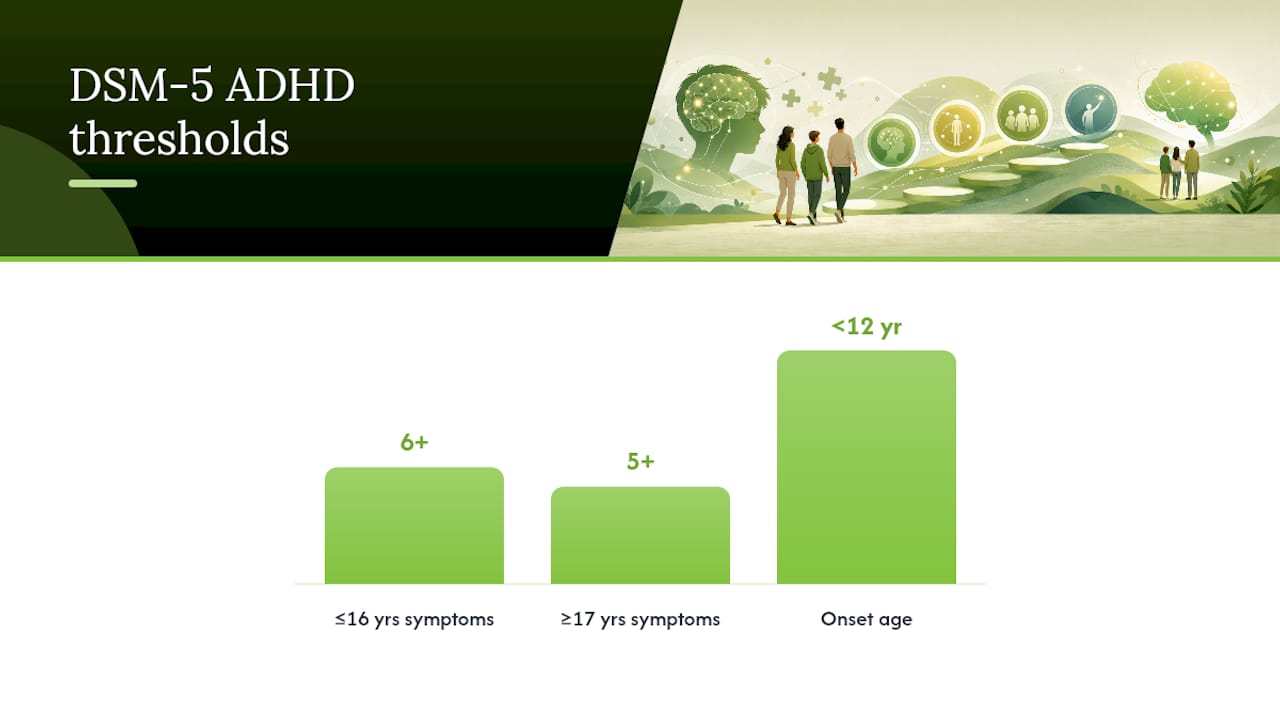
- Symptom count and threshold. Under DSM-5 criteria, adolescents up to age 16 need six or more symptoms of inattention or hyperactivity-impulsivity; at 17 and older, the threshold drops to five. Either way, symptoms must have caused impairment before age 12, even if no one used the word “ADHD” back then.
- Multi-informant reports. Clinicians typically gather input from parents, at least one teacher, and the teen directly, often using standardized tools like the Conners Rating Scale, the Vanderbilt Assessment Scale, or the ADHD-RS. Discrepancies between these reports are common and expected, not a sign something went wrong.
- A full clinical history. This covers developmental milestones, family history, school trajectory, and current stressors.
- Medical rule-outs. Vision and hearing screening, sleep history, thyroid function, and a substance-use conversation all belong in a thorough diagnostic workup, since several of these can mimic ADHD symptoms convincingly.
- Cognitive or learning screening, when the history suggests a learning disorder might be tangled up with the attention problems.
Clinical guidelines recommend evaluation for any adolescent showing academic or behavioral problems, and they call for documentation across more than one setting, not just a parent’s impression at home. Primary care providers can often complete straightforward cases. When the presentation is murky, comorbidities pile up, or first-line treatment doesn’t help, referral to a child and adolescent psychiatrist or developmental specialist is the more honest path.
Pro Tip: Ask relatives who knew your teen in early elementary school what they remember. Old report card comments like “easily distracted” or “struggles to finish work” can be the evidence that confirms symptom onset before age 12, even when you don’t remember the specifics yourself.
How to Prepare for Your Teen’s First Appointment
A little prep work before the first visit saves everyone time and gets you a more accurate answer faster.
- Gather report cards, prior evaluations, and any IEP or 504 documentation going back several years.
- Email one or two teachers directly, asking specifically about attention, task completion, and behavior compared to peers, and give them a two-week window to respond.
- Ask the clinic ahead of time which rating scales they use so you and your teen’s teachers can complete them before the appointment instead of scrambling that morning.
- Write down your own questions: What does the diagnostic process involve? What treatment options exist? What school accommodations might apply? What happens with confidentiality once your teen turns 16 or 18?
Bringing organized documentation to a psychiatric assessment tends to shorten the number of visits needed to reach a diagnosis.
How Long Does Diagnosis Take, and What Does It Cost?
The process usually moves through a few stages: an initial screening call, data collection from parents and teachers, a diagnostic visit, and a follow-up to review results and discuss next steps. Straightforward cases can wrap up in one or two visits. More complicated ones, especially where learning disorders or mood symptoms are tangled in, often need three or more.
Appointment length varies by stage:
- Screening calls: usually 15 to 20 minutes
- Standard diagnostic intakes: 45 to 90 minutes
- Extended evaluation sessions: several hours, when comprehensive testing is indicated
Comprehensive programs sometimes spread testing across multiple visits, combining a clinical interview, rating scales, cognitive screening, and neuropsychological testing when the picture calls for it. Cost depends heavily on which of those pieces are involved. A standard diagnostic evaluation covered by insurance runs far less out of pocket than a full neuropsychological battery, which is billed separately and can run into the thousands without coverage.
Statistic Callout: DSM-5 sets the symptom threshold at six or more for adolescents through age 16, dropping to five for those 17 and older, with onset required before age 12.
To avoid delays, call your insurer before the first visit to confirm coverage, ask the clinic exactly which forms they need in advance, and start the teacher-outreach email early since school staff don’t always respond quickly.
Conditions That Overlap With or Mimic ADHD
Attention problems rarely travel alone in teenagers. Anxiety, depression, learning disorders, substance use, and sleep disturbances all show up frequently alongside ADHD, and each one can also masquerade as it entirely.
- Anxiety can look like inattention when a teen is too preoccupied with worry to focus on schoolwork.
- Depression often produces slowed thinking and poor concentration that resembles attention deficit.
- Learning disorders create task avoidance that gets mistaken for lack of effort or focus.
- Substance use frequently disrupts attention, memory, and motivation in ways that overlap heavily with ADHD symptoms.
- Sleep problems, chronic short sleep especially, can produce daytime inattention nearly identical to ADHD.
Screening for these conditions matters because comorbidity is common, and it changes treatment order. If a teen is in the middle of a depressive episode, clinicians often stabilize mood first, since it’s difficult to accurately assess attention symptoms through the fog of major depression.
Is It ADHD or Typical Teenage Behavior?
Every teenager procrastinates. Every teenager forgets something important occasionally and loses a permission slip somewhere in a backpack. The distinction we look for is pattern, pervasiveness, and impairment, not the occasional lapse.
A teenager without ADHD might blow off one assignment because they didn’t feel like doing it. A teenager with ADHD often wants to complete the work, sits down intending to, and still can’t sustain the attention needed to finish it, across math class, soccer practice, and family dinner, week after week. The behavior shows up in multiple settings, not just the one where motivation happens to be low.
Normal developmental changes complicate this further. Adolescence naturally brings more independence, more risk taking, and more pushback against structure. A clinician’s job is separating that ordinary developmental noise from a genuine, longstanding pattern of inattention or impulsivity that predates the teenage years. This is exactly why the DSM-5’s “before age 12” rule matters so much. It anchors the diagnosis in a history that existed before puberty introduced its own turbulence, rather than letting typical teenage moodiness get mislabeled as a disorder.
Why Parent and Teen Reports Often Disagree
Parents and teens frequently describe the same kid differently on rating scales, and that’s not a red flag; it’s expected. Parents tend to notice organizational chaos, missed chores, and conflict at home. Teens often report their internal experience: racing thoughts, difficulty starting tasks, or feeling like their mind wanders even when they’re trying hard to pay attention.
Neither report is more “true” than the other. They’re measuring different vantage points on the same problem. A clinician weighs both, along with teacher input, rather than picking whichever account sounds more convincing. Teen self-report specifically matters because adolescents are the only ones who can describe what’s happening inside their own head during class, something no parent or teacher can observe directly.

Discrepancies can also point toward something else. A teen who reports few symptoms while parents report many might be minimizing, might function differently at school than at home, or might be dealing with a strained parent relationship that colors the parent’s perception. A skilled clinician treats these mismatches as data, not as a reason to dismiss one party’s account. If your teen’s self-report and your own observations don’t match up neatly, that’s worth mentioning directly rather than smoothing over.
Privacy, Consent, and Your Teen’s Rights During Evaluation
Confidentiality rules shift as teens get older, and this catches a lot of parents off guard. Younger teens generally have less independent privacy in treatment, with parents typically included in most discussions and decisions. As teens approach 16 to 18, many clinics start carving out portions of the visit for the teen alone, partly to build trust and partly because older adolescents often disclose more honestly without a parent in the room.
Specific consent and confidentiality rules vary by state and by clinic policy, particularly around substance use and mental health disclosures, so ask directly at intake how the practice handles this for your teen’s age. What we can tell you generally: most practices will loop parents in on diagnosis and treatment planning even when certain conversations happen privately with the teen. Ask upfront how the clinic handles confidentiality, what gets shared with you automatically, and what stays between the clinician and your teen unless safety is at risk. Getting this clarified before the first visit prevents an awkward surprise later.
Helping Your Teen Feel Ready for the Evaluation
Teens sometimes resist evaluation because they’ve absorbed the idea that “something’s wrong with them,” or they worry medication will change their personality. Address that head-on before the appointment rather than letting it fester in the waiting room.
Explain the evaluation as information gathering, not a verdict on their character. Something closer to: “We’re trying to understand how your brain works so school gets easier, not because you’re broken.” Let them know a diagnosis, if it comes, explains patterns they’ve probably already noticed and struggled with silently. It doesn’t create a new label for something that wasn’t already affecting them.
Give your teen some agency in the process. Ask what they want the clinician to know, and encourage them to answer questions honestly rather than performing what they think you want to hear. Their engagement genuinely shapes the accuracy of the outcome, since a teen who shuts down during the interview gives the clinician far less to work with. A few days before the appointment, walk through what to expect step by step so there are no surprises about forms, questions, or how long it will take.
Partnering With Your Teen’s Clinician for an Accurate Diagnosis
We’ve learned that the evaluations that go smoothly are the ones where the teen feels like a participant, not a subject. Parents sometimes arrive ready to do all the talking, and we gently redirect some of those questions to the teen directly. Their honesty during the interview shapes the accuracy of what we find.
Pro Tip: A short email to the teacher, asking two or three specific questions about attention and task completion, gets you far more useful information than a general request for “thoughts on my kid.”
— Felix
Getting an Evaluation Through Nortex Psychiatry
If you’ve read this far and recognize your teen in these patterns, the next step is booking an evaluation rather than continuing to wonder. Evaluations typically pull together parent input, teacher reports, and your teen’s own account into one coordinated assessment. Some practices offer both in-person visits and telehealth appointments for families who need scheduling flexibility.
A first appointment typically includes a full history, standardized rating scale review, and time to talk through what a diagnosis would mean for school accommodations and treatment. If ADHD is confirmed, we can move directly into medication management or coordinate with your teen’s school on next steps. Before booking, it’s worth reviewing what a comprehensive psychiatric evaluation actually includes, and calling our office to verify your insurance coverage or ask about self-pay rates so there are no surprises on evaluation day. Reach out to schedule your teen’s first appointment this week.
Sources
For deeper background beyond this article, the NIMH overview of ADHD, the CDC’s diagnosis guidance, and the AAP clinical practice guideline form the clinical basis most evaluations follow. Families exploring post-diagnosis support may also find this guide to online therapy for teens useful.
This article is general information, not a substitute for advice from a qualified doctor. Consult a qualified healthcare professional about your own circumstances before acting on anything here.
- Attention-Deficit/Hyperactivity Disorder: What You Need to Know
- CDC — Diagnosing ADHD
- Age-related clinical characteristics of children and adolescents with ADHD
FAQ
How Does a Teenager Get Tested for ADHD?
A teen gets tested through a multi-step evaluation that includes a clinical history, standardized rating scales completed by parents and teachers, a self-report from the teen, and a medical exam to rule out other causes. Some cases also involve cognitive or neuropsychological testing when the picture is unclear.
What Does ADHD Look Like in a 15 Year Old?
At 15, ADHD often looks less like physical hyperactivity and more like chronic disorganization, missed deadlines, trouble estimating how long tasks take, and inconsistent performance despite clear effort and ability.
What Is the 10-3 Rule for ADHD Kids?
The “10-3 rule” isn’t a recognized clinical or diagnostic standard, and definitions of it vary widely across parenting blogs. If you’ve encountered it as advice, treat it as an informal tip rather than a clinical guideline, and ask your evaluating clinician directly about structured routines that fit your teen’s specific needs.
What Are 5 Signs a Child May Have ADHD?
Common signs include frequent trouble finishing tasks, losing important items regularly, difficulty following multi-step instructions, excessive fidgeting or restlessness, and acting impulsively without considering consequences. A cluster of these across school and home settings, present since before age 12, is what points toward a formal evaluation.
Can a Regular Doctor Diagnose ADHD in Teens?
Yes, a primary care provider can diagnose straightforward cases of ADHD in adolescents. When symptoms overlap with other conditions or the picture stays unclear, referral to a child and adolescent psychiatrist or developmental specialist is usually the better route.