


Burnout and depression overlap, but they are distinct: burnout is an occupational phenomenon tied to work exhaustion and cynicism, while depression is a diagnosable, systemic mood disorder that affects multiple life domains. The clearest clue is scope: burnout tends to ease when you step away from work, while depression follows you everywhere. If you are having thoughts of suicide, please treat that as urgent and reach out for help right away.
TL;DR:
- Burnout is primarily caused by workplace stressors like understaffing or unclear expectations, while depression has multiple complex causes including genetics and trauma.
- Symptoms such as low mood and disinterest lasting over two weeks, or spread into home life, suggest depression and require clinical evaluation.
- Burnout symptoms tend to improve with work-related boundary changes, whereas depression often persists despite time off and may need medication or therapy.
- A moderate correlation exists between burnout and depression, so screening for both is essential if someone experiences significant or persistent symptoms.
- Immediate attention is required if thoughts of self-harm or significant functional decline occur, regardless of whether burnout or depression is suspected.
Table of Contents
- What burnout and depression actually mean
- Five key differences between depression and burnout
- Symptoms side by side: what you’ll notice day to day
- What drives each condition, and the role of job strain
- How depression is diagnosed and how burnout gets measured
- Treatment paths: clinical care for depression, workplace fixes for burnout
- Why burnout can mask depression
- What to do right now if you suspect either one
- How we approach patients who come in describing burnout
- How Nortex Psychiatry can help you sort this out
- FAQ
- Sources
What burnout and depression actually mean
We find that most of the confusion starts with language. People use “burnout” and “depression” as if they were interchangeable, but they come from different diagnostic worlds.
The World Health Organization defines burnout as an occupational phenomenon, not a medical condition. It has three dimensions:
- Energy depletion or exhaustion
- Increased mental distance from one’s job, or feelings of cynicism
- Reduced professional efficacy
Because burnout is not classified as a medical diagnosis under ICD-11, it does not come with the same diagnostic checklist, billing code, or treatment protocol that depression does. That matters practically: if your primary complaint gets filed only as “burnout,” it can be harder to access structured mental health treatment.
Major depressive disorder is different. According to NIMH, clinical depression requires symptoms present most of the day, nearly every day, for at least two weeks, alongside a sufficient number of other symptoms like sleep changes, appetite shifts, or loss of interest. It is a diagnosable illness that reaches into every part of life, not just the parts tied to your job.
Five key differences between depression and burnout
When patients ask us to help sort out which one fits, we usually walk through the same five questions.
- Scope: Does the struggle stay contained to work, or has it spread into your home life, relationships, and sense of self?
- Core feeling: Is it exhaustion and cynicism about your job, or a persistent low mood and loss of pleasure in things you used to enjoy?
- Duration and pattern: Has it lasted two weeks or more with most-of-the-day symptoms, which meets the threshold NIMH uses for major depressive disorder, or does it ease up on weekends and vacations?
- Functional impact: Are you still able to enjoy time with family and friends, or has that capacity faded too?
- Urgency: Are there thoughts of self-harm, hopelessness, or worthlessness? These always warrant immediate clinical attention regardless of which label fits.
A moderate but real overlap exists between the two conditions: a systematic review and meta-analysis found a correlation of about r = 0.52 between burnout and depression, meaning the two are related but not the same thing. We mention this not to confuse you further, but because it is the reason we never assume burnout and stop there.
Symptoms side by side: what you’ll notice day to day
Some symptoms show up in both conditions, which is exactly why self-diagnosis gets tricky. Fatigue, trouble concentrating, and a dulled interest in things can show up whether you are burned out or depressed.
What tends to favor depression:
- A persistently empty or low mood that does not lift with rest
- Changes in sleep or appetite that go beyond “I’m tired from work”
- Thoughts of worthlessness, guilt, or suicide
What tends to favor burnout:
- Cynicism or detachment specifically about your job or coworkers
- A felt drop in your effectiveness at work, paired with dread about going in
- Noticeable improvement after a real break, a weekend, or a vacation
We often hear two versions of the same week. One patient describes dragging herself through Monday meetings, feeling disconnected from colleagues she used to like, and then genuinely enjoying her daughter’s soccer game that weekend. That pattern points toward burnout. Another patient tells us the soccer game didn’t register either, that nothing has felt like anything in weeks, and that getting out of bed is its own project regardless of whether it’s a workday. That pattern points toward depression. One finding worth sitting with: burnout and depression correlate at r ≈ 0.52, a moderate relationship that tells us the two frequently travel together without being identical.
What drives each condition, and the role of job strain
Depression usually has more than one cause layered together. Genetics, past trauma, chronic illness, major life changes, and brain chemistry all play a part, often in combination rather than alone.
Work stress has a documented relationship to depression risk, though the size of that relationship depends on how it’s measured. A systematic review and meta-analysis with individual participant data found that job strain was associated with an increased risk of clinical depression, with published studies showing a relative risk around 1.77 and pooled individual-level data showing a more modest relative risk around 1.27.
We want to be honest about the limits here:
- The relationship likely runs in both directions: stressful jobs can contribute to depression, and depression can make work feel more strained
- Self-reported stress measures can inflate how strong the association looks
- No single study proves that a specific job caused a specific depression
Burnout’s causes are more narrowly occupational: chronic understaffing, unclear expectations, lack of control, and misaligned values between you and your workplace tend to top the list.
How depression is diagnosed and how burnout gets measured
A depression diagnosis follows a structured path. Clinicians use the duration and symptom-count criteria NIMH describes: most-of-the-day symptoms for two weeks or more, plus enough additional symptoms (sleep, appetite, concentration, energy, guilt, suicidal thoughts) to clear the threshold.
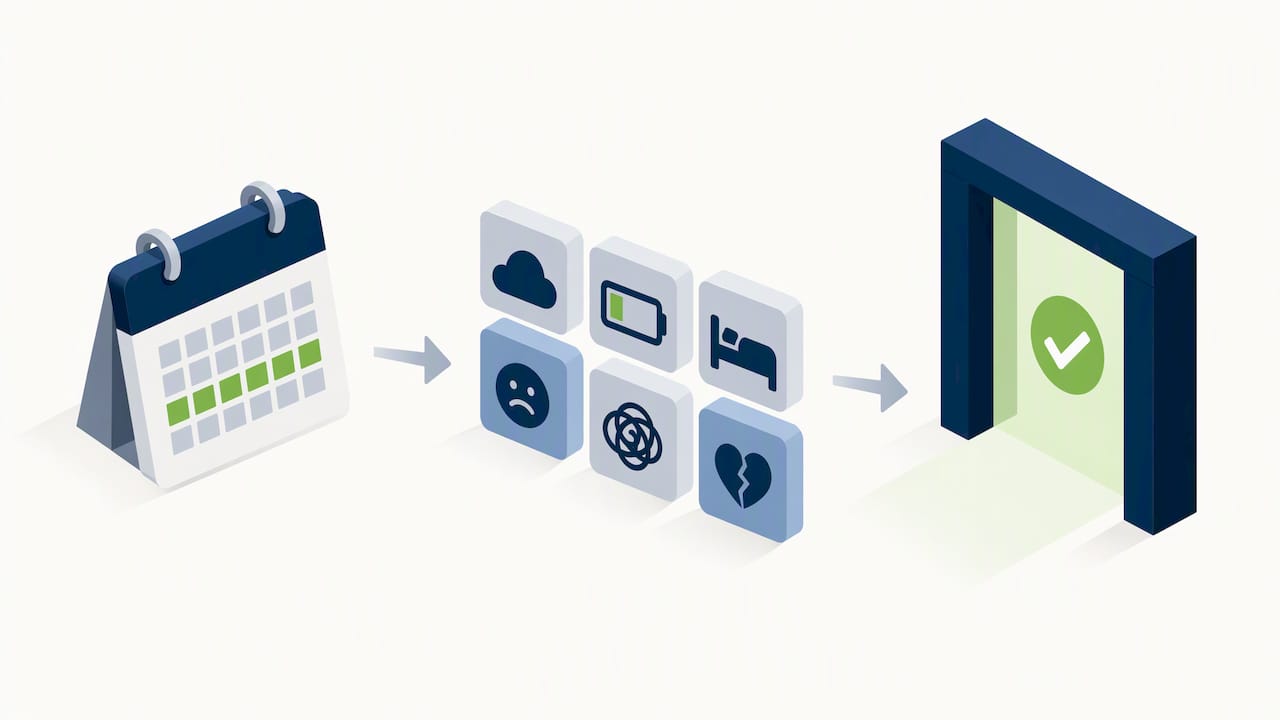
Burnout has no equivalent clinical diagnostic checklist. The most common measurement tool is the Maslach Burnout Inventory, which scores exhaustion, cynicism, and reduced professional efficacy. It’s useful for research and workplace screening, but it was never built to rule depression in or out, and its scores can look similar in people who are actually depressed.
Red flags that move any evaluation into urgent territory:
- Suicidal thoughts or a sense that life isn’t worth continuing
- Functioning that has dropped sharply at home, not just at work
- Symptoms that have lasted weeks without any real break
Pro Tip: Bring a two-week log of your mood, sleep, and energy to your first appointment. It gives your clinician something concrete to work from instead of a single snapshot.
Treatment paths: clinical care for depression, workplace fixes for burnout
Standard depression treatment usually starts with psychotherapy, an antidepressant, or both. When those don’t bring enough relief, NIMH notes that FDA-approved esketamine and brain stimulation therapies like TMS are supported options for treatment-resistant cases, always under clinical supervision and with realistic expectations about response rates. If you’re weighing TMS against medication or comparing TMS to ketamine therapy, those are conversations worth having with a psychiatrist rather than deciding alone.
Burnout responds better to workplace-level and boundary-level changes:
- Reducing workload or renegotiating role expectations with a supervisor
- Structured time off, not just a long weekend
- Clinician-led workplace stress management programs that address the environment, not just the individual
- Rebuilding boundaries around email, on-call hours, and weekends
| Signal | Likely path |
|---|---|
| Symptoms ease with rest, stay work-focused | Workplace change, boundary setting |
| Symptoms persist past 2 weeks, spread beyond work | Clinical evaluation for depression |
| Any suicidal ideation present | Immediate professional care |
Rest alone is not enough once symptoms meet the depression threshold or suicidal thoughts appear. That’s the line where self-care steps aside for clinical treatment.
Why burnout can mask depression
We’ve seen patients carry a “burnout” label for months while an underlying depression went untreated. The moderate correlation between the two constructs, around r = 0.52, tells us they overlap often enough that one can hide inside the other.
What tends to happen in practice:
- A patient and their workplace agree burnout fits, so nobody screens for depression
- Time off helps briefly, but the low mood returns once work resumes
- By the time depression is recognized, it has often deepened
We address this by screening for depression and suicidality regardless of which word the patient walks in with. The label matters less than the actual symptoms underneath it.
What to do right now if you suspect either one
- Start a simple daily log: mood, sleep hours, and energy level, for at least two weeks.
- Ask yourself directly whether you’ve had thoughts of self-harm or that life isn’t worth living. If yes, contact a crisis line or emergency services now.
- Book an appointment with a primary care provider or psychiatrist, and bring your log, current medications, and a brief history of what’s changed recently.
- In the meantime, protect sleep, keep some physical activity, and set one firm boundary at work, even a small one.
Pro Tip: Nortex Psychiatry’s self-assessment tool can help you organize your symptoms before that first visit.
How we approach patients who come in describing burnout
When someone tells us they’re burned out, we don’t take the label at face value. We walk through the timeline together, screen for depression and suicidal thoughts, and ask about specific workplace stressors before building a plan.
A common misperception we address early: burnout and depression aren’t a spectrum where one simply becomes the other at some severity cutoff. They’re related but separate questions, and we’d rather ask both than assume either.
— Felix
How Nortex Psychiatry can help you sort this out
We offer psychiatric evaluation and medication management for depression, along with interventional options like TMS, ketamine therapy, and Spravato when standard treatments haven’t been enough. Appointments are available in person across North Dallas or by telehealth, whichever fits your schedule better. If you’re unsure which label fits your experience, book an evaluation and we’ll work through it with you.
This article is general information, not a substitute for advice from a qualified doctor. Consult a qualified healthcare professional about your own circumstances before acting on anything here.
FAQ
Am I burnt out or am I depressed?
The clearest signal is scope: burnout tends to stay tied to work and ease with rest, while depression spreads into home life, relationships, and things you used to enjoy. If low mood or loss of interest lasts two weeks or more most of the day, that crosses into the clinical depression threshold, and an evaluation is worth scheduling.
What is the 42% rule for burnout?
There is no established clinical percentage rule for burnout in the WHO definition or the research literature we rely on. Be cautious of figures like this circulating online without a named source, since the WHO’s actual framework describes three dimensions (exhaustion, cynicism, reduced efficacy) rather than a percentage threshold.
What are the 7 signs of burnout?
Commonly cited signs cluster around WHO’s three core dimensions: exhaustion, cynicism or mental distance from work, and reduced professional efficacy, often showing up as fatigue, irritability, dread about work, trouble concentrating, and detachment from colleagues. These symptoms are occupational in focus, which is part of what separates burnout from a mood disorder like depression.
How to get out of a depression funk?
If symptoms have lasted two weeks or more and touch most of your day, that’s not a funk to push through alone, it meets the clinical threshold for depression and deserves a proper evaluation. Standard first steps include psychotherapy and antidepressant medication, with options like TMS or esketamine available for cases that don’t respond to initial treatment.
Sources
- Depression – National Institute of Mental Health (NIMH)
- Burn‑out an occupational phenomenon — WHO
- Job strain as a risk factor for clinical depression: systematic review and meta-analysis with additional individual participant data
- The relationship between burnout, depression, and anxiety: a systematic review and meta-analysis