


A mood disorder evaluation is a structured conversation with a clinician, usually a psychiatrist, about your symptoms, your history and your daily life, followed by a diagnosis and a plan if one is warranted. It is not a quiz you pass or fail, and it is not a blood test. Most of the work is careful listening, and most of the value comes from the story you bring in. Below we explain what we look at, how a visit tends to go, and how to get ready for it.
TL;DR
- A mood disorder evaluation is a diagnostic interview. It looks at your symptoms, your history over time, your medical health and your medications.
- A positive result on a screener such as the MDQ does not diagnose anything. It only suggests a fuller conversation is worth having.
- No blood test, scan or genetic test can confirm or rule out bipolar disorder, so the clinician’s assessment carries the weight.
- Preparing a rough timeline, a medication list and a few notes from someone who knows you makes the visit far more useful.
- If you are thinking about hurting yourself, call or text 988 now. Do not wait for an appointment.
Table of Contents
- What a mood disorder evaluation actually assesses
- When it makes sense to ask for an evaluation
- What happens during the visit
- Screening tools are not the evaluation
- How clinicians tell one condition from another
- How to prepare
- What happens afterward
- Perspective: what we have learned from sitting with these evaluations
- Evaluation and care at Nortex Psychiatry
- When symptoms are urgent
- FAQ
- Sources
What a mood disorder evaluation actually assesses
Mood disorders are a group of conditions where mood, energy and thinking shift in ways that interfere with life. Depression is the one most people know. Bipolar disorder, with its swings between highs and lows, is the one most often missed or mislabeled. An evaluation tries to work out which pattern you have, how severe it is, and what else might be contributing.
In our work, we look at a few things at once:
- Current symptoms. Low mood, loss of interest, sleep changes, appetite changes, energy, concentration, irritability, racing thoughts.
- The course over your lifetime. When it started, how often it comes and goes, how long episodes last, and whether there were stretches of unusually high energy.
- Function. How work, school, parenting and relationships are holding up.
- Safety. Whether you have had thoughts of harming yourself, and what protects you.
- Medical and substance factors. Thyroid problems, medication effects, alcohol, cannabis and other things that can imitate or amplify mood symptoms.
The National Institute of Mental Health describes the two poles in plain terms. Mania can look like intense happiness or irritability, rapid talking, racing thoughts and reckless behavior, while depression can bring sadness or hopelessness, low energy, and eating or sleeping too much or too little. Those lists are a starting point. Real people rarely match a list neatly, which is why the interview matters.
When it makes sense to ask for an evaluation
There is no minimum level of suffering required. Still, some situations come up again and again in our office:
- Low mood or anxiety that has lasted weeks and is not lifting on its own.
- Mood that swings in ways you or the people around you notice, with days of very little sleep and a lot of energy.
- An antidepressant that did not help, or that made you feel wired, agitated or worse.
- Symptoms that began after a major change, such as a loss, a move, a new baby or a medical problem.
- A teenager or young adult whose behavior or mood has changed noticeably, and whose parents are not sure whether it is a phase.
- A family history of bipolar disorder or severe depression, combined with symptoms of your own.
Pregnancy and the months after delivery deserve a separate mention. The American Psychiatric Association’s 2025 position statement says perinatal patients should receive mental health screening and assessment, and it notes that untreated postpartum mood disorders are associated with developmental problems in children. The same document estimates that roughly 1 in 7 to 10 pregnant people and 1 in 5 to 8 postpartum people in the United States develop a depressive or anxiety disorder. If that sounds like you, you are not unusual, and asking for help is the right move. We have written separately about TMS for postpartum depression and about ketamine for postpartum depression for readers who want to know what options exist later on.
What happens during the visit
People often expect something clinical and cold. It is closer to a long, careful conversation. Most first evaluations run longer than a typical medical appointment, because rushing it is how diagnoses get missed.
Expect questions along these lines:
- What brought you in? In your own words, and what you hope will change.
- Your symptom history. When you first noticed things, what the worst stretches looked like, and whether there were periods of feeling unusually good, fast or invincible.
- Sleep, energy, appetite, concentration. Often the clearest clues are in sleep. Needing much less sleep and not feeling tired points in a very different direction than sleeping all day.
- Past treatment. Which medications you have tried, at what doses, for how long, and what happened.
- Medical history. Thyroid, neurological conditions, head injuries, hormonal changes, and everything you currently take, including supplements.
- Substance use. Alcohol, nicotine, cannabis, stimulants. We ask without judgment, because we need the real picture.
- Family history. Mood disorders, suicide, substance problems or hospitalizations among relatives.
- Safety. Direct questions about self-harm. These can feel blunt. They are routine, and we ask everyone.
For bipolar disorder in particular, the VA/DoD clinical practice guideline recommends a comprehensive evaluation that includes psychiatric and medical history, medication reconciliation and basic laboratory tests such as thyroid function, a metabolic panel and drug screening. That matches how we think about it. Labs do not diagnose a mood disorder. They help us rule out something else that is producing the same symptoms.
For a closer walk through the process, our page on the bipolar diagnosis process goes step by step.
Screening tools are not the evaluation
If you searched this topic, you may have run into the Mood Disorder Questionnaire (MDQ) or the Rapid Mood Screener. These are short self-report forms that ask about past highs, such as stretches of unusual energy, irritability, or decreased need for sleep. They are useful for one thing: noticing that a conversation about bipolar disorder may be worth having.
They cannot do more than that, and the guidelines are blunt about it. The VA/DoD guideline recommended against routine screening for bipolar disorder in general medical populations because of high false-positive rates and limited sensitivity of the instruments. Its authors warn that false positives can lead to inappropriate referrals or inaccurate charting.
The American Psychiatric Association answers the practical question directly: a positive screen does not diagnose bipolar disorder, and many people with positive screens do not have it. The same is true for depression. The U.S. Preventive Services Task Force states that positive screening results must be followed by diagnostic interviews using standard criteria.
So what should you do with a result?
- Positive screen: Treat it as a reason to book an evaluation, not as a label. Trauma, anxiety, ADHD and personality patterns can all produce a positive score.
- Negative screen: Do not treat it as a clean bill of health if you still feel something is off. A questionnaire only captures what it asks.
- Either way: Bring the printout. It gives us a starting point and shows what you noticed.
How clinicians tell one condition from another
This is where an experienced evaluator earns their time. Depression, bipolar disorder, anxiety, ADHD and trauma overlap more than most people expect. Restlessness, poor sleep, trouble concentrating and irritability show up in nearly all of them.
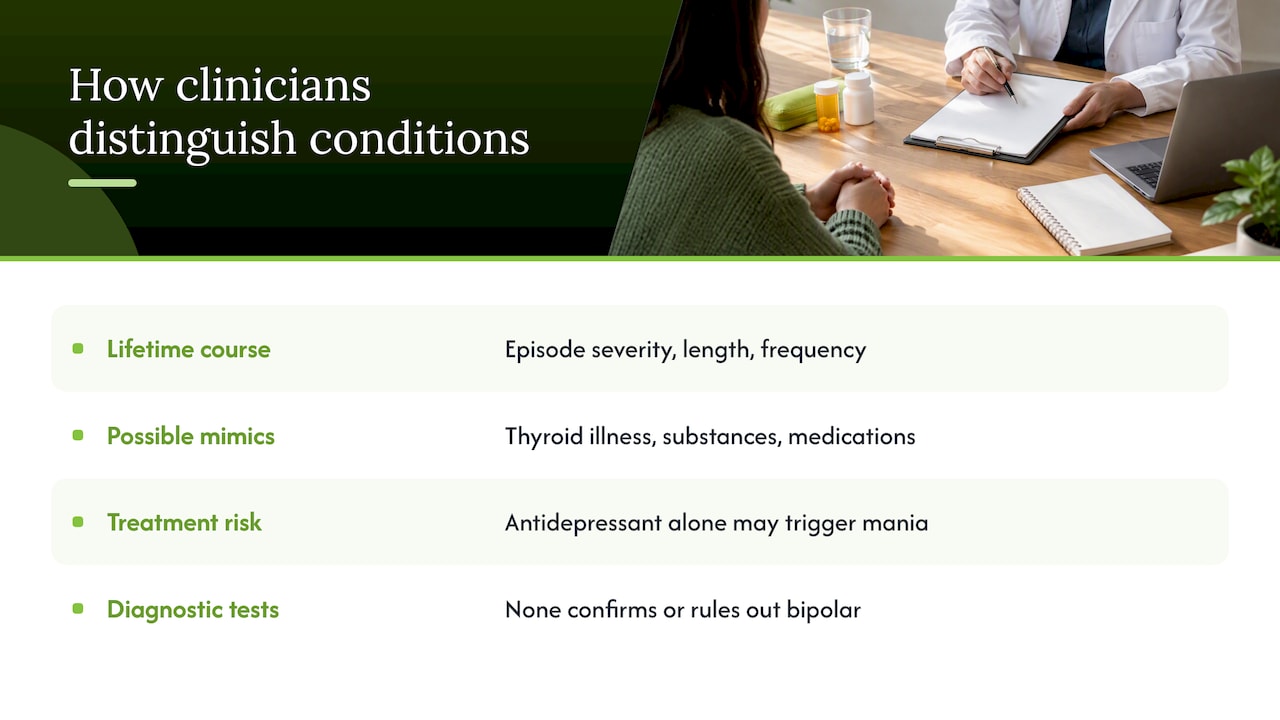
The NIMH explains that clinicians separate bipolar disorder from other conditions by looking at the longitudinal course of symptoms over a lifetime, including the severity, length and frequency of manic and depressive episodes, rather than current symptoms alone. They also check for illnesses such as thyroid disease and consider whether substances or other medications could be mimicking mood symptoms.
This is why we ask so many questions about the past, and why a single snapshot of how you feel today is never enough. A person who comes in depressed may have had a week at age 22 of hardly sleeping and feeling brilliant, and not think to mention it because it felt good.
The stakes are practical. The same NIMH publication notes that treating depression with an antidepressant and no mood stabilizer can trigger mania or rapid cycling in someone who actually has bipolar disorder. Getting the diagnosis right shapes everything that follows.
If you want to go deeper on the differences, we have written about bipolar versus depression, the details patients can bring to show depression versus bipolar, Bipolar I versus II and cyclothymia versus bipolar disorder.
There is also no shortcut test. The APA says that no blood work, genetic test or brain imaging can currently confirm or rule out bipolar disorder in clinical settings, and that diagnosis relies on professional assessment. Anyone offering a single test that settles it deserves some skepticism.
How to prepare
You do not need to arrive with perfect answers. Most people who come in say they feel disorganized, and that is fine. A little preparation still changes the quality of the visit.
Write a rough timeline. Not a diary. Just the main chapters: when you first felt different, when it was worst, any stretch of unusually high energy, and any big life events nearby. Dates can be approximate.
List every medication and supplement. Include doses, how long you took each, and what happened. Past antidepressants matter a great deal. If you cannot remember names, a pharmacy printout helps.
Note your sleep. A week of honest tracking before the visit tells us more than most questionnaires.
Ask someone close to you. A spouse, parent or friend often sees the highs more clearly than you do. If they can come, or send a few lines, bring that. Parents of teens and young adults are especially welcome to share what they have seen.
Bring family history. Even vague facts help: an uncle who was hospitalized, a grandparent who never seemed to sleep.
Write down your questions. Nerves empty the head. Put two or three on paper.
Be candid about substances. Alcohol and cannabis change the picture. We would rather know than guess.
Some people encounter a version of this assessment for another reason, such as clearance before a surgery. A mental health clearance assessment draws on the same ingredients: symptoms, personal history and clinical judgment. A full psychiatric evaluation for a mood concern goes further, because the aim is diagnosis and a treatment plan rather than a yes or no.
What happens afterward
By the end of a good evaluation, you should leave with a clear sense of what we think is going on, what we are unsure about, and what the next step is. Sometimes the answer is a diagnosis and a medication plan. Sometimes it is more observation, because the picture is not yet clear. We are comfortable saying so. A tentative diagnosis held honestly is better than a confident one that turns out wrong.
Typical next steps include:
- Lab work to rule out medical contributors.
- A medication plan, with a specific schedule for follow-up. Early check-ins matter, and our page on check-ins during bipolar depression treatment explains how we think about them.
- Referral for psychotherapy alongside medication.
- For depression that has not responded to medications, a conversation about interventional options.
- A review of the overall approach, which our mood disorder treatment guide lays out.
Recovery tends to be a journey, not a straight line. Early weeks can bring partial improvement, side effects to adjust around, and days that feel like a step back. That is normal, and it is the reason follow-up matters as much as the first visit.
Perspective: what we have learned from sitting with these evaluations
We have learned to slow down. The most common mistake we see in patients’ histories is not a missing test but a missing question, usually about the past. Someone has been treated for depression for years, and nobody asked about the week they barely slept and felt unstoppable. When we ask, the answer often comes with some surprise, and sometimes relief.
We often notice that people arrive apologizing. They worry they are exaggerating, or that they should be able to manage on their own. We tell them what we believe: a mood problem is a health problem, and describing it accurately is the job, not a weakness.
We are also wary of certainty on a first visit. Screening forms tempt everyone toward a quick answer, patients and clinicians alike. In our experience the better route is to take the history seriously, check for medical causes, treat what is clear, and revisit the diagnosis as we learn more. Sometimes the diagnosis changes. That is not failure. It is the work.
And we do not think of treatment as a single track. Many patients do well with medication management and therapy. Some have tried several medications without relief, and for them we can talk about options like TMS, ketamine or Spravato. We only reach those conversations after we are confident about what we are treating.
— Felix
Evaluation and care at Nortex Psychiatry
Our practice is in Allen, Texas, and we see adults and families from Frisco, McKinney, Plano and across North Dallas, in person or by telehealth. If you are weighing an evaluation, we can start with a conversation about your symptoms and history and work from there. Call us or reach out through our website to schedule, and ask about insurance when you do so we can tell you what to expect.
If an evaluation shows that standard medications have not been enough, we also offer Transcranial Magnetic Stimulation, ketamine therapy and Spravato. Whether any of these fits you depends on your diagnosis and history, which is exactly what the evaluation clarifies.
When symptoms are urgent
Some situations should not wait for an appointment. If you or someone you know is in immediate distress or thinking about self-harm, call or text 988, the Suicide and Crisis Lifeline. In a life-threatening situation, call 911. The same applies if someone has not slept for days, is acting in ways that put them in danger, or seems out of touch with reality. Go to an emergency room or call for help first, and arrange an evaluation after.
FAQ
How long does a mood disorder evaluation take?
Most first evaluations take longer than a standard medical visit, because the history is the main tool. Plan for a long conversation rather than a quick check. Follow-up visits are usually shorter and focus on how treatment is going.
Can I get a mood disorder evaluation by telehealth?
Yes, for many people the interview itself works well by video. At Nortex Psychiatry we offer both in-person and telehealth visits. Some situations, such as needing lab work, still involve a trip to a lab, and we will tell you what applies to you.
Does a high score on the MDQ mean I have bipolar disorder?
No. Screening tools flag the need for a fuller interview, and many people with positive screens do not have the disorder. Trauma, anxiety and ADHD can also raise scores. Bring the result to an evaluation and let the clinician put it in context.
Will I need blood work or a brain scan?
Not to diagnose a mood disorder, since no such test confirms it. Basic labs, such as thyroid function, are often used to rule out medical causes, as the VA/DoD guideline describes for suspected bipolar disorder. We decide on a case-by-case basis.
Should I stop my medication before the evaluation?
No. Keep taking prescribed medication unless the prescriber tells you otherwise, and bring the full list to the visit. Stopping suddenly can cause withdrawal or a relapse and makes the picture harder to read.
Sources
- NIMH: Bipolar Disorder in Teens and Young Adults, Know the Signs
- NIMH: Bipolar Disorder
- American Psychiatric Association: Position Statement on Screening and Treatment of Mood and Anxiety Disorders in Pregnancy and Postpartum
- American Psychiatric Association: Expert Q&A on Bipolar Disorder
- VA/DoD Clinical Practice Guideline for Management of Bipolar Disorder
- U.S. Preventive Services Task Force: Screening for Depression, Recommendations and Rationale