


Beta blockers can calm the physical side of anxiety: the pounding heart, the shaky hands, the sweaty palms. They don’t treat the worry itself. Propranolol is the one most often used, usually off-label and usually for situations like public speaking or a performance. If your anxiety is constant rather than situational, a beta blocker is rarely the whole answer.
We hear this question a lot, often from people who have read about a celebrity or a coworker taking “a little pill” before a presentation. Here is what we have learned from prescribing and from the research, laid out the way we’d explain it across the desk.
TL;DR
- Beta blockers such as propranolol slow the heart and blunt adrenaline’s physical effects. They are not FDA-approved for anxiety, so this use is off-label.
- They tend to fit short, predictable situations (a talk, an audition), not daily, all-day anxiety.
- Propranolol usually starts working within a few hours. Common side effects are dizziness, tiredness, cold hands or feet and sleep trouble.
- Asthma, a slow heartbeat, heart failure and diabetes all change the picture. Tell your prescriber before you start.
- If anxiety follows you through the week, there are better-studied treatments worth discussing.
Table of Contents
- Do beta blockers help anxiety?
- Which symptoms they can and can’t relieve
- How propranolol is used for anxiety
- How quickly propranolol works
- Side effects to expect
- Who should be careful or avoid it
- Beta blockers compared with treatment for ongoing anxiety
- When a beta blocker is a reasonable thing to ask about
- Our perspective
- Talking to a psychiatrist in North Dallas
- FAQ
- Sources
Do beta blockers help anxiety?
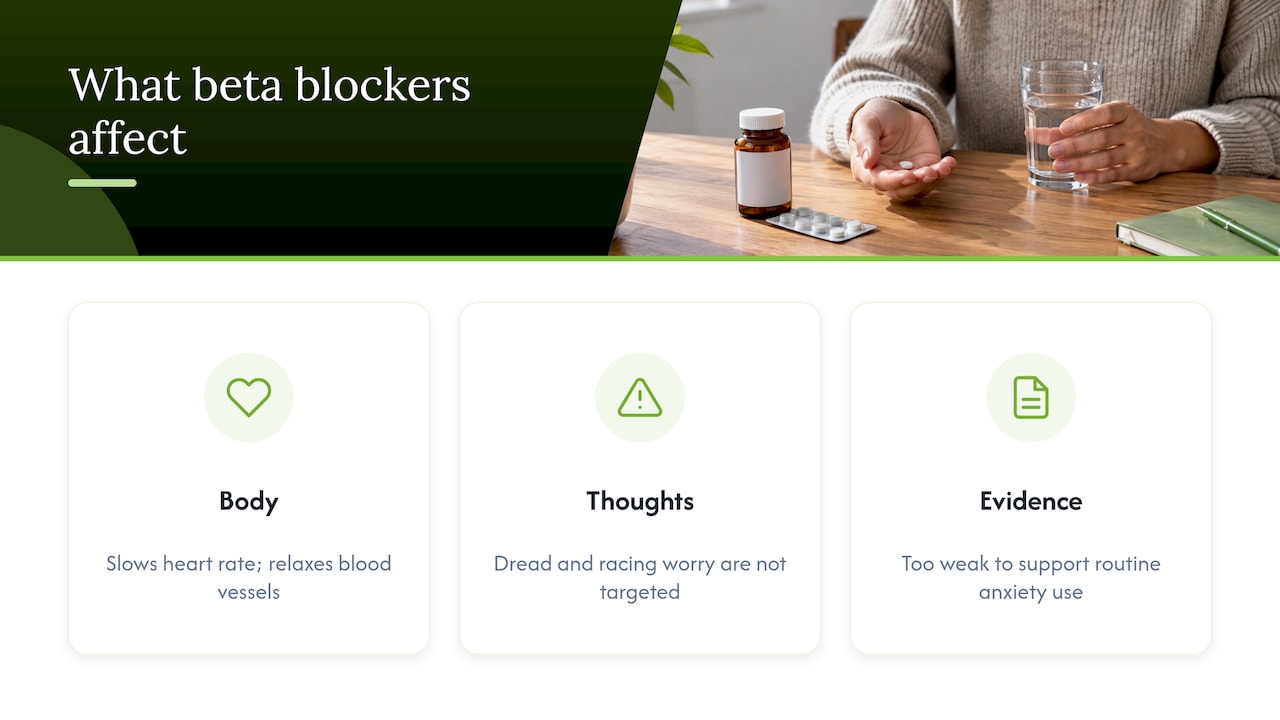
Sometimes, and in a specific way. Anxiety has two layers. One is thought: the dread, the racing worry, the “what if.” The other is body: heart rate, tremor, flushing, a tight throat. Beta blockers act on the second layer.
MedlinePlus describes propranolol as a beta blocker that relaxes blood vessels and slows the heart rate, which is how it lowers blood pressure. When adrenaline surges, those same pathways drive the fast pulse and trembling people notice. Take the edge off the body, and for some people the mind settles a little too, because they stop reading their own racing heart as proof that something is wrong.
That last part is our clinical observation, not a guarantee. The research is more cautious. A systematic review of propranolol for anxiety disorders concluded that the evidence is not strong enough to support routine use for any anxiety disorder. The Washington Poison Center makes a similar point: propranolol addresses the resulting physical symptoms, not the underlying anxiety disorder, and data supporting its use are limited.
So the honest answer is this. A beta blocker can help you get through a moment. It doesn’t change why the moment feels so threatening.
Which symptoms they can and can’t relieve
In our experience people respond best when their worst symptoms are physical and tied to an event.
Usually in range:
- A pounding or fluttering heartbeat
- Trembling hands or a shaky voice
- Sweating and flushing
Usually out of range:
- Racing, repetitive worry
- Avoidance and dread building for days
- Panic that arrives without warning
- Low mood, which sits alongside anxiety more often than people expect
That last point matters. The Washington Poison Center notes propranolol may worsen depressive symptoms. If you’ve been feeling flat or hopeless as well as anxious, say so early. It changes what we’d recommend.
If the physical symptoms are the ones that scare you most, it also helps to have something to do with your body in the moment. Slow breathing isn’t a replacement for medication, but how deep breathing calms anxiety is worth understanding, because it works on the same heart-rate loop from the other direction. We often suggest practicing it on ordinary days, so it’s familiar when you need it.
How propranolol is used for anxiety
Propranolol is the beta blocker you’ll hear about most. Doctors prescribe it for high blood pressure, heart rhythm problems, migraine prevention and tremor. Anxiety is an off-label use, meaning the FDA hasn’t approved the drug for that purpose, though prescribers use it that way regularly.
Two patterns show up in practice:
- As needed. A single dose taken before a specific event, such as a speech, a recital or a high-stakes meeting.
- On a schedule. Less common for anxiety, and in our view usually a sign that we should be looking at the larger picture.
We always recommend a trial dose on a quiet day, not on the morning of the big event. You want to know how your body reacts before it matters. Dosing is individual and your prescriber sets it, so we won’t give numbers here.
How quickly propranolol works
The NHS says propranolol usually starts to work within a few hours. The FDA label gives the pharmacology behind that: peak blood levels arrive roughly 1 to 4 hours after an oral dose, and the elimination half-life is about 3 to 6 hours.
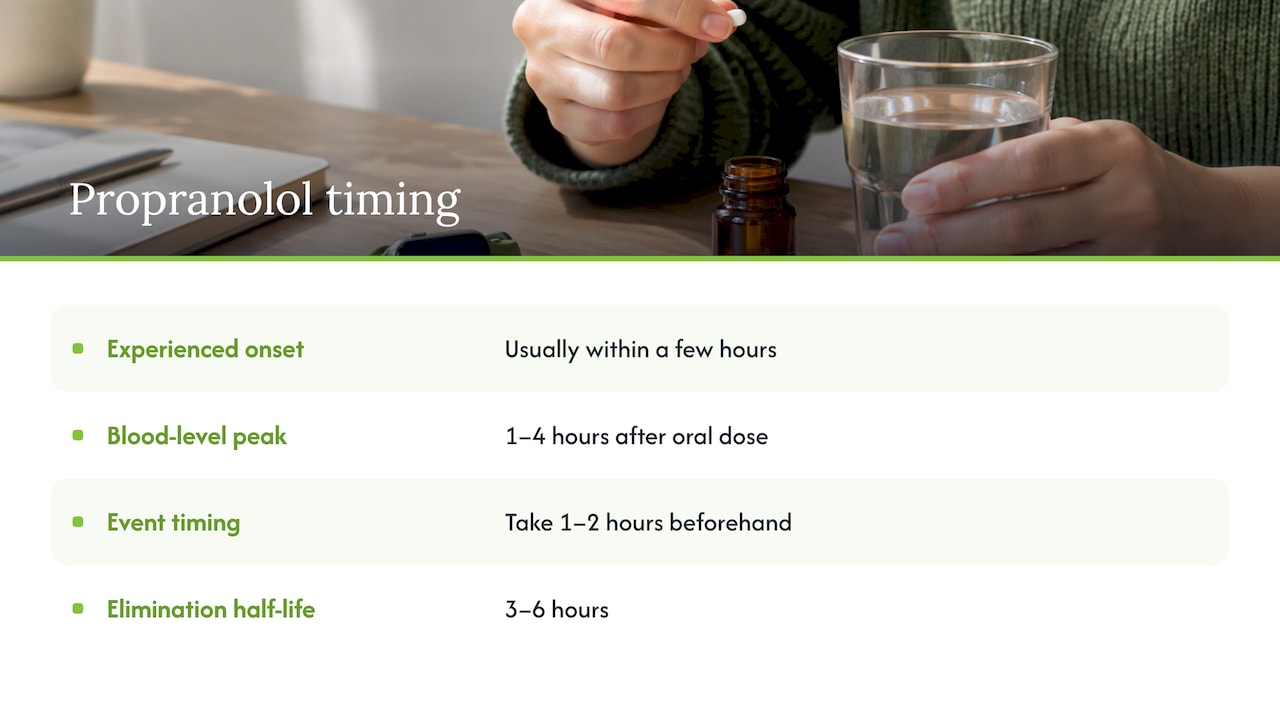
In practical terms, people who use it for an event often take it somewhere between one and two hours beforehand, then see how they feel. The effect fades over the rest of the day. Your prescriber can tell you the timing that suits your situation. Don’t improvise, particularly if you take other medicines.
Note what “working” means here. Your heart may slow and your hands may steady. You’ll still be you, with the same nerves. Some people find that surprising.
Side effects to expect
Most people tolerate propranolol well. The NHS lists the main side effects as dizziness, tiredness, cold hands or feet, difficulty sleeping and nightmares, and says they are usually mild and don’t last long. It also notes the first dose can make you dizzy, so some people take it at bedtime.
MedlinePlus adds lightheadedness, diarrhea and constipation to the list. It also names effects that need prompt attention: feeling faint, shortness of breath, an irregular heartbeat and signs of an allergic reaction. If you notice any of those, contact your prescriber or seek urgent care.
Can a beta blocker make anxiety feel worse?
We get this question more than you’d think. Beta blockers aren’t known as an anxiety-causing drug, but some of their side effects, like lightheadedness, fatigue and poor sleep, can feel uncomfortably close to anxiety. When your body feels off, it’s easy to read that as the worry coming back. If that happens, don’t push through. Tell us, and we’ll sort out which is which.
Long-term use
The NHS says that when propranolol is taken for anxiety, there don’t seem to be lasting harmful effects from taking it for several months or years, and it recommends taking it only for as long as you need it. Please don’t stop a daily dose suddenly without talking to your prescriber, especially if you were also prescribed it for a heart condition.
Who should be careful or avoid it
This is where a proper conversation with a prescriber earns its keep. MedlinePlus advises telling your clinician if you have a slow or irregular heartbeat, heart failure, or asthma or another lung disease, because propranolol may not be suitable. It also warns that propranolol can hide the warning signs of low blood sugar, which matters if you have diabetes.
A few other points we go over with patients:
- Other medicines. MedlinePlus lists aluminum-containing antacids, cimetidine, ibuprofen and naproxen as possible interactions. The FDA label explains that propranolol is processed by liver enzymes including CYP2D6 and CYP1A2, and drugs that inhibit those enzymes can raise its levels. Several common psychiatric medicines are in that category, so bring your full list, including supplements.
- Pregnancy and nursing. The label states propranolol passes into breast milk. If you’re pregnant, nursing or planning to be, see our guide to anxiety medication in pregnancy.
- Teens. Parents ask about this often, and the decision deserves its own conversation. Our page on anxiety medication for teens covers what to ask.
- Overdose. The Washington Poison Center stresses overdose risk. Store it safely, and never share a prescription, however harmless it seems. If you suspect an overdose, call Poison Control at 1-800-222-1222 or 911.
Beta blockers compared with treatment for ongoing anxiety
If your anxiety is a pattern rather than an event, the question changes from “what calms my body for an hour?” to “what helps me live with less of this?”
| Beta blocker (propranolol) | Treatment aimed at the disorder | |
|---|---|---|
| Targets | Physical symptoms | Both thoughts and body |
| Typical use | Before a specific event | Ongoing, with follow-up |
| Onset | Usually within hours | Often weeks for daily medicines or therapy |
| FDA-approved for anxiety | No (off-label) | Several options are |
| Best fit | Stage fright, public speaking | Generalized anxiety, panic, persistent worry |
The review we cited earlier found no statistically significant difference from benzodiazepines in short-term panic disorder outcomes, but it also judged the evidence too weak to recommend propranolol routinely. We read that as: don’t expect it to carry a diagnosis by itself.
Treatment for ongoing anxiety is usually a combination, chosen to fit you. That can include daily medication, therapy, sleep and lifestyle changes. Our overview of anxiety medication options and personalization and the step-by-step anxiety treatment guide walk through how those pieces fit. If your episodes come out of nowhere and peak within minutes, read what actually works for panic attacks. And if you’re not sure whether what you have is panic or generalized anxiety, this explanation of the DSM thresholds can help you describe it to a clinician.
When a beta blocker is a reasonable thing to ask about
We think the question is worth raising when:
- Your anxiety shows up in specific, predictable situations.
- Your main complaint is physical: shaking, racing heart, sweating.
- You have no asthma, slow heart rate or other condition that rules it out.
- You’d like something short-acting rather than a daily medicine.
And it’s worth asking about something broader when:
- You worry most days and can’t switch it off.
- Anxiety disrupts sleep, work or relationships.
- You’ve been using something, whether a prescription, alcohol or a borrowed pill, to get through each week.
- You feel low or hopeless along with the anxiety.
There’s no shame in either list. Many people sit in both.
Our perspective
In our work, the beta blocker conversation usually starts with someone who wants a quick fix for a bad Tuesday meeting, and that’s a fair place to start. We have prescribed propranolol for people who needed steady hands for a presentation, and it was the right tool for them.
What we have learned is that the physical symptoms are often the part people can name, while the deeper pattern takes longer to surface. A person asks about a pill for their shaking, and a few questions later we’re talking about months of poor sleep and worry that never quite lets go. That’s why we start with the whole story before reaching for any prescription.
At Nortex Psychiatry we offer medication management and evaluations, and for people whose symptoms haven’t responded to earlier treatment, we also offer interventional options such as TMS, Spravato and ketamine therapy, and stellate ganglion block for PTSD and anxiety. Those aren’t where most people begin, and not everyone needs them. But it matters to us that you know the path doesn’t end with one pill, and that it’s a journey, not a straight line.
Felix
Talking to a psychiatrist in North Dallas
If you live in Allen, Frisco, McKinney, Plano or nearby, we can sit down with you in person or by telehealth, review your history, your heart and lung health and your current medicines, and decide together whether a beta blocker, something else, or both makes sense. If earlier treatments haven’t given you enough relief, you can read about our TMS therapy, Spravato, ketamine therapy and stellate ganglion block. To start with a consultation, visit Nortex Psychiatry.
If you are in crisis or thinking about harming yourself, call or text 988, the Suicide & Crisis Lifeline, or call 911.
FAQ
Do beta blockers help anxiety?
They can help with the physical symptoms, such as a racing heart and trembling, especially in situations like public speaking. They don’t treat the underlying anxiety disorder, and the evidence for routine use is limited. A prescriber can tell you whether it suits you.
Is propranolol the same as a beta blocker?
Propranolol is one beta blocker, and the one most often used for anxiety. Others exist, but they are mostly prescribed for heart and blood pressure conditions. Don’t swap one for another without medical advice.
How long does propranolol take to work for anxiety?
The NHS says it usually starts to work within a few hours. Effects wear off over the day, since the drug’s half-life is about 3 to 6 hours. Try it on a quiet day first so you know how you respond.
What are the most common side effects?
Dizziness, tiredness, cold hands or feet, sleep problems and vivid dreams are the main ones, and they are usually mild. Fainting, shortness of breath or an irregular heartbeat need prompt medical attention.
Can I take propranolol with ibuprofen or antacids?
MedlinePlus lists ibuprofen, naproxen and aluminum antacids among possible interactions. Check with your prescriber or pharmacist before combining them, and share every medicine and supplement you take.
Sources
- Propranolol: MedlinePlus Drug Information
- Common questions about propranolol, NHS
- About propranolol, NHS
- Propranolol FDA label
- Propranolol for the treatment of anxiety disorders: systematic review
- Propranolol to treat anxiety: Risks outweigh benefits, Washington Poison Center