


Buspirone is an FDA-approved, non-sedating daily medication for generalized anxiety. It works slowly, usually over several weeks, and it is not a rescue pill for a bad moment. For the right person it can be a steady, tolerable option. For someone who needs fast relief, or who has taken benzodiazepines for a long time, it can feel like a letdown. We want you to know which of those you are likely to be before you start.
In our work in North Dallas, people usually ask about buspirone after one of three things happens. An SSRI helped but not enough. A side effect from another medicine was hard to live with. Or they read that buspirone is “non-addictive” and wonder why nobody suggested it sooner. All three are fair reasons to ask, and the answers are a little more nuanced than a headline.
TL;DR
- Buspirone is labeled for managing anxiety disorders, and its trials were in people whose diagnosis roughly matched generalized anxiety disorder (GAD).
- Expect about 3 to 4 weeks of daily use before it helps. It does not work on the spot.
- Dizziness, nausea, headache, drowsiness, and nervousness are the most commonly reported side effects. Grapefruit juice and certain other drugs can interact with it.
- Many clinicians start with an SSRI or SNRI and use buspirone as a second-line or add-on option. Past benzodiazepine use may blunt its effect.
- If it is not working, do not stop it on your own. Talk to your prescriber about the next step.
Table of Contents
- What buspirone is and what it is approved for
- How long buspirone takes to work
- Is buspirone effective?
- Why buspirone is often not the first medicine tried
- Buspirone versus benzodiazepines
- Side effects to expect
- Interactions and safety points
- What to tell your prescriber before you start
- What the downsides really are
- Perspective
- When buspirone is not enough
- Care in Allen, Frisco, McKinney, and Plano
- FAQ
- Sources
What buspirone is and what it is approved for
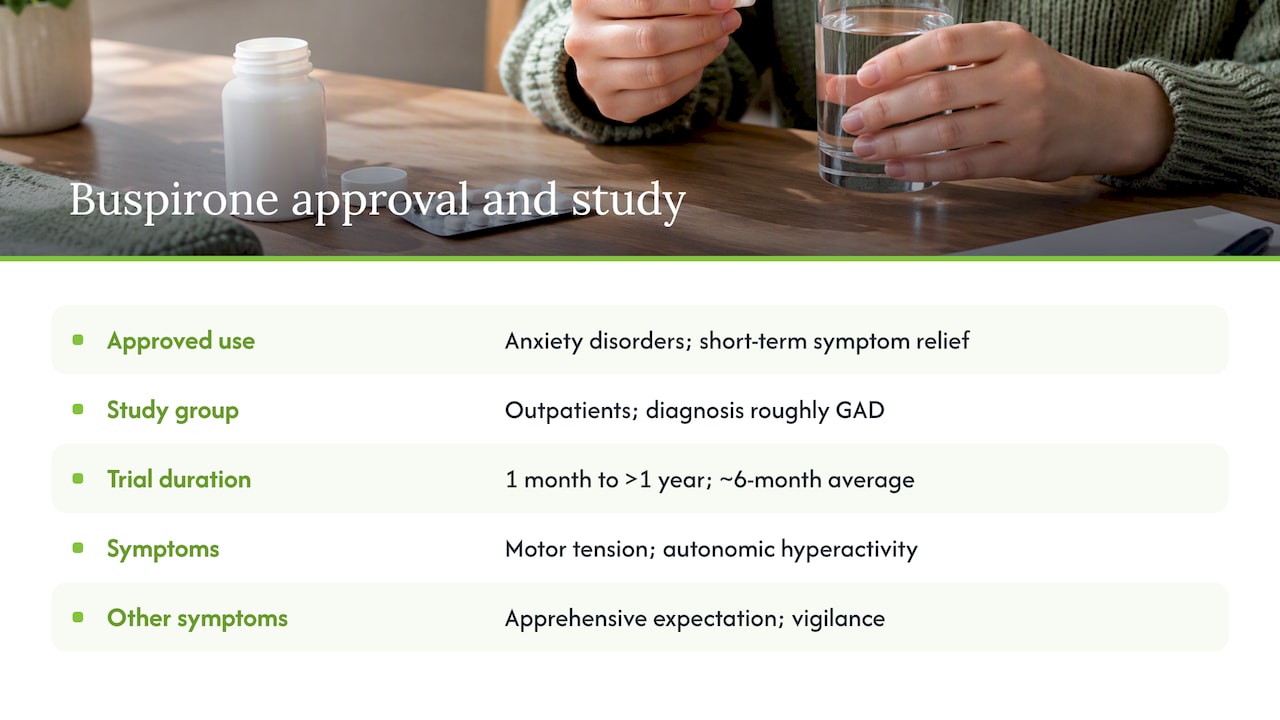
Buspirone is an oral anxiolytic, a medicine meant to reduce anxiety. It is not an SSRI, not a benzodiazepine, and not a sedative. The FDA-referenced labeling says it is indicated for the management of anxiety disorders or the short-term relief of anxiety symptoms, and that its effectiveness was shown in outpatients whose diagnosis roughly corresponds to GAD.
The same label lists the symptoms it may help with: motor tension, autonomic hyperactivity (the racing heart, sweating, and clammy hands), apprehensive expectation, and vigilance or constant scanning. Put plainly, that is the person who feels keyed up, braced for something, and tense through the shoulders and jaw most days.
The trials behind that approval included people who had been anxious for anywhere from one month to more than a year, averaging about six months, according to the same labeling. That tells us who it was studied in. It does not tell us it is the right answer for panic attacks, social anxiety, or trauma symptoms, and we do not assume it is. If you are not sure which anxiety pattern fits you, our piece on panic disorder versus generalized anxiety explains how the diagnostic lines are drawn.
How long buspirone takes to work
This is the part that surprises people most. According to NAMI, buspirone may take 3 to 4 weeks of daily use to provide relief, so it is not a rescue medication. It is taken as a tablet, twice a day, the same way each time, either with food or without.
We have learned to say this out loud at the first visit, because the common pattern is predictable. Someone starts buspirone, feels nothing after five days, concludes it does nothing, and stops. Or they feel a bit lightheaded in week one and assume that is the medicine “not agreeing” with them. Sometimes that is true. Often it is just the early adjustment.
A few practical things help:
- Take it at the same times every day, and keep the habit boring.
- Keep a simple note of your worst anxiety symptoms each week. Memory is unreliable when you are anxious, and a written baseline makes week four easier to judge.
- Do not use it the way you would use an as-needed pill. Skipping days resets the clock.
- Tell us if you are still having a hard time at the four-week mark, rather than waiting it out in silence.
The recovery process is a journey, not a straight line. A bad week in the middle of treatment does not mean the medicine has failed.
Is buspirone effective?
The honest answer is: it is effective for some people, modestly so for others, and it is not the strongest tool for everyone.
A Cochrane systematic review from 2006 found that azapirones, the drug class that includes buspirone, were superior to placebo for GAD. The same review noted they may be less effective than benzodiazepines and are not as acceptable to patients as benzodiazepines. The reviewers also noted that azapirones appeared most useful for people who had not been on a benzodiazepine.
That last point matters in the exam room. If you have taken a benzodiazepine regularly in the past, the buspirone may feel underwhelming by comparison, because the experience of a benzodiazepine is immediate and physical, and buspirone is neither. A review of anxiety pharmacotherapy notes that buspirone’s effects may be diminished in patients previously treated with benzodiazepines. We do not read that as a reason to rule it out. We read it as a reason to set expectations carefully.
Why buspirone is often not the first medicine tried
People sometimes feel slightly misled when they learn buspirone is not usually the opening move. There is no mystery in it. Published reviews describe SSRIs and SNRIs as first-line treatments for adult GAD, with buspirone among possible second-line options (Strawn and colleagues, 2018). Another review says buspirone is often used as a second-line agent, or as an augmenting agent, for patients who do not fully respond to an SSRI or SNRI. Tolerability and whether a person will realistically keep taking the medicine are among the factors clinicians weigh.
In practice, that leaves three common roles for buspirone:
- A second-line choice when an SSRI or SNRI caused side effects you could not tolerate.
- An add-on when an SSRI or SNRI helped partway and there is still leftover anxiety.
- A reasonable alternative when you and your prescriber decide, after a real conversation, that it fits your history better.
If you want the broader picture of how anxiety medicines are chosen, we wrote about it in anxiety medication: science, personalization, and your best options.
Buspirone versus benzodiazepines
These two get compared because both are used for anxiety, but they behave very differently.
| Buspirone | Benzodiazepines | |
|---|---|---|
| How it is taken | Scheduled tablet, twice daily | Often scheduled or as needed, depending on the prescriber |
| When you may feel it | Around 3 to 4 weeks of daily use | Typically felt soon after a dose |
| Evidence in GAD | Better than placebo in a 2006 Cochrane review | The same review suggests azapirones may be less effective than benzodiazepines |
| Place in treatment | Second-line or add-on in many guidelines and reviews | No longer considered first-line monotherapy for anxiety disorders |
| Patient acceptability | Lower than benzodiazepines in that review | Higher in that review |
The row on benzodiazepines comes from an academic review stating that they are no longer considered first-line monotherapy for anxiety disorders and can be used short-term alongside SSRIs or SNRIs. The remaining rows draw on the Cochrane review and the buspirone labeling cited above.
So is one better? Not in a simple way. If you are in the middle of a crisis and need relief that day, buspirone is the wrong tool and we would say so. If you want a steady daily option that is not a sedative, buspirone deserves a fair look. Whether it is the right pick depends on your history, your other medicines, and what you need from the treatment. Please do not stop a benzodiazepine abruptly to switch. That is a plan to make with a prescriber, not alone.
Side effects to expect
FDA-referenced labeling lists these as common in trials: dizziness (12%), drowsiness (10%), nausea (8%), headache (6%), nervousness (5%), and lightheadedness (3%). Most people we see describe these as mild and fading as the body adjusts, though your experience can differ.
Practical ways to take the edge off:
- Be careful driving or operating machinery until you know how you react, especially in the first weeks.
- Stand up slowly if you feel lightheaded.
- Take it consistently with or without food, as NAMI advises, rather than switching between the two.
- Report anything that frightens you, such as chest pain, a very fast heartbeat, or agitation. Do not wait for your next scheduled visit.
If you are thinking, “But I also feel anxious in the first place, and now I’m being told it might make me nervous,” you are not alone. We hear this a lot. It is a good reason to start with a clear plan and a quick check-in.
Interactions and safety points
Some safety points are not negotiable, and we bring them up at the start of treatment.
- MAOIs. Buspirone is contraindicated with MAOIs prescribed for depression, and for 14 days after stopping either one, because of the risk of serotonin syndrome and/or high blood pressure (labeling).
- Other drugs that change its levels. The FDA label reports that erythromycin, diltiazem, verapamil, and itraconazole can significantly change buspirone’s plasma concentrations. Bring a full medication list, including antibiotics, antifungals, and heart or blood pressure medicines.
- Grapefruit juice. The FDA lists buspirone (BuSpar) among medicines that can interact with grapefruit juice. Ask your pharmacist how to handle it.
- Not a substitute for antipsychotic treatment. The same 2010 label says buspirone should not be used in place of appropriate antipsychotic treatment.
Pregnancy and breastfeeding need an individual conversation. If that applies to you, our article on anxiety medication in pregnancy covers how we think about starting low and weighing risk. For younger patients, parents can start with anxiety medication for teens, since the labeled studies above were in adults.
What to tell your prescriber before you start
NAMI’s guidance lists the things a provider should hear before prescribing: your symptoms, medical and psychiatric history, past medications and how they went, what you take now, pregnancy or breastfeeding, and any substance use. It also says not to stop buspirone without talking to your provider (NAMI).
We would add two things from experience. First, say how you actually used previous anxiety medicines, including benzodiazepines you took from a friend or a past prescription. We are not judging. It changes our expectations. Second, say what you most need. If sleep is the worst part, or panic, or racing thoughts at work, that can steer us toward a different plan.
What the downsides really are
For a fair picture, the main practical downsides are these: the slow start, the twice-daily schedule, the modest effect for some people, and the possibility of less benefit after long benzodiazepine use. None of that is a reason to avoid it. It is a reason to match it to the right person and to give it a proper trial, which means weeks, not days.
Perspective
We tend to think of buspirone as a quiet medicine. It rarely makes dramatic changes, and that is partly why people either like it a lot or drop it early.
What we have learned in practice is that the first conversation does most of the work. When someone understands that the first two weeks may feel like nothing, that mild dizziness is common, and that we will check in at the four-week point, they stick with it. When they hear none of that, they often quit by day ten.
We also do not treat a pill as the whole answer. Medication is one part of a plan. For some patients buspirone is enough. For others it is a stepping stone, and the next step may be a different medicine, therapy, or, for anxiety that sits on top of treatment-resistant depression, one of the interventional options we offer such as TMS, ketamine, or Spravato. Having those options in the same practice means you are not starting over each time something does not fit.
If you have been told buspirone “did not work” for you, we would want to know the dose, how long you took it, and what else you were taking. Often there is something to adjust.
Felix
When buspirone is not enough
Sometimes anxiety and depression travel together, and a single daily tablet is not enough. If you have given buspirone and other standard medicines a real trial and still feel stuck, there are other routes. Our step-by-step anxiety treatment guide walks through what usually comes next, and how psychiatrists approach anxiety care for adults describes the process of evaluation and follow-up.
For treatment-resistant depression, we offer Transcranial Magnetic Stimulation, ketamine therapy, and Spravato. For trauma-related anxiety we also provide stellate ganglion block therapy. These are not substitutes for a careful evaluation. They are options we discuss once we understand your history.
Care in Allen, Frisco, McKinney, and Plano
Nortex Psychiatry is based in Allen, Texas, and we see adults and families from across North Dallas, in person and by telehealth. If you are weighing buspirone, thinking about switching, or wondering why your current medicine is not doing enough, we would be glad to review your history and talk through options. You can start from our home page to request a visit.
FAQ
Is buspirone a good anxiety medicine?
It can be, particularly for generalized anxiety in people who have not relied on benzodiazepines. Its trials were in outpatients with GAD-like symptoms, and a Cochrane review found it better than placebo. It may be less effective than benzodiazepines, though, and many clinicians reach for an SSRI or SNRI first.
How quickly does buspirone work?
Plan on about 3 to 4 weeks of daily use, per NAMI. It is not meant for use in the moment of a panic or a stressful event. Keep taking it as prescribed during that period and tell your prescriber how you are doing.
Why is buspirone not usually first-line?
Published reviews describe SSRIs and SNRIs as first-line for adult GAD, with buspirone as a second-line or add-on choice. Factors such as tolerability, adherence, and prior benzodiazepine use shape the decision. It is a ranking of typical starting points, not a verdict that buspirone is weak.
Can I drink grapefruit juice on buspirone?
The FDA lists buspirone among medicines that can interact with grapefruit juice. Ask your pharmacist or prescriber about your situation. If you drink it daily, mention that at your visit so the plan accounts for it.
Sources
- Buspirone Hydrochloride Tablets, USP (DailyMed, FDA labeling)
- Buspirone | NAMI
- Azapirones for generalized anxiety disorder (GAD) | Cochrane
- Pharmacotherapy of Anxiety Disorders: Current and Emerging Treatment Options
- Pharmacotherapy for Anxiety Disorders: From First-Line Options and Beyond
- Pharmacotherapy for Generalized Anxiety Disorder in Adults (2018)
- Grapefruit Juice and Some Drugs Don’t Mix | FDA
- FDA Product Label for buspirone (2010)