


The right psychiatrist is a licensed, board-certified physician who has treated problems like yours, explains the plan in words you follow, and is reachable when you need a change. Credentials get you in the door. Fit decides whether you stay. Below is how we would check both, plus what to ask about cost and insurance in Allen, Plano, Frisco and McKinney.
TL;DR
- A psychiatrist is a medical doctor who can diagnose, prescribe and order medical tests. Therapists usually do talk therapy and do not prescribe.
- Verify the license and board certification yourself before you book. It takes about ten minutes.
- Ask about experience with your specific symptoms, how treatment plans are built and how progress is tracked.
- Cost depends on your insurance, the visit type and the practice. Ask for the numbers in writing before the first appointment.
- Give it two or three visits. If you still do not feel heard, switching is normal and reasonable.
Table of Contents
- Start with what you need, not who is closest
- Check credentials first
- Match experience to your symptoms
- Treatment approach and communication style
- Availability, telehealth and follow-up
- What it costs in Allen and across Texas
- Local support while you search
- Perspective
- What a good first visit looks like
- Signs the fit is not right
- A short checklist you can use on the phone
- If medication has not been enough
- Seeing us at Nortex Psychiatry
- FAQ
- Sources
Start with what you need, not who is closest
Most people begin with a search for “psychiatrist near me” and book the first opening. We understand that. When you are tired, anxious or low, a name on a website feels like enough. But a few minutes of thinking about what you want help with will change which questions matter.
A psychiatrist is a medical doctor trained to diagnose, treat and prevent mental disorders, and can prescribe medication and order medical tests, according to the Cleveland Clinic. A therapist typically holds a master’s degree and focuses on talk therapy without prescribing. Neither is better. They do different jobs, and many people need both.
The American Psychiatric Association notes that effective psychiatric treatment is often highly individualized and frequently combines medication management with psychotherapy. The Anxiety & Depression Association of America says much the same for anxiety and depression: the strongest approach for many people pairs medication management from a psychiatrist or psychiatric nurse practitioner with therapy from a psychologist, therapist or social worker.
So before you search, write down three things:
- What is bothering you most, and for how long? Sleep, focus, panic, low mood, irritability, flashbacks.
- What have you already tried? Medications, therapy, supplements, and how each went.
- What do you want from the visit? A diagnosis, a second opinion, a medication review, or a new option after something did not work.
If you are unsure whether you need a psychiatrist at all, our guide on why see a psychiatrist walks through the signs. If you are weighing pills against talk therapy, therapy vs. medication for adults may help you decide where to start.
Check credentials first
You should not have to take anyone’s word for their training. Three things can be verified independently:
- A current Texas medical license. The Texas Medical Board keeps a public lookup, and it will show any disciplinary action.
- Board certification in psychiatry. This means the doctor completed residency and passed a specialty exam. The AMA Physician Profile is an official display agent for ABMS board-certification information and includes primary-source state licensure data, per the AMA’s documentation. The same source covers medical school and postgraduate training.
- The right title. Some practices staff psychiatric nurse practitioners alongside physicians. That is common and can work very well. You simply want to know who you will see and who supervises.
In our work we notice that people feel awkward asking about training. Please do not. A good practice expects the question and answers it plainly.
Match experience to your symptoms
Psychiatrists treat a wide range of conditions, including depression, anxiety, ADHD, bipolar disorder, schizophrenia, substance use disorders and sleep disorders. No one is equally deep in all of them. Some doctors lean toward adult ADHD, others toward mood disorders, others toward trauma.
The University of Washington’s guide to finding a mental health provider suggests looking at training, experience with similar symptoms, treatment approach, telehealth or in-person options, and insurance. Good questions to bring:
- How often do you treat people with my kind of symptoms?
- What does a typical first plan look like for someone like me?
- When a first medication does not work, what do you usually do next?
- Do you offer treatments beyond medication if I need them?
That last question matters more than it sounds. If you have already tried two or more antidepressants without enough relief, you are in a different situation from someone starting fresh. Some practices only prescribe. Others also offer interventional options such as Transcranial Magnetic Stimulation, which is FDA-cleared for depression, or Spravato for treatment-resistant depression. You do not need those on day one. But knowing a clinic can offer a next step saves you a second search later.
Adults who are on Medicare can also look at what is covered, for instance Medicare depression screening coverage under Part B, as one entry point to a conversation about mood.
Treatment approach and communication style
Two psychiatrists can have the same degree and run very different visits. One spends the first hour on history and gives you a clear diagnosis and plan. Another spends fifteen minutes, writes a prescription and sees you in three months. Neither is a villain, but they suit different people.
Notice, in your first visit or even on the phone:
- Do they ask about your life, sleep, work, family and substance use, or only symptoms?
- Do they explain why they suggest a medication, including side effects and what to expect in the first weeks?
- Do they invite your preferences, such as a wish to avoid certain drugs?
- Do they say how they will measure progress?
The UW guide says a good fit is feeling heard, understood and comfortable being honest in sessions. We would add one practical test. After the visit, can you explain the plan to a friend in two sentences? If not, ask again at the next visit. A plan you do not understand is hard to follow.
Availability, telehealth and follow-up
A brilliant psychiatrist who can see you once every four months may not be right for you, especially in the early weeks of a medication change. Ask these directly:
- How soon is the first appointment, and is there a waitlist?
- How often will follow-ups be at the start, and how often once things settle?
- Can I message or call between visits if side effects show up?
- Are visits in person, by video, or both?
Telehealth is a real option in Texas, and for busy professionals across Plano and Frisco it can remove the commute from a day that is already full. Medication follow-ups often work well by video. Some evaluations and procedures, like TMS, need you in the chair. A practice that offers both lets you choose by situation rather than by rule. Our guide to psychiatry in Texas covers the practical side.
What it costs in Allen and across Texas
This is the question people ask most quietly. Fees vary by practice, by whether you are using insurance, and by whether the visit is an initial evaluation or a follow-up. Initial evaluations are longer and usually cost more than medication follow-ups. We would rather not hand you a number that may not match any real office, so here is how to get a straight answer.
If you have insurance:
- Call the number on your card and ask whether the practice is in network for psychiatry, not just “mental health.”
- Ask about your copay or coinsurance for a psychiatric evaluation and for follow-up visits, and whether your deductible applies first.
- Ask whether telehealth visits are covered the same as in-person ones.
- Ask the practice which billing codes they will use, so the insurer can quote you.
If you are paying yourself:
- Ask for the fee for the first evaluation and for a typical follow-up, in writing.
- Ask what is included, such as visit length and any paperwork.
- Ask if there are separate charges for missed appointments, forms or refills.
If a procedure may be part of your plan: treatments like TMS, ketamine and Spravato are billed differently from office visits, and coverage often depends on documented prior treatments. Our walkthrough on insurance coverage for Spravato shows the kind of steps involved.
Also weigh cost against the whole course of care. A cheaper first visit that leads to a vague plan and many repeat visits can cost more than a thorough evaluation that gets the diagnosis right.
Local support while you search
Finding the right doctor can take weeks. If you are struggling now, you do not have to wait. Texas Health and Human Services directs people thinking about suicide to call or text 988. It also lists LifePath Systems as the local behavioral health authority crisis provider for Collin County, which includes Plano, Allen, Frisco and McKinney, with a crisis line at 1-877-422-5939. The agency says Texas crisis services include prompt face-to-face assessment, crisis intervention, follow-up and relapse-prevention services. Details are on the Texas HHS crisis services page.
If you are in immediate danger, call 911.
Perspective
In our practice we have learned that the first appointment is rarely where people go wrong. It is the long gap before it. Many of the adults who come to see us have waited years, and a good number have already been through a couple of medications that did not do enough. They are tired, and a little wary.
What we try to do in that first visit is slow down. We take a full history, we ask what has and has not helped, and we say out loud what we think is going on and what we are less sure about. We do not always get the wording right. Sometimes a patient corrects us, and that is useful.
We also think a psychiatrist should have more than one tool. Medication management is the base of most of our work, and it helps many people. But for someone whose depression has not responded, it matters that there are other doors: TMS, Spravato, ketamine therapy, and for some trauma and anxiety presentations, stellate ganglion block. Having those under one roof means we can talk about a next step without sending you across town and starting over. That does not mean everyone needs them. Most people do not, at first.
If you take one thing from this page, let it be this: choose someone you can be honest with. The rest can be adjusted.
Felix
What a good first visit looks like
It helps to know what is normal. A first psychiatric visit usually runs longer than later ones. Expect questions about your symptoms and when they began, your medical history, current medications, family history, sleep, alcohol and other substances, and what daily life looks like right now. You may fill out questionnaires.
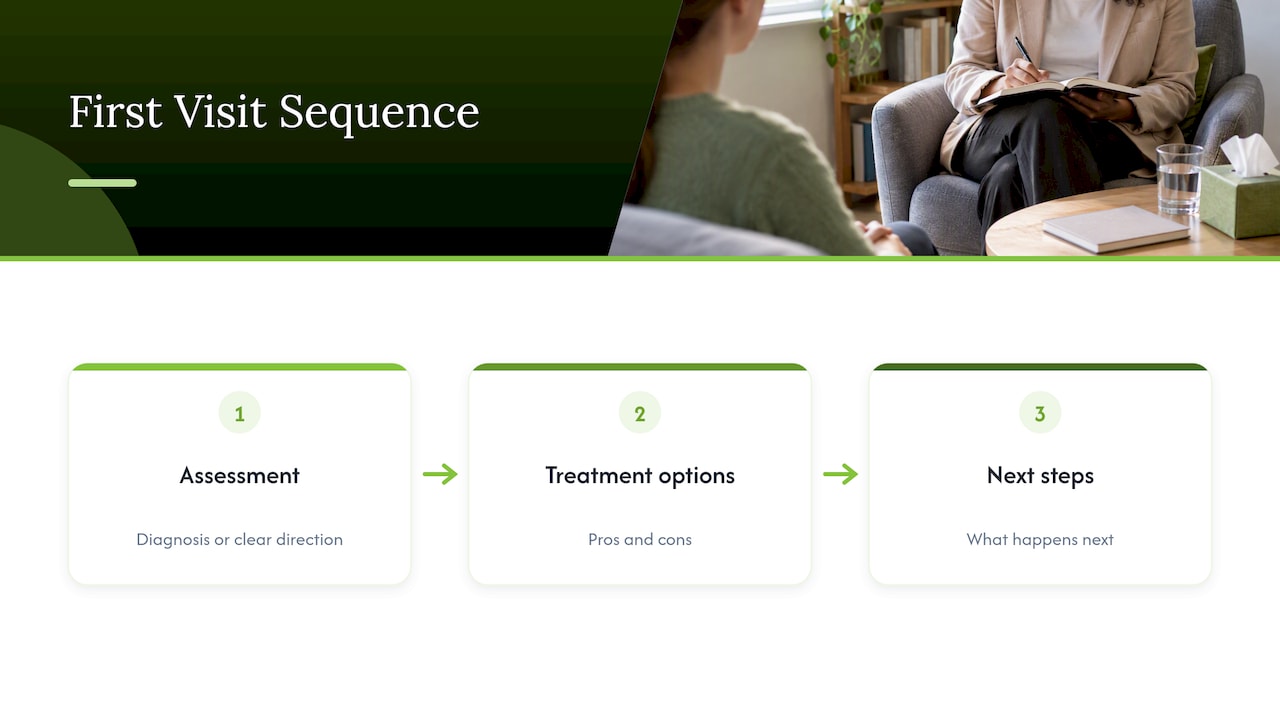
By the end, you should hear a working diagnosis or at least a clear direction, options for treatment with their pros and cons, and what happens next. If medication is suggested, ask about side effects, how long it takes to judge whether it is working, and what to do if it is not.
Bring a list of current medications and doses, past medications and what happened, any recent lab work, and a short note about what you want help with. Our checklist for preparing for a psychiatric appointment goes into more detail, and the step-by-step guide to starting psychiatric treatment explains the weeks that follow.
Signs the fit is not right
Nobody gets every match right on the first try. Consider a change if, after two or three visits:
- You feel rushed, dismissed or talked over.
- You cannot get answers to basic questions about your medication.
- Messages go unanswered for long stretches when you have side effects.
- You are told what to do without any discussion of options.
- You find yourself editing what you say because you do not feel safe being candid.
Switching is not rude. Ask for your records, book with someone else, and bring the history so you do not start from zero. Treatment tends to be a journey, not a straight line, and the first doctor you meet is not always the one who stays with you.
One caution. Never stop a prescribed psychiatric medication suddenly because you are unhappy with a provider. Talk to a prescriber about how to taper or transition, because stopping abruptly can cause withdrawal symptoms or a return of symptoms.
A short checklist you can use on the phone
- Are you accepting new patients, and how long until the first visit?
- Is the doctor board-certified in psychiatry?
- Do you take my insurance for psychiatric evaluation and follow-ups?
- What is the self-pay fee if I do not use insurance?
- Do you offer telehealth, in-person, or both?
- What treatments do you offer beyond medication if I need them?
- How do I reach you between appointments?
Seven questions. Most offices can answer them in under five minutes, and how they answer tells you a lot.
If medication has not been enough
Some readers arrive here after months or years of trying to feel better. If that is you, look for a practice that will revisit the diagnosis, not only change the dose. We have written about how psychiatrists approach anxiety care and what works for anxiety and ADHD together. And if depression has persisted through several treatments, it is reasonable to ask about TMS versus medication.
Seeing us at Nortex Psychiatry
We are an outpatient psychiatric practice in Allen, Texas, seeing adults and families from Plano, Frisco, McKinney and the surrounding North Dallas area. We offer medication management, psychiatric evaluation and telehealth, along with TMS therapy, ketamine therapy, Spravato and stellate ganglion block. If you would like to talk through whether we are the right fit, you can reach us through our website. Ask us the questions in this article. We would rather you ask.
FAQ
Should I see a psychiatrist or a therapist first?
If you think medication might help, or you have symptoms like severe mood swings, trouble functioning or panic that does not ease, a psychiatrist is a sensible first stop. If you mainly want to talk through stress or relationships, a therapist may be enough. Many people end up with both, and either can refer you to the other.
How do I check whether a psychiatrist is board-certified?
Use the AMA Physician Profile, which displays ABMS board-certification information, and check the Texas Medical Board’s public license lookup for license status and any discipline. Both are free. You can also simply ask the office.
How much does a psychiatrist cost in Texas?
It depends on your insurance, the practice, and whether it is an initial evaluation or a follow-up. Evaluations are longer and generally cost more than follow-ups. Ask the office for its self-pay fees or call your insurer for your copay before you book.
Is telehealth psychiatry as good as an in-person visit?
For many adults it works well, especially for evaluations of mood and anxiety and for medication follow-ups. Some treatments, such as TMS, require in-person sessions. A practice that offers both lets you pick what suits each stage.
How long should I stay with a psychiatrist who isn’t a good fit?
Give it two or three visits unless something feels unsafe. If you still do not feel heard or cannot get clear answers, change providers, and ask a prescriber before altering any medication.
Sources
- What is a Psychiatrist? What They Do & When To See One, Cleveland Clinic
- What is Psychiatry?, American Psychiatric Association
- Choosing the Right Mental Health Provider for Anxiety, ADAA
- How to Find a Mental Health Provider, University of Washington
- AMA Physician Profiles supporting documents
- Mental Health Crisis Services, Texas Health and Human Services
- Medicare depression screening coverage