


Holistic psychiatry is defined as a medical approach that evaluates and treats mental health by examining the whole person, including biological, psychological, social, and lifestyle factors, rather than focusing solely on symptoms or diagnoses. The field is also called integrative psychiatry, and both terms describe the same clinically grounded practice. This approach does not replace traditional psychiatry. It expands it. Medication remains part of the picture when clinically indicated, but it sits alongside nutritional support, lifestyle modifications, and therapy rather than standing alone. If you have ever felt that a 15-minute appointment left too much unexplored, this model was built with that gap in mind.
What is holistic psychiatry and what are its core principles?
Integrative psychiatry combines traditional psychiatric tools with evidence-based interventions like nutritional psychiatry, gut health support, and lifestyle change. That combination is the defining feature. It means your psychiatrist is not choosing between medication and lifestyle work. They are using both, in proportion to what your clinical picture actually requires.
The core principles break down into five areas:
- Whole-person assessment. Biological, psychological, social, and lifestyle factors are all evaluated at intake, not just symptom severity.
- Root cause focus. The central question is not only “what are your symptoms?” but what is driving them, including inflammation, hormonal shifts, sleep disruption, or chronic stress.
- Nutritional psychiatry. Diet, gut microbiome health, and micronutrient status are reviewed as contributors to mood, cognition, and anxiety.
- Medication management. Medications are prescribed when clinically indicated and monitored carefully, with attention to minimum effective dosing and interactions with lifestyle factors.
- Active patient participation. Patients are active participants in care, not passive recipients. Treatment goals are set collaboratively, and progress is tracked between sessions.
Pro Tip: If you are researching integrative psychiatry practices, look for providers who ask about your diet, sleep, and exercise history during intake. That level of questioning signals a genuinely whole-person approach.
The personalized care model used in integrative psychiatry also tends to produce more durable results. When patients understand why a recommendation is being made, they follow through more consistently. That engagement is built into the structure of care from the first visit.

How does holistic psychiatry differ from traditional psychiatric care?
Standard psychiatric care typically centers on symptom checklists, brief medication management visits, and diagnosis-driven treatment protocols. That model works well for many people. The limitation is that it often leaves physical health, lifestyle context, and root causes unexamined.
Integrative psychiatry addresses those gaps directly. The table below outlines the key differences.
| Feature | Standard psychiatry | Integrative psychiatry |
|---|---|---|
| Visit length | 15–30 minutes | 60–90 minutes initial; 30–45 minutes follow-up |
| Assessment scope | Symptom checklist, mental status | Full medical, lifestyle, nutritional, and psychological history |
| Root cause focus | Diagnosis-driven | Examines inflammation, hormones, nutrition, and life context |
| Medication approach | Often first-line treatment | One tool among several; minimum effective dose prioritized |
| Patient role | Largely passive | Active participant with between-session goals |
| Care coordination | Referral-based | Medication, therapy, and lifestyle support often under one clinician |
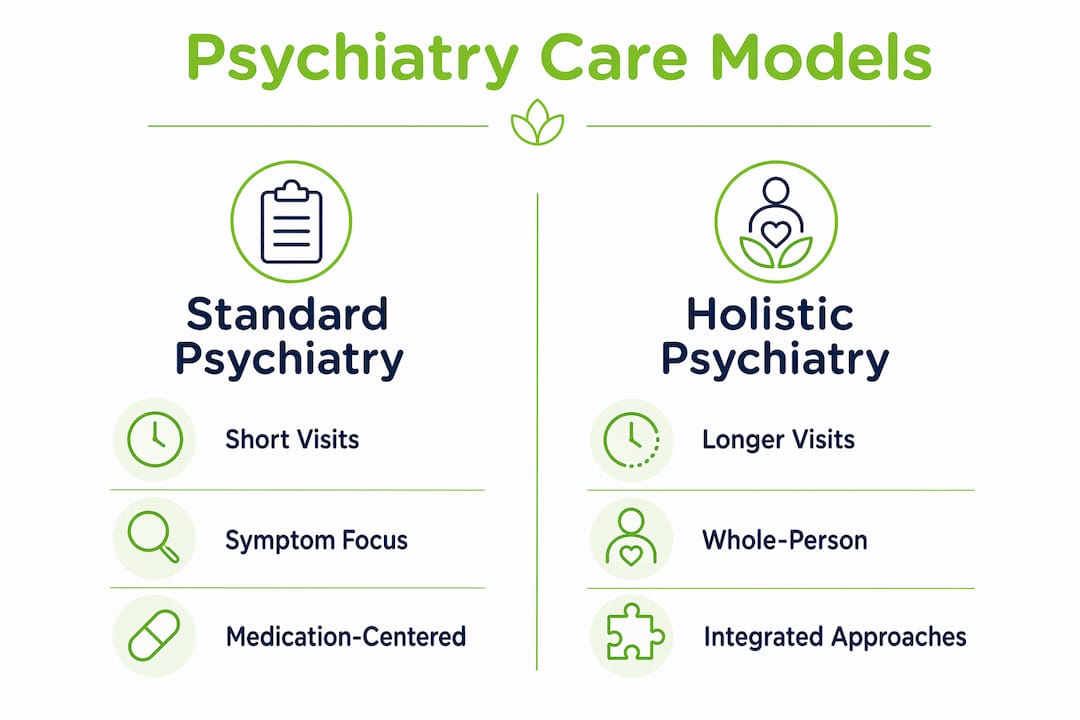
The difference in visit length matters more than it might seem. Initial consultations lasting 60–90 minutes give a clinician enough time to build a picture that a brief visit simply cannot capture. A patient’s sleep quality, dietary patterns, and family medical history all inform the clinical picture in ways that a symptom checklist does not.
The benefits of this kind of psychiatric care are most visible in patients with complex or treatment-resistant presentations. When standard approaches have not produced lasting relief, the expanded assessment often reveals factors that were never addressed.
What can a patient expect during a holistic psychiatry session?
The first appointment is longer and more detailed than most patients expect. Here is what a typical intake process looks like:
- Pre-visit questionnaire. Before you arrive, you complete detailed forms covering family medical history, current medications, supplements, autoimmune conditions, cardiovascular history, and mental health patterns across generations. This is not routine paperwork. It is clinical data.
- Comprehensive history review. The clinician reviews your responses and conducts a structured interview covering sleep, diet, exercise, stress load, relationships, and trauma history alongside your psychiatric symptoms.
- Lab work consideration. Depending on your presentation, the clinician may order labs to assess inflammation markers, thyroid function, hormonal status, or metabolic health. These results directly inform the treatment plan.
- Personalized, written treatment plan. You leave the visit with a clear treatment plan that includes medication recommendations if indicated, lifestyle goals, and any referrals for therapy or specialty care.
- Between-session homework. Patients are often asked to track mood, sleep quality, or dietary patterns between visits. This data shapes follow-up conversations and helps the clinician adjust the plan based on real-world results.
Pro Tip: Bring a written list of every supplement you take to your first appointment. Integrative psychiatrists assess interactions between supplements, medications, and nutritional status. That list is clinical information, not background detail.
Follow-up visits run 30–45 minutes and focus on reviewing progress, adjusting the treatment plan, and checking in on lifestyle goals. The structure rewards patients who engage actively. The more data you bring, the more precisely the plan can be refined.
What are common misconceptions about holistic psychiatry?
The most persistent misconception is that integrative psychiatry is anti-medication. It is not. Medication is prescribed and monitored carefully when clinically indicated, with attention to minimum effective dosing and how medications interact with nutritional status and inflammation. The goal is not to avoid medication. The goal is to use it thoughtfully.
Several other misunderstandings come up regularly:
- “Holistic means natural only.” Integrative psychiatry uses evidence-based medicine. That includes pharmaceuticals, psychotherapy, nutritional interventions, and lifestyle support. No single category is excluded or preferred by default.
- “Medication is always avoided.” Patients with moderate to severe depression, bipolar disorder, or psychosis may absolutely require medication. The real role of medication in mental wellness is not diminished in this model. It is contextualized.
- “It is not evidence-based.” Nutritional psychiatry, lifestyle medicine, and collaborative care models all have growing bodies of peer-reviewed research supporting their use in mental health treatment.
- “You can stop your current medications.” Patients should never adjust or discontinue medications without clinical supervision. Integrative psychiatry works with your current regimen, not against it.
- “Any wellness provider can offer this.” The holistic label is used broadly across the wellness industry. Medically supervised integrative care requires a licensed MD, DO, or qualified psychiatric nurse practitioner.
Understanding what integrative psychiatry actually involves helps you ask better questions and make more informed decisions about your care.
Who benefits most from integrative psychiatry, and how do you find a qualified provider?
Integrative psychiatry fits a specific type of patient well. You are likely a good candidate if any of the following apply:
- You want a thorough assessment that goes beyond symptom suppression.
- You have a complex presentation, treatment-resistant symptoms, or a chronic condition that has not responded fully to standard care.
- You are interested in understanding the lifestyle and physiological factors contributing to your mental health.
- You want medication management, therapy support, and lifestyle guidance coordinated under one clinician rather than across multiple providers.
- You are willing to engage actively between sessions, including tracking symptoms and making lifestyle adjustments.
Finding a qualified provider requires some due diligence. Verify that your provider is a licensed MD, DO, or PMHNP with documented training in integrative or functional medicine. Ask directly whether they conduct comprehensive assessments or primarily offer brief medication management visits with wellness add-ons. The distinction matters. A provider who spends 15 minutes per visit and recommends supplements is not practicing the same model as a clinician who conducts 90-minute intakes and orders targeted lab work.
The ongoing mental health support that integrative psychiatry provides is most effective when the clinician has enough time and clinical depth to track your progress across multiple domains, not just symptom scores.
Key Takeaways
Integrative psychiatry is the most complete model of psychiatric care available because it addresses biological, psychological, and lifestyle factors together rather than in isolation.
| Point | Details |
|---|---|
| Whole-person assessment | Integrative psychiatry evaluates biology, lifestyle, nutrition, and psychology at every intake. |
| Longer visits, deeper data | Initial sessions run 60–90 minutes, giving clinicians time to identify root causes standard visits miss. |
| Medication is not excluded | Medications are prescribed when indicated and monitored for minimum effective dosing alongside lifestyle factors. |
| Active patient role | Between-session tracking and lifestyle goals are standard, not optional, parts of the treatment plan. |
| Credential verification matters | Only licensed MDs, DOs, or PMHNPs provide medically supervised integrative psychiatric care. |
What I have learned from practicing this way
The shift that integrative psychiatry produces is not always dramatic at first. What we notice over time is that patients who receive a thorough initial assessment tend to stay engaged longer. They understand why their plan looks the way it does. That understanding changes how they relate to their own care.
We have also found that the “homework” component, whether that is a sleep log, a mood tracker, or a dietary journal, does something that medication alone cannot. It gives patients a concrete way to participate in their own recovery. The data they bring back to follow-up visits is often the most clinically useful information we receive.
The future of psychiatric care is moving in this direction. Nutritional psychiatry, lifestyle medicine, and collaborative care models are accumulating research support at a pace that makes them increasingly difficult to ignore. What was once considered outside mainstream psychiatry is becoming part of it. That is not a trend. It is a correction.
I believe the holistic mental health approach will become the standard model within a generation, not because it is philosophically appealing, but because the clinical outcomes support it. Patients who are treated as whole people tend to do better over time.
— Felix
Nortexpsychiatry’s approach to whole-person psychiatric care
Nortexpsychiatry serves patients across Allen, Frisco, McKinney, Plano, and the broader North Dallas area with exactly this model of care. The practice blends medication management, comprehensive evaluations, and personalized treatment planning into a single, coordinated experience. Whether you are managing anxiety, depression, ADHD, or a mood disorder, the goal is to understand what is driving your symptoms, not just name them.
If you are ready to understand what psychiatric care can look like when it accounts for your full picture, the guide to seeking psychiatric care is a practical next step. Nortexpsychiatry also offers telehealth options for patients who prefer to start from home. Reaching out is straightforward, and the first conversation is judgment-free.
FAQ
What is holistic psychiatry in simple terms?
Holistic psychiatry is a medical approach that treats mental health by evaluating the whole person, including biology, lifestyle, nutrition, and psychology, rather than focusing only on symptoms or diagnoses.
Does holistic psychiatry use medication?
Yes. Medication is prescribed when clinically indicated and monitored carefully, with a focus on minimum effective dosing and how it interacts with lifestyle and nutritional factors.
How long is a holistic psychiatry appointment?
Initial consultations typically run 60–90 minutes. Follow-up visits are generally 30–45 minutes, allowing time to review progress and adjust the treatment plan.
Is holistic psychiatry the same as alternative medicine?
No. Integrative psychiatry is evidence-based medicine that expands on standard psychiatric care. It includes pharmaceuticals, psychotherapy, nutritional support, and lifestyle interventions based on clinical evidence.
How do I find a qualified holistic psychiatrist?
Look for a licensed MD, DO, or PMHNP with documented training in integrative or functional medicine. Confirm they conduct comprehensive assessments and coordinate medication, therapy, and lifestyle support within a single care plan.