

Not all depression therapies are created equal, and if you’ve been told otherwise, it’s time to rethink that assumption. Research shows that structured, evidence-based therapies like Cognitive Behavioral Therapy (CBT) achieve large effect sizes for depression, with 60 to 92% of people seeing reliable improvement. But the type of therapy, how it’s matched to your needs, and whether it’s combined with other treatments can make a significant difference in how well you recover. This article breaks down what depression therapy actually involves, what the evidence says about outcomes, and how a personalized approach can help you move forward.
Table of Contents
- Defining depression therapy: Goals, types, and approaches
- How effective is depression therapy? What the evidence shows
- Personalizing therapy: Matching treatments to your needs
- What about treatment-resistant depression? Advanced options explained
- Our take: Why matching therapy to the person matters more than modality
- Getting started with evidence-based depression therapy in North Dallas
- Frequently asked questions
Key Takeaways
| Point | Details |
|---|---|
| Therapy types matter | Different evidence-based therapies offer unique approaches and can be matched to your needs. |
| Good results are common | Most people see reliable improvement, with up to 92% benefiting from talk therapy. |
| Personalization is key | Treatment plans should factor in your preferences, history, and any co-occurring issues. |
| Next steps for TRD | Advanced therapies like TMS, ECT, or ketamine help when standard treatments fall short. |
| Ongoing adaptation | Best outcomes come from providers who adjust care based on your progress and feedback. |
Defining depression therapy: Goals, types, and approaches
“Depression therapy” is a broad term that many people use loosely. In clinical practice, it refers to structured, evidence-based talk therapies designed to reduce depressive symptoms, improve daily functioning, and build lasting coping skills. These are not casual conversations. They follow tested frameworks, use specific techniques, and are delivered by trained clinicians over a defined period of time.
The four most well-researched types include:
- Cognitive Behavioral Therapy (CBT): Focuses on identifying and changing negative thought patterns and behaviors. This is the most widely studied and commonly recommended form of depression therapy.
- Acceptance and Commitment Therapy (ACT): Teaches you to accept difficult emotions rather than fight them, while committing to actions that align with your values.
- Interpersonal Therapy (IPT): Targets relationship problems, role transitions, and social conflicts that fuel or maintain depression.
- Short-Term Psychodynamic Therapy (STPP): Explores how unconscious patterns and past experiences influence your current emotional state.
Each of these approaches has a distinct focus, but studies show that CBT, STPP, ACT, and IPT all demonstrate comparable effectiveness in randomized controlled trials (RCTs). That means no single type is universally superior. What matters is which one fits your specific challenges best.
Here’s a quick comparison to help you understand how they differ:
| Therapy type | Core approach | Primary goal | Best suited for |
|---|---|---|---|
| CBT | Thought and behavior change | Reduce negative thinking | Chronic negative thoughts, low motivation |
| ACT | Acceptance and values-based action | Improve psychological flexibility | Rumination, avoidance patterns |
| IPT | Improve communication and relationships | Resolve interpersonal conflicts | Grief, role changes, social withdrawal |
| STPP | Explore unconscious patterns | Increase self-awareness | Unresolved past issues, emotional numbness |
Understanding these personalized treatment steps is essential before committing to a path. A good clinician will help you identify which approach aligns with your situation rather than defaulting to one type for everyone.
Pro Tip: Match therapy type to your main challenge. If negative self-talk dominates your days, CBT may be the place to start. If relationship stress is draining you, IPT might offer faster relief. If you feel stuck in cycles of avoidance, ACT can help you move forward.
With the basics in mind, it’s important to see how these therapies actually perform in practice and what the numbers really tell us.
How effective is depression therapy? What the evidence shows
If you’ve ever wondered whether therapy truly works or whether it’s worth the time and investment, the evidence offers a clear and encouraging answer for most people.

Studies consistently show that psychotherapy delivers strong results. CBT and structured psychotherapy result in 60 to 92% reliable improvement rates and 42 to 62% remission rates, making them equal to medication in most head-to-head studies. Remission means more than just feeling a little better. It means a full return to baseline functioning where depression no longer significantly impairs your daily life.
Here’s how major treatment options compare across key outcomes:
| Treatment | Response rate | Remission rate | Best for |
|---|---|---|---|
| CBT | 60-75% | 42-62% | Mild to moderate depression |
| STPP | 60-70% | 40-55% | Emotionally complex cases |
| ACT | 60-72% | 38-55% | Rumination, chronic worry |
| Antidepressant medication | 50-65% | 35-50% | Moderate to severe cases |
| Combined (therapy + meds) | 70-85% | 50-65% | Moderate to severe, complex cases |
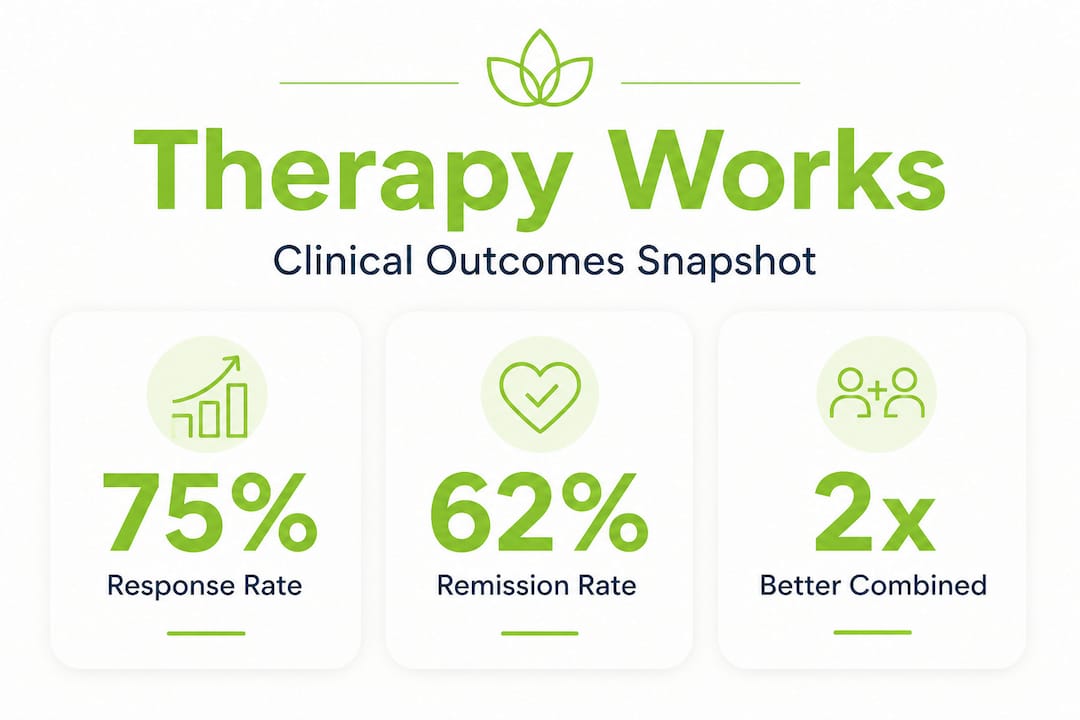
One of the most clinically significant findings in recent research is that combined treatment using both psychotherapy and medication produces superior outcomes, with a relative risk (RR) of 1.35 for treatment response compared to either approach used alone. In practical terms, that means roughly 35% better odds of responding when you combine both.
This matters especially for people with moderate to severe depression who have not fully responded to one approach. The therapy vs. medication outcomes debate is often a false choice. For many people, the real answer is both.
A few additional points worth knowing:
- Progress is typically measured using tools like the PHQ-9 (Patient Health Questionnaire), a simple 9-question self-report that tracks symptom severity over time.
- Most people begin noticing meaningful changes within 8 to 16 weeks of consistent therapy.
- About 20 to 40% of people experience only partial improvement with standard approaches and may need more tailored strategies.
It’s also worth exploring how ketamine therapy success rates and other advanced options compare when standard therapies fall short, and understanding how talk therapy compares to neurostimulation treatments like TMS.
Pro Tip: Track your progress using a PHQ-9 form at least once every two to four weeks. Bring those results to your sessions. Your clinician can use both your self-report and their own assessments to build a clearer picture of how treatment is actually working.
While standard therapies help most people, complex or treatment-resistant cases require a more tailored and sometimes more aggressive approach.
Personalizing therapy: Matching treatments to your needs
Here’s something that often gets overlooked in conversations about depression treatment: the right therapy is not a one-size-fits-all decision. Personalizing your care based on your symptoms, history, and circumstances isn’t just a nice idea. It’s backed by evidence as one of the most important factors in achieving lasting improvement.
Effective personalization involves evaluating your specific symptoms, any co-existing conditions like anxiety or ADHD, your history with past treatments, and your preferences about how you want to engage with care. Emerging research is now using machine learning tools to predict with 71% accuracy whether a specific person will respond better to therapy or medication. That kind of precision is still developing, but it signals a meaningful shift in how mental health care is delivered.
Here’s a practical framework for building a personalized therapy plan:
- Start with a thorough assessment. A qualified clinician should evaluate your depression severity, symptom type, medical history, and any co-occurring conditions before recommending a therapy type.
- Set specific, measurable goals. Rather than “feel better,” aim for something concrete, such as sleeping through the night five days a week or returning to activities you’ve stopped enjoying.
- Choose a therapy type that fits your pattern. Use the therapy comparison table above as a starting point, and discuss your options openly with your provider.
- Monitor and adjust over time. Therapy is not a static process. If you’re not seeing movement after six to eight weeks, it may be time to modify the approach, add medication, or consider a different therapy type.
- Involve your full care team. If you’re also managing anxiety, ADHD, or a physical health condition, your psychiatrist and therapist should coordinate closely to ensure treatments don’t work against each other.
The individualized therapy guidance you receive from an experienced provider should feel responsive to who you are, not just what diagnosis you carry.
Pro Tip: Don’t be discouraged if your first therapy approach doesn’t produce the results you hoped for. That’s not failure. It’s information. Adapting and combining treatments based on your response is exactly how good clinical care works.
Even with well-personalized care, some people face a more difficult challenge. Understanding what comes next for those cases is just as important.
What about treatment-resistant depression? Advanced options explained
Not everyone responds to standard care, and that’s a hard truth worth addressing honestly. Research shows that about 1 in 3 patients with major depressive disorder experience what clinicians call treatment-resistant depression (TRD). This means they haven’t achieved adequate improvement after trying two or more antidepressants at adequate doses and duration.
TRD does not mean untreatable. It means the path forward requires more specialized care.
Advanced options available for TRD include:
- Transcranial Magnetic Stimulation (TMS): A non-invasive procedure that uses magnetic pulses to stimulate underactive brain regions linked to mood regulation.
- Electroconvulsive Therapy (ECT): A highly effective option for severe cases, involving brief electrical stimulation of the brain under general anesthesia.
- Ketamine infusion therapy: Offers rapid symptom relief, sometimes within hours, making it particularly valuable in severe or crisis presentations.
- Medication augmentation: Adding a second medication, such as an antipsychotic or lithium, to boost the effectiveness of an existing antidepressant.
- Intensive or modified psychotherapy: More frequent sessions or adapted protocols designed for people who haven’t responded to standard therapy delivery.
Here’s a practical overview of efficacy and key considerations for each:
| Advanced treatment | Response rate | Key consideration |
|---|---|---|
| TMS | 50-60% | Non-invasive, outpatient, low side effects |
| ECT | 70-90% | Most effective for severe TRD, requires anesthesia |
| Ketamine/esketamine | 50-70% rapid response | Fast acting, controlled setting required |
| Medication augmentation | 40-60% | Requires careful medication management |
| Intensive psychotherapy | 35-55% | High engagement required |
“ECT shows 70 to 90% improvement in severe TRD. However, personalization is critical. What works for one patient may not work for another, and integrating multiple approaches often provides the most durable relief.” — Mayo Clinic Depression Center Panel, The Journal of Clinical Psychiatry
If you’ve already explored TMS, learning more about TMS in treatment-resistant depression can help you set realistic expectations. And if ketamine is on your radar, reviewing the evidence around ketamine for TRD is a worthwhile next step before your next clinical conversation.
Understanding these options is empowering, but real transformation in outcomes often comes from blending expert evidence with individualized, compassionate care.
Our take: Why matching therapy to the person matters more than modality
We’ve worked with enough people navigating depression to say this directly: the debate over which therapy is “best” is mostly a distraction. The research confirms it. CBT, STPP, ACT, and IPT all show comparable results in controlled studies. So why do outcomes vary so widely in the real world?
The answer is fit. Not modality.
What actually moves the needle is whether you feel genuinely heard by your provider, whether the goals you’re working toward feel relevant to your actual life, and whether your treatment is being actively adjusted based on how you’re responding rather than following a fixed script. The collaborative relationship between you and your care team is itself a therapeutic mechanism.
We’ve also seen that people who are willing to stay open and honest about what’s working and what isn’t tend to do better. That sounds simple, but it’s harder than it seems when you’re dealing with depression’s characteristic pull toward withdrawal and hopelessness.
Recovery from depression is a journey, not a straight line. Some people find meaningful relief within months. Others cycle through several approaches before landing on what works. Neither path is wrong. What matters is that your care evolves with you.
Our strong belief, backed by both evidence and direct clinical experience, is that the right answer for most people is a flexible, effective care through personalization approach. That means starting with the best evidence, staying close to how you’re actually responding, and being willing to try something different when the current path isn’t getting you where you need to go.
Pro Tip: When evaluating a new provider or clinic, ask directly whether they use integrative or blended approaches and whether they welcome ongoing feedback about how treatment is landing for you. That openness is often a reliable indicator of quality care.
Getting started with evidence-based depression therapy in North Dallas
If you’re in North Dallas, including Allen, Frisco, McKinney, or Plano, you don’t have to figure this out alone. At Nortex Psychiatry, we offer evidence-based care that’s built around your specific situation, not a template. From initial evaluations to ongoing personalized mood disorder treatment, our team works closely with you to identify the right combination of therapies and, where appropriate, medication management. Whether you’re starting fresh or looking for a better path after previous treatment hasn’t worked, we’re here to help. We also offer telehealth options so care fits your schedule. Explore how we approach comparing TMS and medication options and reach out to schedule a consultation with our team today.
Frequently asked questions
How do I know if depression therapy is working for me?
Signs include a steady reduction in symptoms, improved daily functioning, and a growing sense of capability. Using a tool like the PHQ-9 at regular intervals gives you and your clinician an objective way to track change over time.
Is therapy or medication better for treating depression?
Most evidence shows similar effectiveness between the two, but combining both often produces the strongest and most durable results, particularly for moderate to severe depression.
What if my depression doesn’t improve with therapy?
Ask your clinician about advanced options like TMS, ketamine, or ECT. About one-third of depression cases meet criteria for treatment-resistant depression and may need these next-step strategies.
Can depression therapy be personalized to my unique situation?
Yes. The most effective plans are built around your specific symptoms, preferences, and any co-existing conditions. Personalizing based on your history and past treatment outcomes leads to significantly better results.
How long does depression therapy usually take to work?
Most structured, evidence-based therapies show meaningful improvement within 8 to 16 weeks, though individual timelines vary based on severity, therapy type, and personal history.
Recommended
- TMS Therapy vs. Medication: Which One Wins in Treating Depression? – Nortex Psychiatry
- Ketamine Therapy for Depression: A Breakthrough Treatment – Nortex Psychiatry
- How Does Ketamine Work For Depression? – Nortex Psychiatry
- What’s the Success Rate of Ketamine Therapy for Depression? – Nortex Psychiatry
- Innovative therapies for emotional healing: CBT to psychedelics
- What is mindfulness therapy? Benefits, methods, and tips – Lunix