


If you have been wondering how psychiatry treats depression, you are not alone. Many people assume treatment means a prescription and little else. In reality, depression treatment involves a carefully considered mix of medication, psychotherapy, and in some cases, advanced interventions tailored to your specific situation. The path looks different for each person. Understanding what psychiatrists actually do, and why, can help you feel more prepared and less overwhelmed when you take that first step.
Table of Contents
- Key takeaways
- How psychiatry treats depression: the core approach
- Antidepressant medication: what to expect
- Psychotherapy as psychiatric treatment for depression
- Advanced treatments for resistant or severe depression
- Working with your psychiatrist: practical guidance
- My perspective on how depression gets treated
- How Nortexpsychiatry can support your treatment
- FAQ
Key takeaways
| Point | Details |
|---|---|
| Treatment is rarely one-size-fits-all | Psychiatrists combine medication, therapy, and other tools based on each patient’s unique history and needs. |
| Medications take time | Most antidepressants require two to eight weeks before meaningful symptom relief begins. |
| Psychotherapy is not optional | Talk therapy, especially CBT, improves outcomes significantly when used alongside medication. |
| Advanced options exist | For treatment-resistant depression, ECT, TMS, and ketamine offer real, evidence-based alternatives. |
| Patience and honesty matter | Staying open with your psychiatrist and sticking with treatment is one of the strongest predictors of recovery. |
How psychiatry treats depression: the core approach
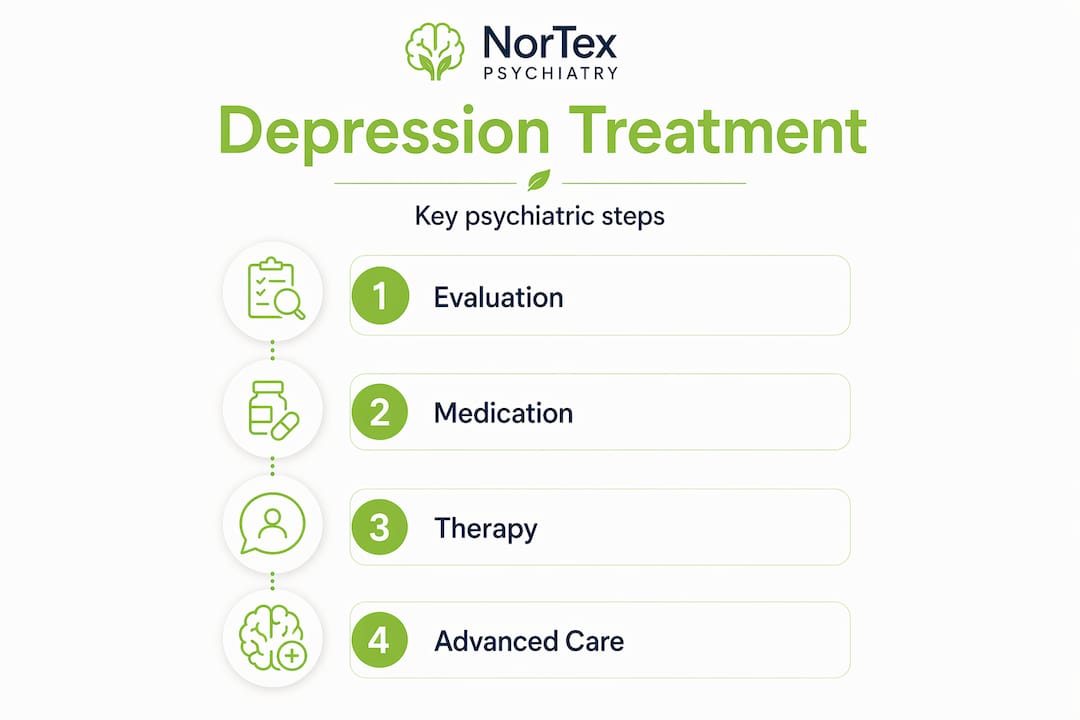
The most important thing to understand is that psychiatric treatment for depression rarely relies on a single tool. Medications and psychotherapy are both effective for most people, and they work even better together. A psychiatrist’s job is to figure out which combination fits you, then adjust over time as your response becomes clearer.
The ways psychiatry addresses depression can be grouped into three broad categories:
- Medication. Antidepressants are usually the first clinical intervention, chosen based on your symptoms, medical history, and any prior treatment experiences.
- Psychotherapy. Talk therapy helps you understand and shift the thought patterns and behaviors that fuel depression. It can run alongside medication or serve as the primary treatment in milder cases.
- Advanced therapies. When medication and therapy are not enough, options like transcranial magnetic stimulation (TMS), electroconvulsive therapy (ECT), or ketamine infusions come into play.
Formats matter too. Therapy can happen in person, via telehealth, or through structured self-help programs. We have found that flexible delivery significantly increases the likelihood that people actually continue care, which is ultimately what produces results. Ongoing evaluation is built into the process. Psychiatrists track your response, watch for side effects, and modify the plan when needed. This is not a set-and-forget process. It is active, collaborative work.
Antidepressant medication: what to expect
When it comes to how depression is treated with medication, selective serotonin reuptake inhibitors (SSRIs) are almost always the starting point. Medications like fluoxetine, escitalopram, and sertraline are well-studied, generally tolerated, and widely used as first-line antidepressant therapy. If one SSRI does not produce results, your psychiatrist may switch to another SSRI or move to a different class, such as serotonin-norepinephrine reuptake inhibitors (SNRIs) or atypical antidepressants.
Here is a realistic picture of the medication timeline:
- Weeks one and two. You may notice changes in sleep or appetite before mood lifts. Some mild side effects like nausea or headaches are common early on.
- Weeks two to four. Therapeutic effects often begin to appear. Energy and motivation sometimes improve before emotional symptoms fully ease.
- Weeks four to eight. Full symptom relief for many people arrives here. If you have not seen enough improvement by eight weeks, your psychiatrist will reassess.
- Months two through twelve. Continuing medication after you feel better is not optional. Most people take antidepressants for six to twelve months after achieving remission to reduce relapse risk.
- Beyond twelve months. Older adults and those with severe or recurrent episodes may need to maintain antidepressant doses for up to two years or longer.
Side effects are real, and they are one of the top reasons people stop medications too early. We have seen this pattern consistently. A mild side effect in week one is not a sign the medication is wrong for you. Most side effects ease within two to four weeks. Stopping early means you never give the drug a fair trial, and it means the depression often returns.
Pro Tip: If a side effect feels unmanageable, call your psychiatrist before stopping the medication. There are often simple adjustments, like changing the time of day you take it or adjusting the dose, that resolve the issue without abandoning a treatment that could be working.

For cases where a single antidepressant is not enough, psychiatrists may try combination strategies, adding a second antidepressant or an augmenting agent. This is a structured, evidence-guided process, not guesswork.
Psychotherapy as psychiatric treatment for depression
Medication changes brain chemistry. Psychotherapy changes how you think and respond. Both are necessary parts of depression management for most people, and neither completely replaces the other.
Cognitive behavioral therapy (CBT) is the most studied form of psychotherapy for depression. It works by helping you identify thought patterns that are distorted or self-defeating and replace them with more accurate, balanced thinking. If you habitually assume the worst or blame yourself unfairly, CBT gives you structured tools to interrupt those cycles. The effects are measurable and durable.
Other psychotherapy formats include:
- Interpersonal therapy (IPT). Focuses on relationship patterns and life transitions that contribute to depression, such as grief, role changes, or conflict.
- Behavioral activation. A more targeted approach that gradually rebuilds engagement with meaningful activities, countering the withdrawal that depression drives.
- Problem-solving therapy. Practical and structured, particularly helpful when life stressors are a clear driver of symptoms.
- Guided self-help. Therapist-supported workbooks or online programs based on CBT principles. A solid option when access to weekly therapy is limited.
The role of psychiatry in depression treatment through therapy is often underestimated. People sometimes expect psychiatrists to only prescribe medication. In our work, the most durable recoveries almost always involve some form of structured psychological support alongside medication.
Pro Tip: If in-person therapy feels like a barrier due to cost, scheduling, or stigma, ask about telehealth options. The evidence for remote CBT is strong, and the flexibility often makes it easier to stay consistent.
Advanced treatments for resistant or severe depression
Not everyone responds to standard medication and therapy. When two or more adequate antidepressant trials fail, the term treatment-resistant depression applies. This is more common than most people realize, affecting roughly one-third of those diagnosed with major depressive disorder. The good news is that psychiatry has meaningful options for this group.
| Treatment | How it works | Best for |
|---|---|---|
| ECT (Electroconvulsive Therapy) | Controlled electrical stimulation under anesthesia induces brief seizure to reset brain activity | Severe, medication-resistant, or high-risk depression |
| TMS (Transcranial Magnetic Stimulation) | Magnetic pulses target specific brain regions without sedation | Moderate treatment-resistant depression, outpatient setting |
| Ketamine (IV infusion) | Rapid-acting NMDA receptor antagonist; effects begin within hours | Acute suicidality, fast relief needed, TRD |
| Esketamine (intranasal) | FDA-approved nasal spray, given twice weekly initially | Treatment-resistant depression with clinical supervision |
| Immunotherapy (emerging) | Anti-inflammatory agents targeting inflammatory depression | Patients with elevated inflammation markers |
ECT has an undeserved reputation. For severe or medication-resistant cases, it remains one of the most effective interventions in psychiatry. TMS is a strong option for people who have not responded to antidepressants but want a drug-free, outpatient approach. You can read more about how TMS compares to ECT to understand which might suit your situation.
Ketamine has changed the conversation around crisis intervention. For someone in acute distress, the rapid onset of ketamine for depression can be genuinely life-saving. It is not a permanent fix, but it creates a window where other treatments can take hold. A pilot trial in 2026 also showed that an anti-inflammatory drug called tocilizumab reduced depression symptoms in patients whose depression was tied to high inflammation. This line of research could open new doors for a subgroup that has not responded well to traditional approaches.
Hospitalization is sometimes necessary when safety is a concern. This is not a failure. It is one of the tools psychiatry has specifically because depression can become life-threatening.
Working with your psychiatrist: practical guidance
Understanding the role of psychiatry in depression also means understanding what happens in the room between you and your psychiatrist. The quality of that relationship shapes your outcomes more than most people expect.
A few things that genuinely help:
- Be honest about what you are experiencing. Your psychiatrist cannot calibrate treatment without accurate information. This includes side effects, substance use, sleep changes, and suicidal thoughts.
- Track your symptoms between appointments. A simple daily mood log gives your psychiatrist a much clearer picture than trying to remember the past four weeks in a ten-minute visit.
- Ask about the plan. Understanding what your psychiatrist is trying to achieve with a particular medication or therapy approach reduces anxiety and increases adherence.
- Do not stop medications without talking to your psychiatrist first. Premature discontinuation is one of the most common reasons treatment fails. Even when you feel better, stopping abruptly can cause relapse or withdrawal symptoms.
- Understand who does what. Psychiatrists prescribe medication and manage your overall treatment plan. Therapists or counselors typically deliver ongoing psychotherapy. In many practices, these roles overlap or coordinate closely.
Recovery is not a straight line. There will be weeks that feel like setbacks. That does not mean the treatment is not working. Stay in communication with your care team, and resist the impulse to make large changes on your own.
My perspective on how depression gets treated
I have worked in psychiatry long enough to notice a recurring pattern. People come in expecting a prescription, a quick fix, and a clear timeline. When that does not happen, they get discouraged. They stop the medication before it has time to work. They skip therapy because they do not see the point. And then they conclude that nothing can help them.
What I have actually seen is that the patients who do best are the ones who commit to a sustained, multimodal approach. Medication alone, for most people, is not enough. Therapy alone, for moderate to severe depression, is often too slow. But together, with consistent support and honest communication, the outcomes are genuinely different. Recovery happens. Not always quickly, and not always smoothly. But it happens.
The mistake I see most often is treating the first medication trial as the whole of what psychiatry has to offer. If the first SSRI does not work well, that is not the end of the road. We have multiple medication options, multiple therapy modalities, and advanced interventions that the average person has never heard of. TRD is a real diagnosis, and it has real treatment options. My strongest advice is to stay in the process long enough to let it work.
— Felix
How Nortexpsychiatry can support your treatment
At Nortexpsychiatry, we work with individuals across Allen, Frisco, McKinney, Plano, and the wider North Dallas area who are navigating depression at all levels of severity. We offer personalized psychiatric care that covers the full range of depression management techniques, from medication evaluation and management to psychotherapy coordination and advanced options like TMS and ketamine therapy. If you have tried medications without enough relief, or if you are just starting to look for answers, we can help you figure out where to begin.
Our TMS vs. medication comparison is a useful starting point if you are weighing your options. We also offer a self-assessment tool to help you better understand your symptoms before your first appointment. Whether you prefer in-person visits or telehealth, we provide the same quality of care. Reach out when you are ready.
FAQ
What does a psychiatrist actually do for depression?
A psychiatrist evaluates your symptoms, medical history, and prior treatments to build an individualized plan that may include medication, psychotherapy referrals, and advanced treatments like TMS or ketamine when needed.
How long does psychiatric treatment for depression take?
Most people take antidepressants for at least six to twelve months after remission, and therapy is often ongoing. Older adults or those with recurrent episodes may need longer-term treatment.
What if the first antidepressant does not work?
If the first medication fails, psychiatrists typically switch to a different antidepressant or add an augmenting agent. For ongoing non-response, advanced options like TMS, ECT, or ketamine are available.
Is psychotherapy necessary if I am already on medication?
For most people with moderate to severe depression, combining medication with therapy produces better outcomes than medication alone. CBT in particular has durable, measurable benefits that medication does not fully replicate.
What is treatment-resistant depression?
Treatment-resistant depression is generally defined as depression that has not responded adequately to at least two different antidepressant trials at appropriate doses and durations. It has specific treatment options, including ketamine and brain stimulation therapies.