


If you want psychiatrist-led ADHD care with reliable medication management, Nortex Psychiatry is the recommended pick for adults in North Dallas and surrounding areas who need a board-certified clinician, continuity of care, and telehealth access. For those outside that region, the platforms below represent the strongest options currently available, each evaluated on prescribing transparency, clinician credentials, and state licensure coverage.
Federal telemedicine flexibilities allowing remote prescribing of Schedule II–V controlled substances, including stimulants like Adderall and Vyvanse, are extended through December 31, 2026. That extension matters because it means you can, under the right conditions, receive a stimulant prescription from a qualified clinician without a prior in-person visit. In recent years, millions of controlled-substance prescriptions have been issued via telemedicine, demonstrating how common remote prescribing has become. The access is real, but the platform you choose determines whether the care behind that prescription is rigorous enough to be safe and sustainable.
Quick shortlist:
- Nortex Psychiatry — Best for psychiatrist-led ADHD diagnosis, medication management, and follow-up in North Texas (telehealth available)
- Talkiatry — Best for dedicated psychiatric medication management via telehealth, insurance-friendly
- ADHD Online — Best for a streamlined remote ADHD assessment process
- ADHD Advisor (ADHDAdvisor.org) — Best for a platform built entirely around ADHD clinical pathways
- Done ADHD — Best for ADHD-focused intake with remote monitoring
- Cerebral — Best for an app-first integrated medication and therapy model
- BetterHelp — Best for therapy-only care without medication management
- Sesame — Best for transparent, pay-per-visit pricing with no subscription
Before booking any platform, confirm its current stimulant-prescribing policy and state licensure for your location. Policies can change faster than websites update.
Pro Tip: Ask any platform directly: “Does a board-certified psychiatrist or a nurse practitioner manage my ADHD medication?” The answer shapes the depth of your evaluation and the quality of your ongoing care.
Table of Contents
- How do the best telepsychiatry platforms for ADHD compare?
- What each platform actually offers for ADHD care
- How do you choose the right telepsychiatry platform for your ADHD care?
- What do the 2026 telemedicine prescribing rules mean for your ADHD medication?
- What does an ADHD evaluation and follow-up look like via telepsychiatry?
- How we chose these platforms
- Key Takeaways
- A clinician’s note on choosing telepsychiatry for ADHD
- Nortex Psychiatry offers psychiatrist-led ADHD care via telehealth
- Authoritative sources and further reading
- FAQ
How do the best telepsychiatry platforms for ADHD compare?
The table below covers the eight dimensions that matter most when choosing a virtual ADHD treatment provider. All cells are summaries. Verify current prescribing rules and state licensure directly with each platform before booking, as policies shift.
| Platform | Best for | Care types | Stimulant prescribing | Insurance / pricing | State availability | Typical wait | Clinician types | Communication |
|---|---|---|---|---|---|---|---|---|
| Nortex Psychiatry | Psychiatrist-led ADHD Dx + med mgmt, North Texas | Psychiatry, med management, telehealth, TMS, Ketamine | Yes, psychiatrist-supervised | Insurance accepted; fee-for-service | Texas (telehealth) | Days to 1–2 weeks | Psychiatrists | Video, phone |
| Talkiatry | Dedicated psychiatric med management | Psychiatry, med management | Yes, psychiatrist-led | Insurance accepted | 40+ states | 1–2 weeks | Psychiatrists | Video |
| ADHD Advisor (ADHDAdvisor.org) | ADHD-dedicated evaluation and follow-up | Psychiatry, ADHD assessment, med management | Yes, ADHD-focused pathways | Varies; check site | Select states | 1–2 weeks | Psychiatrists, NPs | Video, messaging |
| ADHD Online | Streamlined ADHD assessment | ADHD assessment, treatment plans | Yes, with clinical review | Subscription + per-visit | Most states | Days | NPs, clinicians | Video, messaging |
| Done ADHD | ADHD-focused intake and remote monitoring | ADHD assessment, med management | Yes, with monitoring | Subscription model | Select states | Days | NPs, physicians | Video, messaging |
| Cerebral | App-first integrated med + therapy | Psychiatry, therapy, med management | Yes, with clinical oversight | Subscription; some insurance | Most states | Days to 1 week | Psychiatrists, NPs, therapists | Video, messaging |
| Teladoc | Large-network general mental health | Psychiatry, therapy, general telehealth | Yes, case-by-case | Insurance accepted; per-visit | All 50 states | 1–2 weeks | Psychiatrists, NPs, therapists | Video, phone |
| Talkspace | Therapy-first with optional psychiatric consults | Therapy, some psychiatry | Limited; state-dependent | Insurance accepted; subscription | Most states | Days to 1 week | Therapists, some psychiatrists | Video, messaging, phone |
| BetterHelp | Therapy-only, no medication management | Therapy (counseling only) | No | Subscription | All 50 states | Days | Licensed therapists | Video, messaging, phone |
| Sesame | Transparent per-visit pricing | Primary care, some behavioral health | Yes, provider-dependent | Pay-per-visit, no subscription | Most states | Days | MDs, NPs, varies | Video, phone |
| Grow Therapy | Therapy matching and access | Therapy | No | Insurance accepted | Most states | 1–2 weeks | Licensed therapists | Video, phone |
| Circle Medical | Combined primary care + behavioral health | Primary care, behavioral health | Yes, with clinical review | Insurance accepted; per-visit | Most states | Days to 1 week | MDs, NPs | Video |
| ADHD Advisor | ADHD-dedicated clinical pathways | ADHD assessment, med management | Yes | Varies | Select states | 1–2 weeks | Psychiatrists, NPs | Video, messaging |
Key regulatory and prescribing notes:
- Stimulant prescribing via telemedicine is currently permitted under DEA and HHS conditions: legitimate medical purpose, interactive video, and a DEA-registered practitioner.
- Some states impose stricter rules. New Jersey, for example, requires an in-person exam for certain Schedule II prescriptions with limited exceptions, per psychiatry.org guidance.
- Platforms that rely solely on nurse practitioners for prescribing may have narrower authority in some states than those with supervising psychiatrists.
- Table cells are summaries. Confirm current state licensure and prescribing policy with each platform before booking.
What each platform actually offers for ADHD care
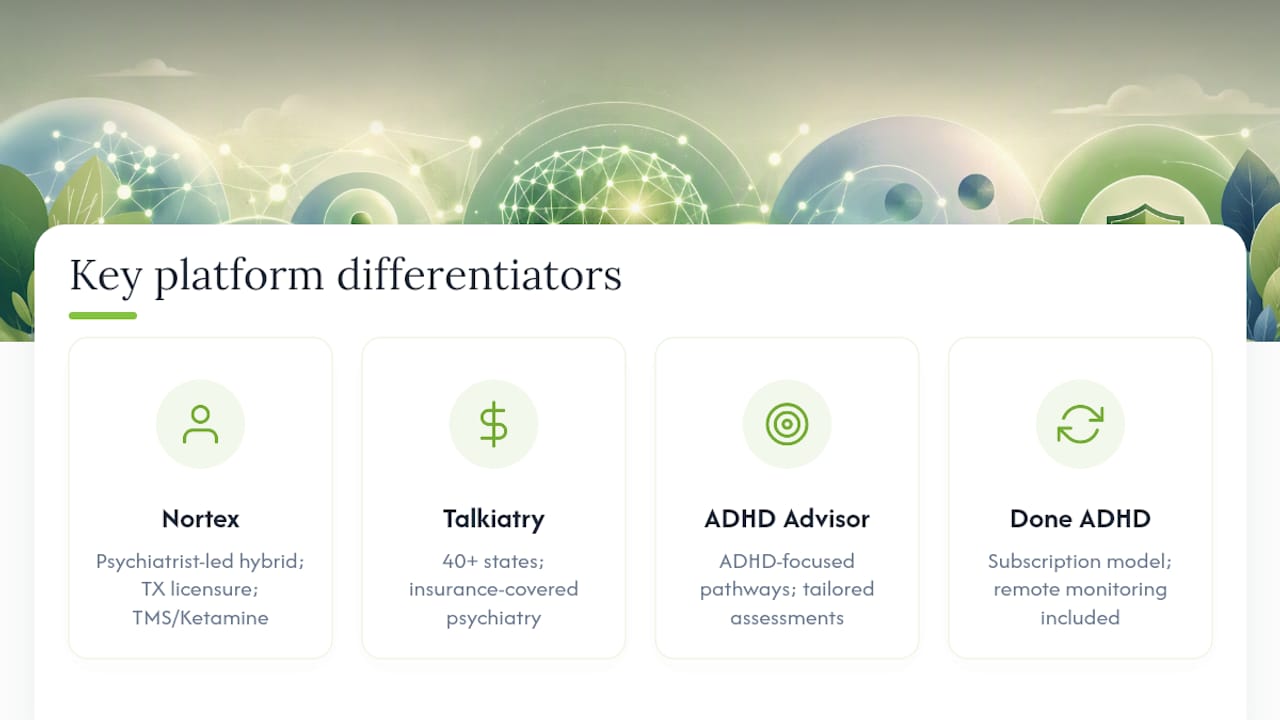
Nortex Psychiatry leads this list because it is the only option here built on a psychiatrist-led, in-person-and-telehealth hybrid model with local licensure in Texas. For adults in Allen, Frisco, McKinney, Plano, and surrounding North Dallas communities, that means your ADHD evaluation and medication management are handled by a board-certified psychiatrist who can also coordinate with your primary care provider, order labs, and adjust treatment over time. The practice offers telepsychiatry for busy adults alongside specialty services like TMS and Ketamine that most telehealth-only platforms cannot provide. If you want a clinical relationship, not just a prescription, this is the model that supports it.
Talkiatry is the strongest national option for patients who want insurance-covered psychiatric medication management without a local practice. It operates in 40+ states, staffs board-certified psychiatrists, and accepts most major insurance plans. The trade-off is that it is psychiatry-only: if you also want integrated therapy, you will need a separate provider.
ADHD Advisor (ADHDAdvisor.org) is built specifically around ADHD clinical pathways, which means the intake process, assessment tools, and follow-up protocols are designed for this condition rather than adapted from a general mental health model. That focus can translate to a more thorough evaluation for adults who have been misdiagnosed or underdiagnosed elsewhere.
ADHD Online prioritizes speed. The assessment workflow is designed to move from intake to diagnosis to treatment plan quickly, which suits adults who have already done the research and want to confirm a diagnosis and start treatment without a lengthy intake process. Clinicians are primarily nurse practitioners, so if you want psychiatrist oversight, confirm that before booking.
Done ADHD uses a subscription model with remote monitoring built in, which works well for adults who want structured check-ins rather than scheduling follow-ups manually. The ADHD-specific workflow is a genuine differentiator, though availability varies by state.
Cerebral offers an app-first experience that combines medication management and therapy in one platform. It has faced regulatory scrutiny in the past regarding prescribing practices, so confirm its current stimulant-prescribing policy and clinician oversight model before enrolling. The integrated care pathway is convenient when it works well.
Teladoc is the broadest network on this list, covering all 50 states and offering both psychiatry and therapy. It is a reasonable choice for adults who need general mental health coverage through their insurance, but ADHD is not a specialty focus, and wait times for psychiatry appointments can run one to two weeks.
Talkspace leads with therapy and adds psychiatric consults in some states. For adults who want to start with counseling and add medication management later, it is a workable path. Prescribing availability is state-dependent, so check before assuming it is available in your location.
BetterHelp is therapy-only. It does not prescribe or manage medication. For adults who want medication vs. therapy guidance before deciding on a platform, that distinction is worth understanding clearly.
Sesame works differently from every other option here. It is a marketplace where you pay per visit at transparent, pre-listed prices, with no subscription. Some providers on Sesame will prescribe stimulants; others will not. You are choosing an individual clinician, not a platform with a consistent prescribing policy.
Grow Therapy matches patients with therapists and focuses on psychotherapy access. Like BetterHelp, it does not offer medication management. It is a solid option for adults who want therapy as their primary intervention and are already managing medication elsewhere.
Circle Medical combines primary care and behavioral health telehealth, which is useful for adults who want a single provider managing both their physical health and ADHD. Prescribing is available but varies by clinician.
Pro Tip: If you are already on a stimulant and switching platforms, ask the new provider explicitly how they handle prescription continuity during the transition period. A gap in stimulant access can significantly disrupt daily function.
How do you choose the right telepsychiatry platform for your ADHD care?
The decision comes down to five questions, in this order.
-
Does the platform employ board-certified psychiatrists? Nurse practitioners and physician assistants can prescribe stimulants in many states, but a psychiatrist brings diagnostic depth that matters for complex presentations, comorbidities like anxiety or depression, and treatment-resistant cases. The role of psychiatrists in ADHD care is not interchangeable with a prescribing-only model.
-
What is the platform’s stimulant-prescribing policy? Some platforms prescribe Schedule II stimulants (amphetamines, methylphenidate) after a remote evaluation. Others prescribe only non-stimulant options like Strattera or Wellbutrin. A few have paused stimulant prescribing entirely in certain states. Get this in writing before you book.
-
How does the platform handle continuity of care? A one-time evaluation that produces a prescription is not a care model. Ask about follow-up cadence, what happens if your clinician leaves the platform, and whether your records transfer if you move to a different provider.
-
Does the platform integrate with your primary care provider? ADHD medications affect blood pressure, sleep, and appetite. A platform that communicates with your PCP, or at minimum provides structured documentation you can share, is safer than one that operates in isolation.
-
Does your insurance cover it? Out-of-pocket costs vary widely. Talkiatry and Teladoc accept most major insurance plans. Sesame and some ADHD-specific platforms are cash-pay only. Cerebral and Done ADHD use subscription models that may or may not be reimbursable.
Red flags to watch for:
- No psychiatrist on staff, only questionnaire-based intake with no structured clinical interview
- Opaque prescribing policies or no published information about how stimulants are managed
- No documented state licensure for your state
- No clear process for emergencies or medication side effects
- Clinician profiles that are not publicly verifiable
What do the 2026 telemedicine prescribing rules mean for your ADHD medication?
The current federal position is clear: HHS and DEA extended telemedicine prescribing flexibilities for Schedule II–V controlled substances through December 31, 2026. That means a DEA-registered clinician can prescribe stimulants like Adderall or Vyvanse via a telehealth visit without a prior in-person exam, provided the visit uses interactive video and serves a legitimate medical purpose.
More than 7 million controlled-substance prescriptions were issued via telemedicine in 2024, demonstrating how central remote prescribing has become to mental health access in the United States. — HHS.gov
This extension is the fourth of its kind since the pandemic-era flexibilities began. The Special Registration NPRM, published in the Federal Register in December 2025, proposes a longer-term framework that would allow some telemedicine prescribing without prior in-person visits under a new DEA registration category. The extension to December 2026 buys time for those final rules to be implemented without creating a “telemedicine cliff” that would abruptly cut off access for patients already receiving care.
The DEA’s conditions for remote prescribing require three things: the prescription must serve a legitimate medical purpose, the visit must use interactive two-way video, and the prescribing clinician must hold a valid DEA registration. Platforms that meet these conditions can legally prescribe stimulants remotely through the end of 2026.
State law adds another layer. Psychiatry.org’s Ryan Haight Act guidance notes that some states impose stricter requirements than federal minimums. New Jersey, for example, requires an in-person examination before prescribing certain Schedule II medications, with limited exceptions. Before you book, check your state’s specific rules, not just the federal extension.
Legal analysts at Kaufman Dolowich and McDermott Will & Emery both note that the extension preserves patient access while giving providers time to build the recordkeeping and monitoring infrastructure the new permanent rules will require. The practical implication: platforms that are already maintaining rigorous PDMP checks, documented follow-ups, and structured monitoring are better positioned for whatever the final rules look like.
What to confirm with any platform before starting stimulant treatment:
- Does the clinician check your state’s Prescription Drug Monitoring Program (PDMP) before prescribing?
- What is the follow-up schedule after the first prescription?
- Will the platform request lab work if clinically indicated?
- What is the refill and monitoring policy if you miss a follow-up?
- How does the platform handle a change in your state’s prescribing rules?
Pro Tip: The telehealth.hhs.gov prescribing guidance is publicly available and written for providers. Reading it takes ten minutes and tells you exactly what any legitimate platform should be doing.
What does an ADHD evaluation and follow-up look like via telepsychiatry?
The first visit on any reputable telepsychiatry platform is a clinical interview, not a questionnaire you fill out and submit. Adult ADHD diagnosis requires a structured assessment of symptom history, functional impairment, and rule-out of conditions that can mimic ADHD, including anxiety, sleep disorders, and mood disorders.
A typical initial telepsychiatry ADHD evaluation follows this sequence:
- Intake forms (completed before the visit): symptom history, medication list, prior diagnoses, family psychiatric history
- Structured clinical interview (30–60 minutes): onset of symptoms, childhood history, current functional impairment across work, relationships, and daily tasks
- Rating scales: tools like the Adult ADHD Self-Report Scale (ASRS) or Conners’ Adult ADHD Rating Scales are commonly used to quantify symptom severity
- PDMP check: the clinician reviews your prescription history before any controlled substance is prescribed
- Collateral history (when available): input from a partner, family member, or prior clinician adds diagnostic accuracy
- Prescription decision: if stimulants are indicated and the platform’s policy permits, a prescription may be issued at the first visit or after a brief follow-up
Follow-up cadence typically looks like this: a check-in at 2–4 weeks after starting a new medication, then at 6–8 weeks to assess efficacy and side effects, then every 3 months once stable. Platforms that offer only annual check-ins are not providing adequate medication management for stimulants.
What to prepare before your first visit:
- Government-issued photo ID
- Current medication list, including supplements
- Prior psychiatric or psychological evaluations, if any
- A quiet, private space with a stable internet connection
- Notes on specific situations where ADHD symptoms affect your daily function
For practical tech setup guidance, the telehealth setup guide for mental health covers equipment, environment, and what to do if the connection drops mid-visit.
Pro Tip: Keep a simple daily log for two weeks before your first appointment: note when focus breaks down, what you were doing, and how long tasks take compared to what you expected. That data is more useful to a clinician than a general description of “I can’t concentrate.”

How we chose these platforms
We reviewed each platform on a defined set of clinical and operational criteria, not on marketing claims or review volume. The process included reviewing published prescribing policies, checking clinician profile pages for board certification and state licensure, attempting sample booking flows to assess wait times and intake transparency, and cross-referencing platform policies against current DEA and HHS telehealth prescribing guidance.
Evaluation criteria:
- Clinical leadership: does a board-certified psychiatrist lead or supervise care?
- Prescribing transparency: is the stimulant-prescribing policy publicly documented?
- Clinician credentials: are individual clinician profiles verifiable?
- State licensure coverage: how many states does the platform serve, and is your state included?
- Communication options: video, messaging, phone availability
- Wait times: days vs. weeks to first appointment
- Pricing and insurance transparency: is cost clear before booking?
- Privacy and data security: HIPAA compliance, data-sharing policies
“Experts caution that the current telehealth prescribing flexibilities are temporary and were intended as a bridge. Patients should choose practices that maintain rigorous clinical standards and recordkeeping so care remains stable if rules change.” — Psychiatry.org
Platforms with opaque prescribing policies, no verifiable psychiatrist on staff, or no documented state licensure were excluded from the shortlist regardless of their marketing presence. Review counts and star ratings were considered as one signal among many, not as a primary ranking factor.
Key Takeaways
The strongest telepsychiatry platforms for ADHD combine board-certified psychiatric oversight, transparent stimulant-prescribing policies, and structured follow-up care that extends well beyond the initial evaluation.
| Point | Details |
|---|---|
| Psychiatrist access matters | Platforms with board-certified psychiatrists offer deeper diagnostic evaluation and safer medication management than prescribing-only models. |
| Stimulant prescribing is legal via telehealth through 2026 | HHS and DEA extended remote Schedule II–V prescribing flexibilities through December 31, 2026, under specified conditions. |
| State rules vary | Some states, including New Jersey, require an in-person exam for certain Schedule II prescriptions; check your state’s rules before booking. |
| Follow-up cadence is a quality signal | Reputable platforms schedule follow-ups at 2–4 weeks, then 6–8 weeks, then every 3 months once stable, not just annually. |
| Nortex Psychiatry | Recommended for adults in North Texas seeking psychiatrist-led ADHD diagnosis, medication management, and telehealth continuity of care. |
A clinician’s note on choosing telepsychiatry for ADHD
We have seen a real shift in how adults access ADHD care over the past few years, and most of it is positive. Telehealth removes barriers that kept people from getting evaluated for years. That matters. At the same time, we notice that the convenience of a fast online intake can sometimes substitute for the depth of a real clinical relationship, and that gap shows up later, when a medication isn’t working or a comorbid condition gets missed.
The trade-off in telepsychiatry ADHD care is not access versus quality. It is continuity versus convenience. A platform that gets you a prescription in 48 hours but has no structured follow-up is not managing your care; it is filling a prescription. The platforms worth your time are the ones where a clinician reviews your PDMP history, asks about sleep and appetite at every follow-up, and adjusts the plan when something isn’t working.
We also want to be direct about something: ADHD in adults often travels with anxiety, depression, or sleep disorders. A platform that evaluates only for ADHD and prescribes a stimulant without screening for those conditions is taking a clinical shortcut. If you have ever been told your anxiety is “just ADHD,” or your depression is “just inattention,” that is worth raising explicitly with any new provider.
Trust the clinical relationship more than the platform’s marketing. Document your symptoms between visits. And if a platform’s prescribing policy is not clearly published, that is information too.
For adults in North Texas who want psychiatrist-led ADHD care with that kind of depth, the ADHD treatment options overview at Nortexpsychiatry covers what to expect and how to prepare.
Nortex Psychiatry offers psychiatrist-led ADHD care via telehealth
For adults in Allen, Frisco, McKinney, Plano, and surrounding North Dallas communities, Nortexpsychiatry provides what most telehealth-only platforms cannot: a board-certified psychiatrist who conducts your evaluation, manages your medication, and maintains your care record over time. That means your stimulant prescription comes with a clinical relationship, not just a remote intake form.
The practice accepts insurance and offers both in-person and telehealth visits, so you can start remotely and transition to in-office care if your treatment plan calls for it. Specialty services like TMS and Ketamine infusion therapy are available for patients whose ADHD coexists with treatment-resistant depression, which is more common than most platforms acknowledge.
If you are ready to move from researching platforms to booking an evaluation, the psychiatric care guide for adults explains what to expect and how to prepare for your first visit. You can also review medication management guidance to understand what ongoing ADHD treatment looks like in practice.
Authoritative sources and further reading
Before booking any telepsychiatry platform, verify its prescribing policy and state licensure directly. Regulations change, and a platform’s website may not reflect the most current rules.
- HHS & DEA Extend Telemedicine Flexibilities for Prescribing Controlled Medications Through 2026 | HHS.gov
- Federal Register, Volume 90 Issue 247 (Wednesday, December 31, 2025)
- DEA/HHS telemedicine rule document (HHS-DEA.pdf)
- Prescribing controlled substances via telehealth | Telehealth.HHS.gov
- Psychiatry.org — Online Prescribing of Controlled Substances
- Adult ADHD — Symptoms and causes – Mayo Clinic
- Pandemic-Era Telemedicine Prescribing Flexibilities for Controlled Substances Extended Through 2026, Kaufman Dolowich
Check your state medical board’s website and the specific platform’s prescribing policy page before scheduling an initial evaluation, particularly if you are currently on a stimulant and need to confirm continuity of access.
FAQ
What is the best telehealth platform for ADHD?
The best platform depends on whether you need medication management or therapy only. For psychiatrist-led ADHD diagnosis and stimulant prescribing, Nortexpsychiatry (for North Texas adults), Talkiatry, and ADHD Advisor are the strongest options. BetterHelp and Grow Therapy are appropriate for therapy-only care.
Can a telehealth provider prescribe ADHD stimulants in 2026?
Yes. HHS and DEA extended telemedicine prescribing flexibilities for Schedule II–V controlled substances through December 31, 2026, allowing DEA-registered clinicians to prescribe stimulants via interactive video without a prior in-person visit, subject to state-level rules.
What is the 24-hour rule for ADHD?
The “24-hour rule” is not a formal clinical or regulatory standard in ADHD treatment. Some clinicians use the phrase informally to describe waiting a day before making a decision when stimulant medication is wearing off, to avoid impulsive choices during that transition period. It is not a prescribing guideline.
How do I know if a telepsychiatry platform is legitimate for ADHD care?
Look for three things: a board-certified psychiatrist or licensed clinician on staff, a published stimulant-prescribing policy that references PDMP checks and structured follow-up, and verifiable state licensure for your location. Platforms that rely solely on intake questionnaires without a live clinical interview are not providing a diagnostic evaluation.
What should I bring to my first telepsychiatry ADHD evaluation?
Prepare a current medication list, any prior psychiatric or psychological evaluations, a photo ID, and notes on specific situations where ADHD symptoms affect your daily function. A quiet, private space with a stable internet connection is also necessary for a productive visit.
This article provides general information about telepsychiatry platforms and ADHD care. It is not a substitute for professional medical advice. Confirm current prescribing rules, state licensure, and platform policies with a qualified clinician or your state medical board before making treatment decisions.