


The single most important thing you can do before your visit: bring your photo ID, insurance card, and a one-page symptom timeline. Everything else builds from there.
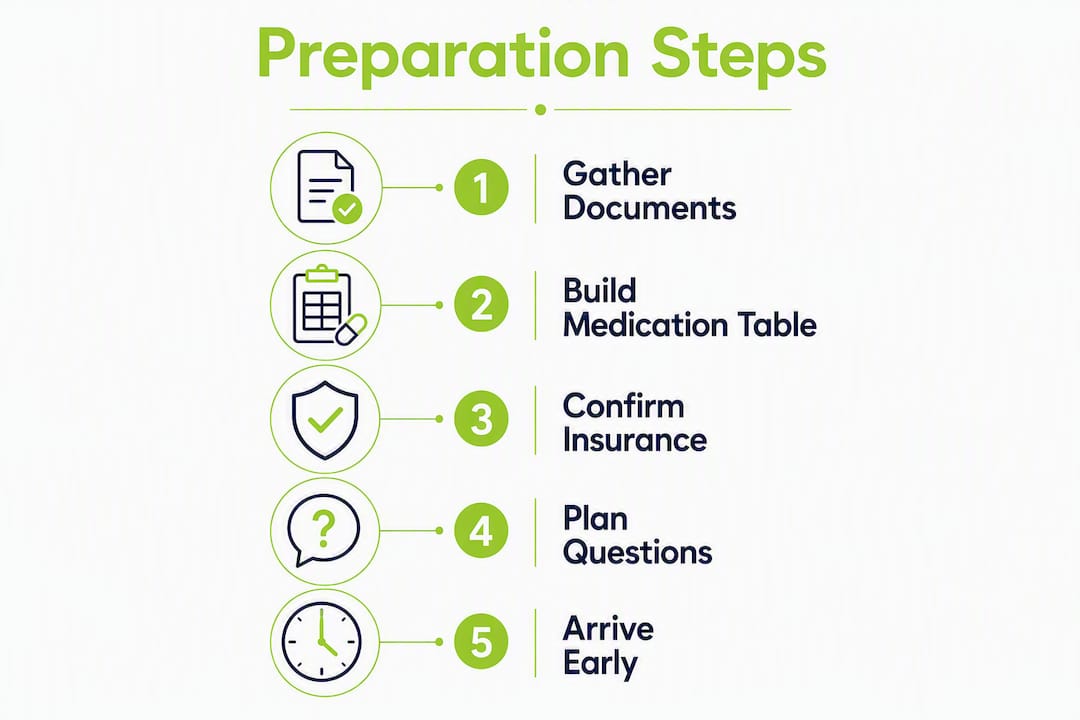
In the 48 hours before your appointment, work through these five actions:
- Write out every current medication, including dosages, how long you’ve taken each one, and any side effects you’ve noticed.
- Print or gather prior psychiatric records, hospital discharge summaries, or recent lab results.
- Write down your top three concerns in plain language, not clinical terms.
- If your visit is via telehealth, test your camera, microphone, and internet connection.
- Call your insurance company to confirm your mental health benefits, copay, and whether a referral is required.
The bottom line: Arrive with your documents organized, your top concerns written down, and your questions ready. NAMI describes this appointment as a collaboration between two experts: your clinician’s training and your lived experience. The more clearly you can share yours, the more useful the visit becomes.
Table of Contents
- What documents should you bring to a psychiatrist?
- How to handle insurance, telehealth setup, and scheduling
- What actually happens during a first psychiatric appointment?
- What should you say to your psychiatrist, and how?
- How to take notes and track your progress between visits
- How do you know if this psychiatrist is a good fit?
- What does a psychiatric appointment cost, and how long does it take?
- Practical resources to use before your visit
- Key Takeaways
- What we notice in first visits, and what we tell patients
- Ready to book your evaluation at Nortexpsychiatry?
- Useful sources
- FAQ
What documents should you bring to a psychiatrist?
Bringing the right documents prevents administrative delays and gives your clinician a clearer starting point. The Ohio State Wexner Medical Center recommends arriving with photo identification, insurance information, and your copay if applicable. Beyond those basics, a complete psychiatric folder makes a real difference in how much ground you can cover.
Your folder should include:
- Photo ID and insurance card
- A payment method (copay or self-pay amount)
- Current medication list with dosages, start dates, and known side effects
- Prior psychiatric or therapy records, even if partial
- Hospital discharge summaries from any mental health-related stays
- Recent lab work, particularly thyroid panels, metabolic panels, or sleep studies
- A one-page symptom timeline covering when symptoms started, what triggers them, and what helps or worsens them
Building your medication table
A focused medication history reduces the risk of interactions and speeds safe treatment decisions. Use this column structure when you write yours out:
| Medication name | Dose | Frequency | Start date | End date | Reason stopped | Side effects |
|---|---|---|---|---|---|---|
| Sertraline | — | Daily | — | — | Partial response | Insomnia, nausea |
| Buspirone 10 mg | 10 mg | Twice daily | — | Present | Ongoing | None noted |

Include over-the-counter medications, supplements, and herbal products. Melatonin, St. John’s Wort, and fish oil all interact with psychiatric medications in ways that matter clinically.
Pro Tip: White-coat amnesia is real. Under clinical pressure, many patients forget key details they know perfectly well at home. Keep a simple folder, digital or paper, with your medication log, symptom notes, and prior records. Pulling it out during the visit takes ten seconds and saves significant time for the actual conversation.
How to handle insurance, telehealth setup, and scheduling
Verifying your insurance coverage
Call the member services number on your insurance card before you book. Ask specifically:
- Is outpatient psychiatric care covered under my plan?
- What is my copay or coinsurance for a specialist visit?
- Do I need a referral from my primary care physician?
- Is this provider in-network?
- What is the cancellation policy, and will I be charged for a missed appointment?
Getting these answers in writing, or at least noting the representative’s name and call date, protects you if billing disputes arise later.
Evaluating provider fit before you commit
Look for a clinician whose stated specialty matches your primary concern. A psychiatrist who focuses on mood disorders and ADHD will approach a depression evaluation differently than one whose practice centers on psychosis or addiction. Ask whether the practice uses shared decision-making and whether you’ll have input in treatment choices. That question alone tells you a great deal about how the relationship will work.
Telehealth setup checklist
Telepsychiatry is effective for medication management and follow-ups, but a technical failure at the start of a session wastes clinical time. Run through this before your appointment:
- Device charged and updated (phone, tablet, or laptop)
- Camera and microphone tested
- Private, quiet location confirmed
- Platform app downloaded and login verified
- Bandwidth adequate (stream a short video to check)
- HIPAA-compliant platform confirmed with the clinic
On privacy: Ask the clinic directly which platform they use and whether it is HIPAA-compliant. For telehealth, your physical location matters too. A parked car or a private room works; a shared office or a coffee shop does not.
Appointment length
Initial psychiatric evaluations typically run around an hour to an hour and a half. Follow-up visits are usually about twenty to thirty minutes. If your history is complex, ask when scheduling whether an extended initial slot is available.
What actually happens during a first psychiatric appointment?
The first visit is primarily fact-gathering, not a finalized treatment plan. Many patients expect to leave with a diagnosis and a prescription. Clinicians usually gather facts first and then monitor symptoms across visits before committing to long-term decisions. Knowing that going in reduces the pressure you put on yourself to have everything figured out.
Here is how the visit typically flows and what each phase is for:
| Visit phase | Approximate time | What the clinician is assessing | What you should be ready to share |
|---|---|---|---|
| Intake and paperwork | about ten minutes | Administrative accuracy, consent | ID, insurance, completed forms |
| Clinical interview | 20–30 min | Symptom history, onset, triggers, functioning | Your one-page timeline, family history |
| Mental status exam | 5–10 min | Mood, cognition, appearance, thought process | Answer honestly; no right answers here |
| Medication review | 5–10 min | Interactions, prior trials, current response | Your medication table |
| Safety assessment | 5 min | Suicidal or self-harm ideation, risk factors | Be direct; this is confidential |
| Next steps discussion | 5–10 min | Diagnostic impression, labs, referrals, follow-up | Your top questions |
A full psychiatric evaluation commonly includes a clinical interview, mental status exam, medication review, and safety assessment. Standardized rating scales, such as the PHQ-9 for depression or the GAD-7 for anxiety, may also be used to quantify symptom severity.
If your appointment time is limited, lead with your most pressing concern in the clinical interview phase. You can always say, “The thing I most need help with today is…” and name it plainly.
What should you say to your psychiatrist, and how?
Clear communication is the skill that makes the biggest difference in a first visit. Writing down your questions and history reduces appointment-related anxiety and helps you cover what matters most.
Questions worth asking your psychiatrist
- What is your working diagnosis, or what conditions are you considering?
- What are my treatment options, and what are the trade-offs?
- If you recommend medication, what side effects should I watch for in the first two to four weeks?
- How will we know if this approach is working?
- How do I reach you between appointments for urgent concerns?
Describing symptoms clearly
Vague language slows the diagnostic process. Compare these two descriptions:
- Vague: “I’ve been feeling off for a while.”
- Specific: “Since March, I’ve had trouble falling asleep at least four nights a week, and I’ve stopped going to the gym, which I used to do daily.”
Concrete examples, specific days, and measurable changes help clinicians form accurate diagnostic impressions faster than general descriptors. If you can say when something started, how often it happens, and what it prevents you from doing, you’ve given your clinician the three things they need most.
Scripts for sensitive topics
Raising difficult subjects is easier with a simple opener. Try:
- “There’s something I haven’t told other providers because I wasn’t sure how it would be received. Can I share it?”
- “I’ve had thoughts of harming myself. They’re not constant, but I want you to know.”
- “I use [substance] occasionally. I want to be honest about that so it doesn’t affect my treatment.”
On confidentiality: Ask your clinician at the start of the visit: “Can you walk me through what stays private and what you’re required to report?” Understanding the limits of confidentiality before you disclose sensitive information helps you share more openly.
Shared decision-making in practice
Ask directly: “Do you use shared decision-making in your practice?” A clinician who does will explain options, invite your preferences, and treat your concerns as data, not obstacles. If you disagree with a recommendation, say so plainly: “I’d like to understand more before I decide.” That is not resistance. It is good clinical collaboration.
How to take notes and track your progress between visits
A simple visit-note template keeps your care organized across appointments:
| Field | What to record |
|---|---|
| Date and clinician | Visit date, provider name |
| Top 3 concerns raised | Exactly as you stated them |
| Working diagnosis | What the clinician said, in their words |
| Medication changes | New prescriptions, dose adjustments, stops |
| Safety plan | Any agreed-upon steps if symptoms worsen |
| Next appointment | Date, time, location or telehealth link |

Between visits, log your medication start date, current dose, and any side effects you notice. Note the date you first noticed a benefit, if one appears. Most psychiatric medications take two to twelve weeks to show meaningful effect, so tracking week by week gives you real data to bring back.
For symptom monitoring, a simple daily mood scale (1–10) and a brief sleep log are enough. You don’t need a clinical app. A notes file on your phone works fine. Knowing how to reach your clinician between visits for refill requests, urgent concerns, or dose questions prevents gaps in care. Ask at the first appointment: “What’s the best way to contact you between visits, and what’s your typical response time?”
How do you know if this psychiatrist is a good fit?
Give it one to three visits before drawing a firm conclusion, unless a safety concern arises. A single appointment rarely shows the full picture of how a clinician works.
Signs the relationship is working:
- The clinician listens without interrupting before forming conclusions.
- They explain their reasoning and invite your questions.
- They present options rather than directives.
- Office communication is clear: you know how to get refills, who to call in a crisis, and when your next appointment is.
Red flags worth noting:
- Dismissive responses to your questions or concerns
- Pressure to accept a medication without any discussion of alternatives or side effects
- No clarity on follow-up or how to reach the clinic between visits
- Repeated administrative errors or difficulty getting callbacks
If you want to raise a concern, try: “I want to make sure I understand the reasoning here. Can you walk me through why this is the recommended approach?” That framing is respectful and gives the clinician a chance to explain. If you decide to transfer care, you have the right to request your records. Ask the front desk for the records release form.
What does a psychiatric appointment cost, and how long does it take?
Costs vary by insurance plan, provider, and visit type. These are the questions to ask before your first appointment:
| Cost question | Why it matters |
|---|---|
| What is my copay for a specialist visit? | Determines your out-of-pocket cost per session |
| Is this provider in-network? | Out-of-network costs can be significantly higher |
| What is the self-pay rate for an initial evaluation? | Relevant if you are uninsured or using out-of-network benefits |
| Is there a cancellation fee, and how much notice is required? | Missed appointments often carry a flat fee |
| Does the practice offer a sliding scale or payment plan? | Ask directly if cost is a barrier to continuing care |
On clinical timelines: diagnostic clarity often takes two to three visits. Medication adjustments typically show meaningful benefit within two to twelve weeks, depending on the medication class. If financial barriers threaten continuity of care, ask about telehealth options, which sometimes carry lower fees, or about spacing visits to monthly rather than biweekly while you stabilize.
Practical resources to use before your visit
Nortexpsychiatry offers patient-education resources designed specifically to help you prepare, including step-by-step starting guides, diagnosis explanations, and telehealth setup instructions. Use them in the 24–48 hours before your appointment.
Here is what to prepare and when to use each resource:
- Telehealth setup checklist: — Run through it 30 minutes before a virtual visit. Log in five minutes early to catch any technical issues.
When you call to schedule, you can use this script: “I’m scheduling an initial psychiatric evaluation. Can you tell me what forms I need to complete before the visit, whether you accept [insurance name], and what the cancellation policy is?” That one call covers the administrative basics.
A note on privacy: All records shared during your visit, whether in-person or via telehealth, are protected under HIPAA. Telehealth platforms used by licensed psychiatric practices are required to be HIPAA-compliant. If you have questions about how your records are stored or shared, ask the front desk before your appointment.
For pre-visit anxiety, the step-by-step anxiety relief guide at Heske Therapy offers daily practices you can use in the days leading up to your appointment.
Key Takeaways
Arriving prepared with your documents, a clear symptom summary, and your top questions is the single most effective way to make a first psychiatric appointment productive.
| Point | Details |
|---|---|
| Documents to bring | Photo ID, insurance card, medication list with dosages, and prior psychiatric records. |
| Symptom timeline | Write when symptoms started, what triggers them, and how they affect daily functioning. |
| Top questions ready | Prepare at least three questions covering diagnosis, treatment options, and follow-up contact. |
| Shared decision-making | Ask your clinician to explain options and invite your input before any treatment decision. |
| Nortexpsychiatry resources | Use Nortexpsychiatry’s patient guides and telehealth checklist in the 24–48 hours before your visit. |
What we notice in first visits, and what we tell patients
The patients who get the most from a first appointment are rarely the ones who have everything figured out. They’re the ones who came prepared to be honest.
We notice a consistent pattern: patients who bring a written medication list and a brief symptom timeline move through the clinical interview faster and spend more time on the questions that actually matter to them. Patients who arrive without those materials spend a significant portion of the visit reconstructing history from memory, often imperfectly.
We also notice that patients frequently minimize symptoms out of concern about how they’ll be perceived. Saying “I’ve been a little down” when you mean “I haven’t left the house in two weeks” costs you diagnostic accuracy. Clinicians are not here to judge the severity of what you’re experiencing. We need the accurate version to help you.
On sensitive disclosures: substance use, suicidal thoughts, and medication non-compliance are among the most common things patients hesitate to share. They are also among the most clinically important. What you tell us stays within the bounds of confidentiality except in specific, legally defined circumstances, which your clinician will explain at the start of the visit.
Bring curiosity, not a performance. The appointment works best when you treat it as a conversation between two people trying to solve the same problem. You know your experience. We know the clinical framework. Together, those two things are enough to get started.
Ready to book your evaluation at Nortexpsychiatry?
If you’re in Allen, Frisco, McKinney, Plano, or anywhere across North Dallas, Nortexpsychiatry offers initial psychiatric evaluations with both in-person and telehealth options. The practice specializes in anxiety, depression, ADHD, and mood disorders, with personalized care that includes medication management and evidence-based treatment.
Learn why psychiatric care makes a difference for adults navigating these conditions, or review the advantages of a formal psychiatric evaluation before you schedule. If you have insurance or billing questions, the front desk can verify your coverage before your first visit. To book an appointment or ask about preparing, contact Nortexpsychiatry directly through the website.
Useful sources
- How to Prepare for Your Psychiatric Appointment | NAMI
- Psychiatric Evaluation | Ohio State Wexner Medical Center
- Starting psychiatric treatment: a step-by-step guide for adults | Nortexpsychiatry
FAQ
What should you not say during a psychiatric evaluation?
Avoid minimizing or exaggerating symptoms to manage how you’re perceived. Saying “I’m fine, just a little stressed” when your functioning has significantly declined gives your clinician inaccurate data to work with. Be specific and honest, even when the truth feels uncomfortable.
What do psychiatrists want to hear from patients?
Clinicians want concrete, specific information: when symptoms started, how often they occur, and how they affect your daily life. Vague descriptors slow the process; specific examples and timelines help form an accurate diagnostic picture faster.
How long is a typical first psychiatric appointment?
Initial psychiatric evaluations typically run around an hour to an hour and a half. Follow-up appointments are usually 20–30 minutes. If your history is complex, ask when scheduling whether an extended initial slot is available.
What is the first question a psychiatrist usually asks?
Most clinicians open with a broad, open-ended question such as “What brings you in today?” or “What’s been going on?” This gives you the floor to describe your primary concern in your own words before the structured interview begins.
Can Nortexpsychiatry help me prepare before my first visit?
Yes. Nortexpsychiatry provides patient-education resources including step-by-step starting guides and telehealth setup instructions. Contact the clinic before your appointment to ask about preparation materials or to confirm your insurance coverage.