


If your antidepressant isn’t working, the most likely explanations are dose, adherence, a drug interaction, or a medical condition that hasn’t been addressed yet. Contact your prescriber before changing anything on your own. Most of the time, a methodical review of these factors resolves the problem without requiring a complete treatment overhaul.
Take these steps now:
- Check whether you’ve missed doses or changed the timing recently.
- List every prescription, over-the-counter medication, and supplement you’ve added in the past few months.
- Note any new alcohol or substance use, major life stressors, or sleep changes.
- Start a daily symptom log covering mood, sleep, appetite, and energy to bring to your next appointment.
If you are experiencing active suicidal thoughts, a sudden severe worsening of mood, new symptoms of mania, or signs of serotonin syndrome (agitation, rapid heart rate, high fever, muscle twitching), call 911, go to your nearest emergency department, or call the 988 Suicide and Crisis Lifeline immediately. These are not situations to wait out.
Key Takeaways
When an antidepressant isn’t working, the most productive first step is a structured diagnostic review, not an immediate medication switch.
| Point | Details |
|---|---|
| Check adherence and dose first | Pseudo-resistance from missed doses or subtherapeutic dosing is the most common and most correctable cause. |
| Rule out medical and diagnostic contributors | Hypothyroidism, sleep apnea, bipolar disorder, and substance use can each block antidepressant response independently. |
| Allow adequate trial time | Most oral antidepressants need 4 weeks at a therapeutic dose before a fair assessment is possible. |
| Change one variable at a time | Simultaneous changes make it impossible to identify what helped; methodical single-variable adjustments are best practice. |
| Nortexpsychiatry offers full TRD evaluation | For North Dallas adults with two or more failed trials, Nortexpsychiatry provides TMS, ketamine, and Spravato alongside medication management. |
Table of Contents
- Why your antidepressant can appear to stop working
- Practical checks to run before your next appointment
- Medical problems and alternate diagnoses that can mimic nonresponse
- What clinicians typically do next: a stepwise approach
- How long to wait and what improvement looks like
- Warning signs that need urgent or emergency attention
- How to prepare for a productive prescriber appointment
- Our clinical approach when a medication seems to have stopped working
- What most advice on this topic gets wrong
- Nortexpsychiatry offers a clear path forward for North Dallas adults
- Sources
- FAQ
Why your antidepressant can appear to stop working
Most people who feel their medication has failed fall into one of a handful of recognizable patterns. Understanding which one fits your situation shapes everything that comes next.
Adherence and dose issues are the most common culprit. Missing doses, taking medication at inconsistent times, or never reaching a therapeutic dose can all produce what looks like nonresponse. This is sometimes called pseudo-resistance, and experts at UTH Psychiatry note that reassessing adherence and diagnostic accuracy frequently changes the management plan before any escalation is needed.
Drug interactions and supplements are underappreciated. St. John’s Wort, for example, induces CYP3A4 enzymes and can lower blood levels of several SSRIs. A new antibiotic, a hormonal contraceptive, or even a proton pump inhibitor can shift how your body metabolizes an antidepressant. Johns Hopkins Medicine lists alcohol use, illicit drug use, pregnancy-related changes, new stressors, and drug interactions as common reasons an antidepressant can appear to stop working.
Tachyphylaxis, sometimes called “poop-out,” is a real but often overdiagnosed phenomenon. It refers to a gradual loss of efficacy during maintenance therapy. One observational study reported tachyphylaxis in roughly 25% of maintenance treatment intervals. Before attributing a return of symptoms to tolerance, though, clinicians look for life-stressor changes and medical contributors first.
Worsening depression or relapse can look identical to medication failure. If your life circumstances have shifted significantly, the medication may simply need support from psychotherapy or a dose adjustment.
Diagnostic drift is the quieter problem. An unrecognized bipolar disorder, untreated PTSD, or a comorbid anxiety disorder can blunt antidepressant response in ways that no dose increase will fix.
Practical checks to run before your next appointment
Before your prescriber considers switching or adding a medication, you can do a lot of the groundwork yourself. This saves appointment time and gives your clinician the specifics they need.
- Confirm your actual dose and timing. Pull up your prescription bottle and verify the dose matches what you were told. Note whether you take it morning or night, and whether that has changed.
- Audit every substance you’re taking. Write down all prescriptions, OTC medications, vitamins, and herbal supplements. Flag St. John’s Wort, melatonin, and any new additions from the past three months.
- Assess alcohol and substance use honestly. Even moderate alcohol use can blunt antidepressant efficacy. This is one of the first things a clinician will ask.
- Review your sleep. Poor or fragmented sleep worsens depression independently of medication. If you snore heavily or wake unrefreshed, mention it.
- Separate side effects from nonresponse. Fatigue, emotional blunting, or low libido are common SSRI side effects that can feel like the medication isn’t working. They are different problems with different solutions.
- Track symptoms daily for two to four weeks. A simple log of mood (1–10), sleep hours, appetite, and energy gives your prescriber a pattern rather than a memory.
Pro Tip: Use the Nortexpsychiatry self-assessment tool to structure your symptom tracking before your visit. A completed tracker often cuts appointment time in half and leads to faster decisions.
For practical guidance on medication management for chronic conditions, including how to organize your medication history, Nortexpsychiatry has a dedicated resource worth reviewing before your appointment.
Medical problems and alternate diagnoses that can mimic nonresponse
When an antidepressant isn’t producing results, the answer sometimes has nothing to do with the antidepressant itself.
Hypothyroidism is the most commonly missed medical cause. Even subclinical low thyroid function produces fatigue, low mood, and cognitive slowing that antidepressants cannot overcome. A TSH level is a simple, inexpensive test that every patient with treatment-resistant symptoms should have.
Anemia, vitamin D deficiency, and sleep apnea each produce depressive symptoms through separate mechanisms. Untreated obstructive sleep apnea, in particular, is frequently overlooked in patients who present with persistent low mood and fatigue. A sleep study is worth requesting if you snore, wake frequently, or feel unrefreshed despite adequate hours.
Ongoing substance use is both a medical and a psychiatric issue. Alcohol is a CNS depressant; regular use directly counteracts antidepressant therapy. Stimulant use, cannabis dependence, and opioid use each alter mood regulation in ways that require their own treatment.
Psychiatric diagnostic reconsideration matters more than most patients realize. Bipolar II disorder, in particular, is frequently misdiagnosed as unipolar depression. Antidepressants used without a mood stabilizer in bipolar disorder can trigger cycling or mixed states. PTSD and comorbid anxiety disorders also respond differently than straightforward major depression.
Cleveland Clinic’s guidance on treatment-resistant depression defines TRD as inadequate response to at least two adequate antidepressant trials and recommends ruling out these contributors before applying that label.
What clinicians typically do next: a stepwise approach
When you and your prescriber agree the current medication isn’t delivering enough benefit, the approach follows a logical sequence. UpToDate’s clinical guidance recommends changing one variable at a time so you can identify what actually helped.
- Verify adherence and duration. Most antidepressants need four to eight weeks at a therapeutic dose before a fair assessment is possible.
- Optimize the dose. If you’ve been on the starting dose, increasing to the upper end of the therapeutic range is often the first move.
- Switch within or between classes. Moving from one SSRI to another, or from an SSRI to an SNRI or bupropion, is a standard next step when optimization fails.
- Augment the current medication. Adding a low-dose atypical antipsychotic such as aripiprazole or quetiapine, or combining with bupropion, can restore response in patients who had partial benefit.
- Consider psychotherapy alongside medication. Cognitive behavioral therapy (CBT) added to pharmacotherapy consistently outperforms medication alone in treatment-resistant cases.
- Refer for procedural options when two or more adequate trials have failed.
Procedural options are more accessible than most patients expect:
- Transcranial Magnetic Stimulation (TMS): Noninvasive outpatient neurostimulation, typically delivered daily over several weeks. No anesthesia, no systemic side effects. A side-by-side comparison of TMS and medication outlines what to expect.
- IV ketamine: A glutamate-modulating therapy that can produce rapid relief, often within hours to days. Effects are transient and usually require repeated sessions.
- Esketamine (Spravato): The intranasal, office-administered form of ketamine. FDA-approved for adults after at least two failed antidepressant trials, with required in-office monitoring after each dose.
- Electroconvulsive therapy (ECT): The most effective treatment for severe, refractory depression. Requires anesthesia and a hospital or outpatient surgical setting. Often misunderstood; modern ECT is safe and well-tolerated. See how TMS and ECT compare for a clear breakdown.
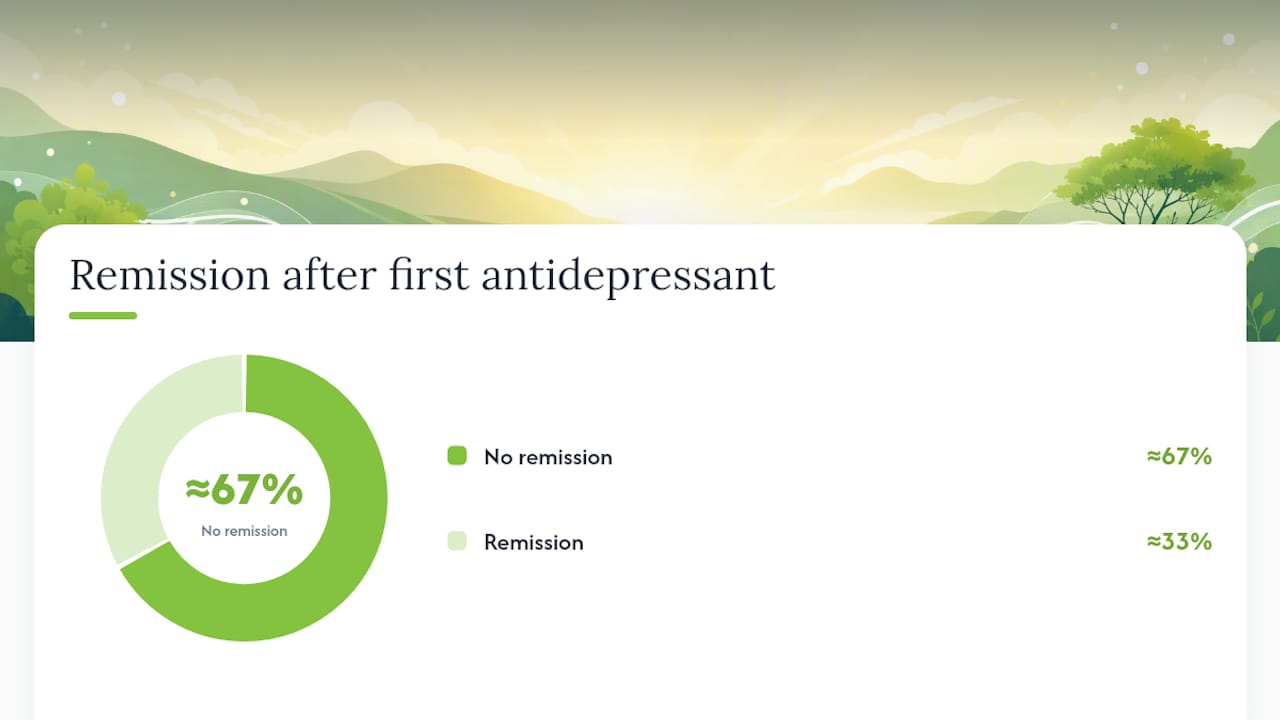
A systematic review in Molecular Biomedicine notes that roughly two-thirds of patients do not achieve remission with the first antidepressant, and that TRD lacks reliable biomarkers, making this stepwise clinical approach necessary rather than optional.
| Likely cause | Recommended next step | Typical timeline | Urgency |
|---|---|---|---|
| Adherence or dose issue | Confirm dose, improve consistency | 2–4 weeks to reassess | Routine follow-up |
| Drug or supplement interaction | Remove/adjust interacting agent | 2–4 weeks after change | Routine follow-up |
| New medical condition | Order labs (TSH, CBC), sleep study | Varies by condition | Prompt evaluation |
| Worsening depression / relapse | Dose optimization or switch | 4 weeks | Routine to urgent |
| Diagnostic revision needed | Psychiatric re-evaluation | Immediate reassessment | Prompt referral |
| Two or more failed trials (TRD) | Augmentation or procedural referral | Weeks to months | Psychiatric referral |
How long to wait and what improvement looks like
Realistic timelines prevent premature changes and unnecessary discouragement.
Most oral antidepressants, whether SSRIs or SNRIs, require four to eight weeks at a therapeutic dose before a meaningful response is evident. At two weeks, you might notice slightly improved sleep or energy. At four weeks, mood often begins to lift. By eight weeks, clinicians typically make a formal assessment of response. A partial response at four weeks is a meaningful signal worth building on, not a reason to switch immediately.
Ketamine and esketamine work on a different timeline. Many patients notice mood improvement within hours to a few days of an infusion or intranasal dose. That speed is clinically significant for patients with severe or suicidal depression, though the effect requires maintenance to sustain.

TMS builds gradually. Most patients notice change around weeks two to three of a standard course, with fuller benefit at the end of a complete series.
| Treatment change | Expected response window |
|---|---|
| Dose increase (oral antidepressant) | 2–4 weeks to assess |
| Switching drug class | 4 weeks at new therapeutic dose |
| Augmentation (atypical antipsychotic or bupropion) | 3–6 weeks |
| TMS (full course) | 3–6 weeks |
| IV ketamine | Hours to days (per session) |
| Esketamine (Spravato) | Days to weeks (series) |
| ECT | 2–4 weeks (course) |
Warning signs that need urgent or emergency attention
Some changes in your mental state require same-day action, not a scheduled follow-up.
Go to the emergency department or call 911 if you have active suicidal thoughts with a plan or intent, are experiencing psychotic symptoms for the first time, or show signs of serotonin syndrome: sudden agitation, rapid heart rate, high fever, and muscle rigidity or twitching. Call the 988 Suicide and Crisis Lifeline (call or text 988) for immediate support when you are in crisis but not in immediate physical danger.
Seek urgent (same-day) evaluation for:
- A sudden, severe worsening of depression that feels qualitatively different from your baseline.
- New or worsening symptoms of mania: decreased need for sleep, racing thoughts, grandiosity, impulsive behavior.
- Severe discontinuation symptoms if you’ve stopped a medication abruptly.
Report to your prescriber at your next scheduled visit (not urgent, but important):
- Gradual return of depressive symptoms after a period of stability.
- New side effects that are affecting your daily function.
- Feeling emotionally blunted or “flat” on your current dose.
How to prepare for a productive prescriber appointment
Arriving organized makes a measurable difference in what your clinician can do for you in a single visit.
- Bring a complete medication list with doses, times, and how long you’ve been on each.
- Bring your symptom tracker covering the past two to four weeks (mood, sleep, appetite, energy, side effects).
- List prior antidepressants with approximate start and stop dates and why each was stopped.
- Be honest about alcohol and substance use. Your clinician needs this to assess interactions and rule out substance-related mood changes.
- Bring relevant lab results if you have recent thyroid, CBC, or vitamin D results.
Questions worth asking your prescriber directly:
- “Could this be bipolar disorder or PTSD rather than unipolar depression?”
- “Should we check labs or order a sleep study before changing my medication?”
- “Is pharmacogenetic testing useful in my situation?” (Most useful when you’ve had unusual side effects or improbable failures across multiple trials, per Mayo Clinic’s guidance.)
- “What are the next-step options if this medication doesn’t improve over the next four to eight weeks?”
- “Am I a candidate for TMS, ketamine, or Spravato?”
When describing your experience, separate side effects from nonresponse. “I feel emotionally flat and have no libido” is a side effect. “My mood is still a 3 out of 10 after eight weeks at the full dose” is nonresponse. Both matter, but they point toward different solutions.
Our clinical approach when a medication seems to have stopped working
In our work at Nortexpsychiatry, we rarely treat a medication plateau as a dead end. We treat it as a diagnostic question. The first thing we do is verify adherence and timing, because pseudo-resistance accounts for a significant share of apparent failures. We then look for medical contributors, particularly thyroid function and sleep quality, before changing any psychiatric medication.
When we do make a change, we change one variable at a time. That discipline matters. If you switch medications and add a supplement and start therapy simultaneously, you cannot know what helped. Methodical single-variable changes are slower in the short term and far more informative.
For patients who have not responded to two or more adequate antidepressant trials, we evaluate for TRD and discuss procedural options directly. We offer TMS, ketamine infusions, and Spravato (esketamine) in our Allen, Texas clinic, and we serve patients across North Dallas including Frisco, McKinney, and Plano, with telehealth follow-up available.
The PMC systematic review on treatment-resistant depression mechanisms reinforces what we see in practice: a substantial share of patients do not remit with first-line monoamine antidepressants, and that reality calls for a broader therapeutic toolkit, not a narrower one.
What most advice on this topic gets wrong
The standard guidance on antidepressants not working tends to focus on switching medications as the primary next step. That framing skips the most important question: why isn’t it working?
Switching from one SSRI to another when the real problem is undiagnosed sleep apnea, ongoing alcohol use, or a missed bipolar diagnosis doesn’t help. It adds another failed trial to a patient’s history and delays the right treatment by months. The UTH Psychiatry perspective on rethinking TRD makes this point plainly: “treatment-resistant” often reflects pseudo-resistance, and reassessment changes management plans more often than escalation does.
The other gap in most advice is timeline realism. Patients are told antidepressants take four to six weeks, and when week six arrives without full remission, they conclude the medication failed. A partial response at six weeks is not failure. It is a signal to optimize, not abandon.
What you should prioritize first: a thorough diagnostic review before any medication change, a single-variable approach when changes are made, and a clear conversation with your prescriber about what “adequate trial” actually means for your specific medication and dose.
Nortexpsychiatry offers a clear path forward for North Dallas adults
When you’ve tried one or more antidepressants without adequate relief, a structured psychiatric evaluation is the most direct route to a better outcome. Nortexpsychiatry, based in Allen, Texas, offers exactly that: a full psychiatric evaluation that reviews your medication history, screens for medical contributors, and maps out a stepwise plan tailored to where you are now.
For patients who qualify, we offer TMS therapy, ketamine infusion therapy, and Spravato (esketamine) in-clinic, along with telehealth follow-up for ongoing medication management across North Dallas. We ask that you bring your medication list, symptom tracker, and prior treatment history to your first appointment so we can move efficiently.
Find out why a psychiatric evaluation matters and what to expect from the process. When you’re ready, schedule your evaluation with Nortexpsychiatry and bring the checklist from this article with you.
Sources
These resources support the clinical guidance in this article and are worth bookmarking for conversations with your prescriber.
- Treatment-resistant depression – Mayo Clinic
- Why Aren’t My Antidepressants Working? | Johns Hopkins Medicine
- Treatment-Resistant Depression: What It Is & Symptoms
- PMC article (systematic review) on mechanisms and management of treatment-resistant depression
- Tachyphylaxis in Unipolar Major Depressive Disorder
- Treatment-resistant depression: molecular mechanisms and management | Molecular Biomedicine | Springer Nature Link
- When two failed antidepressants are not enough — rethinking treatment-resistant depression | UTH Psychiatry
- Treatment-resistant major depressive disorder in adults — UpToDate
Use these sources to frame specific questions for your clinician rather than as a substitute for clinical evaluation.
This article is general information, not a substitute for advice from a qualified doctor. Consult a qualified healthcare professional about your own circumstances before acting on anything here.
FAQ
What happens when antidepressants don’t work?
When an antidepressant isn’t producing adequate relief, clinicians typically follow a stepwise approach: verify adherence and dose, rule out medical causes or a revised diagnosis, then consider switching, augmenting, or referring for procedural options like TMS or esketamine.
Why am I still depressed even on antidepressants?
Persistent depression on medication often reflects an undertreated dose, a drug interaction, an unaddressed medical condition such as hypothyroidism or sleep apnea, or a diagnosis that needs revision, such as bipolar disorder or PTSD.
Can depression get better without medication?
Some people with mild to moderate depression respond well to psychotherapy alone, particularly cognitive behavioral therapy. For moderate to severe depression, a combination of medication and therapy tends to produce better outcomes than either approach on its own.
What is the next step if antidepressants don’t work?
After two or more adequate antidepressant trials without sufficient response, the next steps typically include augmentation strategies, pharmacogenetic testing to guide selection, and evaluation for procedural treatments such as TMS, IV ketamine, or intranasal esketamine (Spravato), which is FDA-approved after two failed trials. Nortexpsychiatry offers all three in North Dallas.