


Yes, telehealth can still result in a legal prescription for ADHD stimulants in 2026. The federal government’s Fourth Temporary Extension keeps the door open for Schedule II through V prescribing by interactive video through December 31, 2026, as long as your provider meets specific federal and state conditions. Your state’s licensing rules and pharmacy checks still shape what actually happens, so your first move should be confirming your provider is licensed in your state and calling ahead to your pharmacy.
TL;DR:
- The extension allows prescribing controlled substances via telehealth until at least December 31, 2026, but prescribers must meet specific federal and state licensing requirements.
- State laws may impose additional rules, such as mandatory in-person evaluations or special telemedicine registrations, which can limit or shape access.
- Prescriptions are only valid if issued after a real-time video consultation for a genuine medical purpose, with proper documentation and compliance with recordkeeping rules.
- Supply shortages of ADHD medications continue into 2026 due to manufacturing and distribution issues, often resulting in partial fills or substitutions.
- Patients should prepare records, verify pharmacy stock, and confirm licensure, as non-compliance risks legal penalties for prescribers and invalid prescriptions for patients.
Table of Contents
- The federal rule: what the Fourth Temporary Extension actually permits
- State licensure, PDMPs, and how local rules shape your access
- What a responsible telehealth ADHD evaluation and follow-up actually involves
- Supply shortages: why your prescription might not get filled
- Getting ready for your telehealth visit: a checklist worth using
- How we run telehealth ADHD care at Nortex Psychiatry
- What might change after December 31, 2026
- Platform requirements that affect whether your prescription is valid
- When your state and your provider’s state disagree
- The real risk of cutting corners on telehealth prescribing rules
- Balancing access and safety in 2026
- How to get ADHD care through Nortex Psychiatry
- FAQ
- Sources
The federal rule: what the Fourth Temporary Extension actually permits
We know this topic generates a lot of anxiety for patients who depend on stimulant medication, so let’s start with what the rule says in plain terms. On December 31, 2025, the DEA and HHS jointly issued the Fourth Temporary Extension of COVID-19 telemedicine flexibilities, covering the period from January 1, 2026 through December 31, 2026. This extension allows DEA-registered practitioners to prescribe Schedule II through V controlled substances, which includes stimulants like Adderall and Vyvanse, through interactive audio-video telemedicine without requiring an in-person exam first.
That is a meaningful continuation of flexibilities that started during the COVID-19 public health emergency. Without it, the law would have reverted to older rules requiring at least one in-person visit before a controlled substance prescription in most circumstances. We have watched patients worry about this cliff edge for several renewal cycles now, and each time, the extension has arrived just before the deadline.
The conditions attached to this extension matter as much as the extension itself. A lawful telemedicine prescription under this rule generally requires:
- A legitimate medical purpose. The prescription has to come from an actual clinical evaluation, not a quick form or a template visit.
- Real-time interactive audio-video contact. A phone call alone, or a messaging-only interaction, typically does not satisfy the requirement. You and your prescriber need to see and hear each other.
- A valid DEA registration held by the prescribing practitioner, consistent with the authority granted under this extension.
- Compliance with recordkeeping and prescribing requirements under 21 CFR Part 1306, which governs how controlled substance prescriptions must be written, documented, and transmitted.
The DEA’s own announcement framed this extension as a way to avoid what the agency called a “telemedicine cliff,” language we think captures the stakes well. Millions of patients built their care around remote access during the pandemic years, and an abrupt reversal would have disrupted treatment for a lot of people managing ADHD, anxiety, and other conditions that benefit from consistent medication.
It is worth distinguishing this temporary extension from the separate rulemaking process sometimes called the Two Final Rules, which deal with a longer-term framework for telemedicine prescribing, including proposals for a special registration process. Those final rules are planned but not yet fully in effect for most practitioners. The extension we are describing here is a bridge, not a permanent solution. The DEA has said plainly that this measure exists to preserve access while a more lasting regulatory structure gets finished, so the rules you rely on today could change after 2026.
We tell our patients this directly: build in some slack. If your current prescriber relies on telemedicine flexibilities to write your stimulant prescription, ask what the plan is if the extension is not renewed or is replaced by a more restrictive framework. A good telepsychiatry practice should already have an answer ready.
State licensure, PDMPs, and how local rules shape your access
Federal rules set the outer boundary of what is allowed, but state law decides what happens in your specific case. A psychiatric nurse practitioner or physician has to be licensed, or otherwise legally authorized, in the state where you are physically located at the time of your visit, not just the state where their practice is based. This is sometimes called the “where the patient is” rule, and HHS telehealth guidance on behavioral health licensure lays it out clearly. If you live in Texas but your prescriber is only licensed in Oklahoma, that visit cannot legally produce a prescription for you, no matter how good the clinical care is.
This becomes especially relevant for readers who travel for work, attend college out of state, or split time between two residences. We have had patients assume that because a telehealth company operates nationally, any of its providers can see them. That is not how licensure works. Our guide to ADHD telehealth in Texas covers some of the state-specific nuances we see most often with Texas patients, including what remote care can and cannot accomplish.
State variation shows up in a few recurring patterns:
- In-person visit requirements. Some states layer their own rules on top of the federal extension, occasionally requiring an initial in-person evaluation regardless of federal flexibilities.
- Special telemedicine registrations. A handful of states require practitioners to hold a distinct telemedicine registration or certificate before prescribing controlled substances remotely.
- Emergency or disaster waivers. States sometimes loosen rules temporarily during public health events, which can confuse patients trying to track what currently applies to them.
Prescription Drug Monitoring Program checks are another layer that federal rules do not erase. Before writing or renewing a stimulant prescription, a responsible clinician checks your state’s PDMP, a database that tracks controlled substance prescriptions you have filled recently. This check helps your prescriber see whether you are receiving similar medications from another provider, which protects you and keeps the practice compliant with state law. If you have moved states recently or filled prescriptions in more than one state, mention it. It can save a confusing conversation later.
If you want to confirm the rules in your own state, your state medical board or nursing board website typically has a telemedicine policy page, and many list current notices about controlled substance prescribing. Keep a copy of your ID and insurance information ready, since many practices now verify identity more carefully for controlled substance telehealth visits than they did a few years ago.
What a responsible telehealth ADHD evaluation and follow-up actually involves
We have learned that patients often come into a telehealth ADHD evaluation unsure what to expect, sometimes worried it will feel rushed or superficial. A thorough evaluation, whether in person or remote, tends to include the same core pieces:
- A detailed history. This covers when symptoms started, how they show up at work, school, or home, and whether anything else might explain the symptoms, like a sleep disorder, anxiety, or a thyroid condition.
- Validated rating scales. Tools like the ASRS or Vanderbilt scales give structure to the conversation and help track symptom severity over time.
- Collateral information when possible. A parent, partner, or old school records can add helpful context, particularly for diagnoses that trace back to childhood.
- A review of prior treatment history. What has been tried before, what worked, and what caused side effects all shape the plan going forward.
Beyond diagnosis, clinicians prescribing stimulants remotely generally build in a few risk mitigation steps: a substance use history, a PDMP check before each new prescription, urine drug testing in some cases, and a structured follow-up schedule rather than an open-ended refill arrangement. We described some of the quality markers that separate a careful evaluation from a rushed one in our piece on legitimate telehealth ADHD diagnoses, and the short version is: if your entire visit lasted fifteen minutes and ended in a prescription with no mention of follow-up, that is worth a second opinion.
Short-duration fills, often 30 days, and monthly check-ins during the early months of stimulant treatment are common clinical practices, not arbitrary hurdles. FDA safety communications have pushed toward more frequent monitoring and stronger counseling around stimulant use, and recent labeling updates reflect that shift. Monthly visits give your prescriber a chance to catch side effects early, including appetite changes, sleep disruption, or increases in heart rate or blood pressure, and to reassess whether the dose still fits.
Pro Tip: Keep a simple log of sleep, appetite, and mood for the first few weeks on a new stimulant dose. It takes two minutes a day and gives your prescriber something concrete to work from at your next check-in.
Patient education matters just as much as the prescription itself. Safe storage, awareness of diversion risk, and knowing which side effects warrant a call rather than waiting for the next appointment are standard topics a careful clinician will walk through, not optional extras.
Supply shortages: why your prescription might not get filled
Even with a completely lawful prescription in hand, you may still run into a pharmacy that cannot fill it. Stimulant shortages have been a recurring problem since 2022, and they have not fully resolved heading into 2026. An FDA and DEA joint letter pointed to a sharp rise in stimulant dispensing between 2012 and 2021 as one driver of the current supply strain, alongside manufacturing and distribution constraints that affect controlled substances more than other drug classes.
When a shortage hits, pharmacies respond in a few predictable ways:
- Partial fills. You might get two weeks of medication instead of a full month, with a promise to fill the rest when stock arrives.
- Therapeutic substitution. A pharmacist may offer a different manufacturer’s version of the same medication, or suggest discussing a different formulation with your prescriber.
- Prior authorization delays. Insurers sometimes require additional paperwork before approving a substitute, which adds time even after your prescriber has acted.
If your pharmacy cannot fill your prescription, call two or three others in your area before assuming you are out of options entirely. Independent pharmacies sometimes carry stock that large chains do not. Reach out to your prescriber promptly rather than waiting, since many practices can send a new prescription to a pharmacy with available stock or discuss a reasonable short-term alternative. The ASHP drug shortages report tracks these shortages on an ongoing basis, and controlled substances continue to represent a notable share of active shortages nationally.
Getting ready for your telehealth visit: a checklist worth using
A little preparation goes a long way toward a smooth telehealth visit and a prescription that actually gets filled without delay.
- Gather your records. Bring prior psychiatric notes, a list of medications you have tried, and any previous ADHD testing or school evaluations if you have them.
- Have a government-issued ID ready. Many practices now verify identity more rigorously before prescribing controlled substances remotely, so expect to show ID on camera or upload it in advance.
- Know your pharmacy’s stock situation. A quick call ahead of your appointment can tell you whether your usual pharmacy currently has your medication, which saves a frustrating runaround afterward.
- Write down your questions. Ask directly about follow-up cadence, what happens if the medication is out of stock, and how PDMP checks factor into your ongoing care.
- Check your internet and camera setup. Interactive audio-video is a legal requirement, not a formality, so test your connection beforehand to avoid a visit that cannot legally proceed on a phone call alone.
Our overview of telepsychiatry platforms for ADHD care walks through what to expect from the technology side if you want more detail before your first appointment.
How we run telehealth ADHD care at Nortex Psychiatry
We built our telehealth ADHD workflow around the idea that remote care should never mean rushed care. Evaluations include a full history, validated rating scales, and a conversation about what has and has not worked before, with the option to move to in-person visits when that makes more clinical sense. We check PDMP data as part of routine practice and set follow-up cadence based on how a patient responds to treatment, not a fixed script.
When shortages affect a medication we have prescribed, our team coordinates directly with pharmacies and, where needed, with insurers on prior authorization paperwork, so patients are not left making those calls alone. Our guide to the psychiatrist’s role in ADHD care goes into more depth on how diagnosis and medication management fit together across a full course of treatment.
What might change after December 31, 2026
We cannot predict federal rulemaking with certainty, but the pattern over the past several years gives some clues. Each extension so far has arrived close to the prior deadline, which tells us agencies are still working through a more permanent framework rather than settling on one. Congressional discussions have touched on a proposed special registration process for telemedicine prescribers of controlled substances, an idea that has circulated for years without being finalized.
A permanent rule could tighten requirements, such as mandating periodic in-person visits even for established telehealth patients, or it could formalize the flexibilities we have now into lasting policy. Either outcome is plausible, and neither is guaranteed. What we tell our own patients is to treat the current extension as reliable for now, through the end of 2026, while staying ready for a transition. Keep copies of your evaluation records and prescription history, since a new regulatory framework may ask for documentation of your treatment continuity if in-person requirements return.
Platform requirements that affect whether your prescription is valid
Not every video call counts as compliant telemedicine under federal rules. The platform your prescriber uses needs to support real-time, two-way audio and video, not a recorded message or a one-directional check-in. Secure, HIPAA-compliant software is standard in legitimate practices, and most require identity verification before a controlled substance visit, often through a photo ID check during the session or a separate verification step beforehand.
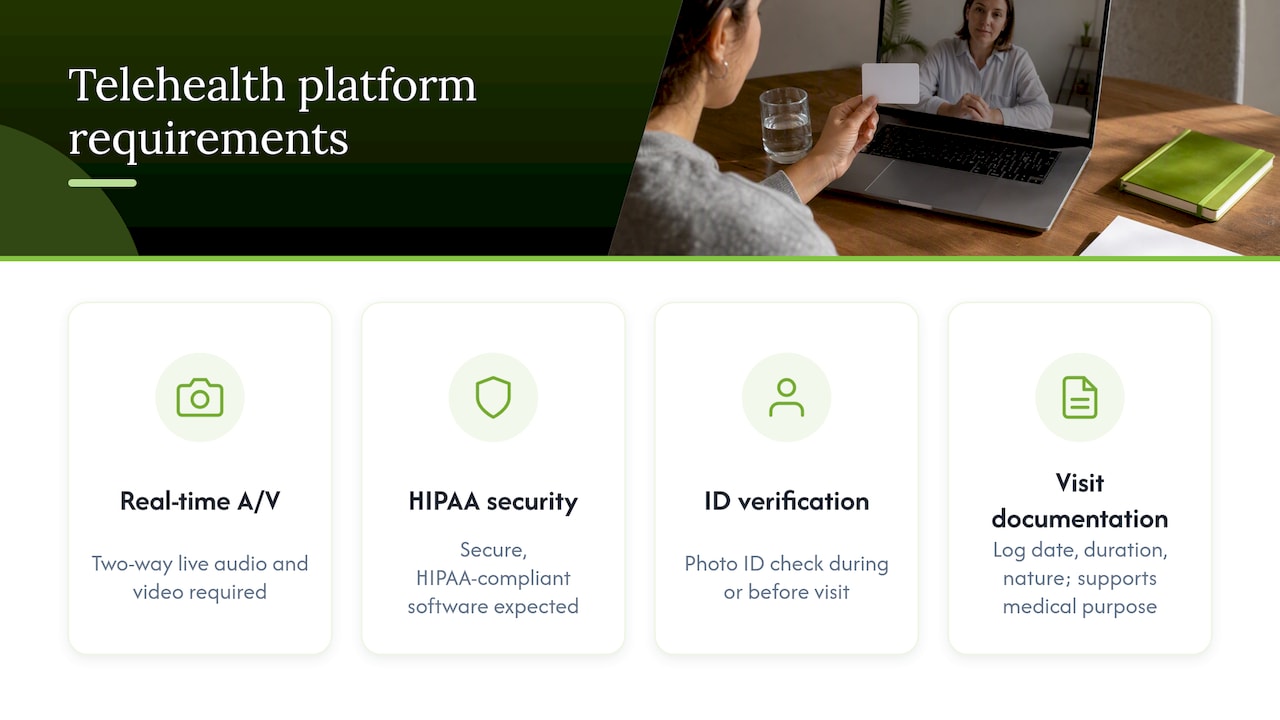
Documentation matters on the back end too. A compliant platform should let your prescriber log the date, duration, and nature of the visit, since that record supports the “legitimate medical purpose” requirement under the federal rule. If a service seems to generate a prescription without a real-time video conversation, that is a signal worth paying attention to, not a convenience worth taking advantage of.
When your state and your provider’s state disagree
Interstate telehealth gets complicated fast. If you are temporarily out of state, for college, work travel, or caregiving, your prescriber generally needs to be licensed in whatever state you are physically sitting in during the appointment, not the state you call home. This catches a lot of patients off guard, especially students who assume their home-state psychiatrist can simply continue care once they move for school.
Some states participate in licensure compacts that ease this friction for certain professions, though coverage varies and does not apply uniformly to all prescribers or all situations. The safest approach is to ask your provider directly whether they hold an active license in the state you will be in at the time of your appointment, and to reschedule or seek a locally licensed option if the answer is no. This is not a bureaucratic technicality. A prescription written in violation of licensure rules can be invalid even if the clinical reasoning behind it was sound.
The real risk of cutting corners on telehealth prescribing rules
Non-compliant telehealth prescribing carries consequences for both prescribers and patients, and we think it is worth being direct about that. A practitioner who prescribes controlled substances outside the bounds of their DEA registration or without meeting the interactive audio-video requirement risks DEA enforcement action, loss of licensure, and potential criminal liability depending on the circumstances.
For patients, the risks look different but are still real. A prescription written by a provider who was not legally authorized to treat you, perhaps because they lacked a license in your state at the time, may not be honored by a pharmacy, or worse, could leave you without a valid medical record if questions arise later. We have seen patients caught in this exact situation after using an out-of-state telehealth service that did not verify licensure carefully. If something about a telehealth arrangement feels too easy, a diagnosis within minutes, no real conversation about history or alternatives, that instinct is usually worth listening to.
Balancing access and safety in 2026
In our work, we see both sides of this debate play out weekly. Telehealth genuinely keeps people in treatment who would otherwise fall through the cracks, especially patients juggling work schedules or living in areas with few psychiatric providers. That continuity matters, and we do not want to understate it.
At the same time, monitoring exists for real reasons. Stimulants carry misuse potential, and the monthly check-ins some patients find tedious are often what catches a problem early. If a telehealth relationship ever starts to feel like a rubber stamp rather than a real conversation, it is reasonable to ask for an in-person evaluation instead. Keep your records organized now. Federal flexibilities are temporary, and whatever comes next will likely ask for proof of a treatment history that holds together.
— Felix
How to get ADHD care through Nortex Psychiatry
We offer both telehealth and in-person psychiatric evaluations for ADHD, along with ongoing medication management for adults and families. Booking starts with a call or a request through our site, and we will let you know ahead of time what to bring, typically a photo ID, a list of current medications, and any prior evaluation records you can locate.
- Telehealth and in-person visits available depending on what fits your situation
- Ongoing follow-up built around your response to treatment, not a fixed schedule
- Coordination with pharmacies when supply issues come up
If you are also dealing with treatment-resistant depression or anxiety alongside ADHD, we offer additional options including Spravato therapy and TMS therapy for conditions that have not responded well to standard approaches. Reach out through our home page to schedule a consultation or ask questions before booking.
This article is general information, not a substitute for advice from a qualified doctor. Consult a qualified healthcare professional about your own circumstances before acting on anything here.
FAQ
Can ADHD medications be prescribed over telehealth?
Yes, stimulant medications for ADHD can be legally prescribed through telehealth in 2026 under the Fourth Temporary Extension, provided the prescriber uses real-time audio-video and meets federal and state requirements. The prescriber also needs to be licensed in the state where you are physically located during the visit.
Can a provider prescribe more than 30 days of Adderall at once?
Prescription length for stimulants is governed by state pharmacy law and clinical judgment rather than a single federal cap, and many prescribers start new patients with 30-day fills to allow close monitoring. Longer supplies become more common once a patient has shown a stable response over several months, though this varies by prescriber and by state.
What is the new law for ADHD medication in 2026?
The relevant update is the Fourth Temporary Extension of COVID-19 telemedicine flexibilities, which runs from January 1, 2026 through December 31, 2026. It allows continued telemedicine prescribing of Schedule II through V controlled substances, including ADHD stimulants, without requiring an in-person visit first, as long as specific conditions are met.
Why is Adderall still in short supply in 2026?
Stimulant shortages trace back to a sharp rise in dispensing between 2012 and 2021, combined with manufacturing and distribution constraints that the FDA and DEA have flagged as ongoing concerns. The ASHP drug shortages report continues to track active shortages affecting controlled substances into 2026.
Sources
- Federal Register :: Fourth Temporary Extension of COVID-19 Telemedicine Flexibilities for Prescription of Controlled Medications
- DEA extends telemedicine flexibilities to ensure continued access to care