


Psychiatrists are the most qualified medical professionals to diagnose and treat ADHD, particularly when symptoms overlap with anxiety, depression, or trauma. The role of psychiatrists in ADHD extends well beyond writing a prescription. They conduct thorough evaluations, manage complex medication decisions, and coordinate care with therapists and primary care providers to build a treatment plan that fits your actual life. If you have been wondering whether a psychiatrist is the right person to see, the answer depends on how complex your situation is. And for most adults, it is more complex than it looks.
What is the role of psychiatrists in ADHD diagnosis?
Psychiatrists bring a level of diagnostic depth that other providers cannot fully replicate. They complete four years of medical school followed by four years of psychiatric residency, totaling eight years of post-undergraduate training. That training matters most when your symptoms do not fit a clean picture.
The psychiatric assessment for ADHD starts with a detailed clinical interview. A psychiatrist asks about your symptom history, childhood behavior, academic and work performance, sleep, mood, and relationships. This is not a checklist exercise. It is a structured conversation designed to understand how your brain has functioned across different settings and life stages.

From there, psychiatrists use structured screening tools and standardized rating scales to quantify symptom severity. These tools add objectivity to what is otherwise a subjective process. But the real value comes in what happens next: differential diagnosis.
ADHD shares symptoms with several other conditions. Anxiety causes distractibility. Bipolar disorder causes impulsivity. Depression slows processing speed. Trauma can look nearly identical to ADHD on a surface-level screening. A psychiatrist trained in all of these conditions can tell the difference. Getting that distinction right prevents misdiagnosis and avoids years of ineffective treatment.
- Comprehensive clinical interview covering developmental, academic, and occupational history
- Standardized rating scales such as the Adult ADHD Self-Report Scale (ASRS) to quantify symptoms
- Differential diagnosis ruling out anxiety disorders, mood disorders, PTSD, sleep disorders, and learning disabilities
- Comorbidity mapping to identify co-occurring conditions that need to be treated alongside ADHD
- Collateral information from partners, family members, or past records when available
Pro Tip: Before your first psychiatric evaluation, write down three to five specific examples of how your symptoms have affected your work, relationships, or daily functioning. Concrete examples help your psychiatrist build a more accurate picture than general descriptions alone.
How do psychiatrists manage ADHD medications?
Medication management is one of the most technical aspects of ADHD care, and it is where psychiatrists treating ADHD hold a clear advantage over general practitioners. They understand the full range of options, the pharmacology behind each one, and how to adjust when things do not go as planned.
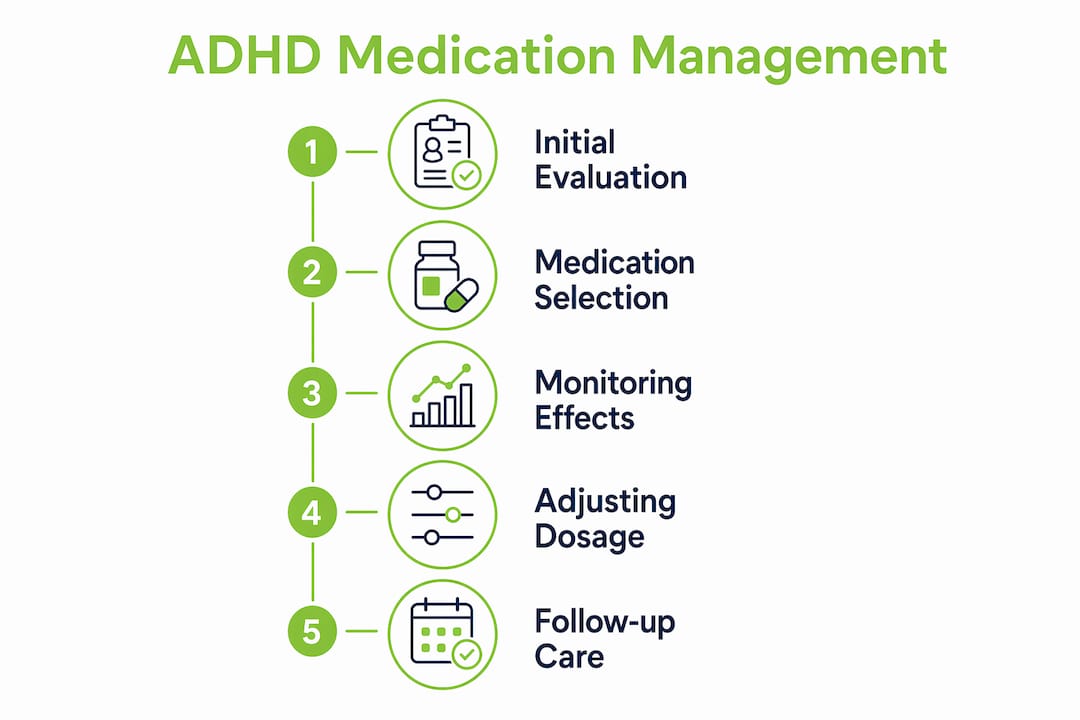
The process follows a structured sequence:
- Select the right medication class. Stimulants such as amphetamine salts and methylphenidate are typically first-line. Non-stimulants like atomoxetine or guanfacine are considered when stimulants are contraindicated or poorly tolerated.
- Start at a low dose and titrate gradually. Psychiatrists adjust dosage based on symptom response and side effect profile, not a fixed schedule.
- Monitor for side effects. Common concerns include appetite suppression, sleep disruption, elevated heart rate, and mood changes. These require active tracking, not passive waiting.
- Reassess regularly. Medication needs shift with life changes, stress levels, hormonal cycles, and aging.
- Manage non-response. When a patient does not respond to adequate trials of first-line medications, referral to a psychiatrist is the appropriate next step if they are not already involved.
Serious adverse events are rare. Psychosis from stimulant use occurs in an estimated 0.01–0.1% of cases. That low rate does not mean it can be ignored. Psychiatrists know the warning signs and act quickly when they appear.
Primary care providers often initiate ADHD care, but they refer to psychiatrists when treatment becomes complicated. That handoff is appropriate and common. What matters is that the person managing your medication understands the full picture of your mental health, not just your ADHD symptoms in isolation. Understanding the types of psychiatric medication used in ADHD care can help you ask better questions at your next appointment.
Pro Tip: Keep a simple weekly log of how you feel on medication, noting sleep quality, appetite, focus, and mood. Bring it to every follow-up. It gives your psychiatrist real data instead of a vague impression.
How do psychiatrists collaborate with therapists and other providers?
Psychiatrists do not work in isolation, and the best ADHD outcomes come from collaborative care that combines medication management with psychological and behavioral support. Understanding how these roles divide is useful when you are building your care team.
A psychiatrist focuses on diagnosis, medication, and medical oversight. A psychologist or neuropsychologist handles formal cognitive testing and psychological assessment. A therapist, particularly one trained in cognitive behavioral therapy (CBT), addresses the emotional and behavioral patterns that medication alone does not fix. These include procrastination habits, shame around past failures, relationship conflict, and anxiety that often travels alongside ADHD.
The practical benefits of coordinated care include:
- Better treatment adherence. When your therapist and psychiatrist communicate, they can reinforce the same goals from different angles.
- Faster identification of problems. A therapist who notices worsening anxiety can flag it to your psychiatrist before it derails your medication plan.
- Reduced risk of misattribution. Without coordination, a new symptom might be treated as a separate condition when it is actually a medication side effect.
- Family involvement. When partners or family members understand the treatment plan, they provide more consistent support at home.
Adults with ADHD frequently carry comorbid depression or anxiety, and treating those conditions in the right sequence matters. Stimulants can worsen untreated anxiety. Treating depression first sometimes resolves what looked like ADHD. A psychiatrist trained in sequencing these treatments prevents the kind of trial-and-error that leaves patients feeling like nothing works. For adults managing both conditions, the guidance on anxiety and ADHD is worth reading alongside your psychiatric care.
Children and adolescents benefit from similar coordination. When ADHD support extends to the school environment, online tutoring for children with ADHD can complement the clinical work psychiatrists and therapists do in session.
What should adults expect from ongoing psychiatric ADHD care?
Ongoing psychiatric care for ADHD is not a set-it-and-forget-it process. Psychiatrists maintain medication effectiveness by monitoring evolving symptoms, adjusting doses, and managing side effects throughout a patient’s life. That ongoing relationship is one of the most underappreciated parts of the process.
After the initial evaluation and medication start, follow-up appointments typically happen every four to six weeks during the titration phase. Once your medication is stable, visits may shift to every two to three months. Each appointment covers symptom changes, side effects, life stressors, and whether the current plan still fits your goals.
Life changes affect ADHD. A new job, a relationship ending, a move, or a health diagnosis can all shift how your symptoms present and how well your medication works. Psychiatrists adjust treatment plans as these circumstances change, rather than assuming what worked last year will work this year.
Telehealth has made this ongoing care significantly more accessible. Remote psychiatric follow-ups work well for adults who travel frequently, have demanding work schedules, or live in areas with limited specialist access. The evaluation and medication review process translates effectively to a video appointment for most patients.
Wait times remain a real barrier. Adults seeking a new psychiatric evaluation often wait two to six months to see a specialist. That delay reflects high demand and a shortage of adult psychiatrists in many regions. Preparing thoroughly for your first appointment, bringing records, symptom logs, and a clear description of your concerns, shortens the time it takes to reach an accurate diagnosis and effective treatment.
Pro Tip: If you are on a wait list, ask your primary care provider to start a basic evaluation in the meantime. They can gather history, rule out medical causes, and sometimes initiate first-line treatment while you wait for your psychiatric appointment.
Key Takeaways
Psychiatrists provide the most thorough ADHD diagnosis and the most medically informed medication management available, making their involvement critical for adults with complex or treatment-resistant presentations.
| Point | Details |
|---|---|
| Diagnostic depth | Psychiatrists complete 8 years of post-undergraduate training, equipping them to differentiate ADHD from anxiety, mood disorders, and trauma. |
| Medication management | Psychiatrists titrate stimulant and non-stimulant medications, monitor side effects, and adjust treatment as symptoms evolve. |
| Collaborative care | Coordinating with therapists and primary care providers improves adherence and addresses emotional impacts medication alone cannot fix. |
| Comorbidity sequencing | Treating co-occurring depression or anxiety in the right order prevents stimulants from worsening untreated conditions. |
| Access planning | Wait times of 2–6 months are common; preparing records and using telehealth options reduces delays in starting effective care. |
What I have learned about the psychiatrist’s role in adult ADHD
One thing we notice consistently in clinical practice is that adults who struggled for years without a clear diagnosis often received a quick label without a thorough evaluation. They were told they had ADHD based on a short questionnaire and a 15-minute appointment. Then the medication did not work well, or it worked for a while and then stopped, and they were left wondering if the diagnosis was even right.
The initial psychiatric evaluation is the most critical step in the entire process. A rushed diagnosis leads to treatment-resistant cases that take years to untangle. The time spent on a thorough assessment is not bureaucratic delay. It is the foundation everything else rests on.
We also see patients who think psychiatry means medication and nothing else. That misunderstanding leads them to skip therapy, avoid telling their psychiatrist about emotional symptoms, and treat the two parts of their care as separate. They are not separate. The best outcomes we observe come from patients who bring their full picture to every appointment and stay connected to both their psychiatrist and their therapist.
If you are looking for a provider, ask directly about their experience with adult ADHD and how they handle cases where the first medication does not work. A psychiatrist who gives you a clear, specific answer to that question is one who has actually managed these cases. That specificity matters more than credentials alone.
— Felix
Nortexpsychiatry’s approach to adult ADHD care
Nortexpsychiatry serves adults across Allen, Frisco, McKinney, Plano, and the broader North Dallas area with psychiatric evaluations and medication management designed for real life. If you are trying to understand whether your symptoms point to ADHD, a co-occurring condition, or both, a thorough psychiatric evaluation is the right starting point.
The practice offers both in-person and telehealth appointments, which means you do not have to rearrange your entire schedule to get consistent care. Nortexpsychiatry works collaboratively with therapists and primary care providers to make sure your treatment plan addresses the full picture, not just one piece of it. If you are ready to take a clear next step, the guide to seeking psychiatric care explains what to expect and how to prepare.
FAQ
What does a psychiatrist actually do for ADHD?
A psychiatrist diagnoses ADHD through a comprehensive clinical interview and differential evaluation, then prescribes and manages medication while monitoring for side effects and symptom changes over time.
Can a psychiatrist diagnose ADHD in adults?
Yes. Psychiatrists are fully qualified to diagnose ADHD in adults and are particularly well-suited for cases where symptoms overlap with anxiety, depression, or other mental health conditions.
How is a psychiatric assessment for ADHD different from a GP visit?
A psychiatric assessment goes deeper than a standard GP visit, covering developmental history, comorbid conditions, and differential diagnosis to rule out disorders that mimic ADHD symptoms.
Do I need a psychiatrist if my primary care doctor already prescribed ADHD medication?
Primary care providers can initiate ADHD treatment, but a psychiatrist becomes necessary when the medication is not working, side effects are significant, or other mental health conditions are present alongside ADHD.
How long does ongoing psychiatric care for ADHD last?
ADHD is a long-term condition, and psychiatric care typically continues as long as symptoms affect daily functioning. Follow-up frequency decreases once medication is stable, but regular check-ins remain part of effective management.