


If you have had an adequate antidepressant trial but only partial relief, augmentation is a commonly evidence-based next step. The best-supported classes are atypical antipsychotics, lithium, and thyroid hormone (T3), with other options like stimulants and glutamatergic agents reserved for specific situations. We think through this decision the same way each time: what has already been tried, how well it worked, and what the symptom pattern is actually telling us.
TL;DR:
- Augmentation is recommended after an adequate antidepressant trial shows partial response, especially if symptoms have improved by 25 to 49 percent.
- The strongest evidence supports adding atypical antipsychotics, lithium, or thyroid hormone, with quetiapine and aripiprazole demonstrating near twice the effectiveness of placebo.
- Clinicians reassess augmentation agents within 2 to 4 weeks, and non-response often prompts consideration of switching medications or exploring interventional therapies.
- If symptoms are primarily fatigue and low motivation, stimulants like Vyvanse may be considered, but only with careful assessment of cardiovascular and misuse risks.
- When augmentation fails or rapid relief is needed, options like TMS, ketamine, or electroconvulsive therapy become appropriate next steps.
Table of Contents
- When to consider augmentation versus switching to a new medication
- What the research actually shows about augmentation options
- Medication options clinicians consider for augmentation
- When medication augmentation is not enough: interventional options
- How clinicians decide which augmentation strategy fits you
- How we approach augmentation and interventional escalation at Nortex Psychiatry
- What gets overlooked in most augmentation conversations
- Getting evaluated for augmentation or interventional care at Nortex Psychiatry
- Sources
- FAQ
When to consider augmentation versus switching to a new medication
We get this question constantly, and the answer depends on two things: whether the trial you had was actually adequate, and how much benefit you got from it.
An adequate trial generally means a therapeutic dose taken consistently for at least 4 to 6 weeks. If you stopped a medication after 10 days because of nausea, that was not a failed trial, that was an intolerable one, and switching makes more sense than augmenting. But if you have been on a reasonable dose for a month or more and you are seeing some improvement, just not enough, augmentation usually becomes the more sensible path.
Clinicians distinguish between partial response and nonresponse. Partial response usually means a meaningful drop in symptom severity, often 25 to 49 percent, without reaching remission. Nonresponse means minimal to no change at all. This distinction matters because the evidence for augmentation is strongest in people who have already shown they can respond, at least partly, to an antidepressant. Nonresponders sometimes do better with a full switch.
We rely on structured tools rather than gut impressions to make this call. The VA/DoD clinical practice guideline for major depressive disorder recommends measurement-based care, using scales like the PHQ-9 or the Clinical Global Impression scales (CGI-S and CGI-I), checked at regular intervals rather than relying on how a visit “feels.” A PHQ-9 score that drops from 18 to 12 over six weeks tells a very different story than one that drops from 18 to 4.
Here is roughly how that decision plays out in practice:
- Adequate trial, partial response: augmentation is typically the preferred next step.
- Adequate trial, no response at all: switching to a different antidepressant class is often considered first.
- Inadequate trial (too short, too low a dose, poor adherence): optimize the current medication before deciding anything else.
- Intolerable side effects regardless of benefit: switching usually takes priority over augmenting.
None of this is mechanical. A person with severe, function-limiting depression who cannot tolerate another few weeks of trial and error might reasonably move to augmentation sooner, even with a borderline trial. Guidelines give direction, not a formula, and the conversation between you and your prescriber should account for how much time and distress you can absorb while waiting to see what works.
What the research actually shows about augmentation options
This is the part where it helps to know which agents have real data behind them and which have more limited or situational support.
A 2022 systematic review and network meta-analysis of augmentation strategies for treatment-resistant depression found that atypical antipsychotics, dopaminergic compounds, lithium, and thyroid hormone all showed evidence of benefit when added to an antidepressant that was not fully working. That is a broader field of options than many people expect, but the strength of evidence is not equal across them.
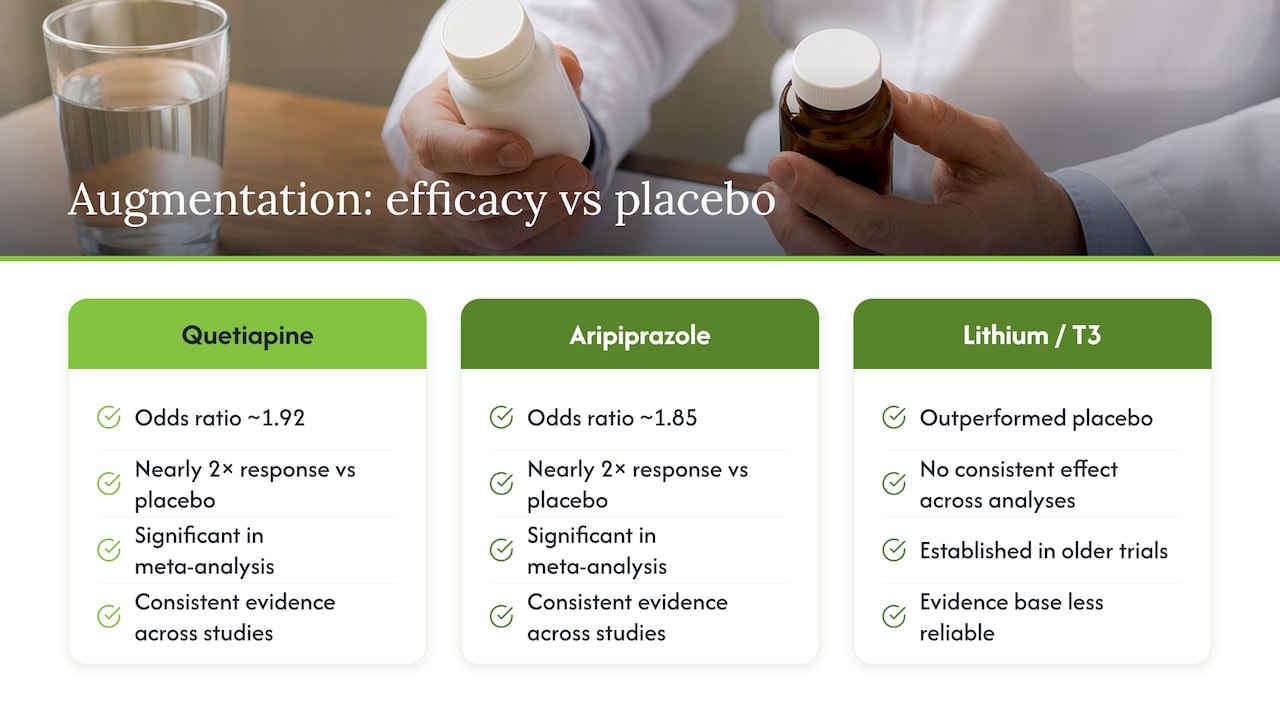
A separate comparative meta-analysis of augmentation agents narrowed in on relative efficacy and found that quetiapine (odds ratio around 1.92) and aripiprazole (odds ratio around 1.85) were significantly more effective than placebo as add-on treatments. Thyroid hormone and lithium also outperformed placebo, though the evidence base for those two was less consistent across studies, meaning the effect held up less reliably when researchers checked it different ways.
One figure worth sitting with: in that comparative analysis, quetiapine and aripiprazole showed odds ratios of roughly 1.85 to 1.92 against placebo, meaning both were nearly twice as likely to produce meaningful improvement compared with adding nothing at all. That is a real signal, not a marginal one, though it still leaves plenty of people who will not respond.
The VAST-D trial, run through the VA system, gives us some of the most clinically useful next-step data available, including insights on bupropion as an alternative and effective anxiety and depression treatment. In that study, Veterans who had not responded adequately to an antidepressant were randomized to either switch to bupropion, augment with bupropion, or augment with aripiprazole. A secondary VAST-D analysis found that augmenting with aripiprazole produced better outcomes than either switching or augmenting with bupropion, and that comorbid PTSD lowered the absolute chance of response across all three arms, even though the relative advantage of aripiprazole augmentation persisted.
That PTSD finding matters more than it might first appear. If you carry a trauma history alongside depression, it is reasonable to expect that treatment may take longer to work and that expectations should be calibrated accordingly, without assuming augmentation itself is a poor fit.
Older trials like STAR*D, which predated much of this newer network meta-analytic work, first established lithium and T3 as viable augmentation strategies decades ago, and later reviews have kept refining how well those findings hold up against newer agents. The OPTIMUM trial, focused specifically on older adults, added evidence that aripiprazole augmentation and bupropion augmentation both have a place in later-life depression, though tolerability differences, particularly around movement side effects and fall risk, shape which one a clinician reaches for first.
None of these trials suggest augmentation is a guaranteed fix. What they consistently show is that it beats doing nothing, and for several agents, the effect size is large enough to matter in a real clinical sense rather than just a statistical one.
Medication options clinicians consider for augmentation
Once the decision to augment is made, the next question is which agent, and that depends heavily on your specific symptom picture, medical history, and what side effects you are willing to tolerate.
Atypical antipsychotics (aripiprazole, quetiapine, and brexpiprazole are the most studied) tend to show benefit within 2 to 4 weeks when they are going to work. Typical adjunctive doses are lower than doses used for psychosis, aripiprazole augmentation often starts around 2 to 5 mg daily, for example, though your prescriber will adjust based on response and tolerability. The main risks are akathisia, an uncomfortable restlessness that can show up early, and metabolic changes over longer use, including weight gain, changes in blood sugar, and lipid shifts. That is why monitoring includes the Abnormal Involuntary Movement Scale (AIMS) and regular metabolic labs such as weight, blood pressure, fasting glucose or HbA1c, and a lipid panel, a pattern supported by AIMS monitoring guidance used widely in psychiatric practice.
Lithium has one of the longest track records of any augmentation agent, and it carries something the newer options do not: evidence tied to lithium and T3 augmentation suggesting a possible protective effect against suicidal behavior in some populations, alongside its antidepressant augmentation benefit. The tradeoff is a narrower therapeutic window, meaning the dose that helps and the dose that harms are closer together than with most psychiatric medications. That means routine blood draws, serum lithium levels, kidney function tests, and thyroid function tests (TFTs), since lithium can affect thyroid function over time.
T3 (triiodothyronine) is considered when lithium is not a good fit or has not worked. Dosing is typically low, in the range used for thyroid augmentation rather than thyroid replacement, and thyroid labs are checked before starting and periodically afterward. It is generally avoided or used with real caution in anyone with a history of thyrotoxicosis or unstable cardiac conditions, since T3 can affect heart rate and rhythm.
Stimulants and dopaminergic agents occupy a narrower lane. They are considered mainly when fatigue and anergia, that heavy, unmotivated exhaustion, dominate the symptom picture rather than sadness or anxiety. The evidence here is thinner than for antipsychotics or lithium, and the risks, cardiovascular strain and misuse potential, mean these are used selectively and often alongside a cardiology conversation if there is any existing heart risk.
Ketamine and esketamine (Spravato) stand apart because they work faster than any other option on this list, sometimes within hours to days rather than weeks. They require in-office or clinic administration with monitoring during and shortly after dosing, because they can cause transient dissociation or blood pressure changes. Good candidates are typically people who have already tried standard augmentation without enough benefit, or who need a faster response due to severity.
Pro Tip: If you are on more than one serotonergic medication (an SSRI plus a supplement like St. John’s Wort, for example), tell every prescriber you see, since combining serotonergic agents raises the risk of serotonin syndrome, a rare but serious reaction involving agitation, rapid heart rate, and muscle rigidity.
A few practical safety habits carry across every one of these options:
- Always disclose every medication, supplement, and over-the-counter product you take, since interactions are often invisible until they are not.
- Ask specifically what the monitoring schedule will be before starting, not after.
- Report new or worsening restlessness, tremor, or unusual movements right away rather than waiting for the next appointment.
When medication augmentation is not enough: interventional options
Sometimes augmentation trials do not get you where you need to be, and that is the point where interventional therapies become worth a serious conversation.
Transcranial Magnetic Stimulation (TMS) uses magnetic pulses to stimulate specific brain regions involved in mood regulation, typically over a course of daily sessions across several weeks. It tend to be considered after one or more medication trials, including augmentation, have not produced enough relief, and its side-effect profile is generally mild, mostly scalp discomfort or headache during early sessions. A comparison of TMS and ketamine therapy walks through how the two options differ in onset and course.
2. Ketamine and esketamine offer a faster route to relief, often within the same treatment course rather than weeks, which makes them a reasonable option when safety concerns or severity make waiting less acceptable. Research on ketamine’s role in treatment-resistant depression outlines who tends to respond best and what a typical course looks like.
3. Electroconvulsive therapy (ECT) remains one of the most effective options for severe, treatment-resistant depression, particularly when safety is an immediate concern, such as active suicidality or catatonia, though it requires anesthesia and more logistical coordination than the other two.
Accessibility matters here as much as efficacy. TMS and ketamine are increasingly available outside of hospital settings, while ECT typically requires a hospital or specialized outpatient surgical center. If you have already been through one or two medication augmentation attempts without meaningful benefit, or if safety concerns are part of the picture, that is generally the point to ask directly about a specialty evaluation for these options rather than trying a third or fourth medication combination on your own timeline. An overview of alternatives to ketamine therapy can help frame how these options relate to one another.
How clinicians decide which augmentation strategy fits you
We think of this less as a flowchart and more as a set of questions we ask in sequence, because depression rarely presents the same way twice.
The dominant symptom pattern usually points us somewhere specific. Prominent fatigue and anergia push us toward considering a dopaminergic agent or stimulant. Anxiety and agitation alongside depression often make quetiapine a more attractive antipsychotic option than aripiprazole, which can occasionally worsen restlessness. Any hint of suicidal ideation adds weight toward lithium, given its documented association with reduced suicidal behavior in some populations.
Comorbidities change the calculation substantially:
- Bipolar disorder, even subtle or previously undiagnosed, changes the entire approach, since standard antidepressant augmentation can occasionally trigger mood elevation.
- PTSD lowers the odds of full response to any strategy, based on VAST-D findings, which means expectations and timelines need adjusting rather than assuming the strategy itself failed.
- Substance use requires caution with stimulants specifically, and honest disclosure here changes what we are willing to prescribe.
Monitoring plans are not one-size-fits-all, but there are patterns. For antipsychotic augmentation, we typically reassess at 2 to 4 weeks. Guidance from a VA academic detailing briefing on treatment-resistant depression notes that if there is no meaningful benefit by around 4 weeks, continuing exposure to the medication’s risks often outweighs any remaining chance of benefit, and stopping becomes the more reasonable choice. For lithium, baseline and periodic labs include serum lithium level, kidney function, and thyroid function. For T3, thyroid panels before starting and at intervals afterward.
A monitoring detail worth remembering: antipsychotic augmentation generally warrants reassessment within 2 to 4 weeks of starting, a shorter window than many people expect for a psychiatric medication to prove itself.
Red flags that call for urgent reassessment, not next visit but now, include new or worsening suicidal thoughts, unusual movements or muscle stiffness, signs of serotonin syndrome like agitation with fever and rapid heartbeat, or any sudden mood elevation that feels out of character. If any of that shows up, contact your prescriber the same day rather than waiting.
How we approach augmentation and interventional escalation at Nortex Psychiatry
We follow a fairly consistent sequence with patients who come to us after a partial response to an antidepressant, and it starts with measurement, not memory. We use structured scales at intake and at follow-up visits rather than relying on how a conversation feels in the moment, because “a little better” can mean very different things to different people.
From there, the conversation becomes genuinely collaborative. We lay out what the evidence supports, walk through the tradeoffs of each option, and let the decision reflect what matters most to the person sitting across from us, whether that is speed of relief, tolerance for side effects, or comfort with lab monitoring.
When we discuss antipsychotic augmentation specifically, we are upfront about the numbers. Our internal reference range for antipsychotic augmentation sits around a number needed to treat (NNT) of 9 to 19, meaning somewhere between 9 and 19 people need to receive the treatment for one additional person to benefit beyond what placebo would produce. That is a real number, and it belongs in the consent conversation, not buried afterward.
Augmentation is a genuine next step for depression that has not fully responded to a single medication, but it works best as part of an honest, monitored process rather than a quick add-on tried in isolation.
When medication augmentation does not get someone far enough, or when the situation calls for something faster, we integrate TMS, ketamine therapy, or Spravato into the plan rather than treating those as a last resort reserved only for the most extreme cases.
What gets overlooked in most augmentation conversations
The part of this conversation that gets skipped most often is time. Augmentation is not a light switch, and the standard advice to “give it a few weeks” undersells how much clarity a structured 4-week checkpoint actually provides. We would rather a patient know upfront that we are reassessing at week four than have them wonder, quietly, whether they are supposed to feel different yet.
The other gap we see constantly is treating augmentation and interventional therapies as sequential last resorts rather than as a continuum. Treatment-resistant does not mean treatment-intractable. It means the first approach was not the right fit, not that nothing will work. Somewhere along the way, patients start to internalize repeated partial responses as a personal failure rather than as data that helps narrow down the next, better-informed choice.
If there is one thing we would ask readers to prioritize, it is asking your prescriber directly what the reassessment timeline is and what the exit plan looks like if a given augmentation does not work. That single question does more to keep a treatment plan honest than almost anything else we can offer here.
— Felix
Getting evaluated for augmentation or interventional care at Nortex Psychiatry
If you have been through one antidepressant trial without full relief, we can walk through augmentation options and interventional care in the same conversation, rather than making you start over with a new provider for each. Nortex Psychiatry offers medication management alongside Transcranial Magnetic Stimulation (TMS) therapy, ketamine therapy, and Spravato therapy, with both in-person visits and telehealth available for patients across North Dallas, including Frisco, McKinney, and Plano.
For your first evaluation, it helps to bring a list of every medication you have tried, including doses and how long you were on each, along with any recent lab work if you have it. If prior treatment records exist from another prescriber, bringing those speeds up the process considerably. We will talk through what has and has not worked, what the evidence supports for your specific pattern of symptoms, and whether medication augmentation or a faster interventional option makes more sense given where you are right now. You can review coverage details or reach out through Nortexpsychiatry to get a visit on the calendar.
This article is general information, not a substitute for advice from a qualified doctor. Consult a qualified healthcare professional about your own circumstances before acting on anything here.
Sources
- Augmentation strategies for treatment resistant major depression: A systematic review and network meta-analysis
- Comparative efficacy, acceptability, and tolerability of augmentation agents in treatment-resistant depression
- Study offers insight on how PTSD affects response to depression treatment (VAST-D analysis)
- VA/DoD clinical practice guideline for management of major depressive disorder (MDD)
FAQ
Can Vyvanse help with depression symptoms?
Vyvanse is a stimulant sometimes used off-label as an augmentation option when fatigue and low motivation dominate a person’s depression, but it is not a first-line augmentation choice and the supporting evidence is more limited than for antipsychotics or lithium. It also carries cardiovascular and misuse considerations that require careful screening before starting.
Is Adderall effective for treatment-resistant depression?
Stimulants like Adderall are used selectively in treatment-resistant depression, mainly for people whose symptoms center on prominent fatigue and anergia rather than low mood alone. The evidence base is thinner than for atypical antipsychotics or lithium, and cardiovascular risk and misuse potential mean this option is reserved for a narrower group of patients.
Can stimulants genuinely help with depression symptoms?
Stimulants can help specifically when fatigue and lack of motivation are the most disabling symptoms, but they are not a broad depression treatment and are not typically a first choice. Clinicians weigh cardiovascular history and any substance use history before considering this route.
Can aripiprazole be used as an augmentation treatment for depression?
Yes, aripiprazole is one of the most well-studied augmentation agents for depression, with a network meta-analysis showing an odds ratio around 1.85 against placebo and the VAST-D trial finding it outperformed switching or augmenting with bupropion. It requires monitoring for akathisia and metabolic changes over time.
How long should an augmentation trial last before judging if it works?
Most antipsychotic augmentation trials are reassessed at 2 to 4 weeks, since a VA academic detailing briefing notes that limited benefit by around week four often means the risks outweigh continuing. Lithium and T3 may take a few weeks longer to show their full effect, and your prescriber should set a specific checkpoint before you start.