


If your low moods come with no history of unusually high, wired, or reckless stretches, you are likely looking at unipolar depression. If those lows have ever alternated with periods of racing thoughts, little need for sleep, or impulsive decisions you later regretted, bipolar disorder needs to be on the table. The depressive symptoms can look identical in both conditions, so the real answer usually depends on history, not the current episode. If you notice early onset, frequent episodes, or a strange “wired” reaction to an antidepressant, that is your cue to get evaluated soon.
TL;DR:
- Recognizing a history of high energy, reduced sleep, or impulsive behaviors, especially after starting antidepressants, strongly suggests bipolar spectrum illness.
- Hypomania often lasts only a few days and may be remembered as productive or pleasant, leading to frequent misdiagnosis as unipolar depression.
- Early onset before age 25, episodic patterns, family history of bipolar disorder, and rapid cycling increase the likelihood of bipolar diagnosis.
- Prescribing antidepressants alone in bipolar depression risks triggering mania or mixed episodes, so mood stabilizers and antipsychotics are preferred treatments.
- Collateral histories from family members are vital because patients may not recall or recognize episodes of elevated mood or impulsivity.
Table of Contents
- Depression vs Bipolar Symptoms: What Actually Separates Them
- Bipolar I, Bipolar II, and the Spectrum: Why Hypomania Gets Missed
- How Do Clinicians Tell Bipolar Depression from Major Depression?
- Why Treatment Changes Completely if the Diagnosis Is Bipolar
- What to Bring to Your Evaluation to Get an Accurate Diagnosis
- Could Something Else Be Causing Your Symptoms?
- How Common Are Depression and Bipolar Disorder?
- What Causes Each Condition Biologically?
- What Life Factors Influence Onset and Course?
- How Do Anxiety and Substance Use Affect Diagnosis and Treatment?
- What Does Long-Term Management Actually Look Like?
- What Else Could This Be? Ruling Out Other Diagnoses
- Clinical Perspective: How We Approach This at Nortex Psychiatry
- Nortex Psychiatry: Evaluation and Treatment Options We Offer
- Sources
- FAQ
Depression vs Bipolar Symptoms: What Actually Separates Them
The depressive side of both conditions can look almost indistinguishable. Low mood, loss of interest in things you used to enjoy, fatigue, disrupted sleep and appetite, trouble concentrating, and sometimes thoughts of suicide show up in both unipolar depression and bipolar depression. We have sat across from patients who spent years treated for “just depression” because nobody asked about the other side of the picture: the highs.
That other side is what actually draws the line. Mania and hypomania are the defining features of bipolar disorder, and they don’t feel like ordinary good days. A manic or hypomanic episode usually involves a cluster of changes happening together, not just one quirky week.
Signs that point toward mania or hypomania:
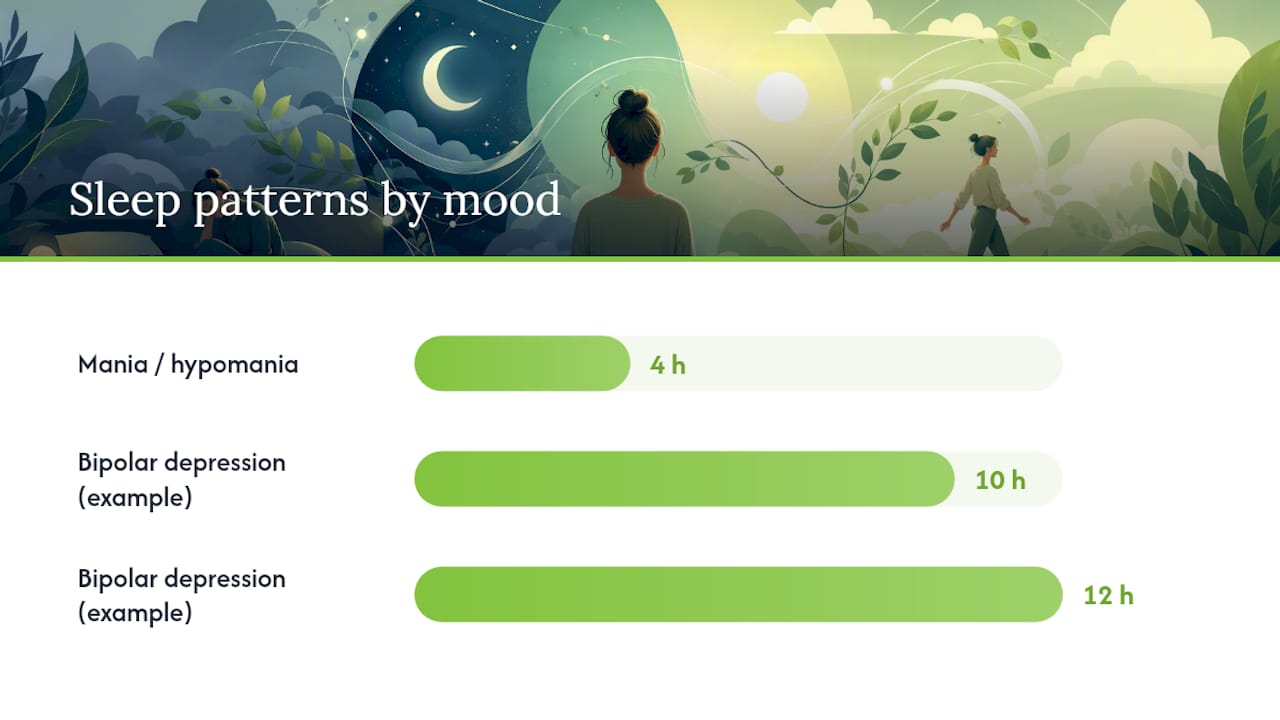
- A decreased need for sleep, where someone functions on four hours and feels fine, not just tired-but-pushing-through
- Racing thoughts or a sense that the mind is moving faster than usual
- A jump in goal-directed activity, like starting three new projects in a weekend or cleaning the entire house at 2 a.m.
- Impulsive or risky behavior, including sudden spending, driving too fast, or uncharacteristic sexual choices
- Grandiosity, an inflated sense of confidence or importance that feels out of proportion
- Pressured speech, talking faster and more than usual, sometimes hard for others to interrupt
Hypomania is the quieter cousin of full mania. It doesn’t cause the same level of impairment, and it rarely lands someone in the hospital, which is exactly why it gets missed. Full mania, by contrast, is disruptive enough that family members usually notice, and it can include psychosis in severe cases.
Here’s where it gets genuinely confusing for both patients and clinicians. Bipolar depression often does not look like the textbook picture of depression. Instead of insomnia, someone might sleep 10 or 12 hours a night and still feel exhausted. Instead of losing their appetite, they eat more and gain weight. Instead of slowing down, some patients feel agitated, restless, and unable to sit still even while feeling hopeless. Clinicians call these atypical features, and research comparing symptom profiles has found that psychomotor changes and certain depressive patterns show up more often in bipolar depression than in unipolar depression, with one large analysis finding that a cluster of features (including psychomotor retardation and psychotic symptoms) could tell the two apart with fairly good accuracy, an AUC around 0.83.
Mixed features add another layer. This is when depressive and manic symptoms show up at the same time; someone feels hopeless and worthless but also agitated, talking fast, and unable to slow their thoughts down. Mixed episodes are uncomfortable to sit with, both for the patient describing them and for a clinician trying to categorize them, because they don’t fit neatly into “depressed” or “manic.” They’re also one of the more dangerous presentations, since the combination of low mood and high energy raises impulsivity around self-harm.
If we had to boil this section down to one habit worth building: track your sleep and energy, not just your mood. Mood is subjective and shifts with context. Sleep and energy patterns are more concrete, and they’re usually what a clinician asks about first when trying to sort out bipolar disorder symptoms from ordinary depression.
Bipolar I, Bipolar II, and the Spectrum: Why Hypomania Gets Missed
Bipolar disorder isn’t one condition with one presentation. Bipolar I involves at least one full manic episode, often severe enough to require hospitalization, sometimes with psychosis. Bipolar II never reaches full mania; it involves hypomania paired with major depressive episodes, and the depression in Bipolar II is frequently more prominent and more disabling than the hypomanic phase ever was. Beyond those two, clinicians also talk about a broader bipolar spectrum, which includes presentations that don’t fully meet the criteria for either but still show a pattern of mood elevation and depression that behaves differently than straightforward unipolar depression.
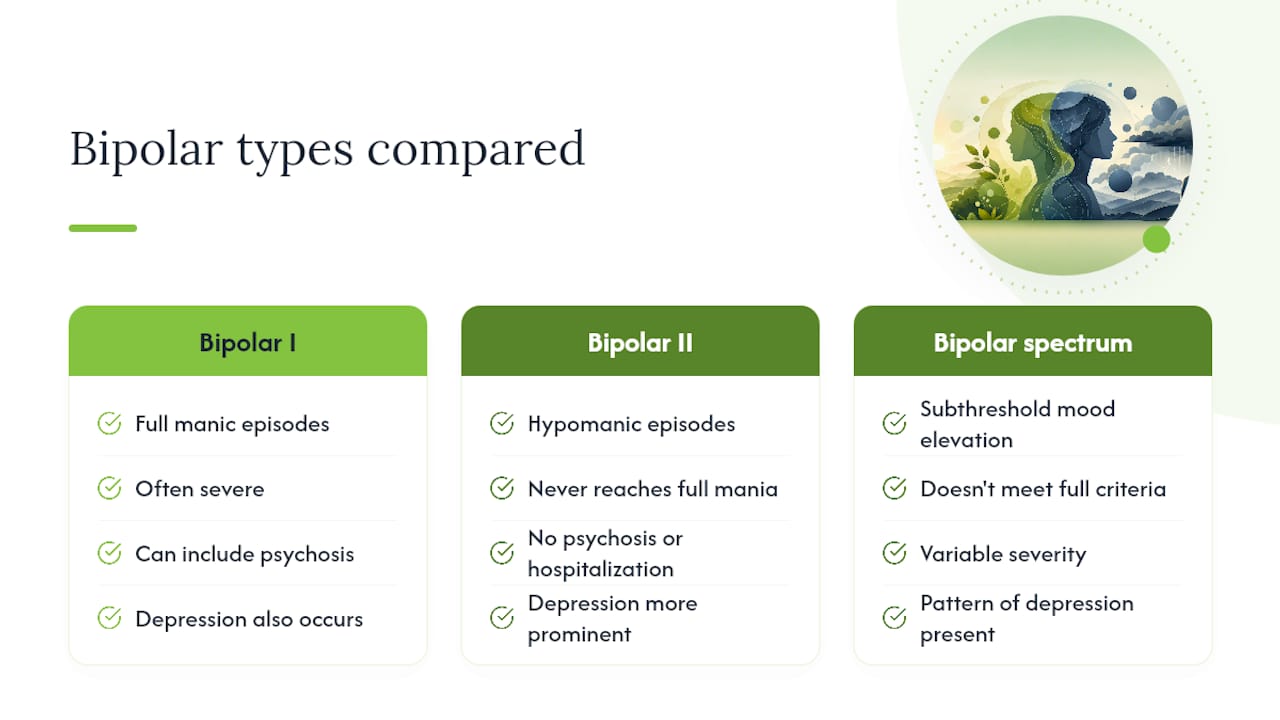
Bipolar II is the one we see misdiagnosed most often, and the reason is almost mechanical. Hypomanic episodes are short, sometimes lasting only a few days, and they don’t cause the dramatic disruption that full mania does. People often remember hypomania fondly. They got more done, felt more social, maybe more productive at work. Nobody schedules a psychiatry appointment because they had “too good” of a week. The depressive episodes, on the other hand, are what actually drive someone to seek care, which means the clinical picture at intake is almost always depression first, hypomania nowhere in sight unless someone specifically asks.
Consider a patient who comes in describing months of low mood, low energy, and hopelessness. If the clinician takes that at face value and prescribes a standard antidepressant, that can be the right call, or it can be the wrong one, depending on a piece of history nobody has asked about yet: two years ago, this same patient had a stretch of about a week where they barely slept, felt unstoppable, redecorated their apartment overnight, and later described it as “the best I’d felt in years.” That week never came up because it didn’t feel like a problem at the time.
Another common scenario involves family history quietly doing a lot of diagnostic work. A patient with a parent or sibling who has bipolar disorder carries a meaningfully higher likelihood of the same diagnosis, even if their own history of elevated mood looks subtle or brief. This is one of several features that research has connected to bipolar illness, alongside younger age of onset and frequent depressive episodes.
The practical takeaway here: if you’ve ever had a period that friends or family described as “not like you” in an energized, wired, or impulsive direction, mention it, even if it felt good at the time and even if it was brief. That detail matters more than most people realize when a clinician is trying to sort bipolar vs unipolar depression.
How Do Clinicians Tell Bipolar Depression from Major Depression?
Clinicians lean heavily on longitudinal course, meaning the pattern of episodes over years, not just the symptoms in front of them today. A single depressive episode tells you very little. A history of several depressive episodes starting in the teens or early twenties, especially with a family member who has bipolar disorder, shifts the probability meaningfully.
Certain details function as red flags that should prompt a closer look at bipolar spectrum illness rather than straightforward unipolar depression:
- Age of onset before 25, particularly with early, recurrent depressive episodes
- A high number of prior depressive episodes rather than one or two
- A history of feeling unusually activated, wired, or “high” after starting an antidepressant, sometimes described as feeling better than normal rather than just less depressed
- Psychotic features during a depressive episode, such as hearing things or holding fixed false beliefs
- Past psychiatric hospitalization, especially if the reason was unclear or described as “agitation” rather than depression
- Rapid cycling, meaning four or more mood episodes within a year
- Mixed features, where depressive and manic symptoms overlap in the same episode
That third item deserves its own callout, because it’s one of the more reliable signals we look for. Feeling unusually elevated or “high” after starting an antidepressant is a stronger clue toward bipolar spectrum illness than most patients realize, and it’s exactly the kind of detail that gets left out of a standard intake conversation unless someone asks directly. If this has happened to you, on any antidepressant, at any dose, tell your clinician in those words.
Screening tools help, but they have real limits worth understanding. The Mood Disorder Questionnaire is designed to flag a possible history of mania or hypomania, and the PHQ-9 measures the severity of current depressive symptoms. Neither tool diagnoses bipolar disorder on its own. They’re a starting point for a conversation, not a verdict, and a negative screen doesn’t rule out bipolar spectrum illness, particularly for milder or briefer hypomanic episodes that patients tend to underreport or forget.
This is why collateral history, meaning input from family members or close partners, carries real weight in this evaluation. People are notoriously unreliable narrators of their own manic or hypomanic periods, partly because those periods often felt good, and partly because insight tends to be impaired during the episode itself. A spouse who remembers “that month you barely slept and kept starting projects at midnight” is sometimes more diagnostically useful than the patient’s own recollection.
Pro Tip: Before your appointment, ask a parent, sibling, or long-term partner if they’ve ever noticed you going through a stretch of unusually high energy, reduced sleep, or impulsive spending, even if it seemed fine or good at the time. Their answer might change the entire direction of your evaluation.
Biomarker research, including neuroimaging studies comparing brain circuitry in bipolar versus unipolar depression, has found real differences at the group level, but none of these findings are reliable enough yet to diagnose an individual patient in routine clinical care. For now, diagnosis still rests on the interview, the history, and the details you and the people close to you can provide.
Why Treatment Changes Completely if the Diagnosis Is Bipolar
This is the part where the diagnosis stops being academic and starts affecting what actually gets prescribed. Standard antidepressant monotherapy, the default first move for unipolar depression, carries real risk in bipolar depression. Prescribing an antidepressant alone to someone with bipolar disorder can trigger a switch into mania, provoke mixed states, or accelerate cycling between episodes. Clinical evidence on bipolar depression treatment has found that antidepressant monotherapy is frequently ineffective or potentially harmful in this population, while mood stabilizers and certain antipsychotics show meaningfully better outcomes.
That shift in strategy is the entire reason getting the diagnosis right matters so much.
Treatments more commonly used once bipolar disorder is identified:
- Mood stabilizers such as lithium and valproate, which remain foundational for managing both poles of the illness
- Mood stabilizers like lamotrigine, often used for long-term maintenance rather than acute depressive episodes
- Certain second-generation antipsychotics, including quetiapine, lurasidone, and cariprazine, several of which carry FDA approval specifically for bipolar depression
- The combination of olanzapine and fluoxetine, another FDA-approved option for bipolar depression in specific cases
- Careful use of antidepressants only when paired with a mood stabilizer, and only when clinically justified, rather than as a standalone first step
For patients whose depression hasn’t responded to standard medication trials, whether the underlying diagnosis is bipolar or unipolar, neuromodulation and rapid-acting treatments have become a meaningful part of the conversation. Transcranial Magnetic Stimulation uses magnetic pulses to stimulate specific areas of the brain and has an established role in treatment-resistant depression. Electroconvulsive therapy remains one of the most effective options for severe or treatment-resistant mood episodes, including certain bipolar presentations. Ketamine and esketamine (Spravato) work differently than traditional antidepressants and have gained attention for producing relief faster than standard medications in some patients with treatment-resistant depression. Which of these fits depends heavily on diagnosis, severity, and what’s already been tried.
The prevalence numbers underscore why getting this right matters at a population level, not just an individual one. NIMH data shows major depressive disorder affects a substantially larger share of American adults than bipolar disorder does, which is part of why unipolar depression tends to be the default assumption clinicians reach for first, sometimes at the expense of catching bipolar spectrum illness underneath it.
Monitoring looks different once bipolar disorder enters the picture, too. Medication changes, especially adding or adjusting a mood stabilizer or antipsychotic, usually call for closer follow-up than a standard depression check-in, often every two to four weeks in the early stages rather than every few months. Safety planning becomes a standard part of the conversation, particularly around mixed states, where the combination of low mood and high energy raises impulsivity around self-harm. If you’re on a new medication and notice sudden shifts in sleep, energy, or mood, that’s worth a call to your prescriber rather than waiting for the next scheduled visit.
What to Bring to Your Evaluation to Get an Accurate Diagnosis
An accurate diagnosis depends on information that lives outside a fifteen-minute conversation about how you’re feeling this week. The more concrete detail you bring, the faster your clinician can build an accurate picture, and the less likely you are to spend years on a treatment plan that’s aimed at the wrong target.
- Write down any period where you felt unusually “high,” wired, or activated, especially if it followed starting or increasing an antidepressant. This single detail is one of the strongest signals clinicians look for.
- List any stretch of days or weeks with drastically reduced sleep that didn’t feel exhausting, paired with high energy or a rush of new ideas and projects.
- Note any impulsive behavior you’ve since regretted, including sudden spending, risky decisions, or uncharacteristic behavior that surprised people close to you.
- Bring your medication history, including what you’ve tried, at what doses, for how long, and how you responded, particularly any activation or worsening.
- Note the approximate dates of past depressive episodes and any hospitalizations, even rough timeframes help establish a pattern.
- Ask a parent, sibling, or partner if they’ve ever noticed you going through an unusually elevated or impulsive stretch, and bring their answer with you.
- Mention any family history of bipolar disorder, even in distant relatives, since this shifts diagnostic suspicion meaningfully.
- List current substance use, including alcohol, cannabis, or stimulants, since these can mimic or mask mood symptoms.
A first evaluation for a possible mood disorder typically runs longer than a standard follow-up visit, because the clinician is trying to reconstruct years of history, not just assess the last two weeks. Expect questions about early adulthood, family psychiatric history, and specific behavioral episodes rather than just a mood questionnaire. If bipolar spectrum illness looks likely, you can expect closer early monitoring, usually every two to four weeks after a medication change, along with a conversation about safety planning and, in appropriate cases, a discussion of neuromodulation or rapid-acting treatment options if standard medication trials haven’t worked.
Pro Tip: Bring a written timeline instead of trying to recall dates on the spot. Even a rough sketch, “depressed most of 2023, felt unusually great and barely slept for about two weeks in spring 2024,” gives your clinician far more to work with than a verbal summary under pressure.
If you’re worried a past diagnosis missed something, patient-advocacy resources on navigating misdiagnosis offer practical steps for raising concerns with a new clinician without feeling like you’re second-guessing prior care.
Could Something Else Be Causing Your Symptoms?
Mood symptoms don’t always come from a primary mood disorder, and ruling out other causes is a standard part of a careful evaluation. Thyroid disease, particularly hypothyroidism, can produce fatigue, low mood, and cognitive slowing that mimics depression closely. Anemia causes similar fatigue and low energy. Steroid medications can trigger mood elevation or irritability that looks like mania. Stimulant use, whether prescribed or recreational, can produce symptoms that resemble hypomania, and withdrawal from alcohol or sedatives can produce both anxiety and depressive symptoms severe enough to be mistaken for a primary mood episode.
Common confounders worth ruling out:
- Thyroid dysfunction, especially hypothyroidism presenting as low mood and fatigue
- Anemia or other causes of chronic fatigue
- Steroid medications, which can trigger mood elevation or irritability
- Stimulant use or withdrawal from alcohol, benzodiazepines, or other sedatives
- Vitamin D or B12 deficiency, which can contribute to low energy and mood changes
- Sleep apnea, which produces fatigue and mood symptoms often mistaken for depression
A few signals point away from a primary mood disorder and toward something else entirely: symptoms that started suddenly alongside a new medication, mood changes tightly linked to a medical illness or lab abnormality, or a pattern that doesn’t fit the sustained, multi-week course typical of depressive or manic episodes. Basic labs, including thyroid function and a complete blood count, are a reasonable first step before assuming a mood disorder is the whole story.
Some situations call for urgent evaluation rather than a scheduled appointment. Active suicidal thoughts, especially with a plan or intent, psychosis of any kind, or a rapid, severe decline in someone’s ability to function at work, school, or home all warrant same-day psychiatric assessment, often through an emergency department if no same-day psychiatric appointment is available.
How Common Are Depression and Bipolar Disorder?
The numbers here explain a lot about why misdiagnosis happens as often as it does. NIMH data on major depressive disorder shows it affects a considerably larger portion of the adult population in any given year than bipolar disorder does, based on NIMH data on bipolar disorder. Depression is, put simply, the far more common diagnosis clinicians expect to see walk through the door.
That imbalance creates a quiet bias. When a patient describes low mood, poor sleep, and loss of interest, the statistical odds favor unipolar depression, and most of the time that assumption is correct. But bipolar disorder often begins with a depressive episode, sometimes years before the first manic or hypomanic episode ever appears, which means a portion of patients labeled with depression early on are, in fact, in the early stages of bipolar illness. Research on diagnostic delays has found that a meaningful share of people eventually diagnosed with bipolar disorder were first told they had major depressive disorder, sometimes for years before the correct diagnosis surfaced.
Onset patterns also differ. Bipolar disorder tends to emerge earlier in life, often in the late teens or early twenties, while unipolar depression can develop at any age and sometimes appears for the first time much later in life. That age-of-onset pattern is one more piece of context clinicians weigh when a young adult presents with a first depressive episode.
What Causes Each Condition Biologically?
Both conditions run in families, but bipolar disorder shows a notably stronger genetic pattern. Having a first-degree relative with bipolar disorder raises your own risk meaningfully more than having a relative with unipolar depression raises the risk of depression, which is part of why clinicians ask about family history so directly during an evaluation.
Neuroimaging research has identified group-level differences in brain circuitry and white matter integrity between bipolar and unipolar depression, particularly in regions involved in emotional regulation and reward processing. These findings are genuinely interesting from a research standpoint, but they are not yet reliable enough to diagnose an individual patient in a clinical setting. We mention this because patients sometimes ask if a brain scan can settle the question. Right now, it can’t.
Circadian rhythm disruption appears to play a larger role in bipolar disorder than in unipolar depression, which may explain why sleep changes are often the earliest visible sign of an approaching episode in either direction. Dopamine and reward-circuit sensitivity also appear to differ between the two conditions, which may help explain why manic and hypomanic states involve such a strong pull toward novelty, risk, and goal-directed activity that depression simply doesn’t produce.
None of this biology is diagnostic on its own. It helps explain why the two conditions can look similar on the surface while behaving very differently over time, and why family history remains one of the more practical clues available in a standard evaluation.
What Life Factors Influence Onset and Course?
Genetics load the gun, but life circumstances often pull the trigger, and this holds true for both conditions in different ways. Chronic stress, major life transitions, sleep disruption, and trauma history all influence when a first episode appears and how severe subsequent episodes become.
Sleep deprivation deserves particular attention in bipolar disorder, since it’s one of the more reliable triggers for a manic or hypomanic episode. Shift work, a newborn at home, jet lag, or even a few consecutive short nights during a stressful stretch can be enough to tip someone into an episode who is otherwise stable on treatment. This is part of why sleep hygiene isn’t a throwaway suggestion in bipolar care. It functions closer to a treatment component.
Unipolar depression tends to follow a somewhat different pattern, often triggered or worsened by prolonged stress, loss, social isolation, or unresolved grief, without the same tight link to sleep disruption specifically. That said, poor sleep worsens both conditions regardless of which one you’re managing.
Social support has a measurable protective effect in both directions. Patients with a stable, informed support system, people who understand the illness and can gently flag early warning signs, tend to catch episodes earlier and recover more fully between them. This is one more reason collateral history from family matters so much during evaluation. The people around you often see the earliest signs before you do.
How Do Anxiety and Substance Use Affect Diagnosis and Treatment?
Anxiety disorders and mood disorders travel together often enough that clinicians expect to see them overlap. A significant portion of patients with bipolar disorder also meet criteria for an anxiety disorder at some point, and the same holds true for unipolar depression. When anxiety is present, it can obscure the underlying mood pattern, making agitation from a mixed bipolar episode look like generalized anxiety, or making anxious rumination in depression look like the racing thoughts of hypomania.
Substance use adds another layer of complexity, and it cuts both ways diagnostically. Stimulant use can produce symptoms that mimic hypomania almost exactly, while alcohol use, especially heavy or chronic use, can produce depressive symptoms severe enough to look like a primary mood disorder on its own. This is precisely why a thorough substance use history is a standard part of any mood disorder evaluation rather than an afterthought.
Treatment gets more complicated once a comorbid condition enters the picture. Some anxiety medications and certain treatments for substance withdrawal can interact with mood stabilizers or antipsychotics, and undiagnosed substance use can undermine an otherwise well-chosen treatment plan. Clinicians typically want any significant substance use addressed, or at least clearly identified, before drawing firm conclusions about whether depressive or manic-like symptoms reflect a primary mood disorder or a substance effect. Treating the mood disorder without acknowledging active substance use tends to produce inconsistent results and can make it harder to tell whether a medication is actually working.
What Does Long-Term Management Actually Look Like?
Both conditions are manageable over the long run, but the shape of “manageable” differs. Unipolar depression often responds well to a combination of antidepressant medication and psychotherapy, with many patients reaching full remission and staying there for extended periods, particularly with maintenance treatment after a first or second episode.
Bipolar disorder tends to require a longer view. It’s a recurring illness for most patients, which means the goal typically shifts from “curing” it to managing it well across years, similar in some ways to how a cardiologist manages a chronic condition rather than expecting to eliminate it outright. Long-term mood stabilizer or antipsychotic treatment, consistent sleep habits, and ongoing monitoring for early warning signs of an approaching episode form the backbone of most successful long-term plans.
Psychotherapy plays a role in both conditions but tends to focus on different goals. In bipolar disorder, therapy often centers on recognizing early warning signs of mania or depression and maintaining stable routines, particularly around sleep. In unipolar depression, therapy more often targets thought patterns, behavioral activation, and processing the life stressors that triggered or worsened the episode.
The honest long-term outlook: episodes can and often do recur in bipolar disorder even with good treatment, which is why ongoing psychiatric follow-up matters more here than a short course of care. Patients who stay engaged with treatment, keep consistent sleep schedules, and maintain open communication with their psychiatrist about early symptoms tend to have fewer and less severe episodes over time.
What Else Could This Be? Ruling Out Other Diagnoses
Mood symptoms overlap with enough other psychiatric conditions that a careful differential diagnosis matters before settling on either unipolar depression or bipolar disorder. Borderline personality disorder can produce rapid mood shifts that sometimes get mistaken for bipolar cycling, though the shifts in borderline personality disorder tend to be shorter, more reactive to interpersonal events, and less tied to the sustained sleep and energy changes seen in true hypomania.
Cyclothymic disorder sits on the milder end of the bipolar spectrum, involving chronic mood fluctuations that don’t reach the full threshold for hypomania or major depression but still cause noticeable instability over years. Attention-deficit/hyperactivity disorder occasionally gets confused with hypomania in younger patients, since both can involve impulsivity and racing thoughts, though ADHD symptoms tend to be more consistent over time rather than episodic.
Seasonal affective patterns, premenstrual dysphoric disorder, and adjustment disorders can all mimic aspects of unipolar depression without representing a full mood disorder. Schizoaffective disorder is another consideration when psychotic symptoms appear alongside mood episodes, since distinguishing it from bipolar disorder with psychotic features requires careful attention to whether psychosis occurs only during mood episodes or persists independently of them.
Getting this differential right matters because treatment approaches diverge meaningfully across these conditions, and a thorough clinical history remains the most reliable tool for sorting them out.
Clinical Perspective: How We Approach This at Nortex Psychiatry
In our work, the most common thing we see missed isn’t a rare symptom. It’s a period of feeling unusually good that nobody thought to mention. We ask about it directly, every time, because patients rarely bring it up on their own.
We also lean hard on collateral history. A five-minute conversation with a spouse or parent sometimes tells us more than several sessions with the patient alone, simply because insight during a hypomanic episode is often limited.
What we try to balance is genuine: patients want relief now, and caution takes time. We don’t sit on a diagnosis indefinitely, but we also won’t start an antidepressant alone if the history raises real concern for bipolar spectrum illness, because the risk of triggering a mixed state or manic switch is real. If any of this sounds like your own history, the most useful next step is a formal evaluation, not more self-monitoring. Bring the timeline. Bring a family member’s observations if you can. It genuinely speeds things up.
— Felix
Nortex Psychiatry: Evaluation and Treatment Options We Offer
Nortex Psychiatry offers something most primary care visits can’t: an evaluation built specifically to catch the difference between unipolar depression and bipolar spectrum illness, not just a symptom checklist. We provide full psychiatric evaluations, ongoing medication management, and, for cases that need more than standard medication trials, options including Transcranial Magnetic Stimulation, Ketamine Therapy, and Spravato Therapy for treatment-resistant depression. Your first appointment focuses on history: past episodes, medication responses, family psychiatric history, and, where possible, input from someone close to you. Both in-person visits and telehealth are available for patients in the North Dallas area. If your depression hasn’t responded the way you expected, or if something about your history doesn’t quite fit the standard picture, schedule an evaluation with Nortex Psychiatry and bring your timeline with you.
This article is general information, not a substitute for advice from a qualified doctor. Consult a qualified healthcare professional about your own circumstances before acting on anything here.
Sources
- Distinguishing bipolar from unipolar depression: the importance of clinical symptoms and illness features (PMC)
- American Journal of Psychiatry article on distinguishing features
- Springer article on misdiagnosis (2024)
FAQ
Can Depression Be Mistaken for Bipolar Disorder?
Yes, and it happens often in the other direction too. Bipolar depression can look identical to unipolar depression on the surface, which is why research on diagnostic delays has found many people eventually diagnosed with bipolar disorder were first labeled with major depressive disorder.
How Do You Know If It’s Depression or Bipolar?
The clearest signal is history of manic or hypomanic episodes, meaning periods of decreased sleep, high energy, racing thoughts, or impulsive behavior. A single depressive episode with no such history points toward unipolar depression, but a thorough evaluation and collateral history from family are still the most reliable way to be sure.
What Is the Difference Between Anxiety, Depression, and Bipolar Disorder?
Anxiety centers on excessive worry and physical tension without the sustained low mood or energy shifts seen in mood disorders. Depression involves persistent low mood, fatigue, and loss of interest, while bipolar disorder adds distinct episodes of mania or hypomania on top of depressive periods.
What Is the First Red Flag of Bipolar Disorder?
A common early red flag is feeling unusually elevated, energized, or “high,” rather than simply less depressed, after starting an antidepressant. Other early signals include a decreased need for sleep paired with a surge in energy or activity that feels out of character.
Is Bipolar a Type of Depression?
No. Bipolar disorder includes depressive episodes, but it’s defined by the presence of manic or hypomanic episodes as well, which unipolar depression never includes.