


Side effects from ADHD medication are common, and for most patients they are mild and manageable. Serious reactions are rare. The usual suspects are decreased appetite, sleep trouble, headache, stomach upset, and shifts in mood. If something feels off, start by checking dose timing with your prescriber. Call immediately for chest pain, fainting, hallucinations, or a painful erection lasting more than four hours.
TL;DR:
- The most common side effects, such as decreased appetite, sleep problems, and headaches, usually appear within the first two weeks and tend to improve over time.
- Amphetamine stimulants generally show slightly higher efficacy than methylphenidate but may cause more tolerability issues, requiring careful dose management.
- Serious side effects like chest pain, fainting, hallucinations, or painful erections require immediate medical attention, with close monitoring of cardiovascular symptoms for at-risk populations.
- Adjusting medication timing, switching formulations, and implementing behavioral strategies can effectively mitigate side effects without discontinuing treatment.
- Long-term safety studies indicate small but consistent increases in blood pressure and heart rate, with serious cardiovascular events remaining rare in the general population.
Table of Contents
- Types of ADHD Medications and How Their Side Effects Differ
- Common Side Effects: What They Look Like and How Long They Last
- Serious but Rare Side Effects You Should Not Ignore
- How to Reduce ADHD Medication Side Effects Without Stopping Treatment
- What Monitoring Should Look Like Over Time
- Special Populations: Children, Teens, Pregnancy, and Older Adults
- What Long-Term Studies Say About ADHD Medication Safety
- How Nortex Psychiatry Approaches Side-Effect Management
- How Side Effects Affect Daily Life and Whether Patients Stick With Treatment
- Do Men and Women Experience ADHD Medication Side Effects Differently?
- The Gap Between How Side Effects Get Talked About and How They Actually Play Out
- Getting Support for ADHD Medication Side Effects
- Sources
- FAQ
Types of ADHD Medications and How Their Side Effects Differ
The medication you take shapes the side effects you should expect. We often find that patients get lumped into one “ADHD medication” bucket in their own minds, when the four main categories behave quite differently in the body.
Amphetamine stimulants (mixed amphetamine salts, lisdexamfetamine) and methylphenidate stimulants (methylphenidate, dexmethylphenidate) make up most prescriptions. Both classes raise dopamine and norepinephrine activity, which is why they share a side-effect fingerprint: appetite suppression, sleep disruption, and small increases in heart rate and blood pressure. A network meta-analysis comparing ADHD medications found amphetamines tend to edge out methylphenidate on efficacy, but that gain sometimes comes with a tolerability trade off, which is exactly the kind of thing we weigh with a patient before writing the first prescription.
Atomoxetine, a non-stimulant, works on norepinephrine alone. It skips the appetite and cardiovascular profile of stimulants but brings its own issues: nausea, fatigue, and occasionally mood changes that show up weeks into treatment rather than on day one.
Guanfacine and clonidine, the alpha-2 agonists, were originally blood pressure medications. They cause sedation, especially at the start, and can drop blood pressure too far if combined carelessly with other medications.
Bupropion and certain tricyclics sometimes get used off label when stimulants aren’t tolerated. Bupropion carries its own seizure-risk considerations at higher doses; tricyclics need cardiac monitoring in anyone with a heart history.
Formulation matters as much as the drug itself:
- Immediate-release tablets act fast and wear off fast, which can produce a sharper “crash” as the dose fades.
- Extended-release capsules smooth out the curve but take longer to kick in each morning.
- Switching from one formulation to another, even within the same drug, sometimes resolves a side effect that a dose change alone couldn’t touch.
Common Side Effects: What They Look Like and How Long They Last
Most side effects show up in the first one to two weeks and either fade or become predictable enough to work around. Here is what we watch for most often, and what typically happens over time.
Decreased appetite and weight change usually appears within the first few days of stimulant treatment. It tends to be strongest at lunchtime, when the medication is at peak effect, which is why many kids eat a normal breakfast, skip lunch, then come home ravenous at dinner. For children, we recommend weighing and measuring height every three months during the first year. Nutritional strategies that actually help: front loading calories at breakfast before the dose kicks in, keeping calorie-dense snacks available in the evening, and adding a protein shake if weight trends downward for two consecutive visits.
Sleep problems and insomnia can come from two different directions, and telling them apart matters. Some patients have trouble falling asleep because the stimulant is still active at bedtime. Others experience rebound insomnia as the medication wears off and residual ADHD symptoms resurface right when the brain should be winding down. The fix differs depending on which one is happening, which is why we ask patients to track bedtime symptoms for a week rather than guessing.
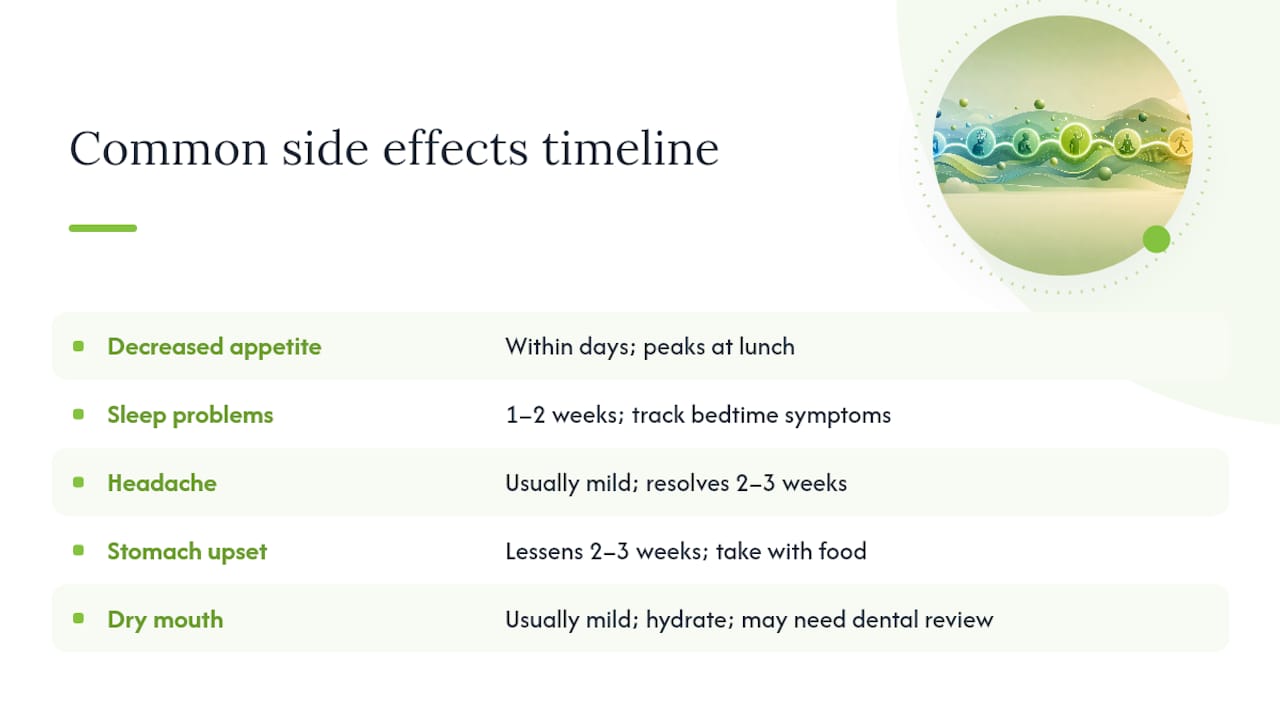
Headache, stomach upset, and dry mouth are usually mildest of the bunch and often resolve within two to three weeks as the body adjusts. Taking medication with food reduces stomach upset for most people. Dry mouth responds to hydration and, per pediatric ADHD guidance on stimulant-related dental issues, sometimes needs a closer look from a dentist if it persists, since dry mouth and stimulant-related teeth grinding tend to travel together.
Rebound irritability versus an underlying mood disorder is one of the trickier distinctions we make in clinic. Rebound irritability clusters tightly around the hours right after a dose wears off, usually late afternoon, and disappears on non-medication days. A mood disorder tends to be present regardless of dosing schedule and doesn’t track the medication’s half-life. Parents who keep a simple mood log by time of day give us the clearest picture.
By the numbers: A comprehensive systematic review of stimulant side effects found decreased appetite, sleep problems, headache, and stomach ache to be the most consistently reported adverse effects across studies, alongside small average increases in blood pressure and heart rate. The review found no consistent signal for serious cardiovascular events tied to these small increases.
Serious but Rare Side Effects You Should Not Ignore
The vast majority of patients never encounter these. But you should know what to watch for, because early action matters more here than almost anywhere else in ADHD treatment.
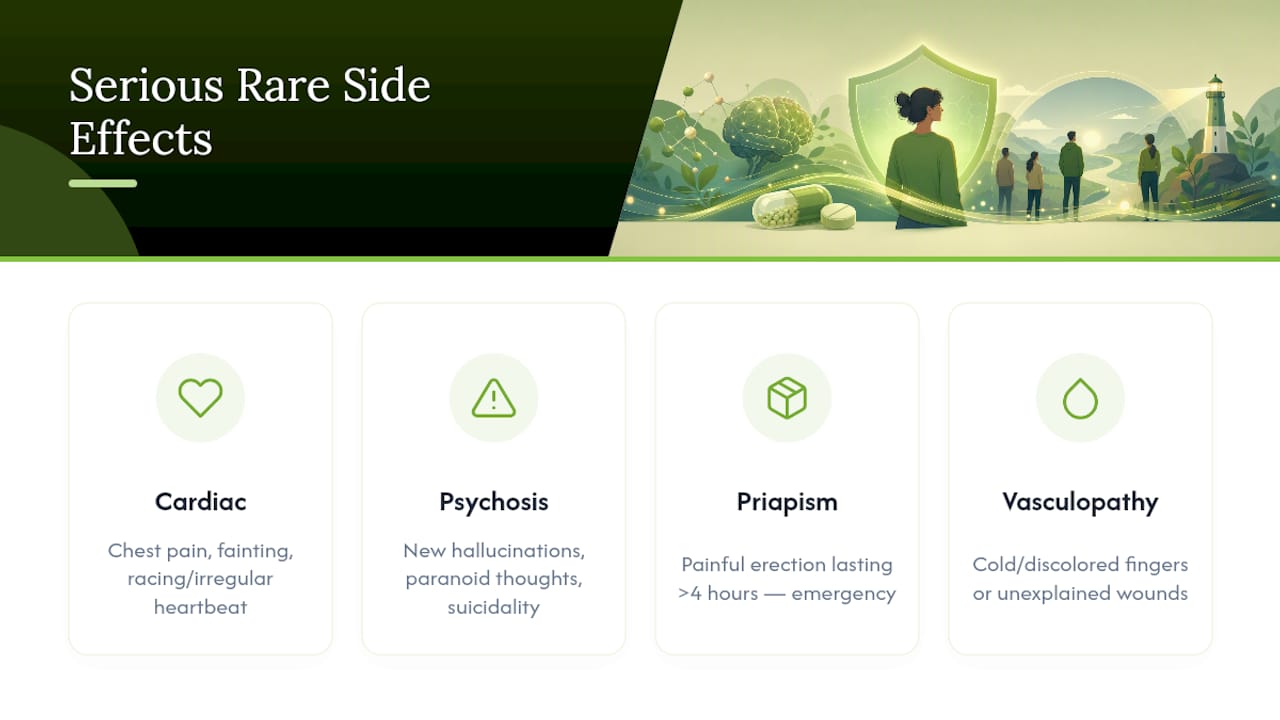
Cardiac symptoms deserve immediate attention: chest pain, fainting, or a racing or irregular heartbeat that doesn’t settle down. Before starting a stimulant, we take a careful personal and family cardiac history, because a history of unexplained fainting, a heart rhythm disorder, or sudden cardiac death in a young relative changes the calculus entirely. Clinical guidance from pediatric ADHD specialists supports skipping routine ECGs in healthy patients with a negative screening history, reserving that testing for anyone whose history raises a flag.
Psychosis and severe mood changes are rare, but they are the reason we ask direct questions about hallucinations, paranoid thoughts, and suicidal ideation at every follow up, not just the first visit. New-onset hallucinations, sudden severe aggression, or a sharp break from a patient’s usual personality warrants stopping the medication and calling your prescriber the same day.
Priapism, a persistent and often painful erection unrelated to sexual activity, is a documented but rare event with stimulant medications according to product labeling for methylphenidate. This is an emergency. Anything lasting beyond four hours needs same-day medical care, not a scheduled appointment.
Peripheral vasculopathy, unexplained cold, painful, or discolored fingers and toes, or wounds that appear without an obvious injury, is another rare but real signal listed on stimulant labeling. These findings deserve a call to your prescriber before your next dose.
None of these findings are meant to make you afraid of starting treatment. They are meant to give you a short, specific list of what “call now” actually looks like, so you’re not left guessing at 9 p.m. on a Tuesday.
How to Reduce ADHD Medication Side Effects Without Stopping Treatment
Most side effects can be managed without abandoning a medication that’s otherwise working well. Here is the order we typically work through with patients.
- Adjust timing and dose splitting first. Moving a dose thirty minutes earlier often resolves insomnia. Splitting an immediate-release dose into a smaller morning and afternoon dose can smooth out a harsh midday crash without raising the total daily amount.
- Consider a formulation change before a class change. If extended-release methylphenidate causes appetite loss that’s hard to manage, switching to an immediate-release version dosed around meals sometimes solves the problem while keeping the same active ingredient.
- Address appetite with structure, not force. For kids, we suggest a calorie-dense breakfast before the morning dose, easy-to-grab snacks during the afternoon lull, and a substantial dinner once appetite returns in the evening. Some families take planned medication breaks on weekends or during summer to let growth and appetite catch up, though this should be a decision made with your prescriber, not a unilateral choice.
- Fix sleep with behavior before pills. Sleep hygiene basics, consistent bedtime, no screens in the last hour, a cool dark room, resolve a surprising number of cases. When that isn’t enough, melatonin is often tried next. Adding a sedating medication on top of a stimulant is a bigger step and carries its own interaction risks, so we treat it as a later option, not a first move.
- Treat symptomatic side effects directly. Dry mouth responds to hydration and sugar-free gum; persistent teeth grinding sometimes needs a night guard and a dental visit rather than a medication change. Mild nausea often improves by taking the dose with food.
- Watch for polypharmacy pileup. Every additional medication added to manage a side effect is another interaction to track. We keep a running list with patients so a “quick fix” doesn’t quietly turn into five medications.
Pro Tip: Keep a simple daily log for the first month, noting dose time, meals, mood, and sleep. Patterns that are invisible day to day often jump out clearly after two or three weeks on paper.
Misuse prevention matters just as much as symptom management, particularly for stimulants. The FDA has updated warnings on prescription stimulants specifically because of risks tied to misuse, abuse, and addiction. Store medication in a locked cabinet, never share it even with a sibling who “seems like they might have it too,” and dispose of unused pills through a pharmacy take-back program rather than the trash or toilet. For families managing a teenager’s prescription, our guide to medication management for teens covers storage and school coordination in more depth.
What Monitoring Should Look Like Over Time
A responsible monitoring plan starts before the first pill and continues for as long as you’re on the medication. Here is the baseline and follow-up rhythm we use in clinic.
Before starting, we gather a personal and family cardiac history, a baseline blood pressure and heart rate, weight and height for children, and a screen for mood symptoms and substance use history. This isn’t paperwork for its own sake. It’s the reference point every future visit gets compared against.
In the first month, we check back within one to four weeks of any dose change or new prescription. This is when most side effects surface, and it’s the easiest window to catch a problem before it becomes a pattern.
Ongoing follow-up includes blood pressure and heart rate checks at each visit, growth measurements every three months for children during the first year of treatment, and a full medication review at least annually. If a family has questions about coordinating this with other chronic-condition care, our overview of medication management for chronic conditions walks through what that ongoing relationship typically looks like.
Specific thresholds that should prompt a referral or dose reconsideration: sustained blood pressure or heart rate elevation across multiple visits, weight loss significant enough to affect growth trajectory in children, or a growth curve that flattens out compared to a child’s own historical percentile. None of these are emergencies on their own, but they are not something to watch indefinitely either.
Special Populations: Children, Teens, Pregnancy, and Older Adults
Age and life stage change both the risk profile and the monitoring plan.
- Children under six carry a specific FDA warning. The agency found higher plasma exposures and higher rates of clinically significant weight loss in this age group when using extended-release stimulants, which is why labeling now limits use and calls for closer growth monitoring.
- School-age children need coordination between prescriber, parent, and teacher. A medication that looks fine at a fifteen-minute office visit can look very different across a six-hour school day, and teacher feedback often catches side effects parents don’t see at home.
- Adolescents and young adults carry a real diversion and misuse risk, sometimes from peers asking to buy or borrow pills before exams. This is where the storage and disposal guidance above stops being theoretical.
- Pregnancy and breastfeeding come with limited safety data for most ADHD medications. This is never a decision to make alone. It requires an individualized conversation weighing the risks of untreated ADHD symptoms against the unknowns of medication exposure.
- Older adults and anyone with existing cardiac disease should have a lower threshold for cardiovascular evaluation before starting a stimulant, including a closer look at blood pressure trends and any history of arrhythmia.
If you’re weighing medication against other approaches for an adult diagnosis, our comparison of medication versus therapy for ADHD covers how the two typically work together rather than as a strict either/or choice.
What Long-Term Studies Say About ADHD Medication Safety
The long-term evidence is reassuring on balance, though it comes with real limitations worth understanding.
Systematic reviews consistently find small average increases in blood pressure and heart rate with stimulant use, without a consistent signal for serious cardiovascular events in the broader patient population. That’s a meaningfully different finding from “no risk at all,” and it’s why ongoing blood pressure checks remain part of routine care rather than a one-time formality.
Comparative research suggests amphetamine-based stimulants may carry a somewhat higher psychosis signal than methylphenidate in some populations, a nuance that factors into which class we recommend first for a given patient, particularly anyone with a personal or family history of psychotic symptoms.
By the numbers: Long-term follow-up research on methylphenidate in adults found that while many patients remain on treatment over time, attrition is common, and adverse effects are a frequent reason patients stop. Those who stay on treatment tend to report a tolerable side-effect profile alongside meaningful symptom benefit.
The honest limitation here is that long-term studies, by nature, follow the patients who tolerated treatment well enough to stay in the study. That’s part of why individualized monitoring matters more than leaning on population-level averages alone. Your response to a medication is not the study’s average response, and it shouldn’t be treated as if it were.
How Nortex Psychiatry Approaches Side-Effect Management
In our practice, side-effect management starts at the evaluation, not after a problem shows up. We walk through personal and family history, current symptoms, and what matters most to that specific patient, whether that’s school performance, work focus, or simply getting through the day without feeling scattered.
From there, we titrate slowly and check in early, usually within a few weeks of any new dose, because that’s the window where most side effects either resolve or reveal themselves as something worth addressing. When a side effect does show up, we start with the least disruptive fix. That might mean adjusting dose timing before considering a formulation switch, or trying a formulation switch before moving to a different drug class entirely.
We also spend real time distinguishing rebound irritability from an underlying mood disorder, since treating one as the other leads nowhere good. If you’re curious what that evaluation process looks like from the start, our overview of the psychiatrist’s role in adult ADHD care walks through what a first visit typically covers, whether by telehealth or in person.
How Side Effects Affect Daily Life and Whether Patients Stick With Treatment
Side effects rarely show up as a single dramatic event. More often, they wear on a patient in small, cumulative ways, a child who dreads lunch because food has lost its appeal, an adult who lies awake at midnight replaying the day, a teenager who feels flatter and less like themselves by late afternoon.
These are the kinds of side effects that don’t send anyone to the emergency room, but they’re exactly the kind that quietly end a treatment plan. When a medication makes daily life harder rather than easier, patients stop taking it, sometimes without telling their prescriber, which leaves the ADHD symptoms it was meant to treat right back in charge. Long-term tolerability data backs this up directly: adverse effects are one of the most common reasons patients discontinue stimulant treatment over time.
We treat quality-of-life complaints as clinically significant, not as background noise to tolerate until the “real” problem gets fixed. A parent mentioning that their child seems sad in the afternoons, or an adult saying they’ve stopped enjoying meals, is data. It belongs in the conversation at the next visit, not something to push through silently for months. The goal of ADHD treatment is a fuller, more functional life. A medication that undercuts that goal in a different way than the ADHD itself did needs adjusting, not just enduring.
Do Men and Women Experience ADHD Medication Side Effects Differently?
Sex-based differences in ADHD medication side effects are real but underappreciated, partly because so much of the original stimulant research skewed toward male participants. In clinical practice, we notice patterns worth naming even where the research base is still catching up.
Appetite suppression and its downstream effects, weight change and nutritional impact, tend to draw more concern in female patients, particularly adolescents, where body image and growth intersect with an already sensitive developmental period. Hormonal fluctuations across the menstrual cycle can also shift how a stimulant feels from week to week, something we hear about often but that rarely gets mentioned in standard medication counseling.
Cardiovascular monitoring matters for both sexes, but baseline risk factors differ, and pregnancy potential adds a layer of consideration unique to women of childbearing age that simply doesn’t apply on the other side.
None of this means one sex tolerates ADHD medication better or worse than the other across the board. It means the side-effect conversation should include a question we don’t ask often enough: does this feel different depending on where you are in your cycle, your growth, or your life stage right now? That question alone sometimes surfaces a pattern that a standard symptom checklist misses entirely.
The Gap Between How Side Effects Get Talked About and How They Actually Play Out
The conventional framing of ADHD medication side effects tends to split into two unhelpful camps: dismissive reassurance that everything is minor and temporary, or alarmist lists of rare events that make starting treatment feel like a gamble. Neither matches what actually happens in practice.
What the evidence supports is more specific than either extreme. Most side effects are real, common, and manageable with small adjustments, not something to simply wait out. Serious events are genuinely rare, but they are specific and recognizable enough that every patient and parent should know the short list by name rather than a vague sense of “call if something seems wrong.”
Where conventional advice falls short is treating side-effect management as a binary. Keep the medication or stop it. In our experience, the more useful move is almost always somewhere in between: adjust the timing, change the formulation, add a targeted fix for one specific complaint. The reader’s first priority should not be deciding whether stimulants are “safe” in the abstract. It should be learning their own pattern well enough, through a simple log, honest conversations at follow-up, to tell an expected side effect from one that needs a same-day call.
— Felix
Getting Support for ADHD Medication Side Effects
If you’re managing side effects on your own, adjusting timing by guesswork or riding out symptoms because you’re not sure what’s normal, that’s exactly the gap outpatient psychiatric follow-up is meant to close. Ongoing medication management for ADHD and psychiatric evaluations are often available through local providers offering telehealth and in-person visits in North Dallas and surrounding areas.
A first visit typically includes a review of current medication, symptom history, and any side effects noticed, so adjustments can be based on your actual pattern rather than a generic protocol. Bring a list of current medications, notes on timing and side-effect patterns if you’ve been tracking them, and any relevant family medical history. Learn more about what ongoing medication management looks like, or reach out if a side effect has you wondering whether your current plan still fits. If you’re supporting an adult with ADHD who is also building coping strategies outside of medication, resources like adult ADHD executive function coaching can complement the clinical side of care.
This article is general information, not a substitute for advice from a qualified doctor. Consult a qualified healthcare professional about your own circumstances before acting on anything here.
Sources
- FDA updating warnings to improve safe use of prescription stimulants used to treat ADHD and other conditions
- Methylphenidate hydrochloride tablets — DailyMed
- Long-term tolerability and safety of methylphenidate in adults with ADHD
FAQ
What happens when you stop taking ADHD medication?
ADHD symptoms typically return within hours to a few days as the medication clears your system, since stimulants don’t have a lasting effect once discontinued. Some patients also notice short-term rebound irritability or fatigue, which usually settles within a few days.
What does unmedicated ADHD feel like?
Unmedicated ADHD often feels like constant mental noise, difficulty starting or finishing tasks, and a sense of being scattered even when trying hard to focus. Many adults describe it as running several browser tabs at once with no way to close any of them.
What is the most effective medication for treating ADHD?
Comparative research suggests amphetamine-based stimulants often show a slight efficacy edge over methylphenidate on average, but the best option is individual and depends on tolerability, health history, and how a patient responds to a specific formulation.
What are the pros and cons of taking medication for ADHD?
The main benefit is meaningful symptom control for attention, impulsivity, and hyperactivity, often improving school, work, and relationship functioning. The trade-offs are the common side effects covered throughout this guide, appetite changes, sleep disruption, and mood shifts, most of which respond to dose or formulation adjustments rather than requiring the medication to be stopped entirely.
How long do ADHD medication side effects typically last?
Most common side effects like headache, stomach upset, and appetite changes improve within two to three weeks as the body adjusts, though appetite suppression can persist longer and needs ongoing monitoring, especially in children.