


Mental health care is not something you finish. Yet many people seek help only when things reach a breaking point, then step away once symptoms ease. The role of ongoing mental health support is often misunderstood this way, treated as a short-term fix rather than a sustained process. What the research shows, and what we see consistently in practice, is that continuous care changes outcomes in ways that brief intervention simply cannot. If you are managing anxiety, depression, or chronic stress, what happens between crises matters just as much as how you respond during them.
Table of Contents
- Key takeaways
- What ongoing mental health support actually means
- Benefits of continuous care for anxiety, depression, and stress
- Challenges that get in the way of consistent care
- How to maintain mental wellness through ongoing support
- Comparing treatment approaches in ongoing care
- What I’ve learned from watching sustained care transform outcomes
- How Nortex Psychiatry supports your long-term mental wellness
- FAQ
Key takeaways
| Point | Details |
|---|---|
| Ongoing care prevents relapse | Continuous therapy and medication management significantly reduce the chance of symptoms returning after remission. |
| Combined treatment works best | Psychotherapy paired with medication outperforms either approach alone in long-term relapse prevention. |
| Barriers are real but solvable | Stigma, cost, and access challenges can be addressed through integrated care models and personalized planning. |
| Booster sessions extend gains | Scheduled follow-up therapy after acute treatment preserves progress over months and years. |
| You need a personalized plan | Effective ongoing support accounts for your history, comorbidities, and life context, not just your current symptoms. |
What ongoing mental health support actually means
People sometimes assume ongoing mental health support means being in crisis indefinitely or depending on a provider forever. That is not what it means. What it describes is a structured, evolving relationship with care that adapts as your needs change.
Outpatient mental health services rely on your ability to maintain stability between sessions, which is precisely why the system of support surrounding those sessions matters so much. Ongoing support is distinct from acute or inpatient treatment. It is the layer of care that sustains the progress you make when things are most difficult.
The components that make up ongoing support typically include:
- Psychotherapy, such as cognitive behavioral therapy (CBT), delivered on a regular schedule even when symptoms are mild
- Medication management, including careful monitoring, dose adjustments, and planned tapering when appropriate
- Social support, meaning relationships, peer groups, or community connections that reinforce stability
- Lifestyle factors, such as sleep hygiene, physical activity, and stress management practices that your care team helps you build and maintain
- Integrated care, where mental health providers work alongside primary care physicians to catch issues early and reduce fragmentation
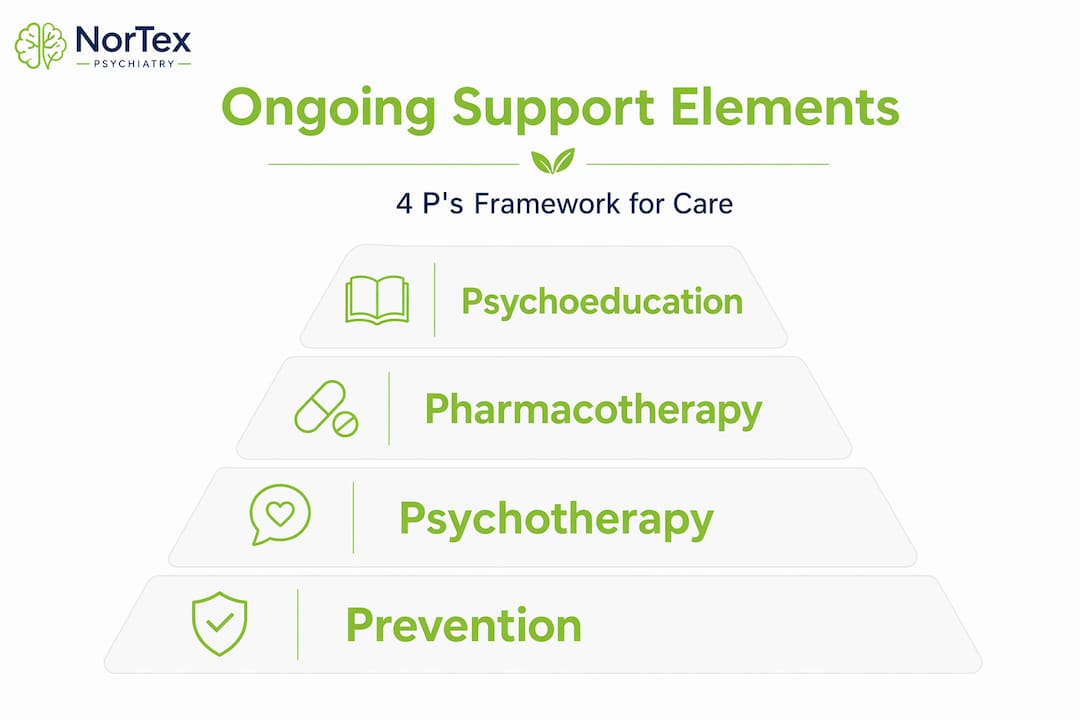
A personalized treatment plan takes all of these elements into account. The “4 P’s” framework used by many clinicians, which maps predisposing, precipitating, perpetuating, and protective factors, helps create long-term support plans that address root causes rather than just current symptoms.
Benefits of continuous care for anxiety, depression, and stress
The evidence for sustained mental health support is not subtle. The ANTLER trial found a 56% relapse rate in patients who discontinued antidepressants, compared to 39% in those who continued over 52 weeks. That gap represents a significant difference in quality of life, work performance, and personal functioning for real people.

Beyond relapse prevention, the benefits of continuous therapy reach into daily life in ways that matter to you. Among students and employees receiving ongoing care, measurable productivity improvements are consistently documented. Mental health conditions left without sustained attention account for 1 in 6 years lived with disability globally. The burden is real, and so is the difference that sustained care makes.
Specific benefits worth understanding include:
- Relapse prevention: Regular therapy and medication continuity keep symptom recurrence lower over time
- Functional recovery: People in ongoing care report better relationships, clearer thinking, and more consistent work output
- Emotional regulation: With continued skill-building in therapy, coping responses become more automatic and reliable
- Reduced crisis episodes: Sustained monitoring catches warning signs before they escalate into emergencies
Booster therapy sessions after completing acute treatment are one of the most underutilized strategies in mental health care. A 2024 study in Psychotherapy and Psychosomatics tracked anxiety disorder patients over four years and found that those who attended scheduled booster sessions maintained their gains significantly longer than those who did not.
For patients with both depression and anxiety, the PReDICT study findings underscore the importance of tailored combination treatment for better long-term outcomes. Anxiety comorbidity changes how depression responds to treatment, and a plan that does not account for this often falls short.
Pro Tip: If you have recently completed an acute phase of treatment and feel stable, that is actually the ideal time to schedule a conversation about a maintenance plan, not the time to stop care entirely.
Challenges that get in the way of consistent care
Even when people understand the importance of mental health support, sustained engagement is hard. The obstacles are practical, emotional, and structural, and they deserve honest acknowledgment rather than a list of vague suggestions.
Stigma remains a significant barrier for many people. Seeking ongoing care, rather than just crisis intervention, can feel to some like an admission of permanent weakness. Integrated mental health care in medical settings reduces this barrier meaningfully. When a behavioral health provider works alongside your primary care physician, seeking mental health support feels less like stepping into a separate and stigmatized system and more like a normal part of managing your overall health.
Other common challenges include:
- Cost and insurance coverage: Ongoing therapy sessions add up, and not all insurance plans cover extended care equally
- Geographic access: In areas outside major cities, finding a psychiatrist or therapist who accepts new patients is genuinely difficult
- Time and scheduling: Regular appointments require consistency that life does not always allow, especially for working adults or parents
- Patient agency: Some people feel passive in their care, waiting for a provider to tell them what to do rather than actively shaping their own plan
Focusing exclusively on individual coping skills can also miss the bigger picture. Systemic causes of chronic stress, such as workplace conditions, financial strain, and social isolation, require a support plan that goes beyond symptom management. A good ongoing care plan addresses what perpetuates the problem, not only what started it.
How to maintain mental wellness through ongoing support
Knowing you need continuous care and actually building it into your life are two different things. The following steps give you a framework for doing that practically.
-
Schedule regular therapy, even when you feel well. Waiting until symptoms return to re-engage with therapy is a common pattern that leads to preventable setbacks. Monthly or bimonthly sessions during stable periods keep skills sharp and catch early warning signs.
-
Treat medication adherence as non-negotiable during managed phases. If you are on antidepressants or other psychiatric medications, do not adjust or stop them without guidance. Slower tapering of antidepressants over more than four weeks, when clinically appropriate, significantly lowers relapse rates compared to faster discontinuation.
-
Ask explicitly about a maintenance plan. After completing acute treatment, ask your provider: what does the next 12 months of care look like? A structured answer to that question is a sign you are receiving thoughtful, long-term care.
-
Build a supportive environment. The people and spaces around you affect your stability between sessions. Supportive environments are not a soft concept. They are a clinical variable that affects outcomes.
-
Use telehealth when in-person care is not feasible. Telehealth appointments lower the barrier to consistency, especially during busy or difficult periods. Keeping the relationship with your provider intact matters more than the format of any single session.
-
Advocate for integrated care. If your primary care doctor and mental health provider are not communicating, ask about coordination. Integrated care models reduce gaps and improve the consistency of your overall treatment.
Pro Tip: Keep a brief weekly mood log, even just two or three sentences in a notes app. Over time, this gives you and your provider concrete data to guide decisions rather than relying only on memory during appointments.
Comparing treatment approaches in ongoing care
Not all ongoing mental health support looks the same. Therapy, medication, and combined treatment each have a different profile for long-term management.
| Approach | Relapse prevention | Skill building | Long-term durability | Best suited for |
|---|---|---|---|---|
| Psychotherapy (CBT) | Moderate to high | Strong | High (skills remain after therapy ends) | Anxiety, depression, stress, behavioral patterns |
| Medication alone | Moderate (while continuing) | Limited | Lower if discontinued | Acute to moderate depression, mood disorders |
| Combined therapy and medication | Highest | Strong | Highest overall | Moderate to severe depression, comorbid anxiety |
A 2024 meta-analysis in Frontiers in Psychiatry confirmed that combined treatment outperforms medication alone for relapse prevention and remission over the long term. The key insight is that medication’s protective effects often diminish when it is stopped, while the cognitive skills developed in CBT provide durable protection that persists beyond the treatment period. This is why timing and sequencing matter. Starting therapy alongside medication, rather than after, builds the skill foundation before medication is ever tapered.
You can also explore how TMS therapy compares to medication for people who have not responded to first-line treatments, which adds another dimension to the long-term planning conversation.
What I’ve learned from watching sustained care transform outcomes
In my experience, the patients who do best over the long run are not necessarily the ones who had the mildest conditions. They are the ones who stayed engaged with care through the ordinary periods, not just the hard ones.
What surprises many people is how subtle the benefits of continuous support can be in the short term. A session where nothing dramatic happens still calibrates your awareness, maintains your relationship with your provider, and reinforces the habits that protect you when things get harder. Patients who stop care during stable periods often return months later describing a gradual erosion they did not notice until it was significant.
I have also noticed that the biggest misconception is not about what therapy costs or how long it takes. It is the belief that needing ongoing support means something is fundamentally wrong, that the goal of “getting better” means eventually needing nothing. Mental health is dynamic. It responds to life. The goal of ongoing care is not to eliminate that reality. It is to meet it with more skill and stability than you had before. That shift in perspective, from finishing treatment to building capacity, changes how people engage with their care. And that, in practice, makes all the difference.
— Felix
How Nortex Psychiatry supports your long-term mental wellness
At Nortex Psychiatry, we work with individuals across Allen, Frisco, McKinney, Plano, and the surrounding North Dallas area who are looking for more than a one-time evaluation. Our approach is built around personalized psychiatric care that adjusts as your needs evolve, whether you are managing anxiety, depression, ADHD, or a mood disorder.
We offer medication management, psychiatric evaluations, and treatment planning that is designed to sustain your progress over time, not just stabilize an acute episode. If you are weighing your options, our mood disorder treatment guide walks through the personalized steps we use to build long-term relief. For those exploring how psychiatrist-led care addresses anxiety specifically, our anxiety care approach explains what that process looks like in practice.
Both in-person and telehealth appointments are available, making it easier to keep the consistency that ongoing support requires. If you are ready to take the next step toward sustained wellness, we are ready to help you build a plan that fits your life.
FAQ
What is ongoing mental health support?
Ongoing mental health support is continuous, structured care that helps people manage conditions like anxiety, depression, and stress over time. It typically includes regular therapy, medication management, and lifestyle planning rather than single-episode treatment.
How does continuous therapy reduce relapse?
Continuous therapy maintains the coping skills and provider relationship that protect against symptom recurrence. Research shows that patients who stay engaged with therapy after acute treatment have significantly lower relapse rates than those who stop care entirely.
What types of mental health interventions are part of ongoing care?
Ongoing care typically combines psychotherapy such as CBT, psychiatric medication management, booster sessions, social support, and lifestyle strategies. Combined approaches consistently show better long-term outcomes than any single intervention alone.
How can I maintain mental wellness between therapy sessions?
Keeping a mood log, maintaining consistent sleep and activity routines, and staying in contact with your provider through telehealth when needed all help sustain stability between formal appointments.
Is ongoing mental health support only for severe conditions?
No. Ongoing support benefits people across a range of severity levels. Even individuals with mild to moderate symptoms see better long-term functioning and lower relapse risk when they maintain regular care rather than seeking help only during acute episodes.