


If you’ve ever started treatment for depression and felt like you were just reacting to each appointment without a clear sense of where things were headed, you’re not alone. A well-structured depression treatment workflow changes that. It gives you a map, not just a destination. This guide walks you through each phase of evidence-based care, from the first screening question to relapse prevention, so you know what to expect, what to ask, and how to stay actively involved in your recovery.
Table of Contents
- Preparing for depression treatment: what you need to know
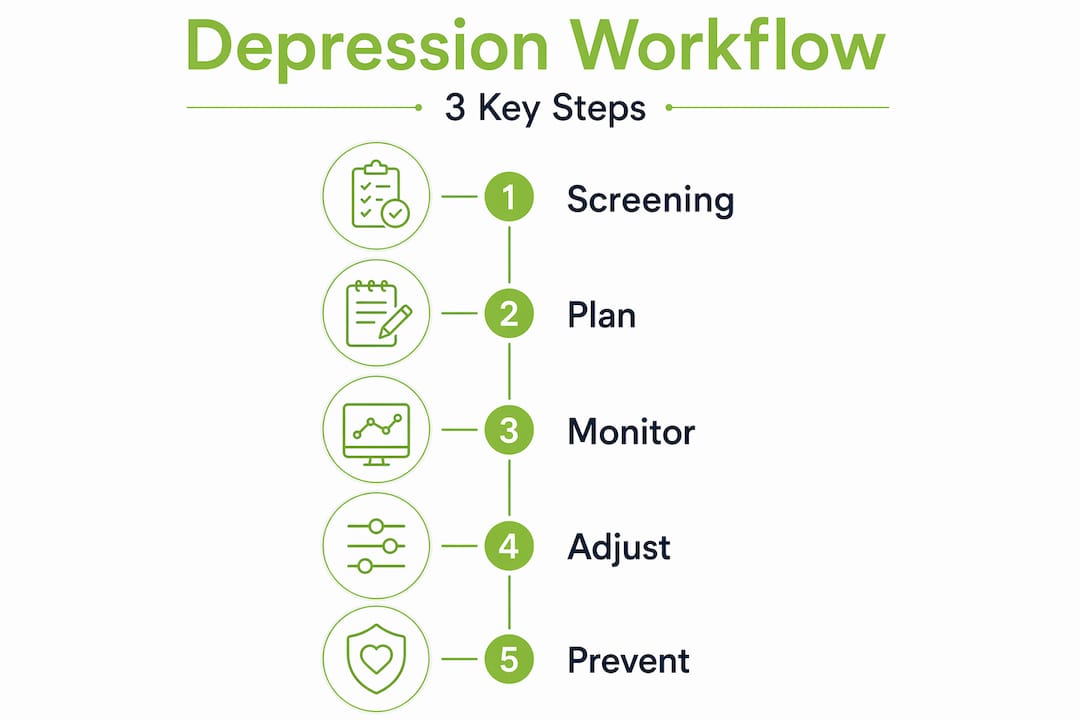
- Step 1: standardized screening to identify depression severity
- Step 2: developing your personalized treatment plan with measurement-based care
- Step 3: monitoring progress and adjusting treatment
- Common challenges and expert tips for navigating depression treatment workflows
- Our perspective: the most underused tool in depression care is follow-up timing
- Ready to start your depression care plan with expert support in North Dallas?
- Frequently asked questions
Key Takeaways
| Point | Details |
|---|---|
| Prepare ahead | Bringing documents, medication lists, and questions helps your treatment start smoothly. |
| Screening guides care | PHQ tools assess your depression severity to tailor next steps effectively. |
| Measurement-based care | Regular symptom tracking every 2-4 weeks ensures timely treatment adjustments. |
| Matched treatment | Treatment intensity matches severity, combining therapy and medication when appropriate. |
| Ongoing monitoring | Early follow-ups and relapse prevention sustain your recovery over time. |
Preparing for depression treatment: what you need to know
Before your first appointment, a little preparation goes a long way. Many people underestimate how much the logistics and practical side of getting started can shape their experience. SAMHSA recommends planning practical logistics before outpatient mental health treatment, including transportation, childcare, and having key documents ready.
Here’s what to bring to your first appointment:
- Photo ID and insurance card. Your provider needs these to open your file and verify coverage.
- A current medication list. Include dosages, how long you’ve been taking each medication, and any supplements or over-the-counter drugs.
- A brief summary of prior treatments. Even a few written notes about what you’ve tried before, what helped, and what didn’t will save valuable time.
- Your questions. Write them down in advance. Many people forget what they wanted to ask once they’re sitting in the room.
A quick note on technology: if you’re doing a telehealth visit, test your camera and microphone at least 24 hours ahead. Technical problems at appointment time can delay your care start by days.
Pro Tip: If preparing for mood disorder treatment feels overwhelming, start with just the medication list. It’s the single most useful document your provider will want to see.
| Item to prepare | Why it matters |
|---|---|
| ID and insurance card | Required for intake and billing |
| Current medication list | Prevents drug interactions and duplicates |
| Prior treatment history | Guides your provider’s starting point |
| List of questions | Helps you get the most from your appointment |
| Tech check (telehealth) | Avoids delays and appointment cancellations |
Knowing what to expect also reduces anxiety about starting. Most first appointments focus on gathering information, not immediately prescribing medications or starting therapy. Think of it as the foundation being laid.
Step 1: standardized screening to identify depression severity
With your preparations in place, the next step is understanding how screening tools kick off your personalized care plan. The depression pathway often starts with a PHQ-2 screening for every patient, then administers the PHQ-9 when the PHQ-2 is positive, stratifying severity to decide on monitoring, treatment, or referral.
The PHQ-2 is just two questions. It takes about 30 seconds and asks how often in the past two weeks you’ve felt little interest in things and how often you’ve felt down or hopeless. It’s designed to be fast and applied broadly, not just when someone mentions depression.
A positive PHQ-2 triggers the full PHQ-9, a nine-question tool that covers the complete range of depressive symptoms including sleep, energy, concentration, appetite, and thoughts of self-harm. Scores fall into categories:
- 0 to 4: Minimal depression, monitor and follow up
- 5 to 9: Mild depression, may benefit from watchful waiting or guided self-help
- 10 to 14: Moderate depression, likely warrants therapy and possibly medication
- 15 to 27: Moderate to severe depression, combination treatment or referral often needed
“Systematic screening prevents the all-too-common scenario where depression is identified only after it has significantly impaired someone’s work, relationships, and daily function.” — Clinical care principle reflected in depression treatment guidelines
This structured approach matters because it removes guesswork. Your provider isn’t relying solely on conversation to judge severity. A score gives both of you a shared, objective starting point. You can also use the depression self-assessment to familiarize yourself with these questions before your first appointment.
Pro Tip: If you complete a PHQ-9 before or during intake, ask your provider to share your score with you. Understanding where you fall on the scale helps you take ownership of your progress.
Step 2: developing your personalized treatment plan with measurement-based care
Once severity is determined, your provider crafts a plan tailored to your situation, adjusting regularly with measurable feedback. This is where the personalized depression treatment guide approach really becomes visible.
Treatment intensity is matched to your PHQ-9 score. The underlying principle is that more intensive interventions are reserved for more severe presentations. Antidepressants are not routine first-line for less severe depression, and are offered based on informed patient preferences and a discussion of alternatives. That’s worth knowing. If your provider jumps straight to medication without discussing your preferences and other options, it’s reasonable to ask about the full picture.
Here’s how treatment typically maps to severity:
- Mild depression (PHQ-9 score 5 to 9): Guided self-help, structured problem solving, lifestyle interventions like exercise, and psychoeducation. Active monitoring with scheduled follow-ups.
- Moderate depression (PHQ-9 score 10 to 14): Cognitive behavioral therapy (CBT), other evidence-based psychotherapies, or medication, often based on patient preference. This is where shared decision-making is most active.
- Severe depression (PHQ-9 score 15 and above): Combination of antidepressant medication and structured psychotherapy, with closer follow-up intervals and possible specialist referral.
Shared decision-making is central to this phase. Your values, your history, your preferences about therapy versus medication choices, and your practical life circumstances all shape what gets recommended. This isn’t a one-size-fits-all prescription.
Measurement-based care workflows repeat the PHQ-9 every 2 to 4 weeks during active treatment. This is not paperwork. It’s your provider tracking whether your score is moving in the right direction. A 50% reduction in PHQ-9 score is the clinical definition of response. Hitting a score of 4 or below is remission.
Pro Tip: Ask your provider to set a SMART goal with you at the start of treatment. Something like “reduce PHQ-9 from 16 to below 9 within eight weeks using CBT and medication” gives both of you a concrete, time-bound target to aim for.
| Depression severity | PHQ-9 score | Typical first-line approach |
|---|---|---|
| Minimal | 0 to 4 | Monitor, lifestyle support |
| Mild | 5 to 9 | Guided self-help, watchful waiting |
| Moderate | 10 to 14 | Therapy, medication (based on preference) |
| Moderately severe | 15 to 19 | Combination therapy and medication |
| Severe | 20 to 27 | Intensive combination, possible referral |
Step 3: monitoring progress and adjusting treatment
Your initial plan is just the start. How consistently progress is tracked and how quickly adjustments are made often determines whether treatment works. Follow-up after initial treatment typically occurs every two weeks initially, using PHQ-9 scores to guide dose changes, medication switches, adding psychotherapy, or referral if response stalls around four to six weeks.

This is called active management. It’s not a passive “let’s wait and see” approach. Your provider is watching specific milestones.
Key checkpoints in the monitoring phase:
- Weeks 2 to 4: Check for side effects, early symptom changes, and engagement with therapy sessions
- Week 4 to 6: If PHQ-9 hasn’t improved by at least 25 to 50%, the plan is revisited. This might mean a dose increase, a medication switch, or adding a therapy modality.
- Week 8 to 12: Assess for full response or remission. Adjust the plan based on current score.
- Ongoing: Safety monitoring continues throughout, especially for anyone with moderate or severe scores that include thoughts of self-harm.
“Stagnating for months on an ineffective treatment is one of the most preventable sources of prolonged suffering in depression care. The purpose of scheduled assessments is to catch that stagnation early.” — Principle reflected across depression treatment protocols
Safety planning isn’t just for crisis situations. It’s a standing part of the workflow for treating depression at moderate to severe levels. It means your provider is asking directly about thoughts of self-harm at each visit and has a documented plan in place.
Relapse prevention includes continuing antidepressants for at least six months after remission for first episodes, and often longer for repeated episodes or high relapse risk. Feeling better is not the same as being done.
Pro Tip: Don’t stop medication once you start feeling like yourself again without talking to your provider first. Premature discontinuation is one of the most common reasons depression comes back. Use your ongoing depression assessments to stay informed about where your scores actually stand.
Common challenges and expert tips for navigating depression treatment workflows
Knowing the workflow is great, but let’s address some real obstacles people in North Dallas face when trying to follow through with care, and how to navigate them.
Practical barriers before the first appointment include transportation, childcare, tech readiness, and medication history. These aren’t minor inconveniences. They’re among the most common reasons people delay or discontinue care. Telehealth has removed the transportation problem for many, but it introduces tech-related friction of its own.
Common challenges and how to address them:
- “I don’t know my medication history.” Call your pharmacy. Most pharmacies can print a complete history going back years. It takes one phone call and usually costs nothing.
- “I’m not sure what to say to my provider.” Write a timeline: when symptoms started, what changed, what life events may have contributed. You don’t need to explain everything in session one.
- “I feel like I’m not improving but my provider hasn’t changed anything.” Ask directly about your PHQ-9 score and whether your current response rate suggests it’s time to adjust your plan. Proactive communication matters.
- “I keep missing appointments.” Telehealth appointments are far easier to keep. Nortex Psychiatry offers overcoming treatment challenges support with both in-person and virtual options to reduce this barrier.
Pro Tip: Before each follow-up appointment, take five minutes to jot down how your mood has been that week, any side effects you’ve noticed, and one thing you want your provider to address. Walking in prepared transforms a 20-minute visit into something genuinely useful.
Our perspective: the most underused tool in depression care is follow-up timing
Here’s something most articles won’t tell you. The depression treatment workflow is not where most people fail. Where care breaks down is the gap between appointments.
Providers schedule follow-ups. Patients miss them, reschedule them, or show up without tracking what’s actually changed. When that happens, the measurement-based care system loses its signal. The PHQ-9 becomes a form you fill out in the waiting room rather than a clinical tool driving real decisions.
We’ve seen patients who spent six months on a medication that wasn’t working because no one looked closely enough at their scores between visits. That’s not a failure of the protocol. It’s a failure of follow-through on both sides.
The uncomfortable truth is this: understanding the workflow matters, but actively participating in it is what determines outcomes. That means keeping appointments, tracking your mood between visits, being honest about side effects, and asking your provider to show you your PHQ-9 trend over time. Recovery is not a straight line, but it should move. If it isn’t moving after six weeks, that’s a data point worth acting on.
The patients who do best are the ones who treat their mental health treatment steps like any other health condition requiring active management, not passive waiting.
Ready to start your depression care plan with expert support in North Dallas?
At Nortex Psychiatry, we work with adults across Allen, Frisco, McKinney, Plano, and the greater North Dallas area using the same evidence-based depression treatment workflow described in this guide. Whether you’re starting care for the first time or want a second opinion on a plan that isn’t working, we offer personalized psychiatric evaluations, medication management, and coordinated care in a judgment-free environment. Both in-person and telehealth appointments are available. You don’t have to figure this out alone. Contact Nortex Psychiatry to schedule your evaluation and take the first real step toward feeling better.
Frequently asked questions
What is the difference between PHQ-2 and PHQ-9 screenings?
PHQ-2 is a quick, initial screening for depression symptoms, while PHQ-9 is a detailed questionnaire used if PHQ-2 indicates possible depression to assess severity and guide treatment. The depression pathway starts with PHQ-2 for every patient, then administers PHQ-9 if positive to stratify severity.
How often should depression symptoms be assessed during treatment?
Symptoms should be assessed every 2 to 4 weeks using the PHQ-9 to monitor progress and guide adjustments as needed. Measurement-based care workflows repeat this assessment consistently during active treatment to keep decisions data-driven rather than impression-based.
When is medication recommended for depression treatment?
Medication is recommended based on symptom severity and patient preference, often combined with therapy for moderate to severe depression. Antidepressants are not routine first-line for less severe cases and should be offered only after discussing the evidence and alternatives with the patient.
How long should antidepressant treatment continue after symptoms improve?
Continuation for at least six months after remission is recommended for first episodes, with longer durations for repeated episodes or high relapse risk. Stopping too early is one of the most common reasons depression returns.