


Most people assume a psychiatric treatment plan looks the same for everyone: see a doctor, get a prescription, come back in a month. That assumption leads many adults in North Dallas to feel like they’re not getting the care they actually need. The truth is, a well-built psychiatric treatment plan is dynamic, collaborative, and shaped by your specific symptoms, history, and goals. Whether you’re managing anxiety, depression, or ADHD, understanding how these plans work gives you real power to participate in your own recovery and get better results faster.
Table of Contents
- What makes a psychiatric treatment plan personal?
- Evidence-based frameworks for anxiety, depression, and ADHD
- How feedback and early progress shape your plan
- Telehealth and local options in North Dallas
- The uncomfortable truth about psychiatric treatment plans
- Explore personalized care options with Nortex Psychiatry
- Frequently asked questions
Key Takeaways
| Point | Details |
|---|---|
| Plans adapt with progress | Personalized psychiatric treatment evolves as symptoms and preferences change. |
| Evidence guides decisions | Clinical frameworks and early feedback inform medication and therapy choices. |
| Collaborative care matters | Working with your provider ensures plans align with your needs and values. |
| Telehealth offers flexibility | Remote and local options make high-quality psychiatric care accessible in North Dallas. |
| Patient input shapes outcomes | Active participation leads to better, more personalized treatment results. |
What makes a psychiatric treatment plan personal?
With that misconception challenged, let’s clarify what actually goes into a psychiatric treatment plan and why the personal touch matters.
A psychiatric treatment plan is not a checklist handed to every patient with the same diagnosis. At its core, a strong plan includes four foundational elements: a clear diagnosis based on clinical criteria, a method for tracking your symptoms over time, evidence-based interventions chosen to match your specific presentation, and regular checkpoints to assess progress. Each of these elements is shaped by who you are, not just what condition you carry.
Your preferences matter more than you might think. Some people respond well to therapy alone. Others need medication to stabilize enough to benefit from therapy. Some want to start conservatively; others want to move fast. The APA’s clinical practice guideline framework explicitly incorporates patient values, preferences, age-specific factors, and clinician resources into treatment decisions. That means your voice isn’t just welcome in the room. It’s built into the model.
Here’s what a personalized plan typically includes:
- Diagnosis and symptom profile: Not just “depression,” but how severe, how long, and what specific symptoms are most disabling for you
- Treatment goals: Defined collaboratively so you know what progress actually looks like
- Chosen interventions: Therapy type, medication class, or a combination based on evidence and your preferences
- Measurement tools: Validated scales like the PHQ-9 for depression or GAD-7 for anxiety to track changes objectively
- Review schedule: Planned checkpoints, often at 4 weeks and 8 weeks, where your clinician evaluates whether to stay the course or adjust
The table below shows how a plan differs across three common presentations:
| Feature | Anxiety-focused plan | Depression-focused plan | ADHD-focused plan |
|---|---|---|---|
| Primary therapy | CBT or exposure therapy | CBT or behavioral activation | CBT plus skills coaching |
| Medication first-line | SSRIs or SNRIs | SSRIs or SNRIs | Stimulants or non-stimulants |
| First major review | 4 to 6 weeks | 4 weeks | 4 to 6 weeks |
| Symptom scale used | GAD-7 | PHQ-9 | ASRS |
| Plan flexibility | High | High | Moderate to high |
Understanding personalized care for North Dallas means recognizing that the plan you receive should reflect the full picture of who you are, not just a symptom category.
For those managing mood disorders specifically, exploring personalized steps for relief can offer additional clarity on how treatment phases connect to real-world outcomes.
Evidence-based frameworks for anxiety, depression, and ADHD
Now that the basics are clear, let’s see how evidence shapes real-world plans for different conditions.
Every psychiatric treatment plan should be grounded in clinical evidence, but evidence looks different depending on the condition. Understanding how frameworks are built for your specific diagnosis helps you know what to expect and what questions to ask.
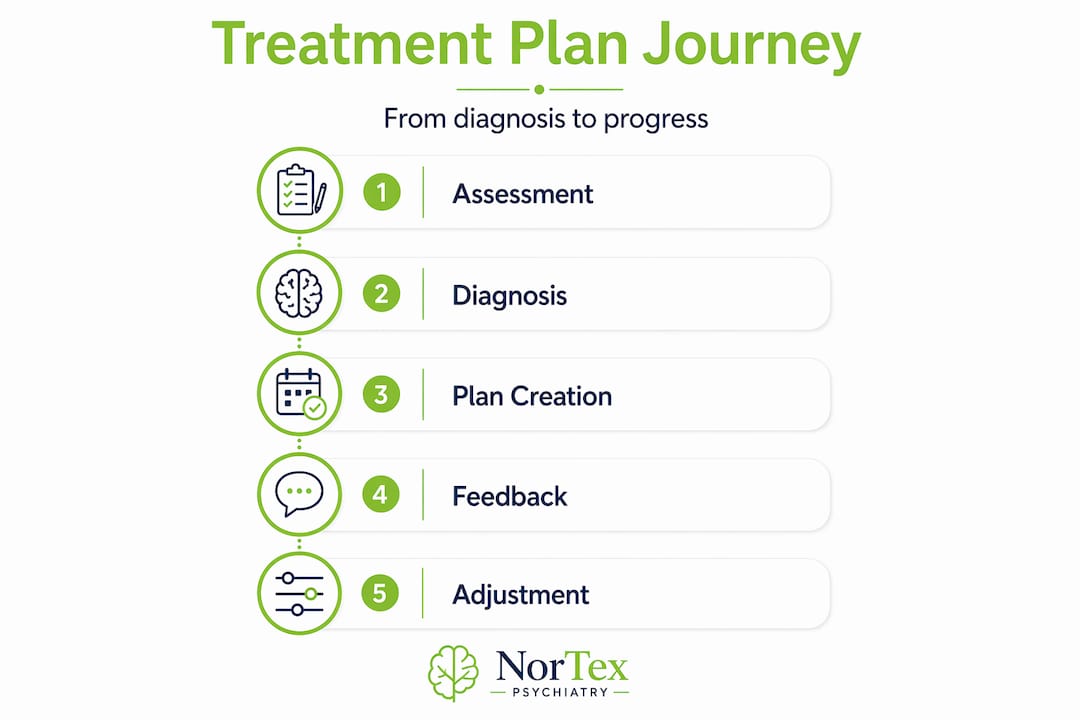
For depression, the process is structured around early response monitoring. According to a CANMAT and Harvard Psychiatry summary published by the American Academy of Family Physicians, depression management emphasizes checking whether symptoms are improving within the first four weeks. If they’re not, the plan changes. This might mean adjusting the dose, switching medications, or adding therapy. The key insight here is that waiting months to see if something works is no longer the standard. Modern depression care is active and responsive.
For anxiety, the evidence points toward a stepped care model. A review in JAMA Internal Medicine confirms that cognitive behavioral therapy, or CBT, is the first-line treatment for adult anxiety disorders, with SSRIs and SNRIs as the primary pharmacotherapy options. Benzodiazepines are generally not recommended for long-term use due to risks of dependence and cognitive side effects. Many people are surprised to learn this, since benzodiazepines are still widely prescribed. A well-designed plan avoids this pitfall from the start.
For adult ADHD, the framework is multimodal. Research from the Harvard Review of Psychiatry supports combining medication with CBT-based therapy, especially over the long term. Medication alone often leaves gaps in skills like organization, time management, and emotional regulation that therapy can directly address.
Here’s how a stepped care approach works across conditions:
- Start with the least intensive, evidence-supported option that matches your symptom severity
- Monitor response at defined intervals using validated assessment tools
- Step up treatment intensity if the current approach isn’t producing adequate improvement
- Consider combination approaches when a single modality falls short
- Reassess and consolidate once you reach a stable point, with a maintenance plan to prevent relapse
Pro Tip: Ask your psychiatrist which clinical guideline is informing your treatment. Knowing whether your plan follows CANMAT, APA, or another framework helps you understand the reasoning behind each recommendation and builds trust in the process.
For a broader look at how psychiatric care actually helps, reading about the psychiatric care benefits for anxiety and depression offers context that goes beyond medication alone. If you’re weighing whether to prioritize therapy or medication, exploring the therapy vs. medication question directly can help you have a more informed conversation with your provider.
For depression specifically, understanding evidence-based depression therapy helps clarify what good treatment actually looks like in practice. And if anxiety is your primary concern, a structured anxiety treatment steps guide walks you through the process from evaluation to relief.
How feedback and early progress shape your plan
A plan isn’t static. Here’s how real-time feedback and early progress can reshape your treatment journey.

One of the most overlooked parts of psychiatric care is the feedback loop. Many patients assume the plan is set at the first appointment and doesn’t change much unless something goes drastically wrong. In reality, the most effective treatment plans are designed to evolve based on what’s actually happening in your body and life.
The benchmark that matters most early on is the four-week mark for depression. CANMAT-based guidance recommends monitoring for at least a 20% reduction in symptom severity by four weeks. If that threshold isn’t reached, your psychiatrist should revise the plan, whether that means adjusting the medication dose, switching to a different agent, or introducing or intensifying therapy. This isn’t failure. It’s the plan working exactly as intended.
For anxiety, the feedback loop is equally important. A review in JAMA Internal Medicine found that collaborative care management in anxiety can significantly improve outcomes compared to standard primary care. Collaborative care means your psychiatrist, therapist, and possibly your primary care provider are communicating and adjusting together, rather than working in silos.
“Recovery in mental health treatment is a journey, not a straight line. The most meaningful progress often comes after an honest conversation about what isn’t working.”
Here’s what good feedback-driven care looks like in practice:
- Regular symptom check-ins: Using validated tools like the PHQ-9 or GAD-7 at every visit, not just occasionally
- Honest self-reporting: Your clinician can only adjust what they can measure, so being specific about what’s changed, what hasn’t, and what side effects you’re experiencing is critical
- Scheduled plan reviews: Not just open-ended follow-ups, but actual structured moments to evaluate whether your current approach is still the right one
- Side effect tracking: Some medications cause early side effects that improve over time; knowing this helps you stay the course when appropriate
- Life context updates: Changes in sleep, stress, relationships, or work can shift your symptom pattern and should inform your plan
The Merck Manual’s overview of generalized anxiety disorder reinforces that GAD diagnosis and treatment rely on ongoing clinical assessment and individualized therapy decisions based on how you’re progressing.
Pro Tip: Before each appointment, spend five minutes writing down what has changed since your last visit. Include sleep quality, mood shifts, anxiety triggers, and any side effects. This small habit dramatically improves what your psychiatrist can do with the time you have together.
If you want to take a structured first step before or between appointments, using self-assessment tools can help you track your symptoms systematically. For practical day-to-day support, exploring anxiety relief strategies gives you tools to use between sessions.
Telehealth and local options in North Dallas
For many adults, convenience and accessibility are real barriers to consistent psychiatric care. Here’s how evidence-based psychiatric care is delivered both locally and remotely across North Dallas.
The good news is that geography no longer determines the quality of care you can access. Whether you’re in Allen, Frisco, McKinney, or Plano, you have options for both in-person and telehealth psychiatric services that follow the same evidence-based frameworks discussed throughout this article.
Telehealth psychiatric care has grown significantly in recent years, and the evidence supports its effectiveness. The APA’s clinical practice guidelines and collaborative care models are just as applicable in virtual settings, meaning your telehealth appointments can be just as structured, measurement-focused, and personally tailored as in-person visits.
Here’s what quality telehealth psychiatric care in North Dallas should offer:
- Validated symptom tracking using the same standardized tools used in person, submitted before or during your appointment
- Medication management with the same level of clinical oversight, including regular reviews and dose adjustments
- Flexible scheduling that works around your work schedule, family obligations, or transportation limitations
- Continuity between visits through follow-up messages, care plan summaries, or access to your treatment notes
- Coordination with other providers so your therapist, primary care doctor, or specialist stays in the loop
For local families across North Dallas, choosing a practice that blends in-person evaluations with ongoing telehealth follow-ups gives you both the depth of an initial comprehensive assessment and the convenience of ongoing care from home. This hybrid model works especially well for ADHD management, where frequent brief check-ins are often more valuable than longer infrequent appointments.
Accessing evidence-based psychiatry in North Dallas means you don’t have to choose between quality and convenience. You can have both.
The uncomfortable truth about psychiatric treatment plans
Most articles on this topic make treatment planning sound like a science with clear, predictable outcomes. Follow the guideline, take the medication, do the therapy, get better. We want to be honest with you: it’s more complicated than that, and the best outcomes we see come from something the guidelines don’t always emphasize enough.
The most powerful tool in psychiatric treatment is not the medication or the specific therapy modality. It’s your willingness to report honestly and your clinician’s willingness to change course quickly. We’ve seen patients who followed a plan by the book for months without improvement because neither the patient nor the provider was willing to say “this isn’t working.” The plan became a script instead of a map.
Treatment plans should be treated as adaptable maps. The destination is clear, getting you to a place where you feel better, think clearer, and function well in your daily life, but the route can and should change based on what the terrain actually looks like. A plan that doesn’t change when the evidence says it should isn’t a good plan. It’s a missed opportunity.
Here’s what we actually believe makes the difference: early, honest conversation. Not waiting until the three-month appointment to mention that you stopped taking the medication three weeks in because of nausea. Not hoping the anxiety will improve on its own because you don’t want to seem like you’re complaining. The psychiatrists who get the best outcomes are the ones who create environments where those conversations happen early and often.
Telehealth has made this easier in some ways. When accessing real-world personalized care doesn’t require taking time off work or finding parking, the friction drops and people actually show up. More touchpoints mean more chances to catch what’s not working before it becomes a pattern.
The uncomfortable truth is that psychiatric treatment success depends less on having the perfect initial plan and more on having the flexibility and trust to revise it. Build that relationship with your provider first, and the plan will follow.
Explore personalized care options with Nortex Psychiatry
At Nortex Psychiatry, we build treatment plans around you, not around a template. Whether you’re managing depression, anxiety, ADHD, or a mood disorder, we use evidence-based frameworks and ongoing symptom tracking to make sure your care evolves with you. Our team serves Allen, Frisco, McKinney, Plano, and surrounding North Dallas communities, with both in-person and telehealth options to fit your schedule. Start by reviewing our mood disorder treatment guide to understand your options, or learn how we transform anxiety care through structured, personalized approaches. Ready to take the first step? Complete our quick self-assessment to begin the conversation.
Frequently asked questions
How are psychiatric treatment plans created?
Treatment plans are formed using clinical guidelines and patient preferences, alongside diagnosis and ongoing symptom assessment to ensure care fits your individual situation.
What happens if I don’t improve after starting medication for depression?
If there is less than 20% improvement after four weeks, your psychiatrist should adjust or change your approach, as early response monitoring is a core part of modern depression management.
Are benzodiazepines recommended for anxiety treatment?
Benzodiazepines are generally not recommended for long-term anxiety treatment due to adverse effects; CBT and SSRIs or SNRIs are the preferred first-line options for adults.
Can telehealth deliver personalized psychiatric care?
Yes. Telehealth platforms apply the same APA guideline frameworks and collaborative care methods used in person, making high-quality personalized care accessible remotely.
Is CBT effective for adult ADHD?
CBT improves outcomes for adult ADHD for at least 12 months and works best when combined with medication as part of a multimodal treatment approach.