


Most people assume that better psychiatry means better medication. Pick the right drug, find the right dose, and recovery follows. But a growing body of research tells a more complicated and more hopeful story. Combining CBT and structured social support produces significantly greater improvements in depression and anxiety than routine care alone. The environment around treatment, the people, the space, the relationship with your clinician, shapes outcomes in ways that science is only now beginning to measure. If you’re seeking relief from anxiety, depression, or ADHD in North Dallas, this matters more than you might think.
Table of Contents
- Why environment matters in psychiatric care
- Core mechanisms: How supportive environments improve outcomes
- Comparing routine care vs. supportive, multidimensional approaches
- Physical and social environment: From biophilic design to social determinants
- Supportive care in North Dallas: What to expect locally
- Why the ‘soft stuff’ is the hard science: Rethinking psychiatric success
- Access compassionate, supportive psychiatric care in North Dallas
- Frequently asked questions
Key Takeaways
| Point | Details |
|---|---|
| Environment shapes outcomes | Supportive settings make a measurable difference in recovery from anxiety, depression, and ADHD. |
| Therapeutic alliance is key | A strong patient-clinician connection often predicts success better than treatment type. |
| Physical and social factors matter | Natural elements and active social support both reduce symptoms and improve quality of life. |
| Local care can be supportive | North Dallas practices emphasize compassion, inclusivity, and holistic treatment models. |
Why environment matters in psychiatric care
The word “environment” in psychiatry carries more weight than most people realize. It is not just about having a comfortable waiting room or a friendly receptionist. A truly supportive environment in psychiatry operates on three interconnected levels.
Physical environments include the design and sensory qualities of a clinical space, natural light, artwork, plants, calming colors, and noise levels. These elements shape how safe and relaxed patients feel before they even sit down with their clinician.
Social environments involve the web of relationships surrounding a patient, including family members, peers in support groups, community connections, and workplace relationships. Social interaction directly mediates the relationship between positive environmental perception and reduced depression and anxiety symptoms.
Relational environments refer to the quality of the clinician-patient bond. This is the most researched dimension, and arguably the most powerful. When you feel genuinely heard and respected, your brain and your body respond differently to treatment.
“The environment of care is not a backdrop to treatment. It is part of the treatment itself.”
Understanding this helps explain why two people can receive the same medication and have completely different outcomes. The quality of support surrounding treatment is not incidental. It directly modifies how the brain processes stress, how willing a patient is to engage with treatment, and how quickly symptoms lift. Personalized psychiatric care that accounts for all three levels of environment tends to produce results that purely medication-focused approaches cannot match on their own.
Key benefits of supportive environments include:
- Faster reduction in anxiety and depression symptoms
- Lower rates of relapse after initial treatment response
- Greater patient engagement and medication adherence
- Reduced feelings of isolation and stigma
- Stronger motivation to maintain healthy lifestyle changes
Core mechanisms: How supportive environments improve outcomes
Knowing that environment matters is one thing. Understanding why it matters gives you the ability to seek it out intentionally.
The most well-documented pathway is therapeutic alliance, which is the degree of trust, connection, and shared purpose between you and your clinician. Research consistently shows that therapeutic alliance enhances emotion regulation and mediates improvements in symptom relief. In other words, the relationship is not just a pleasant add-on. It is a biological catalyst for change.
Here is what that looks like neurologically. When you feel genuinely safe and supported, your amygdala, the brain’s alarm system, becomes less reactive. Your prefrontal cortex, responsible for planning, decision-making, and emotional regulation, becomes more active. This neurological shift allows therapy to work more effectively and medication to integrate more smoothly into daily functioning.
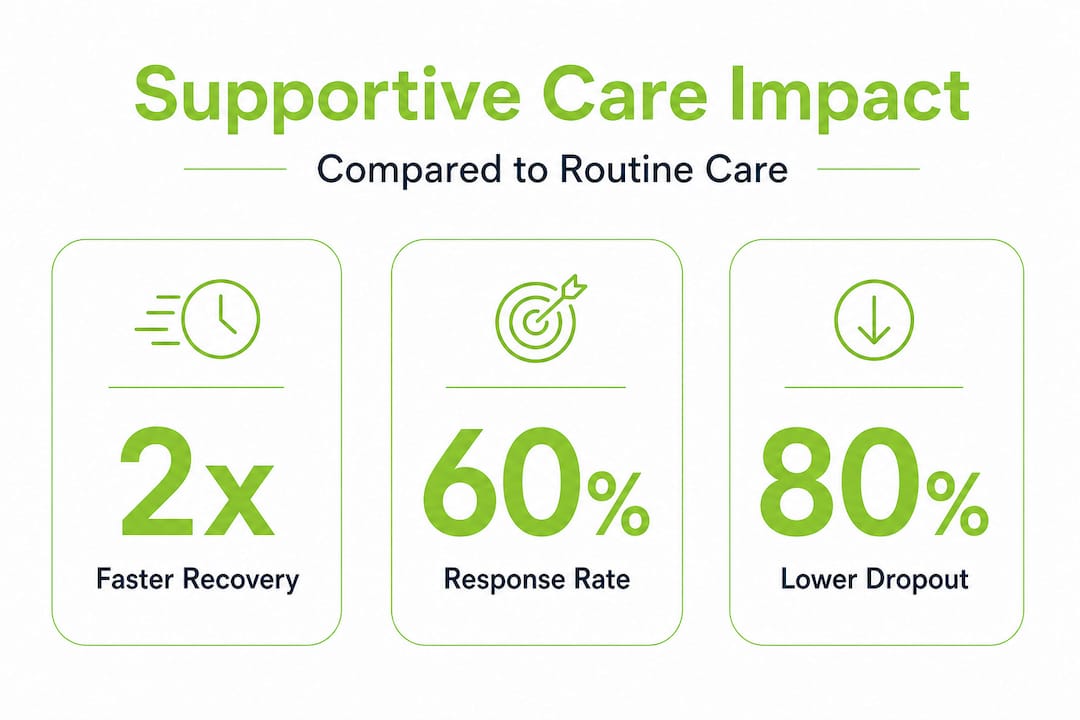
The numbers are striking. Telepsychiatry studies show that higher therapeutic alliance predicted clinically significant improvement in both anxiety and depression, even when care was delivered entirely over video. The medium matters less than the quality of connection within it.
Pro Tip: When evaluating a new psychiatric practice, pay attention to whether the clinician asks about your life circumstances, not just your symptoms. That curiosity is a signal of a strong therapeutic alliance in the making.
Psychological mechanisms also play a major role:
- Reduced stigma: Judgment-free spaces make patients more willing to disclose symptoms honestly, which leads to more accurate diagnosis and treatment.
- Increased adherence: Patients who feel supported are significantly more likely to take medications consistently and attend follow-up appointments.
- Empowered patient roles: When clinicians invite you into shared decision-making, you are more invested in the outcome and more likely to follow through on treatment goals.
- Better coping skill integration: Learning strategies for transforming anxiety care is far more effective when practiced within a trusting, supportive clinical relationship.
The science here is not soft. It is some of the most robust data in modern psychiatry.
Comparing routine care vs. supportive, multidimensional approaches
Routine psychiatric care typically involves a short appointment, a prescription review, and a follow-up in four to eight weeks. It is not ineffective, but it leaves a significant portion of healing on the table.
Supportive, multidimensional care takes a different approach. It layers evidence-based treatments, structured social support, and strong clinician-patient relationships into a coherent whole. This combination outperforms routine care on measurable depression and anxiety metrics.
| Outcome measure | Routine care | Multidimensional supportive care |
|---|---|---|
| Depression symptom reduction | Moderate | Significantly greater |
| Anxiety symptom relief | Moderate | Substantially faster |
| Patient adherence rate | Lower | Noticeably higher |
| Relapse at 12 months | More frequent | Considerably lower |
| Patient satisfaction | Variable | Consistently higher |
“Structured social support combined with evidence-based therapy produces outcomes that medication management alone rarely achieves.”
For North Dallas adults, this distinction is not academic. It is the difference between managing symptoms and genuinely recovering. Here is what the pathway to better care looks like in practice:
- Seek a bio-psycho-social evaluation. Ask your provider to assess biological, psychological, and social factors together, not just symptoms and medication history.
- Include family or peer support intentionally. Identify one or two people in your life who can be part of your care, even informally.
- Prioritize practices that build in communication. Regular check-ins, clear goals, and honest conversations about progress signal a multidimensional approach.
- Consider proven depression therapies alongside medication. Cognitive behavioral therapy and structured support groups consistently add measurable benefit.
Physical and social environment: From biophilic design to social determinants
You might be surprised by how much the physical details of your care environment influence your healing. Biophilic design, which incorporates plants, natural light, water elements, and nature-inspired artwork into clinical spaces, is not just aesthetically pleasing. Biophilic art environments reduced depression and anxiety symptoms meaningfully across a 12-month study period.

| Environmental element | Mechanism | Effect on symptoms |
|---|---|---|
| Natural light | Regulates circadian rhythm and serotonin | Reduces depression severity |
| Plants and greenery | Lowers cortisol, promotes calm | Reduces anxiety and stress |
| Nature-inspired artwork | Activates restorative attention | Improves mood and focus |
| Quiet, private spaces | Reduces hypervigilance | Lowers ADHD symptom load |
Pro Tip: When you visit a new psychiatric practice, notice whether the space feels calming or clinical. Warm lighting, greenery, and artwork are not decorative choices. They are therapeutic ones.
Beyond the clinical space, the social environment you return to every day plays an equally important role. Family support, peer connections, and community belonging are not just nice-to-haves. They are clinical variables. Addressing social determinants through psychosocial strategies reduces the adverse impact of stressors like housing insecurity, unemployment, and social isolation on mental health outcomes.
This means that quality psychiatric care in 2026 should include questions about your living situation, your relationships, your employment, and your sense of community. These are not personal questions overstepping a clinical boundary. They are essential data points for effective treatment. Personalized care models that incorporate social determinants consistently outperform narrower approaches.
Key social factors that support recovery include:
- Regular, positive contact with at least one trusted person
- Access to peer support groups for anxiety, depression, or ADHD
- Stable housing and basic safety
- Engagement in meaningful work or purposeful activity
- Connection to a community, whether spiritual, cultural, or social
Supportive care in North Dallas: What to expect locally
North Dallas is a large and diverse region, and the quality of psychiatric care varies considerably across practices. When you are looking for support in Allen, Frisco, McKinney, Plano, or surrounding areas, knowing what to look for helps you find the right fit faster.
Local North Dallas practices emphasize compassionate, holistic care with multidisciplinary support and judgment-free environments as core values. The best practices in the area share several hallmarks that you can look for when making your decision.
Hallmarks of genuinely supportive psychiatric practices in North Dallas:
- Bio-psycho-social intake assessments that explore your full life context, not just your symptom checklist
- Clear, collaborative treatment planning where you have a voice in setting goals and choosing approaches
- Access to both in-person and telehealth appointments so geography or scheduling does not become a barrier to consistent care
- Warm, non-judgmental communication at every touchpoint, from scheduling to follow-up
- Family involvement options for those whose home environment is central to their recovery
Pro Tip: Before your first appointment, write down three questions about how the practice supports patients between sessions. Practices with strong supportive cultures will have clear, confident answers.
If you are new to psychiatric care or switching providers, start with a thorough evaluation appointment. This is where the relational foundation gets built. Be honest about your social circumstances, your prior treatment experiences, and what has or has not helped. The more context your clinician has, the more precisely they can tailor your care. Exploring psychiatry alternatives and local resources in Texas can also help you understand the full range of options available to you. Personalized psychiatric support is not a luxury in this region. It is increasingly the standard that leading practices are setting.
Why the ‘soft stuff’ is the hard science: Rethinking psychiatric success
Here is something we believe strongly, and the research backs it up: the aspects of psychiatric care that get labeled “soft,” warmth, relationship, environment, community, are actually the hardest-working variables in the recovery equation.
For years, the field focused almost exclusively on pharmacology and specific therapy protocols. The assumption was that technique and medication drove outcomes, and everything else was pleasant but secondary. That assumption is now being overturned. Alliance can outperform technique in predicting recovery, and support lapses in the weeks immediately following hospitalization or treatment intensification sharply increase relapse risk.
The first 30 days after a major treatment change are particularly vulnerable. When formal support suddenly decreases, and patients return to environments that may not reinforce the progress made in treatment, outcomes can reverse quickly. This is why managing post-treatment transitions thoughtfully is not optional. It is part of the treatment itself.
We also know that physical and natural environments can buffer socioeconomic gaps in mental health outcomes. Green spaces and biophilic clinic environments reduce symptoms across income levels, meaning that good environmental design is a form of health equity. Every patient, regardless of their circumstances, deserves a care environment that works with their healing rather than against it.
The question we believe every treatment plan should begin with is simple: How are you supported beyond these walls? That question, asked with genuine curiosity and care, is both clinically sound and deeply human. It is the kind of question that signals the difference between a practice that treats a diagnosis and one that supports a person. Understanding whether you have a path toward preventing depression relapse depends greatly on what surrounds you when formal treatment ends.
Recovery is not a straight line. But the environment you walk through every step of the way makes that line far easier to follow.
Access compassionate, supportive psychiatric care in North Dallas
At Nortex Psychiatry, we have built our practice around exactly the principles this article explores. We know that medication matters, but so does the relationship, the space, and the support structure surrounding your care. Our team specializes in personalized, evidence-informed treatment for anxiety, depression, ADHD, and mood disorders, and we serve adults across Allen, Frisco, McKinney, Plano, and throughout the North Dallas area.
Whether you are exploring care for the first time or looking for a practice that truly sees the whole picture, we are here to help. Learn more about how our psychiatrists approach anxiety care, explore our personalized mood disorder treatment options, or find out whether TMS therapy might be part of your path forward. Your first step can be as simple as a consultation. We would love to be part of your support system.
Frequently asked questions
What does a supportive environment in psychiatry include?
It combines compassionate clinicians, peer and family support, inviting physical space, and attention to patient comfort and safety. Holistic, multidisciplinary practices in North Dallas build these elements into their standard of care.
How much do supportive environments improve mental health outcomes?
Studies show they significantly boost treatment response and speed symptom relief compared to routine care. Multidimensional interventions combining CBT and social support consistently outperform standard medication-only approaches on measurable depression and anxiety scores.
Can my home environment act as a supportive factor?
Yes, positive social interaction and elements like natural light, art, or plants at home can lower depression and anxiety risk. Biophilic art environments have been shown to reduce both depression and anxiety symptoms over a 12-month period.
Is telepsychiatry as effective as in-person care when it comes to support?
With strong therapeutic alliance, telepsychiatry can deliver similar improvements in anxiety and depression as in-person visits. Research confirms that telepsychiatry therapeutic alliance predicted clinically significant symptom improvement regardless of location.
How can I find a supportive psychiatric practice in North Dallas?
Look for practices that highlight holistic, multidisciplinary support and client-centered values in their published approach. Compassionate, judgment-free care environments are increasingly the standard in quality North Dallas psychiatric practices.