


Seeking psychiatric care in Texas is one of the most direct steps you can take when anxiety, depression, ADHD, or another mental health condition is affecting your daily life. An estimated 22% of Texas adults experienced a mental health disorder in the past 12 months, yet Texas ranks 45th nationally for mental health care access. That gap between need and access is exactly why knowing your options matters. Psychiatrists are medical doctors who can diagnose your condition, prescribe and manage medications, and coordinate care with other providers. Resources like the Texas Health and Human Services Commission (HHSC), Local Mental Health Authorities (LMHAs), and practices like Nortexpsychiatry exist to help you close that gap.
Here is what you need to know before taking the first step:
- Mental health conditions are common and can be effectively treated with appropriate professional support
- Psychiatrists uniquely provide diagnosis and medication management that other mental health providers typically do not offer
- Texas residents 18 and older qualify for a free mental health assessment through their local LMHA
- Telehealth has expanded psychiatric care access, especially in underserved areas
- State legislation supports payment parity for telehealth mental health services, helping to reduce cost barriers
What is a psychiatrist, and how do they differ from other providers?
Psychiatrists are medical doctors specialized in mental health who complete medical school followed by a psychiatric residency. That training gives them the authority to diagnose mental illnesses, prescribe medications, and manage complex conditions that may involve both physical and psychological factors. No other mental health professional in Texas has the same scope of practice.
The differences between providers matter when you are choosing care:
- Psychiatrists (MD or DO): Diagnose, prescribe, and manage medications; treat complex or chronic conditions
- Psychologists (PhD or PsyD): Provide therapy and psychological testing; generally cannot prescribe in Texas
- Licensed Professional Counselors (LPC): Deliver talk therapy for a range of emotional and behavioral concerns
- Licensed Clinical Social Workers (LCSW): Offer therapy and connect patients to community resources
- Psychiatric Nurse Practitioners (PMHNP): Can prescribe medications under collaborative agreements in Texas
In Texas, all of these professionals must hold active licenses through their respective state boards. The Texas Health Professions Resource Center tracks licensing and supply data by county, which is useful when you are trying to find a provider near you. Understanding who does what helps you ask for the right kind of help from the start.
Common psychiatric treatments you can expect
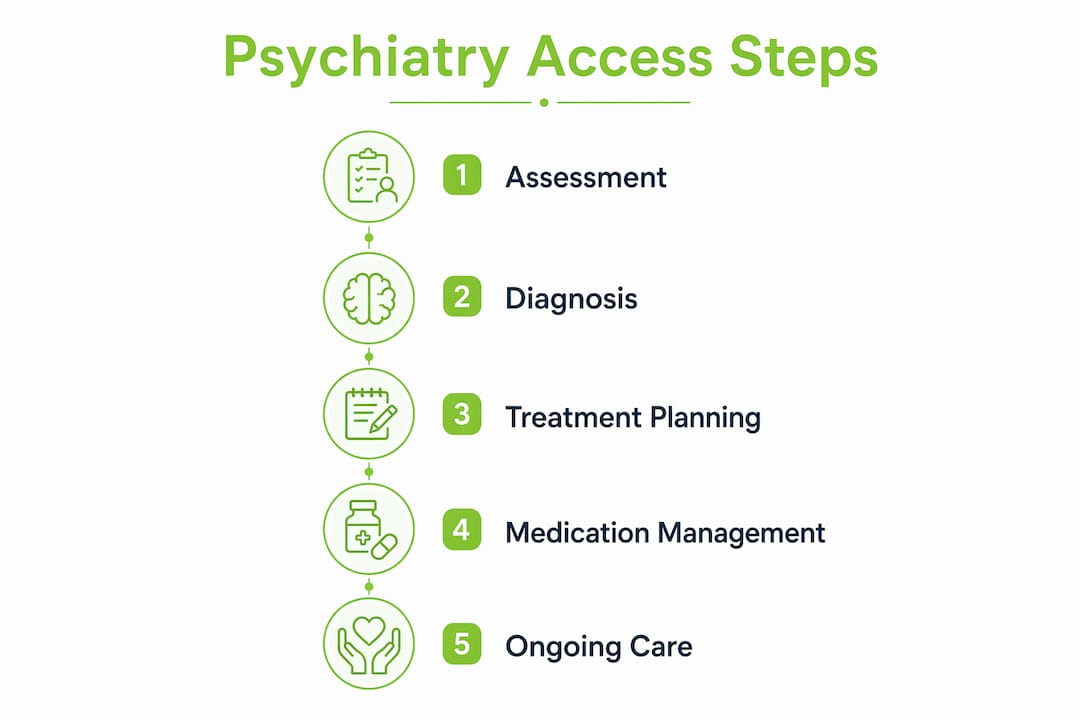
Psychiatric treatment typically involves medication management, psychotherapy, or a combination of both, tailored through a thorough assessment of your specific needs. There is no single formula. What works for one person’s depression may not work for another’s, and a good psychiatrist adjusts the plan as your situation changes.
Common treatment approaches include:
- Medication management: Prescribing and monitoring medications for anxiety, depression, ADHD, bipolar disorder, and PTSD
- Individual psychotherapy: Cognitive behavioral therapy (CBT), dialectical behavior therapy (DBT), and other evidence-based modalities
- Combined treatment: Medication plus therapy, which research consistently shows produces better outcomes for moderate to severe conditions
- Psychiatric evaluations: Structured assessments that clarify diagnosis and guide the treatment plan
- Telehealth sessions: Video appointments that deliver the same quality of care without requiring you to travel
Texas mental health authorities support evidence-based practices across the state system. Medication management, for example, is one of the most widely used services in Texas’s public mental health network. The goal is always a plan that fits your life, not a generic protocol.
Why choose a psychiatrist over other mental health providers?
The clearest reason is medical complexity. If you are dealing with symptoms that have not responded to therapy alone, or if you need a diagnosis that rules out underlying medical causes, a psychiatrist is the right starting point. Their specialized training covers both the biological and psychological dimensions of mental illness, which means they can see the full picture.
A few situations where psychiatric care is especially valuable:
- Symptoms are severe, persistent, or worsening despite other treatment
- You need medication prescribed or your current medication adjusted
- Your condition involves multiple diagnoses (for example, depression alongside PTSD or ADHD)
- A previous provider has recommended a psychiatric evaluation
- You want a benefits of psychiatric care review for anxiety or depression that goes beyond general counseling
One misconception we often hear is that seeing a psychiatrist means your situation is “serious enough.” That framing keeps people from getting help earlier than they should. Psychiatric care is appropriate any time your mental health is affecting your work, relationships, or quality of life.
How to select a psychiatrist in Texas
Start with credentials. Every psychiatrist practicing in Texas must be licensed by the Texas Medical Board, and you can verify that license online. Beyond the basics, look for someone with experience treating your specific condition, whether that is anxiety, ADHD, a mood disorder, or something else.
Practical steps for choosing the right provider:
- Verify licensure through the Texas Medical Board’s public lookup tool
- Check insurance before your first appointment; mental health claims in Texas are denied at higher rates than medical claims, so confirming coverage upfront saves frustration
- Ask about their approach to medication versus therapy, and whether they collaborate with your existing providers
- Consider telehealth if geography or scheduling is a barrier; state law supports parity for telehealth mental health services
- Use LMHA resources if cost is a concern; Local Mental Health Authorities can connect you to sliding-scale or free services
Questions worth asking before you commit to a provider: How do you approach medication management? What does a typical first appointment look like? How do you handle urgent concerns between sessions? Do you offer telehealth?
Pro Tip: If you are in North Dallas, Frisco, McKinney, or Plano, Nortexpsychiatry offers both in-person and telehealth appointments, which removes the geographic barrier that stops many Texas residents from starting care.

Accessing mental health services in Texas
Nearly all mental health and substance use disorder services in Texas begin with a formal assessment by a licensed clinician. That assessment is not a formality. It determines your diagnosis, shapes your treatment plan, and unlocks access to the services you need. Skipping it, or relying on online self-screening tools, leaves you without a real clinical picture.

Texas residents 18 and older can access a free mental health assessment through their local LMHA. To find yours, call 2-1-1 and ask for the LMHA or LBHA in your area.
Key access points and considerations:
- Texas HHSC: Oversees adult mental health services statewide and sets standards for care
- Local Mental Health Authorities (LMHAs): Coordinate services, connect residents to providers, and offer free assessments
- Telehealth: State legislation supports payment parity, making video-based psychiatric care a real option for rural and underserved communities
- School-based programs: For families with children, school-based health centers offer an accessible entry point for mental health support
- Insurance navigation: If a claim is denied, you have the right to appeal; many denials are overturned with documentation from your provider
Nearly 80% of Texas counties are designated mental health professional shortage areas. Telehealth is not just convenient in that context. For many Texans, it is the only realistic path to consistent psychiatric care. If you are ready to take the first step, starting psychiatric treatment does not have to be complicated.
Nortexpsychiatry serves patients across Allen, Frisco, McKinney, Plano, and the broader North Dallas area with personalized, evidence-based psychiatric care. Whether you are managing anxiety, depression, ADHD, or a mood disorder, the team offers both in-person and telehealth appointments designed to fit your schedule. Learn more about why psychiatric care may be the right next step for you.
Key Takeaways
Psychiatric care in Texas is accessible, evidence-based, and often the most direct path to effective treatment for mental health conditions affecting daily life.
| Point | Details |
|---|---|
| Prevalence is high | An estimated 22% of Texas adults experienced a mental health disorder in the past 12 months. |
| Free assessments exist | Texas residents 18 and older qualify for a free mental health assessment through their local LMHA. |
| Psychiatrists prescribe | Unlike counselors or psychologists, psychiatrists can diagnose and manage medications for complex conditions. |
| Access gaps are real | Nearly 80% of Texas counties are designated mental health professional shortage areas; telehealth helps close that gap. |
| Start with an assessment | Nearly all Texas mental health services are based on findings from a formal clinical assessment. |
FAQ
Is Texas a good state for mental health care access?
Texas ranks 45th nationally for mental health care access, with over 26% of residents reporting they could not access needed mental health treatment in 2021. Access has improved through telehealth expansion and LMHA services, but provider shortages remain a real challenge.
Why are psychiatrists in high demand in Texas?
Psychiatrists can prescribe medications and treat complex conditions that other providers cannot, and nearly 80% of Texas counties are designated mental health professional shortage areas, creating significant unmet demand.
What do the “4 D’s” in psychiatry refer to?
A common clinical framework uses multiple criteria—such as deviance, distress, dysfunction, and danger—to assess mental health concerns. Clinicians use these criteria to evaluate whether symptoms rise to the level of a diagnosable disorder.
When should you seek psychiatric help rather than general counseling?
Seek psychiatric care when symptoms are severe or persistent, when medication may be needed, when multiple diagnoses are involved, or when therapy alone has not produced improvement. A formal assessment by a licensed clinician is the clearest way to determine the right level of care.
How do Local Mental Health Authorities help Texas residents?
LMHAs coordinate behavioral health services across Texas, offer free mental health assessments for adults 18 and older, and connect residents to sliding-scale or no-cost care. Call 2-1-1 to find the LMHA in your area.