


Supportive therapy is defined as a structured form of psychotherapy that provides emotional support, stability, and practical coping skills to help adults manage anxiety, depression, and stress-related conditions. Unlike therapies that require deep exploration of past trauma or unconscious conflict, supportive therapy focuses on your present needs. It works by strengthening your ability to cope, reducing distressing symptoms, and helping you feel more stable and in control. At Nortex Psychiatry, we often recommend it as part of a broader, personalized treatment plan for adults who need emotional grounding before or alongside other interventions.
What is supportive therapy and what does it actually do?
Supportive therapy is a psychotherapeutic approach that bolsters ego functions, improves reality testing, and helps you adapt to daily challenges in a non-threatening environment. The term “supportive psychotherapy” is the recognized clinical label, though many people simply call it supportive therapy or supportive counseling. The goal is not to uncover hidden psychological conflicts. The goal is to help you function better right now.
The therapy works by giving you a reliable, emotionally safe relationship with a trained clinician who validates your experience, helps you problem-solve, and teaches you concrete coping strategies. This matters because many adults dealing with anxiety or depression are not in a place where deep insight work feels safe or productive. They need stability first. Supportive therapy provides exactly that.

Research confirms that supportive therapy is symptom-focused, often used for adults with anxiety and depression who need stability and coping skills before anything else. That framing is important. It tells you this is not a lesser form of therapy. It is a deliberate, clinically appropriate choice for a specific set of needs.
What techniques are used in supportive therapy sessions?
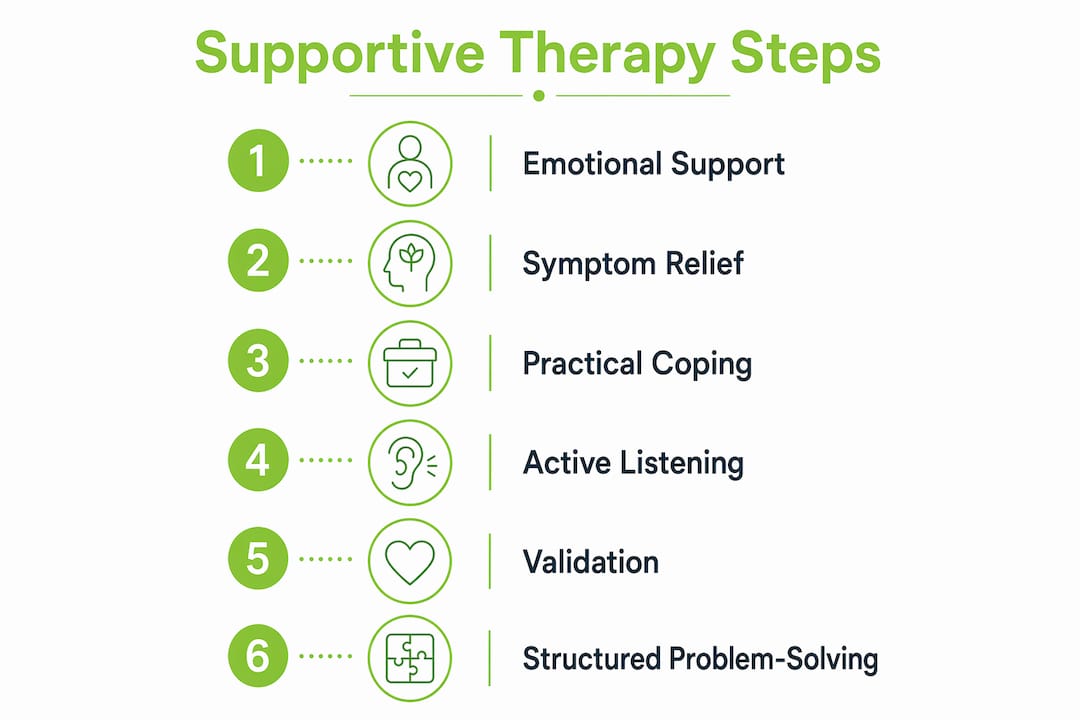
Supportive therapy is more directive and practical than insight-oriented approaches, relying on a defined set of techniques that therapists calibrate to your current emotional state. These techniques are not random. They are chosen to protect you from overwhelm while building your capacity to manage distress.
The core techniques include:
- Active listening and validation: Your therapist reflects back what you share without judgment, which reduces shame and helps you feel understood.
- Structured problem solving: You work through specific challenges step by step, building confidence in your own decision-making.
- Stress management skills: Breathing techniques, grounding exercises, and behavioral strategies give you tools you can use between sessions.
- Reassurance and encouragement: Your therapist offers realistic, honest reassurance that counters catastrophic thinking without dismissing your concerns.
- Gentle reality testing: When distorted thinking is making things worse, your therapist helps you examine the evidence calmly, not confrontationally.
The therapist’s role here is active and warm. This is not a blank-screen approach where the clinician says little and waits for you to arrive at insight. The therapist guides, supports, and at times offers direct input.
Pro Tip: If you are starting therapy and feel overwhelmed by the idea of exploring your past, tell your therapist. Supportive therapy can be explicitly structured around present-focused coping, and a good clinician will adjust accordingly.
How does supportive therapy differ from other psychotherapy approaches?
This is where many people get confused, and the distinction matters for choosing the right care. The table below compares supportive therapy with two common alternatives.
| Feature | Supportive therapy | Cognitive behavioral therapy (CBT) | Insight-oriented therapy |
|---|---|---|---|
| Primary focus | Emotional stability and coping | Thought patterns and behavior change | Unconscious conflict and self-understanding |
| Depth of exploration | Present functioning | Present thoughts and behaviors | Past experiences and patterns |
| Therapist role | Active, directive, nurturing | Structured, collaborative, skill-based | Reflective, interpretive, neutral |
| Best suited for | Acute distress, fragile stability | Specific anxiety or depressive disorders | Clients with capacity for insight work |
| Evidence standing | Recommended with uncertainty | First-line for most anxiety disorders | Varies by modality |
The key distinction is depth versus stability. CBT, for example, asks you to actively challenge and restructure your thinking, which requires a degree of emotional bandwidth. Insight-oriented therapies go further, asking you to examine the roots of your patterns. Supportive therapy asks something different: can you get through this week feeling more capable than last week?
For clients with attachment anxiety, increased use of supportive techniques leads to greater symptom reduction than supportive-expressive methods. That finding is clinically significant. It means that for people who struggle with trust and emotional closeness, the warm, consistent, non-probing nature of supportive therapy is not just comfortable. It is more effective.
Supportive therapy is also widely applicable for acute crises, chronic mental illness, and situations where insight-oriented therapy might actually destabilize a patient. We often use it as a bridge to more intensive work, or as a long-term maintenance approach for people managing chronic conditions.
Is supportive therapy effective? What the evidence says
The honest answer is: yes, with important caveats. Clinical guidelines classify supportive therapy as “recommended with uncertainty” for anxiety disorders, meaning it is not typically the first-line standalone treatment. That classification reflects the quality of available research, not a judgment about the therapy’s real-world value.
“Supportive therapy is often chosen for symptom relief and workable coping rather than deep emotional exploration, making it preferable for clients who need emotional stability first.” — Supportive Therapy Definition and Use
What the evidence does support clearly is this: supportive therapy reliably improves coping, reduces acute distress, and helps people feel more emotionally contained. For many adults, that is exactly what they need. The differences in effectiveness between supportive and supportive-expressive formats may depend more on the amount of support given per session than on the therapy label itself. More support, better outcomes. That is a practical finding with real implications for how sessions should be structured.
Clinicians at practices like Nortex Psychiatry combine supportive therapy elements with stronger first-line treatments, adjusting the approach based on disorder type and patient needs. This integrated model is where supportive therapy often shines. It does not have to stand alone to be valuable.
Who can benefit from supportive therapy and what to expect
Supportive therapy is appropriate for a broad range of adults. You do not need a severe diagnosis to benefit from it. The following groups tend to respond particularly well:
- Adults managing anxiety or depression who are not yet stable enough for intensive therapy
- People going through major life transitions such as divorce, job loss, grief, or a new diagnosis
- Individuals with chronic medical conditions who need emotional support alongside physical care
- Adults in acute crisis who need containment and grounding before deeper work begins
- People who have tried other therapies and found them too confrontational or overwhelming
Sessions typically last 45 to 50 minutes and center on what is happening in your life right now. Your therapist uses the “good parent” model to calibrate emotional safety, offering nurturance when you need comfort and gentle limits when you need structure. This is not about recreating a parental relationship. It is about providing the kind of consistent, attuned response that helps regulate your emotional state.
You will likely leave sessions with specific coping strategies to practice. These might include structured problem solving, breathing techniques, or simple behavioral plans for managing a specific stressor. The pacing is intentional. Your therapist will not push you faster than you can handle.
Pro Tip: Ask your provider directly whether supportive therapy is being used as a standalone approach or as part of a broader treatment plan. Knowing this helps you set realistic expectations and track your progress more clearly.
Supportive therapy vs counseling: understanding the difference
Many people use “therapy” and “counseling” interchangeably, but there are meaningful differences worth understanding.
Counseling is generally a broader term that covers guidance, psychoeducation, and support across a wide range of life concerns. It does not always operate within a formal psychotherapy framework and may not target clinical symptoms directly. Supportive therapy, by contrast, is a specific psychotherapeutic modality with defined techniques, a clinical rationale, and a focus on symptom relief and functional improvement.
The practical differences include:
- Scope: Counseling often addresses life skills, relationships, and adjustment. Supportive therapy targets mental health symptoms like anxiety and depression.
- Structure: Supportive therapy follows a more defined clinical framework. Counseling can be more flexible and conversational.
- Provider training: Supportive therapy is typically delivered by licensed mental health professionals with clinical training in psychotherapy. Counseling may be provided by a wider range of practitioners.
- Integration: Supportive therapy can incorporate counseling techniques, and many counselors use supportive approaches. The distinction is in the clinical intent and depth.
Your goals should guide which approach you pursue. If you are managing a diagnosable condition and need symptom relief, supportive therapy within a psychiatric or clinical psychology setting is the more targeted choice.
Key takeaways
Supportive therapy is a clinically grounded approach that prioritizes emotional stability and practical coping over insight, making it most effective when matched to the right patient at the right stage of care.
| Point | Details |
|---|---|
| Core definition | Supportive therapy targets symptom relief and coping, not deep insight or past exploration. |
| Primary techniques | Active listening, validation, problem solving, and stress management are the foundational tools. |
| Evidence standing | Guidelines recommend it with uncertainty; it works best as part of an integrated treatment plan. |
| Best-fit populations | Adults with anxiety, depression, life stressors, or fragile stability benefit most from this approach. |
| Therapy vs counseling | Supportive therapy is more clinically structured and symptom-focused than general counseling. |
A psychiatrist’s honest view on supportive therapy’s place in care
What I have noticed over years of clinical work is that supportive therapy is frequently underestimated. Patients sometimes arrive expecting it to feel less serious than CBT or medication. They change their minds quickly.
The reason is simple. When someone is in acute distress, their nervous system is not in a state that allows for productive insight work. Asking a person in crisis to examine childhood attachment patterns is like asking someone to do algebra during a fire alarm. Supportive therapy addresses the alarm first. That is not a limitation. That is good clinical judgment.
Where I think it gets misused is when it becomes the default because it feels easier to deliver, not because it is the right fit. Supportive therapy should be a deliberate choice, calibrated to the patient’s current functioning and goals. For adults managing anxiety and depression, it often serves as the foundation that makes other treatments possible.
I also want to be honest about its limits. For some people, supportive therapy alone will not produce lasting change. If you have worked through acute distress and stabilized, it may be time to ask your provider whether adding CBT, medication, or another modality makes sense. Recovery is not a straight line, and the right treatment at one stage is not always the right treatment at the next.
— Felix
How Nortex Psychiatry can help you find the right approach
At Nortex Psychiatry, we work with adults across Allen, Frisco, McKinney, Plano, and the broader North Dallas area who are managing anxiety, depression, and mood-related conditions. Supportive therapy is one part of a wider set of evidence-based approaches we use to build personalized treatment plans. Whether you need emotional stabilization, medication management, or a combination of both, we start with a thorough evaluation to understand what you actually need. If you are ready to take a step toward feeling more in control, explore our mood disorder treatment guide or reach out to schedule a consultation. We are here to help you figure out what comes next.
FAQ
What is supportive therapy used for?
Supportive therapy is used to provide emotional stability, symptom relief, and practical coping skills for adults managing anxiety, depression, life transitions, and acute stress. It is particularly effective when a patient needs stabilization before or alongside more intensive treatments.
How does supportive therapy work in practice?
A therapist uses active listening, validation, structured problem solving, and reassurance to help you manage present challenges. Sessions focus on your current functioning rather than past experiences, and you typically leave with concrete coping strategies to use between appointments.
Is supportive therapy the same as counseling?
No. Supportive therapy is a specific psychotherapeutic modality with defined clinical techniques targeting mental health symptoms. Counseling is a broader term that covers guidance and life skills support and does not always operate within a formal psychotherapy framework.
Who should consider supportive therapy?
Adults with anxiety, depression, chronic illness, or fragile emotional stability are strong candidates. It is also appropriate for people in acute crisis or those who have found more confrontational therapies overwhelming or destabilizing.
Is supportive therapy effective for anxiety and depression?
Clinical guidelines classify it as recommended with uncertainty for anxiety disorders, meaning it is not always first-line alone. However, it reliably improves coping and reduces acute distress, and it is most effective when integrated with other treatments such as CBT or medication management.