


A mental health clinic is a specialized outpatient facility that diagnoses, treats, and supports people living with emotional, behavioral, or psychological conditions. These clinics serve as the primary access point for professional mental health care outside of a hospital setting. Whether you are managing anxiety, depression, ADHD, or a mood disorder, a mental health clinic offers structured, ongoing care from licensed clinicians. Understanding what these facilities actually do, and what to expect when you walk through the door, makes the process far less intimidating.
What is a mental health clinic and what does it treat?
A mental health clinic is defined in clinical practice as an outpatient facility that delivers biopsychosocial assessments and individualized treatment for mental health conditions. The term “outpatient” means you attend scheduled appointments and return home afterward. You are not admitted for continuous monitoring. SAMHSA and the National Mental Health Authority both recognize outpatient clinics as the foundation of community mental health care in 2026.
These clinics treat a wide range of conditions. Depression, generalized anxiety disorder, ADHD, bipolar disorder, PTSD, and obsessive-compulsive disorder are among the most common. Many clinics also support people navigating grief, life transitions, or chronic stress that has started to affect daily functioning.

Telehealth is now standard at most modern clinics, not an add-on. This matters because access has historically been one of the biggest barriers to care. Clinics that offer both in-person and virtual visits reach patients who could not otherwise attend consistently.
What services are offered at a mental health clinic?
Mental health clinics offer a broader range of services than most people expect. The core services include:
- Psychiatric evaluations: A structured assessment of your symptoms, history, and functioning. This is typically the first appointment.
- Psychological and diagnostic testing: Standardized tools like the PHQ-9 and GAD-7 screen for depression and anxiety with high sensitivity and specificity, making them reliable for tracking progress over time.
- Individual therapy: One-on-one sessions using evidence-based approaches such as cognitive behavioral therapy (CBT) or dialectical behavior therapy (DBT).
- Group and family therapy: Structured sessions that address relational patterns and shared coping skills.
- Medication management: A psychiatrist prescribes and monitors psychiatric medications, adjusting doses based on your response and any side effects.
- Case management: A coordinator helps you navigate referrals, community resources, and care transitions.
- Crisis intervention: Short-term stabilization services for patients experiencing acute distress who do not require hospitalization.
Telehealth visits now account for 60–70% of appointments at many modern practices, with 30–40% remaining in-person. That shift reflects patient preference and improved access, not a reduction in care quality. Research confirms that telepsychiatry is comparable to in-person visits for adult outpatient medication management and follow-ups.
Pro Tip: Before scheduling, call the clinic and ask specifically which services they offer. Not every clinic provides therapy and psychiatry under one roof. Knowing this upfront saves time and prevents gaps in your care.
What happens during a typical visit to a mental health clinic?
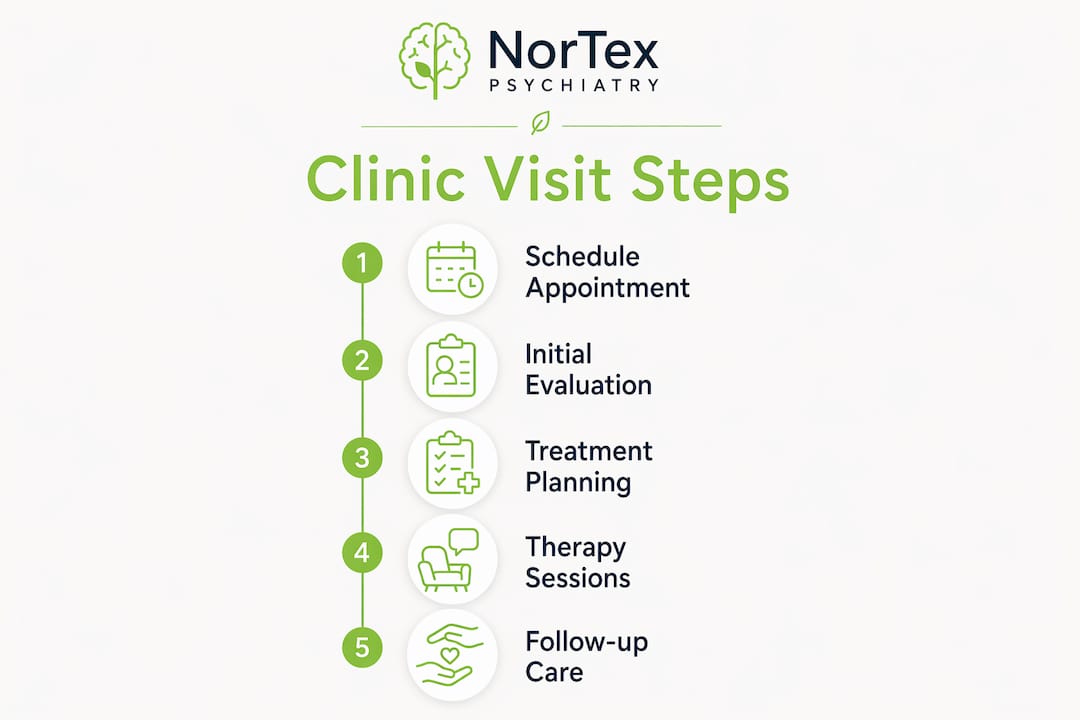
Knowing what to expect reduces the anxiety that often comes with a first appointment. Here is how a standard visit unfolds:
- Initial evaluation (45–60 minutes). The first visit is an assessment, not a treatment session. Your clinician gathers a full picture of your symptoms, history, and daily functioning. You leave with a working diagnosis and a written treatment plan.
- Mental Status Examination (MSE). This clinical observation tool happens during conversation. The clinician observes your mood, thought process, attention, and memory. There is nothing to pass or fail. Most patients do not realize it is happening.
- Collaborative goal setting. The first appointment focuses on your current symptoms and their impact on daily life, not simply assigning a label. You and your clinician agree on treatment priorities together.
- Follow-up appointments (20–30 minutes). Subsequent visits are shorter and focused on reviewing progress, adjusting medications if needed, and updating your treatment plan.
- Communication and safety planning. Early in care, your clinician will clarify how to reach the practice between visits, how medication refills are handled, and who to contact in an emergency. Getting this information early gives you a clear safety net.
No physical exam is required for most psychiatric visits. Lab work may be ordered if you start certain medications that require monitoring, such as mood stabilizers or stimulants.
Pro Tip: Write down your three most pressing concerns before your first appointment. Evaluations move quickly, and having a short list helps you and your clinician use the time well. You can find more detail on what to expect in a psychiatric evaluation guide from Nortexpsychiatry.
How do mental health clinics fit within the broader care spectrum?
Outpatient mental health clinics occupy a specific place in the care continuum. Outpatient care assumes that you are stable enough to live at home and attend scheduled sessions. It is built around discrete appointments, not continuous monitoring.
Inpatient psychiatric care, by contrast, is for acute crisis stabilization. If someone is at immediate risk of harm to themselves or others, a hospital setting provides 24-hour supervision. A mental health clinic is not the right setting for that level of acute need. Once stabilized, patients transition back to outpatient care.
The outpatient spectrum itself has several levels of intensity:
| Care level | Structure | Best suited for |
|---|---|---|
| Standard outpatient | Weekly or biweekly sessions | Mild to moderate symptoms, stable functioning |
| Intensive Outpatient Program (IOP) | 9+ hours per week across multiple days | Moderate symptoms requiring more support |
| Partial Hospitalization Program (PHP) | 20+ hours per week, daytime only | Severe symptoms not requiring overnight care |
| Inpatient | 24-hour hospital admission | Acute crisis, safety risk |
Intensive outpatient programs can run nine or more hours per week, providing a meaningful step between weekly therapy and full hospitalization. They are often used after a hospital discharge to prevent re-admission.
Follow-up within 7 days of hospital or intensive program discharge is a recognized quality benchmark. Clinics that schedule this promptly significantly reduce the risk of re-hospitalization. Effective outpatient care also depends on matching treatment intensity to your actual symptom severity, not a one-size approach.
How to choose the right mental health clinic for your needs
Choosing a clinic is not a single decision. It is a process, and it is reasonable to take your time with it.
Start with referrals. SAMHSA recommends seeking referrals from primary care doctors or social workers, and consulting multiple clinicians before committing. A recommendation from someone who knows your history is more useful than a general online search.
When you contact a clinic, pay attention to these factors:
- Services offered. Does the clinic provide both therapy and psychiatric medication management? Can you see a therapist and a psychiatrist in the same place?
- Telehealth availability. If your schedule or location makes in-person visits difficult, confirm that virtual appointments are available. You can review a practical breakdown of online vs. in-person care to weigh your options.
- Clinician qualifications. Ask whether you will see a psychiatrist, a licensed counselor, or a nurse practitioner. Each has a different scope of practice.
- Insurance and availability. Confirm that the clinic accepts your insurance and has appointment times that work for your schedule.
- How you feel in the intake conversation. If the intake process feels rushed or dismissive, that is useful information. A good clinic treats the first call with the same care as the first appointment.
Pro Tip: Consulting two or three clinics before choosing one is not indecisive. It is good clinical judgment. The right fit for your care matters more than speed.
Key Takeaways
A mental health clinic is an outpatient facility that provides structured, evidence-based care across a spectrum of services, from initial evaluations to ongoing medication management and therapy.
| Point | Details |
|---|---|
| Definition of a mental health clinic | An outpatient facility offering assessments, therapy, psychiatric care, and medication management. |
| First visit is an assessment | The initial appointment lasts 45–60 minutes and produces a working diagnosis and treatment plan. |
| Telehealth is standard | Many clinics now conduct 60–70% of visits virtually, expanding access without reducing quality. |
| Outpatient vs. inpatient | Clinics serve stable patients; inpatient care is for acute crisis only. IOPs bridge the gap. |
| Choosing a clinic | Seek referrals, verify services and insurance, and trust your experience of the intake process. |
What I have learned from years of psychiatric practice
One of the most common things we hear from new patients is that they waited too long to come in. Not because they did not want help, but because they were not sure what a psychiatric visit actually involved. They imagined something more clinical, more intimidating, or more final than it turned out to be.
The first visit is not a verdict. It is a conversation. We are trying to understand your experience, not fit you into a category. The Mental Status Examination, the screening tools, the questions about sleep and appetite and concentration: all of it is in service of building a picture that helps us help you more precisely.
What I have also noticed is that patients who ask questions during that first appointment do better over time. Not because the questions change the diagnosis, but because asking questions is a sign that you are engaged in your own care. That engagement is one of the strongest predictors of a good outcome.
Telehealth has genuinely changed what is possible. We see patients in Allen, Frisco, McKinney, and Plano who would not have been able to attend consistently before virtual visits existed. That access matters. At the same time, telehealth is not the right fit for every patient or every situation. Part of our job is helping you figure out which format serves you best.
If you are reading this and wondering whether a mental health clinic is the right next step, the answer is almost always: come in and find out. The first appointment is low-stakes in the best possible way. You will leave with more clarity than you arrived with.
— Felix
Nortexpsychiatry is here when you are ready
Nortexpsychiatry serves patients across Allen, Frisco, McKinney, Plano, and the broader North Dallas area with personalized, evidence-based psychiatric care. Services include psychiatric evaluations, medication management, and treatment for anxiety, depression, ADHD, and mood disorders. Both in-person and telehealth appointments are available, so you can choose the format that fits your life. If you are unsure whether psychiatric care is the right step, the guide to seeking psychiatric care from Nortexpsychiatry walks through the decision clearly. You can also take a self-assessment to get a clearer sense of where you stand before your first call.
FAQ
What is the difference between a mental health clinic and a psychiatrist’s office?
A mental health clinic typically offers multiple services under one roof, including therapy, psychiatric evaluation, and case management. A psychiatrist’s private practice may focus primarily on medication management and evaluation.
How long does the first appointment at a mental health clinic take?
The initial evaluation lasts 45–60 minutes and results in a working diagnosis and a written treatment plan. Follow-up appointments are shorter, typically 20–30 minutes.
Can I attend a mental health clinic via telehealth?
Yes. Telepsychiatry is clinically comparable to in-person care for adult outpatient medication management and follow-ups. Many clinics now conduct the majority of their visits virtually.
How do I find a mental health clinic near me?
Start with a referral from your primary care doctor or a social worker. SAMHSA also offers a national treatment locator at findtreatment.gov that lists licensed outpatient mental health providers by location.
What should I bring to my first mental health clinic appointment?
Bring a list of current medications, any previous diagnoses or records if available, and a short summary of your main concerns. Knowing your insurance information ahead of time also speeds up the intake process.