


Most SSRI side effects are predictable and often temporary, but a small number of reactions require urgent attention. Across clinical reviews and FDA prescribing guidance, the picture is consistent: nausea, sleep changes, and sexual dysfunction are common; serotonin syndrome and severe bleeding are rare but serious. The FDA boxed warning on all antidepressants flags increased risk of suicidal thoughts and behaviors in people up to age 24, particularly early in treatment. At Nortexpsychiatry, we walk through this with every patient before the first prescription is written, because knowing what to expect makes a real difference in whether treatment succeeds.
Sexual dysfunction affects an estimated 30%–70% of patients on SSRIs depending on the agent and how carefully it is assessed — and it is the leading reason people quietly stop their medication.
If a side effect is bothering you, contact your prescriber rather than stopping on your own. That single step prevents most avoidable harms.
Key Takeaways
Most SSRI side effects are dose-dependent, often temporary, and manageable with early prescriber contact — but a few rare reactions require emergency care.
| Point | Details |
|---|---|
| Common effects are usually temporary | Nausea, headache, and sleep changes typically resolve within 2–6 weeks of starting treatment. |
| Sexual side effects affect 30%–70% of patients | Under-reporting is common; raise this with your prescriber at the first follow-up, not months later. |
| Young adults need close early monitoring | The FDA boxed warning requires monitoring for new or worsening suicidal thoughts in patients up to age 24. |
| Tapering matters when stopping | Abrupt discontinuation causes withdrawal symptoms; paroxetine carries the highest risk, fluoxetine the lowest. |
| Nortexpsychiatry provides structured follow-up | Medication management at Nortexpsychiatry includes early check-ins, side-effect documentation, and individualized taper planning. |
This article is general information, not a substitute for advice from a qualified doctor. Consult a qualified healthcare professional about your own circumstances before acting on anything here.
Table of Contents
- What are the common side effects of SSRIs?
- How common are sexual side effects with SSRIs?
- What serious but uncommon SSRI risks should you know?
- What drug interactions and contraindications matter most?
- What happens when you stop an SSRI, and why does tapering matter?
- How do SSRI risks differ across key patient groups?
- When do side effects start, and when does the medication actually work?
- How do you manage SSRI side effects practically?
- How we monitor and manage SSRI side effects at Nortexpsychiatry
- What symptoms require emergency care right now?
- Why do SSRIs cause these side effects in the first place?
- Personalized SSRI management at Nortexpsychiatry
- Sources
- FAQ
What are the common side effects of SSRIs?
SSRIs work by increasing serotonin activity throughout the body, not just in the brain. Serotonin receptors line the gut, regulate sleep centers, and influence blood pressure control, which explains why the most common effects are gastrointestinal, sleep-related, and neurological rather than purely psychiatric.
Controlled trial data from sertraline (Zoloft) prescribing information gives a useful benchmark: nausea occurred in 26% of sertraline-treated patients versus 12% on placebo. That gap is real, but it also means roughly three-quarters of patients do not report nausea as a problem.
Sources: DailyMed sertraline prescribing information; NCBI Bookshelf SSRI review
Most of these effects appear within the first few days and settle within 2–6 weeks as your body adjusts. Sweating is the outlier — it can persist throughout treatment for some patients. If nausea is significant, taking the medication with food or shifting the dose to evening often helps. Tremor that appears or worsens after weeks of stability deserves a call to your prescriber.
Clinical timing note: Side effects typically arrive before therapeutic benefit. Mood and anxiety improvement usually takes 4–8 weeks. That gap is one of the most common reasons people stop too early.
How common are sexual side effects with SSRIs?
Sexual dysfunction is the most under-recognized and under-reported SSRI side effect, and it is the one most likely to drive quiet discontinuation. A peer-reviewed PMC review documents prevalence ranging from roughly 30% to 70% across studies, with the wide range reflecting differences in how carefully clinicians ask.
The principal effects are:
- Reduced libido — decreased interest in sex, affecting both men and women
- Delayed ejaculation or anorgasmia — difficulty reaching orgasm, often the most bothersome complaint
- Erectile difficulties — less consistent than the above but reported across agents
- Reduced arousal and lubrication in women
Under-reporting is the bigger clinical problem. Patients rarely volunteer these concerns unprompted, and clinicians often do not ask directly. Real-world data consistently show sexual functioning among the most commonly reported patient-experienced burdens, yet it frequently goes undocumented in clinical notes.
Pro Tip: Bring up sexual side effects at your first follow-up visit, not months later. The earlier your prescriber knows, the more options are available — dose adjustment, switching agents, or adding a targeted medication. Waiting six months to mention it limits what can be done.
Management options worth discussing with your prescriber include:
- Dose reduction — if symptom control allows, a lower dose often reduces sexual effects
- Switching agents — bupropion and mirtazapine have lower rates of sexual dysfunction
- Timing adjustments — taking the dose after sexual activity (practical for once-daily agents)
- Adjunctive medications — certain agents can be added; discuss specifics with your prescriber
- Watchful waiting — for mild cases, effects sometimes improve after 2–3 months
One less-discussed clinical nuance: SSRI-induced delayed ejaculation is sometimes used therapeutically for premature ejaculation, an off-label application that illustrates how the same effect can be a problem or a benefit depending on context.
What serious but uncommon SSRI risks should you know?
Rare reactions can be serious, and recognizing them early changes outcomes. The four most clinically important are serotonin syndrome, bleeding, hyponatremia, and cardiac effects.
Pharmacovigilance analyses across WHO VigiBase and the FDA Adverse Event Reporting System (FAERS) have identified class-wide safety signals for serotonin syndrome, hyponatremia, bleeding, and sexual dysfunction — with agent-specific patterns that inform monitoring decisions.
Serotonin syndrome
This is a drug-interaction emergency, not a dose-dependent toxicity. It presents as a triad of mental status changes (agitation, confusion), autonomic instability (rapid heart rate, high blood pressure, fever), and neuromuscular findings (tremor, clonus, hyperreflexia). Risk rises sharply when SSRIs are combined with other serotonergic drugs: MAOIs, linezolid, tramadol, triptans, or high-dose lithium.
Action: Stop the suspected serotonergic agent, seek emergency care immediately. Do not wait to see if symptoms resolve on their own.
Increased bleeding risk
SSRIs reduce platelet serotonin, which impairs clotting. The risk is modest on its own but becomes clinically significant when combined with NSAIDs (ibuprofen, naproxen) or anticoagulants (warfarin, apixaban). GI bleeding is the most common presentation.
Action: Tell your prescriber about all NSAIDs and blood thinners. A proton pump inhibitor is sometimes added for patients who need both an SSRI and an NSAID regularly.
Hyponatremia (low sodium)
SSRIs can cause syndrome of inappropriate antidiuretic hormone secretion (SIADH), leading to low blood sodium. Older adults on diuretics are at highest risk. Symptoms include headache, confusion, nausea, and in severe cases, seizures.
Action: Baseline sodium levels and a recheck within 2–4 weeks are reasonable in older adults or anyone on diuretics.
Cardiac effects and seizure risk
Citalopram (Celexa) carries a higher potential for QTc prolongation than most other SSRIs, which led regulators to set dose limits for patients at cardiac risk. Escitalopram (Lexapro) carries a smaller but real signal. All SSRIs carry a low seizure risk, which rises at higher doses or in patients with a seizure history.
Action: If you have a cardiac arrhythmia history or take other QT-prolonging drugs, discuss whether an ECG is appropriate before or during treatment.
What drug interactions and contraindications matter most?
Before starting any SSRI, a full medication review is not optional. Several combinations carry serious or life-threatening risk.
Absolute contraindications and high-risk combinations:
- SSRI + MAOI (phenelzine, tranylcypromine, selegiline): risk of fatal serotonin syndrome; a washout period of at least 14 days is required between agents
- SSRI + linezolid or methylene blue: both are serotonergic; avoid concurrent use
- SSRI + pimozide (especially with fluvoxamine or fluoxetine): QTc risk and CYP interactions
Common interacting drugs patients may already be taking:
- Triptans (sumatriptan, rizatriptan) — serotonin syndrome risk, especially at higher doses
- Tramadol — serotonergic and lowers seizure threshold
- Warfarin or direct oral anticoagulants — bleeding risk amplified
- NSAIDs (ibuprofen, naproxen) — additive GI bleed risk
- Lithium — serotonin syndrome risk at higher levels
- Certain antibiotics (clarithromycin, azithromycin) — QTc prolongation risk with citalopram/escitalopram
- Tamoxifen — paroxetine and fluoxetine inhibit CYP2D6, reducing tamoxifen efficacy
Prescriber discussion points:
- Bring a complete list of all medications, supplements, and OTC drugs to every appointment
- Ask specifically about CYP2D6 and CYP3A4 interactions if you take multiple medications
- Request an ECG if you are starting citalopram or escitalopram and have cardiac risk factors
- Discuss narrow-angle glaucoma risk if relevant — SSRIs can precipitate acute angle-closure in susceptible individuals
What happens when you stop an SSRI, and why does tapering matter?
Stopping an SSRI abruptly, or even missing a few doses, can trigger a discontinuation syndrome that is uncomfortable and sometimes mistaken for relapse. This is not addiction, but it is a real physiological response to the sudden drop in serotonin activity.
Common discontinuation symptoms include:
- Dizziness and balance problems
- Electric-shock sensations (“brain zaps”) — brief, startling, and distinctive
- Flu-like symptoms: fatigue, muscle aches, sweating
- Insomnia and vivid dreams
- Irritability, anxiety, and low mood
- Nausea
Why the specific SSRI matters for tapering
The half-life of the drug determines how quickly serotonin levels fall after the last dose, and that directly predicts discontinuation risk.
- Paroxetine (Paxil) has a short half-life and no active metabolite. Pharmacovigilance data consistently show it carries the highest discontinuation risk among SSRIs. Even a missed dose can trigger symptoms. Tapering should be slow, often over weeks to months.
- Sertraline (Zoloft), citalopram (Celexa), escitalopram (Lexapro), and fluvoxamine (Luvox) carry moderate discontinuation risk. Gradual tapering over several weeks is standard.
- Fluoxetine (Prozac) has a long half-life and an active metabolite (norfluoxetine) that effectively self-tapers. Discontinuation symptoms are uncommon, which is why clinicians sometimes switch patients to fluoxetine before stopping entirely.
Tapering principles:
- Reduce the dose by no more than 10%–25% every 2–4 weeks as a starting point; some patients need slower reductions
- Individualize the plan based on how long you have been on the medication and your symptom history
- If symptoms emerge during a taper, slow down rather than push through
- Consider switching to fluoxetine if tapering another agent proves difficult
Good medication management guidance always includes a clear taper plan before treatment starts, not as an afterthought when you decide to stop.
How do SSRI risks differ across key patient groups?
Side effect profiles and monitoring needs shift depending on who is taking the medication. Four groups deserve specific attention.
Young adults (under 25):
- The FDA boxed warning requires close monitoring for new or worsening suicidal thoughts and behaviors, particularly in the first weeks of treatment
- Follow-up within 1–2 weeks of starting is standard; weekly contact is appropriate for higher-risk patients
- Worsening agitation or activation in the first 1–2 weeks should prompt an immediate call to the prescriber
Older adults:
- Higher risk of hyponatremia, especially with concurrent diuretics; baseline and early sodium monitoring is practical
- Increased fall risk from dizziness and orthostatic hypotension
- Drug interactions are more likely given polypharmacy; a medication reconciliation at every visit matters
- QTc monitoring is more relevant given higher rates of cardiac comorbidity
Pregnant and breastfeeding patients:
- The decision to continue, switch, or stop an SSRI during pregnancy requires shared decision-making, not a blanket rule
- Paroxetine carries a specific cardiac malformation signal and is generally avoided in pregnancy
- Neonatal adaptation syndrome (jitteriness, feeding difficulties, respiratory changes in the newborn) is possible with third-trimester exposure
- Persistent pulmonary hypertension of the newborn (PPHN) is a rare but serious concern with late-pregnancy SSRI use
- For postpartum patients, TMS therapy is a nonpharmacologic option worth discussing when medication concerns are high
People with bipolar disorder:
- SSRIs can trigger manic or hypomanic episodes in people with undiagnosed or undertreated bipolar disorder
- Screening for personal and family history of mania before starting is standard practice
- SSRIs are generally not used as monotherapy in bipolar depression; mood stabilizer coverage is typically required first
When do side effects start, and when does the medication actually work?
One of the most important things we explain to patients is that the timeline for side effects and the timeline for benefit are not the same.
| Phase | Timing | What to expect |
|---|---|---|
| Immediate effects | Hours to 2 days | Nausea, headache, initial activation or sedation |
| Early side effects | Days 1–14 | GI symptoms, sleep changes, nervousness, dizziness |
| Side effect resolution | Weeks 2–6 | Most common effects fade; sexual effects may persist |
| Partial therapeutic response | Weeks 2–4 | Some improvement in sleep, energy, or appetite |
| Full therapeutic benefit | Weeks 4–8 | Mood, anxiety, and functional improvement |
| Monitoring checkpoint | Week 1–2 | Contact prescriber; assess tolerability and safety |
| Medication review | Week 4–6 | Assess efficacy; adjust dose if needed |
Early activation — worsened anxiety, restlessness, or agitation in the first 1–2 weeks — is a recognized phenomenon, particularly with fluoxetine and sertraline. It does not mean the medication is wrong for you. Clinicians typically respond with a slower titration, a brief adjunctive anxiolytic, or a dose reduction. Pushing through without reporting it is not the right approach.
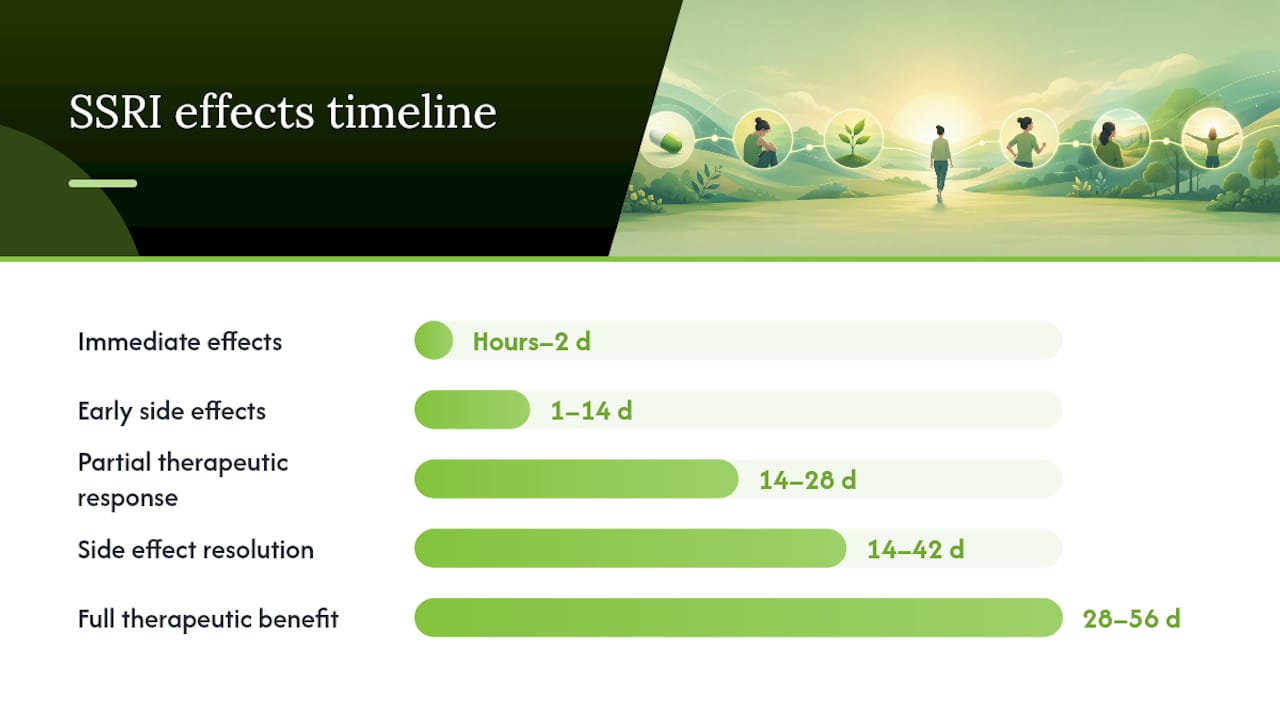
For a broader picture of what a structured depression recovery plan looks like alongside medication, the timeline above fits into a larger framework of monitoring checkpoints and treatment adjustments.
How do you manage SSRI side effects practically?
When a side effect appears, the worst response is to stop the medication without telling anyone. Here is a practical sequence to follow.
- Identify the effect clearly. Note when it started, how severe it is on a 1–10 scale, and whether it is worsening, stable, or improving. A simple symptom diary works well.
- Check timing and food interactions. Nausea is often reduced by taking the medication with food or shifting to an evening dose. Insomnia may improve by moving the dose to morning.
- Review your other medications. Note any new OTC drugs, supplements, or prescription changes since the side effect appeared.
- Contact your prescriber within 1–2 weeks for any bothersome effect, sooner for anything severe. Do not wait for the next scheduled appointment if the effect is affecting daily function.
- Discuss dose adjustment. Many side effects are dose-dependent; a modest reduction often improves tolerability without sacrificing efficacy.
- Ask about switching agents. If an effect persists and is affecting quality of life, a different SSRI or a different antidepressant class may be a better fit.
- Seek emergency care immediately for any red-flag symptoms (see the section below).
Nonpharmacologic strategies that help:
- Sleep hygiene measures (consistent schedule, limiting screens before bed) for insomnia
- Ginger or small frequent meals for nausea in the first week
- Staying hydrated and avoiding alcohol, which amplifies dizziness
Pro Tip: Take your SSRI at the same time every day, and if insomnia is the main complaint, try shifting the dose to morning for one week before asking for a medication change. A timing adjustment resolves sleep disruption in a meaningful number of cases without any dose change.
How we monitor and manage SSRI side effects at Nortexpsychiatry
In our practice, the first follow-up after starting an SSRI happens within 1–2 weeks, not at the standard 30-day refill. That early contact is specifically for tolerability, not efficacy — because most serious problems emerge in the first two weeks, and most patients will not call unless prompted.
At the 4–6 week visit, we assess both tolerability and early response. If a patient reports partial improvement but significant side effects, the conversation centers on whether the trade-off is acceptable or whether a dose adjustment or agent switch makes more sense. We document side effects at every visit using a structured approach, not just a general “how are you doing” check-in.
For older adults, we order baseline sodium and a follow-up within 2–4 weeks. For patients starting citalopram or escitalopram with cardiac risk factors, we discuss whether an ECG is warranted. These are not bureaucratic steps — they are the specific monitoring actions that prevent the serious but preventable harms.
Sexual side effects are addressed directly and without judgment. Options exist. The goal is never to dismiss the concern or tell someone to live with it.
For patients with anxiety alongside depression, we pay particular attention to early activation symptoms in the first two weeks, since that population is more sensitive to the initial stimulant-like effects of some SSRIs.
What symptoms require emergency care right now?
Some reactions cannot wait for a scheduled appointment. Go to the nearest emergency department or call 911 for any of the following.
Call 911 or go to the ER immediately if you experience:
- Rapid heart rate, high fever, muscle rigidity, or confusion — these are signs of serotonin syndrome
- New or worsening thoughts of suicide or self-harm, or a plan to act on them
- Unexplained or heavy bleeding that does not stop
- Fainting, irregular heartbeat, or chest pain
- A seizure
- Severe confusion, extreme headache, or difficulty speaking (possible hyponatremia or neurological event)
Immediate actions:
- Stop the suspected medication only if it is clearly safe to do so and you are with someone who can help
- Call 911 for life-threatening signs; do not drive yourself
- Bring your full medication list to the emergency department
- Contact Poison Control (1-800-222-1222) for suspected overdose or drug interaction questions
For practical emergency guidance and medical disclaimer information, Sinava’s emergency guidance resource provides a useful reference. The 988 Suicide and Crisis Lifeline is available 24/7 for anyone experiencing suicidal thoughts.
Why do SSRIs cause these side effects in the first place?
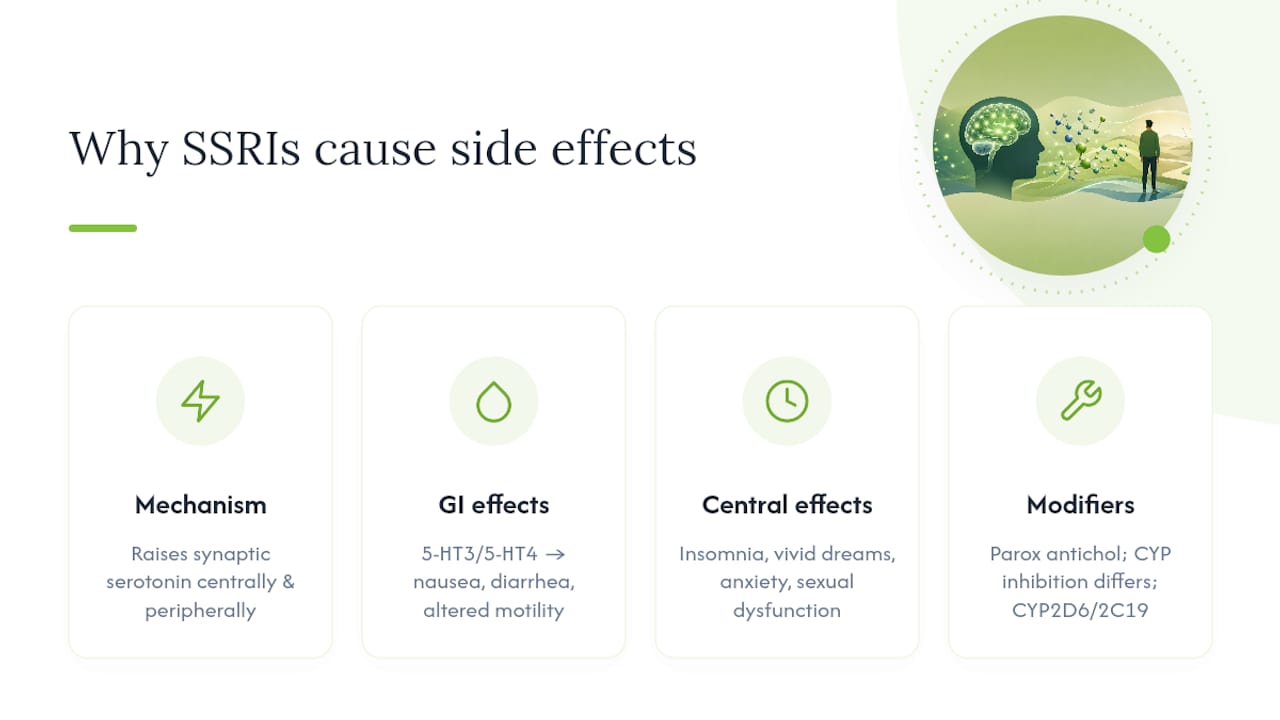
SSRIs block the serotonin reuptake transporter (SERT), which increases serotonin concentration in synapses throughout the central and peripheral nervous system. That mechanism is the same one that produces therapeutic benefit — but serotonin receptors are not confined to mood circuits.
When SERT is blocked peripherally, serotonin accumulates in the GI tract and activates 5-HT3 and 5-HT4 receptors, producing nausea, diarrhea, and motility changes. This is why GI side effects are so consistent across the class and why 5-HT3 antagonists (like ondansetron) can sometimes relieve SSRI-induced nausea.
Centrally, increased serotonin in sleep-regulating circuits explains insomnia and vivid dreams. In limbic and prefrontal circuits, it explains early activation and anxiety. In spinal and peripheral circuits, it explains the sexual effects — delayed ejaculation and anorgasmia reflect serotonin’s inhibitory influence on the spinal ejaculatory reflex and genital arousal pathways.
Individual SSRIs differ in ways that matter clinically. Paroxetine has anticholinergic activity (dry mouth, constipation, cognitive effects in older adults) and inhibits CYP2D6 strongly. Fluoxetine is also a potent CYP2D6 inhibitor. Fluvoxamine inhibits CYP1A2 and CYP3A4, creating a distinct interaction profile. Citalopram and escitalopram are more selective and have fewer drug interactions, though the QTc signal with citalopram is real. These differences are why the NCBI Bookshelf clinical review describes SSRIs as a class with shared mechanisms but meaningfully different tolerability profiles.
Pharmacogenomics adds another layer. Variations in CYP2D6 and CYP2C19 genes affect how quickly individuals metabolize SSRIs, which influences both efficacy and side-effect burden. Poor metabolizers of paroxetine, for example, accumulate higher plasma levels and experience more side effects at standard doses. Genetic testing is not routine for every patient, but it is a reasonable consideration when someone has had unexpected reactions to multiple agents.
A note from our clinical team
We have learned that most people starting an SSRI have two fears: that the side effects will be unbearable, and that the medication will not work. Both are understandable. What we tell patients is this — the side effects are real, but most of them are manageable and temporary. The ones that are not temporary are worth addressing directly, not tolerating in silence.
If something feels wrong, tell us early. We would rather adjust a dose at week two than hear at month four that you stopped the medication because of a problem we could have addressed. Shared decision-making is not a phrase we use lightly. It means your experience of the medication matters as much as the clinical numbers.
Personalized SSRI management at Nortexpsychiatry
Managing SSRI side effects well requires more than a prescription and a follow-up in six weeks. At Nortexpsychiatry, serving patients across Allen, Frisco, McKinney, Plano, and the broader North Dallas area, our medication management services are built around close follow-up, structured side-effect monitoring, and individualized taper planning when the time comes.
We can help with side-effect management at any stage of treatment, taper planning for patients who want to stop safely, and alternative treatments like TMS therapy for those who cannot tolerate medication or have not responded adequately. Both in-person and telehealth appointments are available.
To get started, schedule a psychiatric evaluation or reach out through our website. A prescriber who knows your full picture makes every medication decision safer.
Sources
- Safety Concerns, Mechanistic Pathways, and Knowledge Gaps in the Clinical Use of Selective Serotonin Reuptake Inhibitors – PMC
- Selective Serotonin Reuptake Inhibitors: Uses & Side Effects – NCBI Bookshelf
- Depression Medicines | FDA
- ZOLOFT (sertraline hydrochloride) highlights of prescribing information – DailyMed
FAQ
What are the worst side effects of SSRIs?
The most serious SSRI side effects are serotonin syndrome, severe bleeding, hyponatremia, and QTc prolongation — all rare but potentially life-threatening.
Do SSRIs make anxiety worse at first?
Yes, some patients experience increased anxiety, restlessness, or agitation in the first 1–2 weeks, particularly with fluoxetine and sertraline. This early activation usually resolves with a slower dose titration or a brief dose reduction, and it does not predict whether the medication will ultimately help.
How long do SSRIs take to work?
Most patients see partial improvement in sleep, energy, or appetite within 2–4 weeks, but full therapeutic benefit for mood and anxiety typically takes 4–8 weeks. Side effects often appear before benefit does, which is why early follow-up and realistic expectations matter.
How long does SSRI withdrawal last?
SSRI discontinuation symptoms typically begin within 1–3 days of stopping and resolve within 1–2 weeks for most patients, though some experience symptoms for longer. Paroxetine carries the highest withdrawal risk due to its short half-life; fluoxetine carries the lowest. A gradual taper significantly reduces the likelihood and severity of symptoms.