


Evidence-based psychotherapy, specifically cognitive behavioral therapy (CBT) with exposure, and antidepressant medications (SSRIs and SNRIs, with short-term benzodiazepines when clinically appropriate) are the treatments that reliably reduce panic attacks and panic disorder. If you are in the middle of an attack right now, here is what to do:
- Slow your breathing. Inhale for 4 counts, hold for 1, exhale for 6. Repeat until your heart rate settles.
- Ground yourself with the 3-3-3 rule. Name 3 things you can see, 3 sounds you can hear, and move 3 parts of your body. This pulls attention away from the spiral.
- Relax your muscles deliberately. Drop your shoulders, unclench your jaw, and release your fists.
- Move to a safer or quieter space if the environment is contributing to the attack.
- Call for help if you need it. If you are experiencing chest pain you cannot explain, thoughts of harming yourself, or you feel you may faint, call 911 or the 988 Suicide and Crisis Lifeline immediately.
If you are having frequent attacks or your fear of the next one is changing how you live, that is panic disorder, and it responds well to treatment. Nortexpsychiatry offers urgent psychiatric evaluations in Allen, Texas, and via telehealth across North Dallas, including Frisco, McKinney, and Plano.
Pro Tip: Save 988 in your phone now. Having the number ready before a crisis removes one barrier when you need it most.
Key Takeaways
Effective panic attack treatment combines immediate coping strategies with evidence-based clinical care: CBT with exposure for durable recovery, SSRIs or SNRIs as first-line medication, and short-term benzodiazepines only when clinically necessary.
| Point | Details |
|---|---|
| First-line treatments | CBT with exposure therapy and SSRIs/SNRIs are the primary evidence-based options for panic disorder. |
| Medication onset | SSRIs and SNRIs typically take 2–4 weeks for initial effect; full benefit often appears at 6–8 weeks. |
| Benzodiazepine caution | Clonazepam and alprazolam provide fast relief but carry high dependence risk; use short-term only. |
| When to escalate care | Frequent attacks, avoidance behaviors, or suicidal thoughts require direct psychiatric evaluation, not self-management alone. |
| Nortexpsychiatry | Offers in-person and telehealth psychiatric evaluations and medication management across North Dallas for panic disorder. |
Table of Contents
- How do clinicians tell a panic attack from panic disorder?
- What are the two main pillars of panic attack treatment?
- What does therapy for panic disorder actually look like?
- Which medications treat panic disorder, and how do they compare?
- What should you do during a panic attack, step by step?
- Who should you see first, and when?
- How long does panic attack treatment take to work?
- What should you ask before your first psychiatric appointment?
- How Nortexpsychiatry evaluates and treats panic disorder
- What we have learned from treating panic disorder
- Nortexpsychiatry offers a direct path to panic disorder care
- Sources
- FAQ
How do clinicians tell a panic attack from panic disorder?
A single panic attack is a discrete episode: intense fear or discomfort that peaks within minutes and includes physical symptoms like racing heart, shortness of breath, chest tightness, dizziness, or a sense of unreality. Panic disorder is the diagnosis when attacks recur unexpectedly and are followed by at least one month of persistent worry about future attacks, or by significant changes in behavior, such as avoiding exercise, crowds, or driving.
The DSM-5 distinguishes the two clearly. A panic attack is a symptom, not a diagnosis on its own. Panic disorder requires recurrent unexpected attacks plus the anticipatory anxiety or avoidance that follows. That distinction matters clinically because it shapes the treatment plan.
Before any psychiatric diagnosis is made, medical causes need to be ruled out. Conditions and substances that can produce panic-like symptoms include:
- Cardiac arrhythmias and mitral valve prolapse
- Pulmonary embolism or asthma
- Hyperthyroidism or hypoglycemia
- Pheochromocytoma (a rare adrenal tumor)
- Stimulant medications, caffeine, or decongestants
- Alcohol or benzodiazepine withdrawal
- Cannabis use in susceptible individuals
A first panic attack in someone over 45, or one that occurs during sleep and wakes the person, warrants a medical workup before assuming a psychiatric cause. An EKG, thyroid panel, and basic metabolic labs are a reasonable starting point.
If your symptoms began recently and you have no prior psychiatric history, starting with your primary care physician is reasonable. They can order labs, rule out cardiac causes, and refer you to a psychiatrist or therapist. If attacks are frequent, severe, or accompanied by depression or suicidal thoughts, ask for a direct psychiatric referral rather than waiting.
Up to 1 in 3 people report at least one panic attack in their lifetime, but only about 1–4% develop panic disorder. Professional evaluation is what separates an isolated episode from a condition that needs structured treatment.
What are the two main pillars of panic attack treatment?
Psychotherapy and medication are both first-line, and the evidence supports using either alone or in combination depending on severity, patient preference, and comorbidities.
Psychotherapy (CBT with exposure) is the most durable option. It addresses the catastrophic thinking and avoidance behaviors that sustain panic disorder. It works without the side effects or dependence risks that medications carry, and its gains tend to hold after treatment ends.
Antidepressant medications (SSRIs and SNRIs) reduce the biological substrate of panic. They take weeks to reach full effect but are appropriate as a standalone treatment, particularly when therapy is not immediately accessible or when symptoms are severe enough to interfere with daily functioning.
When to consider each approach:
- Therapy alone: Mild to moderate panic disorder, patient preference for non-medication treatment, pregnancy, or history of medication intolerance.
- Medication alone: Severe or frequent attacks that make engaging in therapy difficult, limited access to a trained therapist, or significant comorbid depression.
- Combined therapy and medication: Moderate to severe panic disorder, comorbid agoraphobia, prior treatment failure with monotherapy, or when faster initial relief is needed alongside longer-term skill building.
Benzodiazepines like clonazepam and alprazolam can reduce acute panic quickly, but clinical guidance recommends them only for short-term use or as a bridge while an antidepressant reaches therapeutic effect. Chronic benzodiazepine use carries real dependence and withdrawal risks, and they do not address the underlying disorder.
CBT can be delivered in individual sessions, group formats, or guided self-help programs. A network meta-analysis published in Psychological Medicine found no meaningful efficacy difference between these formats, which means guided self-help and telehealth-delivered CBT are legitimate first-line options, not just substitutes when nothing else is available.
What does therapy for panic disorder actually look like?
CBT for panic disorder targets two things: the catastrophic misinterpretation of physical sensations (“my heart is racing, so I must be dying”) and the avoidance behaviors that reinforce fear. Exposure therapy, a core component, teaches the nervous system that the sensations are uncomfortable but not dangerous.
A typical course runs 12–15 weekly sessions, though some patients see meaningful improvement in 8. Sessions usually follow this structure:
- Psychoeducation about the panic cycle and how avoidance maintains it.
- Cognitive restructuring to identify and challenge catastrophic thoughts.
- Interoceptive exposure — deliberately inducing mild panic sensations (spinning in a chair, breathing through a coffee straw) to practice tolerating them without escape.
- Situational exposure to avoided places or activities, starting with less feared items and working up.
- Relapse prevention planning so gains hold after sessions end.
Between sessions, homework matters. Practicing exposures outside the therapy room is where most of the learning happens. Patients who complete homework consistently tend to do better than those who treat sessions as the whole treatment.
The evidence for CBT is strong, but honest. Research published in PMC shows that a meaningful proportion of patients do not reach full panic-free status after a standard course, and some need additional sessions, a different format, or combined medication. That is not a failure of the approach; it reflects the variability in how panic disorder presents and responds.
Pro Tip: When interviewing a therapist, ask directly: “Do you use interoceptive exposure with panic disorder patients?” A therapist trained in CBT for panic will know exactly what that means and describe how they use it. Vague answers about “working on anxiety” are a signal to keep looking.
Credentials to look for include licensed psychologists (PhD, PsyD), licensed clinical social workers (LCSW), or licensed professional counselors (LPC) with specific training in CBT and exposure-based treatments. The Association for Behavioral and Cognitive Therapies (ABCT) maintains a therapist directory.
Which medications treat panic disorder, and how do they compare?
SSRIs and SNRIs are considered first-line pharmacological options for panic disorder. They generally take a few weeks to become effective and do not carry the dependence risk associated with benzodiazepines. Commonly used medications include sertraline, fluoxetine, paroxetine, escitalopram, and venlafaxine XR as SSRIs/SNRIs, plus clonazepam and alprazolam as short-term benzodiazepines for acute symptom relief.
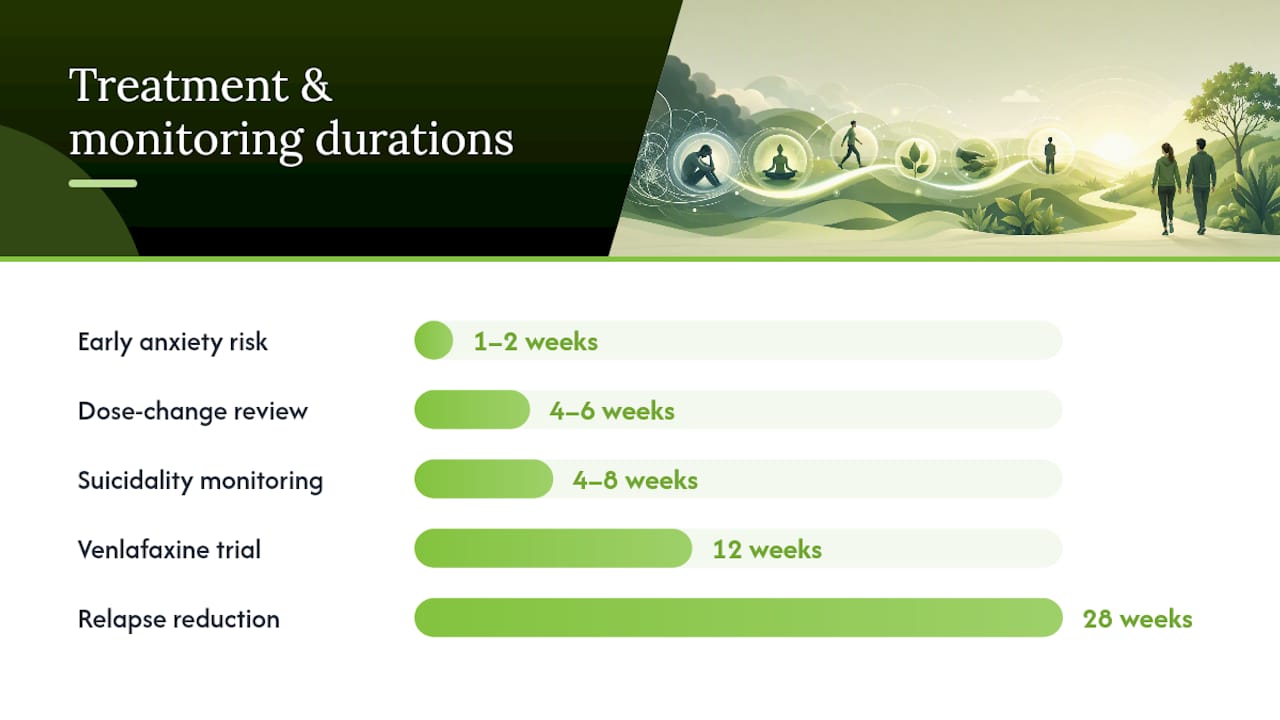
Sertraline’s efficacy is supported by multiple double-blind, placebo-controlled trials, and continuation reduced relapse rates over 28 weeks compared to placebo. Venlafaxine XR demonstrated efficacy in 12-week placebo-controlled trials; dosing typically starts at 37.5 mg/day and is titrated upward based on response and tolerability.
Starting doses for SSRIs in panic disorder are usually lower than those used for depression, because some patients experience a transient increase in anxiety in the first 1–2 weeks. Starting low and titrating slowly reduces this effect.
Monitoring checklist for anyone starting an antidepressant:
- Review response and side effects at 2 weeks, then at 4–6 weeks after any dose change.
- Screen for worsening suicidal ideation, particularly in the first 4–8 weeks and after dose increases. The FDA requires a black-box warning on antidepressants for this risk in patients under 25.
- Ask about drug interactions, especially with other serotonergic agents.
- For venlafaxine, monitor blood pressure, as some patients experience small increases.
- Plan for a minimum of 6 months of treatment after achieving a good response before discussing a taper.
Benzodiazepines like clonazepam and alprazolam should be tapered gradually when discontinuing. Abrupt stopping after regular use can cause withdrawal seizures. Never stop a benzodiazepine suddenly without guidance from your prescriber.
For patients where substance use intersects with anxiety or panic, managing anxiety during detox requires careful coordination, since benzodiazepine use in that context carries additional risk.
What should you do during a panic attack, step by step?
Knowing what to do in the moment reduces the fear of the fear, which is often what sustains the cycle. These steps work whether you are having your first attack or your fiftieth.
- Recognize it. Tell yourself: “This is a panic attack. It will peak and pass. It cannot harm me.”
- Slow your exhale. Breathe in for 4 counts, out for 6. The longer exhale activates the parasympathetic nervous system.
- Use the 3-3-3 rule. Name 3 things you see, identify 3 sounds, move 3 body parts. This grounds you in the present and interrupts the spiral.
- Relax your body deliberately. Drop your shoulders, unclench your hands, soften your jaw. Physical tension amplifies the sensation of panic.
- Stay where you are if it is safe. Leaving the situation reinforces avoidance. If you can stay and let the wave pass, you build tolerance.
- Use prescribed acute medication if you have it. If your clinician has prescribed a short-acting benzodiazepine for acute attacks, take it as directed. Do not combine it with alcohol.
When to seek emergency care: Go to the ER or call 911 if you have chest pain that does not resolve, you faint or lose consciousness, you have an injury, or you are having thoughts of suicide or self-harm. A panic attack alone does not require emergency care, but ruling out a cardiac event is appropriate if you are unsure.
If you are having multiple attacks per week, the goal shifts from managing individual episodes to treating the underlying disorder. That requires a clinical evaluation, not just coping strategies.
Who should you see first, and when?
The right first call depends on how severe your symptoms are and how long they have been happening.
Start with your primary care physician if:
- This is your first or second panic attack.
- You have no prior psychiatric history.
- You want to rule out medical causes before pursuing psychiatric care.
- Symptoms are mild and not yet affecting daily functioning.
Go directly to a psychiatrist if:
- Attacks are frequent (more than once a week) or severely disabling.
- You have comorbid depression, substance use, or a prior psychiatric history.
- You have already had a medical workup and it was normal.
- You are having thoughts of suicide or self-harm.
Call 911 or go to the ER if:
- You have chest pain, fainting, or an unexplained neurological symptom.
- You are in immediate danger of harming yourself.
To prepare for your first appointment, bring:
- A symptom log: dates, times, duration, and triggers of recent attacks.
- A list of all current medications, supplements, and substances (including caffeine and alcohol).
- Any prior psychiatric or medical records relevant to anxiety.
- A note on what you have already tried (therapy, medication, self-help).
- Your questions written down so you do not forget them in the moment.
Understanding what a psychiatric assessment involves before you arrive can reduce the anxiety of the first visit itself.
How long does panic attack treatment take to work?
Recovery is not linear, but there are predictable milestones worth knowing.
With medication (SSRIs/SNRIs):
- Weeks 1–2: Possible transient increase in anxiety as the medication starts; some patients notice mild nausea or sleep changes.
- Weeks 2–4: Initial reduction in attack frequency for many patients.
- Weeks 6–8: More consistent symptom reduction; this is when most prescribers assess whether the dose needs adjustment.
- Months 3–6: Full therapeutic effect; anticipatory anxiety and avoidance often improve alongside attack frequency.
- After 6 months of good response: Discussion of whether to continue, taper, or maintain.
With CBT:
- Sessions 1–3: Psychoeducation and early cognitive work; some patients feel relief just from understanding the panic cycle.
- Sessions 4–8: Exposure work begins; this is often the hardest phase and the most effective one.
- Sessions 8–15: Consolidation, situational exposures, and relapse prevention.
Clinical guidelines suggest reviewing medication response at 2 weeks and again at 4–12 weeks after any dose change, then continuing for at least 6 months after a good response before considering a taper. Relapse after stopping medication is real, particularly if therapy was not part of the treatment. Combined treatment tends to produce more durable outcomes. A step-by-step approach to anxiety treatment can help you understand what each phase of care should look like.
What should you ask before your first psychiatric appointment?
Practical logistics stop a lot of people from getting care. These are the questions worth having answered before or at your first visit.
Questions to ask your clinician:
- What treatment do you recommend for my specific situation, and why?
- How long before I should expect to notice a difference?
- What side effects should I watch for, and when should I call you about them?
- How often will we meet, and what does follow-up look like?
- What do I do if I have a crisis between appointments?
Insurance checklist:
- Does your plan cover outpatient psychiatry and outpatient therapy separately?
- Is prior authorization required for specific medications?
- What is your deductible and copay for mental health visits?
- Does your plan cover telehealth psychiatric visits at the same rate as in-person?
What happens at the first psychiatric visit:
- A full psychiatric history, including symptom onset, prior treatments, and family history.
- A safety assessment covering suicidal ideation and self-harm.
- A medication reconciliation to check for interactions.
- A diagnostic formulation and a treatment plan with clear next steps.
Understanding the benefits of psychiatric care before your first appointment helps you know what to expect and what questions to prioritize.
How Nortexpsychiatry evaluates and treats panic disorder
At Nortexpsychiatry, the first visit starts with a thorough psychiatric evaluation: a detailed history of your panic symptoms, a safety assessment, a review of any medical workup already completed, and a medication reconciliation. We do not hand you a prescription at the end of a 15-minute intake. We build a plan.
Services available include:
- In-person and telehealth psychiatric evaluations for adults across Allen, Frisco, McKinney, Plano, and surrounding North Dallas communities.
- Medication management for SSRIs, SNRIs, and short-term benzodiazepine bridging when clinically appropriate.
- Coordinated referrals to CBT-trained therapists when therapy is part of the plan.
- Urgent appointments for patients in crisis or with rapidly worsening symptoms.
- Ongoing follow-up at clinically appropriate intervals, not just annual check-ins.
What to bring to your first visit:
- Photo ID and insurance card.
- A list of current medications and supplements.
- Any prior psychiatric records or lab results.
- A brief written summary of your symptoms: when they started, how often they occur, and what makes them better or worse.
Our personalized psychiatric treatment approach means the plan we build with you reflects your specific history, preferences, and goals, not a generic protocol.
What we have learned from treating panic disorder
We often notice that patients arrive having already spent months managing panic attacks on their own, convinced that what they are experiencing is either a heart problem or a sign of something deeply wrong with them. The relief that comes from a clear diagnosis and a concrete plan is sometimes as therapeutic as the treatment itself.
We recommend a few habits that consistently make both therapy and medication work better:
- Sleep regularly. Sleep deprivation lowers the threshold for panic. Irregular sleep is one of the most underestimated triggers we see.
- Cut caffeine, at least temporarily. Caffeine is a direct physiological trigger for panic in many patients. Reducing it during the early weeks of treatment removes one variable.
- Exercise consistently. Aerobic exercise reduces baseline anxiety and improves medication tolerability. Even 20–30 minutes of walking most days makes a measurable difference.
- Stay with the plan. The first few weeks of an SSRI can feel worse before they feel better. Stopping early is the most common reason treatment fails.
- Tell your prescriber about side effects. Most side effects are manageable with dose adjustments or medication changes. Suffering in silence and then stopping is not the answer.
Recovery from panic disorder is not a straight line. Some patients respond quickly; others need two or three medication trials or an extended course of therapy. That variability is normal, and it does not mean the condition is untreatable. What we have found, consistently, is that patients who stay engaged with their treatment team get better.
Nortexpsychiatry offers a direct path to panic disorder care
For adults in North Dallas who are ready to move from managing panic attacks to actually treating the disorder behind them, Nortexpsychiatry provides clinician-led psychiatric evaluations, medication management, and coordinated therapy referrals, all available in person or via telehealth. You do not need a referral to book a first appointment, and telehealth visits mean you can access care from Allen, Frisco, McKinney, Plano, or anywhere in the surrounding area without rearranging your schedule.
The first visit is a real evaluation, not a questionnaire. You leave with a diagnosis, a treatment plan, and a clear next step. Find out why psychiatric care makes a difference and book your evaluation at Nortexpsychiatry today.
Sources
These sources informed the clinical guidance in this article and are worth reviewing if you want to go deeper.
- Panic attacks and panic disorder – Diagnosis and treatment
- Coping Skills and Exposure Therapy in Panic Disorder and Agoraphobia: Latest Advances and Future Directions – PMC
- CBT treatment delivery formats for panic disorder: a systematic review and network meta-analysis of randomised controlled trials | Psychological Medicine | Cambridge Core
- Anxiety: Pharmacotherapy | CAMH
- Sertraline Hydrochloride Tablets — Clinical trial and relapse data (DailyMed)
This article is general information, not a substitute for advice from a qualified doctor. Consult a qualified healthcare professional about your own circumstances before acting on anything here.
FAQ
What should you do during a panic attack?
Use slow diaphragmatic breathing (inhale 4 counts, exhale 6), apply the 3-3-3 rule (name 3 things you see, 3 sounds you hear, move 3 body parts), and remind yourself the attack will pass. If you have a prescribed acute medication, take it as directed and avoid alcohol.

What is the 3-3-3 rule for panic attacks?
The 3-3-3 rule is a grounding technique: identify 3 things you can see, 3 sounds you can hear, and deliberately move 3 parts of your body. It interrupts the cognitive spiral of a panic attack by redirecting attention to the immediate environment.
What causes panic disorder?
Panic disorder likely involves a combination of genetic vulnerability, heightened sensitivity to physical sensations, and learned avoidance patterns. Medical conditions like thyroid disorders, cardiac arrhythmias, and stimulant use can trigger panic-like episodes and should be ruled out before a psychiatric diagnosis is made.
How do you break the panic attack cycle?
Breaking the cycle requires addressing both the biological and behavioral components: antidepressant medication reduces the frequency and intensity of attacks, while CBT with exposure therapy targets the catastrophic thinking and avoidance that sustain the disorder. Using both together tends to produce more durable results than either approach alone.
When should you see a psychiatrist for panic attacks?
See a psychiatrist directly when attacks are frequent or severely disabling, when you have comorbid depression or a prior psychiatric history, or when a medical workup has already come back normal. Nortexpsychiatry offers both in-person and telehealth evaluations for adults across North Dallas.