


Recognizing mental health symptoms means noticing lasting shifts in your emotions, thoughts, and behaviors that disrupt daily life. These changes go beyond ordinary stress. Approximately 22–23% of U.S. adults are affected by mental illness, with more than 5% experiencing serious conditions that impair daily functioning. That scale means most people either live with these symptoms themselves or know someone who does. The challenge is that mental health symptoms rarely announce themselves clearly. They tend to build gradually, and many adults dismiss early signs as tiredness, stress, or just “going through a rough patch.” Knowing what to look for changes that.
What are the common signs of mental health issues?
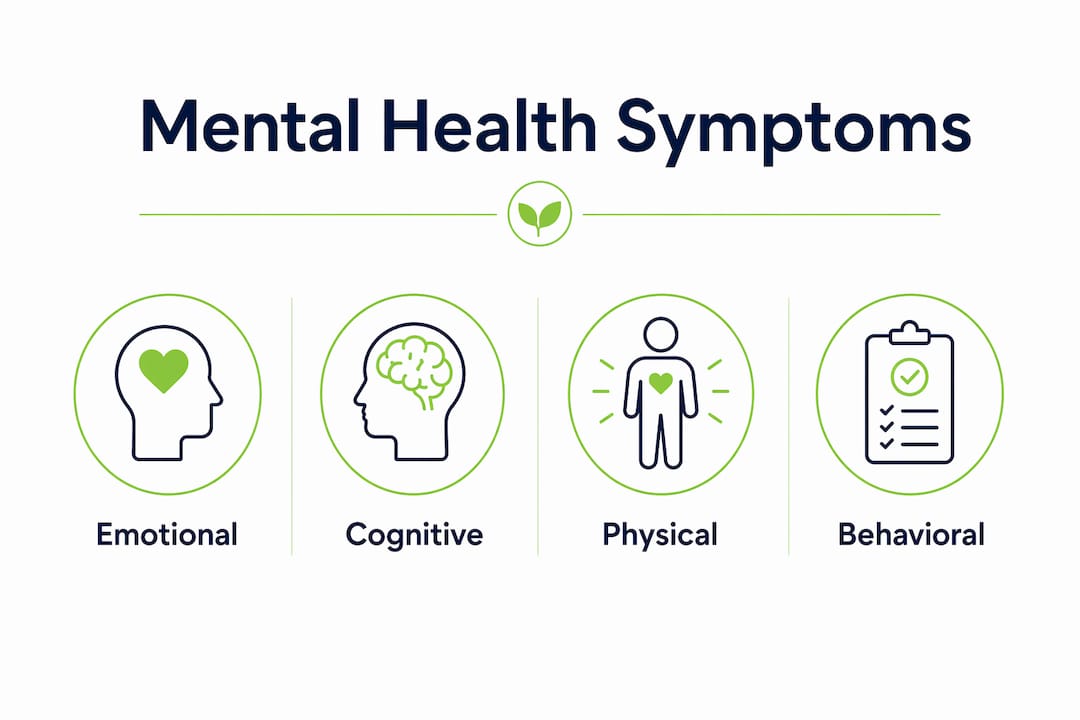
Mental health symptoms fall into four categories: emotional, cognitive, physical, and behavioral. Clinicians use this framework because symptoms rarely appear in isolation. A cluster of signs across multiple categories is a stronger signal than any single symptom alone.
Emotional signs
Persistent sadness, irritability, or emotional numbness are the most recognized emotional signs. But mood swings that feel disproportionate to the situation also count. You might notice you’re reacting to minor frustrations with intense anger, or that you feel flat and disconnected from things that used to matter. Early symptoms include emotional numbness and withdrawal from activities you previously enjoyed.
Cognitive signs
Difficulty concentrating, forgetting simple things, or feeling mentally foggy are common cognitive symptoms. Racing or intrusive thoughts and persistent hopelessness are signs that stress has progressed into something requiring evaluation. These cognitive shifts are easy to attribute to busyness or poor sleep, which is exactly why they get missed.

Physical signs
Sleep disturbances are one of the earliest physical indicators. This includes both insomnia and sleeping far more than usual. Appetite changes, unexplained headaches, stomach problems, and chronic fatigue also fall here. Chronic stress creates what researchers call “allostatic load,” a physical burden on the body that signals mental health decline. The body keeps score before the mind fully registers the problem.
Behavioral signs
Withdrawing from friends and family, neglecting personal hygiene, losing interest in work or hobbies, and increased use of alcohol or substances are all behavioral warning signs. You can also look for changes in how someone speaks, whether they’ve become quieter, more agitated, or less engaged. Reviewing common mental health conditions can help you match what you’re observing to recognized patterns.
Pro Tip: Keep a simple daily log for two weeks. Note your mood, sleep quality, energy, and any physical complaints. Patterns become visible on paper in ways they never do in your head.
How do you tell normal stress apart from mental illness?
This is the question most adults struggle with. Stress is a normal response to pressure. Mental illness is a clinical condition that persists, intensifies, and impairs function regardless of whether the stressor is still present.
The clearest rule is duration. Symptoms that linger more than 2–4 weeks after a stressor ends, or that don’t improve with rest, warrant professional attention. That timeline matters because normal stress typically resolves when the pressure lifts.
The second factor is functional impairment. Ask yourself these questions:
- Are your symptoms affecting your performance at work or school?
- Have your relationships become strained because of how you’ve been feeling?
- Are you avoiding daily tasks you used to handle without difficulty?
- Is your sleep or appetite significantly disrupted for more than a few weeks?
- Do your reactions feel out of proportion to what’s actually happening?
Functional impairment is the clearest indicator that symptoms have crossed into diagnosable territory. Clinicians focus on how symptoms affect work, relationships, and daily tasks, not just on how you feel emotionally.
There is also a formal diagnosis that sits between stress and full mental illness. Adjustment disorder describes stress reactions that exceed expected levels or last longer than typical, and it often resolves within six months with appropriate care. It is one of the most common outpatient diagnoses, and it is highly treatable.
When symptoms persist beyond a few weeks and start affecting your ability to function at work, in relationships, or in daily life, that is the moment to stop waiting and start talking to someone. Feelings alone don’t define a diagnosis. Impact does.
How to monitor and track your mental health symptoms
Consistent self-monitoring is one of the most practical tools available. Journaling and symptom checklists help you recognize patterns and identify when professional support is needed. The goal is not self-diagnosis. The goal is building enough awareness to have an informed conversation with a clinician.
The table below outlines what to track and why each area matters.
| Area to Track | What to Note | Why It Matters |
|---|---|---|
| Mood | Daily emotional tone, highs and lows | Reveals patterns of persistent low mood or instability |
| Sleep | Hours slept, quality, waking at night | Sleep disruption is often the first measurable symptom |
| Energy | Fatigue level, motivation to do tasks | Low energy that doesn’t improve with rest signals more than tiredness |
| Social behavior | Contact with others, desire to withdraw | Isolation is a behavioral red flag across many conditions |
| Physical complaints | Headaches, stomach issues, appetite | Physical symptoms often accompany emotional distress |
Beyond self-tracking, input from people who know you well is genuinely useful. A close friend or family member often notices behavioral changes before you do. Asking someone you trust whether they’ve noticed anything different about you is not weakness. It is good information gathering.
When patterns emerge from your tracking, a structured mental health self-assessment can help you organize what you’ve observed before speaking with a professional. These tools do not replace clinical evaluation, but they prepare you for a more productive conversation.
Pro Tip: Use a 1–10 scale for mood and energy each morning. After two weeks, look for the floor, not the average. Consistently low floors matter more than occasional bad days.
A family mental health support checklist can also help if you’re trying to support someone else while managing your own observations.
What mistakes make it harder to identify mental health symptoms?
Several common errors delay recognition and treatment. Understanding them helps you avoid the same traps.
-
Confusing normal fluctuations with illness. Everyone has bad days. The problem is when people use that fact to dismiss symptoms that have lasted weeks or months. Normal mood variation does not impair function consistently.
-
Ignoring symptoms because they feel “manageable.” Many adults tolerate significant distress because they can still get through the day. Only about 50% of people with mental illness receive treatment, partly because symptoms feel manageable until they aren’t. Manageable is not the same as healthy.
-
Relying on internet searches for diagnosis. Online symptom checkers provide general information, not clinical judgment. They cannot assess duration, severity, or functional impact in context. They are useful for building vocabulary, not for reaching conclusions.
-
Waiting for a crisis. Waiting for emergency-level symptoms before seeking help leads to worse outcomes. Early intervention improves recovery speed and treatment effectiveness. The window for easier treatment is earlier than most people act.
-
Letting stigma or system confusion stop you. The main barrier to care for many adults is not knowing where to start. Confusion about how to navigate the mental health system keeps people stuck. Starting with a single phone call or a guide to psychiatric care is enough to begin.
Mental health exists on a continuum. You can experience poor mental health without a diagnosable illness. That means you do not need to meet a clinical threshold to deserve support.
Key Takeaways
Recognizing mental health symptoms requires tracking persistent changes in mood, behavior, sleep, and function, then acting before symptoms reach crisis level.
| Point | Details |
|---|---|
| Symptoms cluster across categories | Emotional, cognitive, physical, and behavioral signs together are more meaningful than any single symptom. |
| Duration and function define severity | Symptoms lasting more than 2–4 weeks that impair work or relationships signal a clinical concern. |
| Self-monitoring builds clarity | Daily mood and sleep tracking reveals patterns that are invisible without a record. |
| Waiting worsens outcomes | Early intervention improves recovery; acting before a crisis is always the better path. |
| Stigma and confusion are barriers | Most people who don’t seek care cite system confusion, not lack of need. Starting small still counts. |
What I’ve learned about recognizing symptoms early
The most consistent pattern I see in outpatient practice is this: people arrive having already known something was wrong for months. They describe it as “not feeling like myself” or “just being tired.” They waited because the symptoms felt explainable. Work was stressful. Sleep was bad. Life was busy.
What I’ve come to understand is that the feeling of being explainable is part of how mental health symptoms work. They attach themselves to real circumstances so they feel proportionate. The signal I pay closest attention to is not the intensity of the feeling. It is the duration and the drift. When someone’s baseline has quietly shifted over weeks, and they’ve stopped doing things they used to do without noticing, that is the pattern worth taking seriously.
The other thing I’d say is that functional impairment is a more honest measure than emotional reports. People minimize how they feel. They rarely minimize whether they’ve stopped going to the gym, stopped calling friends, or started missing deadlines. Those behavioral facts are harder to rationalize away.
If you’re reading this and recognizing something in it, that recognition matters. You don’t need certainty to reach out. You need enough concern to start a conversation.
— Felix
How Nortexpsychiatry supports adults navigating mental health concerns
When symptoms persist and start affecting your daily life, a professional evaluation gives you clarity that self-monitoring alone cannot. At Nortexpsychiatry, we work with adults across Allen, Frisco, McKinney, Plano, and the broader North Dallas area to assess what’s happening and build a plan that fits your life. Whether you’re dealing with anxiety, depression, mood changes, or something you haven’t been able to name yet, our team provides personalized, evidence-based care without judgment. We offer both in-person and telehealth appointments, so access is not a barrier. If you’re ready to understand what you’re experiencing, psychiatric care for adults is a clear place to start. You can also learn more about what a formal evaluation involves through our guide to psychiatric evaluations.
FAQ
What are the first signs of a mental health problem?
Early signs include sleep changes, appetite shifts, difficulty concentrating, emotional numbness, and withdrawal from activities. These often appear weeks before more obvious symptoms develop.
How long should symptoms last before I seek help?
Symptoms that persist beyond 2–4 weeks after a stressor ends, or that don’t improve with rest, warrant professional evaluation. Functional impairment at work or in relationships is a strong signal to act sooner.
Can I have poor mental health without a diagnosable illness?
Yes. Mental health exists on a continuum, and you can experience significant distress without meeting the criteria for a formal diagnosis. Support is appropriate at any point on that spectrum.
What is the difference between anxiety symptoms and an anxiety disorder?
Clinicians distinguish the two by assessing functional impairment, duration, and severity. Anxiety becomes a disorder when it consistently disrupts work, relationships, or daily tasks beyond what the situation warrants.
Why do so many people with mental illness not get treatment?
Approximately 50% of people with mental illness do not receive treatment, largely due to cost, wait times, and confusion about how to navigate the mental health system. Starting with a single conversation or a structured resource is often enough to break through that barrier.