


Effective treatments exist for postpartum depression, and most women improve once they start one. The main paths are psychotherapy (especially CBT and IPT), medications including the two FDA-approved postpartum-specific drugs zuranolone and brexanolone, and, for severe or urgent cases, somatic options like ECT, TMS, or ketamine. Which one fits you depends on symptom severity, whether you’re breastfeeding, and your own preferences. If a screening tool flagged you, or you’re worried about your safety or your baby’s, get evaluated soon. Waiting rarely helps.
TL;DR:
- Treatment effectiveness depends on symptom severity, with therapy alone usually suitable for mild cases and combined therapy and medication reserved for moderate to severe depression.
- Rapid-acting options like zuranolone and ketamine offer symptom relief within days to weeks, but they require careful monitoring and are typically used for treatment-resistant cases.
- Somatic treatments such as ECT, TMS, and brexanolone are reserved for the most severe or urgent cases, often requiring inpatient or highly specialized care.
- Early assessment to rule out bipolar disorder and psychosis is critical to avoid worsening symptoms with inappropriate medication choices.
- Practical barriers like insurance, cost, childcare, and stigma can delay treatment, but integrated clinics and telehealth are improving access for new mothers.
Table of Contents
- What Are the Goals of Postpartum Depression Treatment?
- How Effective Is Psychotherapy for Postpartum Depression?
- What Medications Treat Postpartum Depression?
- When Do ECT, TMS, and Ketamine Come Into Play?
- How Do Clinicians Build a Treatment Plan?
- When Should You Seek Urgent Care?
- How Long Does Recovery Take, and What Comes After?
- How Nortex Psychiatry Approaches Postpartum Depression Care
- What Side Effects Should You Expect From Each Option?
- What Gets in the Way of Getting Treatment?
- How Does Stigma Affect Treatment for New Mothers?
- Do Support Groups Actually Help With Postpartum Depression?
- Can Lifestyle Changes Support Postpartum Depression Recovery?
- Why Evidence-First, Safety-Forward Care Matters Most
- Get Evaluated at Nortex Psychiatry
- Sources
- FAQ
What Are the Goals of Postpartum Depression Treatment?
We’ve sat across from a lot of exhausted, guilt-ridden new mothers, and almost every one of them asks some version of the same question first: “Will I feel like myself again?” The honest answer is yes, usually, and treatment is what gets you there faster.
Clinicians aim for three things at once: symptom remission, safety for both mother and infant, and restoring the ability to function and bond. That third piece gets overlooked in a lot of general depression discussions, but it matters enormously here. A mother who’s clinically “better” on a rating scale but still can’t make eye contact with her baby hasn’t finished treatment.
We use what’s often called a stepped approach. Mild symptoms usually respond to psychotherapy alone. Moderate to severe depression typically calls for combined therapy and medication. Severe presentations with psychotic features need urgent, often inpatient, care. The CANMAT guideline for perinatal mood and anxiety disorders frames management this way, and it lines up with what we see in daily practice.
A few factors shape where you land on that ladder:
- Whether you’ve had depression or bipolar disorder before pregnancy
- Screening results for bipolar disorder or psychosis, since antidepressants alone can worsen bipolar depression
- Breastfeeding status and your own feelings about medication while nursing
- Comorbid anxiety, which shows up in the majority of postpartum depression cases we treat
- How much practical support you have at home
A first evaluation usually takes 45 to 60 minutes, with follow-up visits every two to four weeks early on. That cadence isn’t arbitrary. It’s how a psychiatrist catches a treatment that isn’t working before you’ve lost another month to it.
How Effective Is Psychotherapy for Postpartum Depression?
For mild to moderate postpartum depression, therapy is often the first thing we recommend, and the evidence backs that instinct. A network meta-analysis found cognitive behavioral therapy to be among the most effective psychotherapeutic approaches for maternal depression, with interpersonal therapy also showing meaningful benefit in several analyses.
CBT works by targeting the distorted thought patterns that depression feeds on: “I’m a terrible mother,” “Nothing I do is right,” “This will never get better.” IPT takes a different angle, focusing on the relationship shifts that come with new parenthood. Both have decades of research behind them, and both were built for exactly this kind of life-transition depression.
The durability of the benefit is worth pausing on. A broad overview of psychological treatment for perinatal depression found moderate-to-large effect sizes, with improvements often holding for six to twelve months after treatment ends. That’s not a quick patch. It’s a skill set that keeps paying off long after the sessions stop.
Formats vary more than people expect. You can access psychotherapy through:
- Individual sessions with a therapist trained in perinatal mental health
- Group therapy, which doubles as peer support
- Telehealth, now widely used and shown to be effective in several trials
- Guided self-help programs for women who can’t fit in weekly appointments
Emerging research also suggests that non-specialist therapists trained in specific perinatal protocols can deliver care that’s just as effective as specialist-led sessions. That matters in areas where perinatal specialists are scarce, which, frankly, is most places.
A typical course runs 8 to 16 sessions, though some women see meaningful change by session six. Sessions usually start with a mood check, move into whatever technique the model calls for (thought restructuring in CBT, communication work in IPT), and end with a small, concrete task for the week. If you’re not noticing any shift by week six or eight, that’s the point to talk with your therapist about adding medication rather than waiting it out.
Pro Tip: Ask your OB or pediatrician’s office for a referral list of therapists specifically trained in perinatal mental health, not just general practice. The Edinburgh Postnatal Depression Scale (EPDS) is the most widely used screening tool, and most perinatal-trained therapists will already be using it to track your progress session to session.
Access has gotten easier than it was even five years ago. Most major insurers now cover telehealth psychotherapy at parity with in-person visits, and a growing number of postpartum support organizations maintain directories of perinatal-trained clinicians who accept insurance.
What Medications Treat Postpartum Depression?
Medication decisions in postpartum depression hinge on one extra variable that doesn’t apply to general depression treatment: what’s passing through breast milk. That single consideration shapes almost every conversation we have about drug choice.
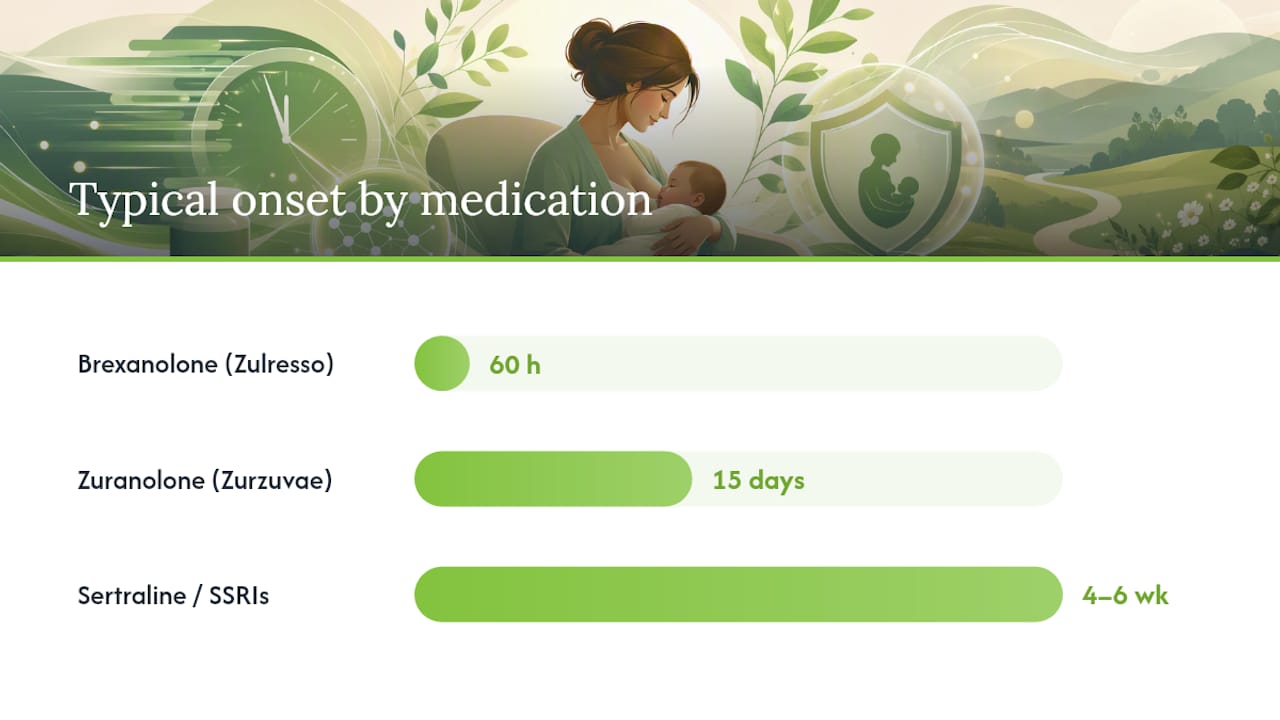
Standard oral antidepressants. Sertraline is often the preferred first choice for breastfeeding mothers because of its long track record of low levels in breast milk. Other SSRIs, along with SNRIs and bupropion, are also used, but each carries its own profile of infant exposure data and side effects. Fluoxetine, for example, has a longer half-life that can lead to higher, more sustained levels in breast milk than sertraline, which is why we weigh it more carefully in nursing mothers. None of this is a reason to avoid medication. It’s a reason to make the decision with a prescriber who knows the current data, not a decade-old pamphlet.
Zuranolone (Zurzuvae). This is the first oral medication approved by the FDA specifically for postpartum depression in adults, and it works differently than a standard antidepressant. It’s a neuroactive steroid that acts on GABA receptors rather than serotonin. Dosing is 50 mg once daily in the evening for 14 days, taken with a fat-containing meal, which affects absorption meaningfully enough that skipping the meal isn’t a minor shortcut.
In FDA trials, patients showed statistically significant symptom reduction by day 15, with the effect holding at day 42. That’s a two-week course with benefit that outlasts the pills themselves, which is unusual in psychiatry.
Zuranolone carries a real safety consideration: it can impair driving and cause central nervous system depression, so patients are advised not to drive or operate heavy machinery for at least 12 hours after each dose. If CNS effects become bothersome, the dose can be reduced to 40 mg. The prescribing information also flags dosing adjustments needed with CYP3A4 inhibitors and cautions around fetal exposure, so this is not a medication to self-adjust.
Brexanolone (Zulresso). This was the first PPD-specific drug approved, and it’s administered very differently: a continuous intravenous infusion given over 60 hours in a healthcare facility, with monitoring throughout. That logistical commitment, nearly three full days admitted for infusion, means it’s typically reserved for more severe cases or situations where oral treatment isn’t practical or hasn’t worked. It’s not something most patients choose as a first step, but for the right patient it can produce rapid, substantial relief.
Here’s a rough side-by-side of what to expect:
| Medication | Route | Course | Typical onset |
|---|---|---|---|
| Sertraline (and similar SSRIs) | Oral, daily | Ongoing, often 6+ months | 4 to 6 weeks |
| Zuranolone (Zurzuvae) | Oral, daily | 14 days | As early as day 15 |
| Brexanolone (Zulresso) | IV infusion | 60 hours, inpatient/facility-based | Within days |
We monitor patients on any of these closely in the first few weeks, watching for worsening mood, emerging suicidal thoughts, and side effects like sedation or gastrointestinal upset. If a standard antidepressant hasn’t moved symptoms after 4 to 6 weeks at an adequate dose, that’s usually the point to consider switching or augmenting rather than waiting longer.
When Do ECT, TMS, and Ketamine Come Into Play?
Somatic treatments aren’t first-line for most postpartum depression, but they matter enormously for the subset of women who need faster or more powerful intervention. We think of these as tools for when standard therapy and medication haven’t been enough, or when the situation is too urgent to wait weeks for a response.
Electroconvulsive therapy (ECT) remains the most reliable option for severe or psychotic postpartum depression. It’s administered under brief general anesthesia, typically in a hospital setting, usually over a series of sessions three times a week. ECT has a reputation problem left over from decades-old portrayals, but in current clinical practice it’s one of the fastest, most effective treatments we have for the most severe presentations, particularly when psychosis or a high suicide risk makes speed the priority.
Transcranial magnetic stimulation (TMS) sits at the opposite end of the intensity spectrum. It’s noninvasive, outpatient, and doesn’t require anesthesia or sedation. A magnetic coil placed against the scalp stimulates targeted areas of the brain involved in mood regulation, typically over daily sessions for four to six weeks. Because there’s no systemic drug exposure, TMS is often appealing to breastfeeding mothers who want to avoid medication but haven’t responded fully to therapy alone. We’ve covered how TMS may help postpartum depression specifically in more depth, including who tends to be a good candidate.
Ketamine and Spravato (esketamine). These act on the glutamate system rather than serotonin, which is part of why they can produce noticeable mood improvement within hours to days rather than weeks. Ketamine is given by IV infusion in a monitored clinical setting; Spravato is a nasal spray, also administered under supervision because of dissociative side effects and the need to monitor blood pressure. Both require the patient to remain in the clinic for observation after dosing. For breastfeeding mothers, the safety data on ketamine and esketamine in lactation is still limited, which is exactly why this decision should happen with a psychiatrist experienced in perinatal care rather than through general research alone. We’ve written about the role of ketamine therapy specifically for postpartum depression for readers who want the fuller picture.
Pro Tip: If you’re considering a rapid-acting option like ketamine or Spravato, ask directly how the clinic coordinates with your OB or pediatrician. Good interventional psychiatry care doesn’t happen in isolation from the rest of your postpartum care team.
A few things are worth being clear-eyed about. Evidence for ketamine and TMS in postpartum-specific populations is still smaller than the evidence base for general depression, though it’s growing. These treatments are specialist-led, meaning you’ll typically need a referral or direct consultation with a psychiatrist trained in interventional psychiatry, not something started by a primary care provider. And none of them replace ongoing psychotherapy. They tend to work best as a bridge that gets you functional enough to fully engage in therapy, not as a standalone fix.
How Do Clinicians Build a Treatment Plan?
We follow something close to a decision tree, even if it doesn’t always feel that structured from the patient’s chair. Here’s roughly how it goes:
- Full assessment. Standardized screening (EPDS or similar), a clinical interview, and a careful history of past mood episodes.
- Rule out bipolar disorder and psychosis. This step gets skipped too often in primary care settings, and it’s critical, because antidepressants alone can trigger mania or worsen a mixed episode in someone with undiagnosed bipolar disorder.
- Match treatment to severity and preference. Mild cases often start with therapy alone. Moderate to severe cases usually combine therapy with medication. Severe or psychotic cases move to urgent, often inpatient, somatic treatment.
- Set a monitoring cadence. Weekly check-ins early on, tapering to every two to four weeks as symptoms stabilize.
- Reassess and adjust. If there’s no meaningful improvement within 4 to 6 weeks on medication, or 6 to 8 sessions of therapy, we revisit the plan rather than assuming the patient just needs to be more patient.
Monitoring isn’t just about mood scores. We’re checking for suicidal ideation at every visit, screening for how the mother is bonding with and caring for the infant, and tracking scores on tools like the EPDS or Hamilton Depression Rating Scale over time so improvement (or lack of it) is measurable rather than a gut feeling.
Augmentation strategies come up often. That might mean adding a second medication, layering in psychotherapy on top of a drug that’s partially working, or, for cases that have stalled despite adequate trials, moving toward TMS or a rapid-acting option. None of these decisions happen in a vacuum. Coordination with the obstetric team and pediatrician matters, especially around breastfeeding, medication timing relative to feeding schedules, and infant monitoring for any medication passed through breast milk. Informed consent here isn’t a formality. It’s a real conversation about what’s known, what isn’t, and what you’re comfortable with.
When Should You Seek Urgent Care?
Some symptoms mean don’t wait for your next scheduled appointment. Get help the same day, or immediately.
- Thoughts of suicide, especially with any plan or intent
- Thoughts of harming the baby
- Hallucinations, delusions, or a sense of disconnection from reality
- Inability to care for yourself or your infant’s basic needs
- Rapid, severe mood shifts alongside racing thoughts or extreme agitation
If any of these apply, contact your psychiatrist’s office immediately, call 911, or go to the nearest emergency room. The 988 Suicide & Crisis Lifeline is available around the clock if you need someone to talk to right now. Postpartum psychosis in particular is a medical emergency that almost always requires inpatient stabilization and often responds fastest to somatic treatment like ECT.
Until help arrives, don’t stay alone with the baby if you’re having thoughts of harm. Hand off infant care to a partner, family member, or trusted friend, and stay with someone who can keep you safe.
How Long Does Recovery Take, and What Comes After?
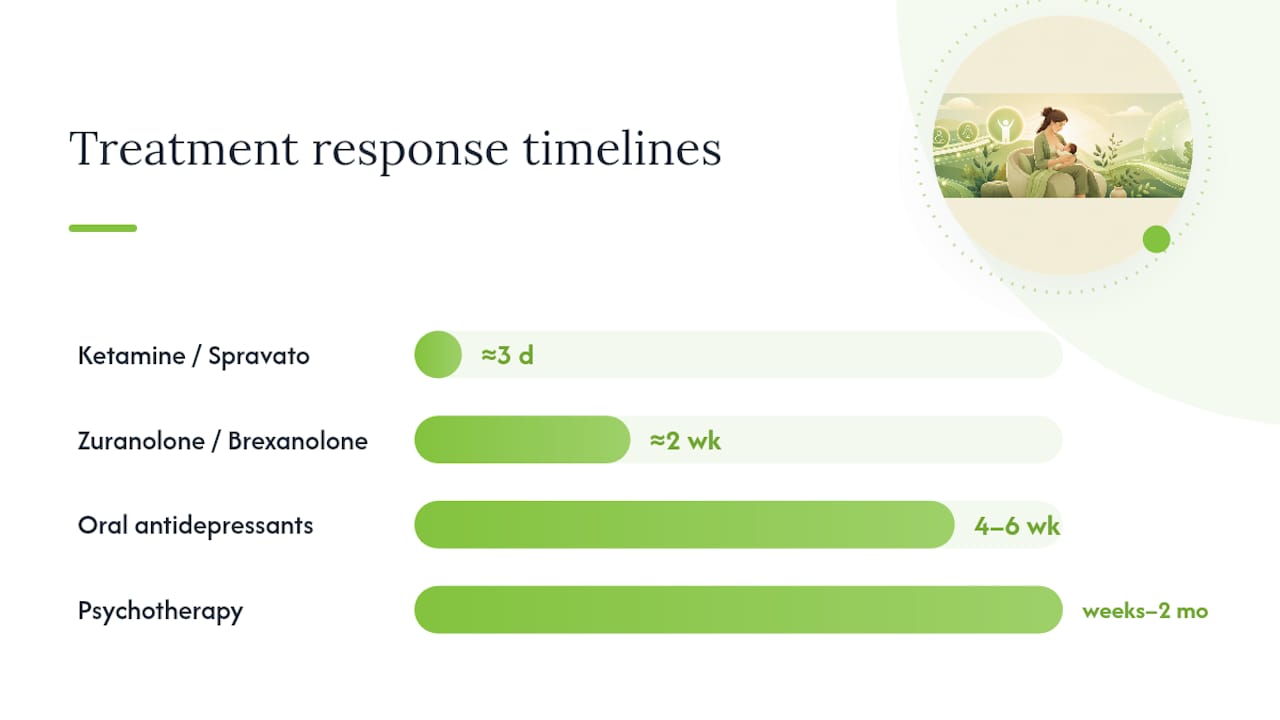
Timelines vary by treatment, and knowing what to expect helps you avoid giving up on something that’s actually working. Psychotherapy tends to show meaningful movement over weeks to a couple of months, with benefits that, as noted earlier, can persist six to twelve months after treatment ends. Standard oral antidepressants usually take four to six weeks to show full effect. Zuranolone and brexanolone were designed to work faster, showing improvement within roughly two weeks. Ketamine and Spravato can show change within days.
Left untreated, postpartum depression doesn’t just linger, it compounds. The CANMAT guideline is direct about the risks: untreated perinatal mood and anxiety disorders raise the risk of impaired mother-infant bonding, developmental effects on the child, relationship strain, and in the most severe cases, risk to the mother’s life. Treatment doesn’t just relieve symptoms. It measurably changes those downstream outcomes for both mother and child.
Staying well after the acute phase comes down to a handful of practical habits:
- Continuing maintenance therapy or medication for the length of time your psychiatrist recommends, even after you feel better
- Protecting sleep aggressively, since sleep deprivation is one of the strongest relapse triggers we see
- Staying connected to peer or group support rather than isolating once the crisis feeling passes
- Keeping a scheduled follow-up even when things feel stable, so early warning signs get caught
How Nortex Psychiatry Approaches Postpartum Depression Care
In our practice, evaluation starts with validated screening tools alongside a full clinical interview, because a score alone never tells the whole story. We ask about safety directly and early, not as an afterthought, and we coordinate with each patient’s OB or pediatric team so nothing about breastfeeding or infant health gets decided in isolation.
Candidacy for interventional options depends on where you are in that stepped process we described earlier. Women who’ve tried therapy and standard medication without full relief are often good candidates for TMS. Those needing faster relief, or who haven’t responded to prior antidepressant trials, may be candidates for ketamine. Spravato tends to fit a similar profile for treatment-resistant depression more broadly.
A typical pathway looks like this:
- Initial evaluation and safety screening
- Discussion of options, including risks, benefits, and breastfeeding considerations
- Informed consent and a concrete treatment plan
- Scheduled treatment with regular monitoring and check-ins
We built this practice around evidence-based, judgment-free care, because postpartum depression carries enough guilt without adding a clinical experience that feels cold or rushed on top of it.
What Side Effects Should You Expect From Each Option?
Every treatment on this list carries tradeoffs worth knowing before you start, not after.
CBT and IPT carry minimal physical risk, though sessions can be emotionally difficult, especially early, as you work through painful thoughts. Standard antidepressants like sertraline commonly cause nausea, headache, or sleep changes in the first one to two weeks, usually settling afterward. Zuranolone’s main concerns are sedation and driving impairment, plus the need for caution with certain drug interactions and in pregnancy. Brexanolone’s infusion can cause sedation and, in rare cases, loss of consciousness, which is exactly why it requires continuous monitoring in a facility rather than home use.
ECT’s most discussed side effect is short-term memory disruption around the time of treatment, which typically improves after the course ends. TMS is generally well tolerated, with scalp discomfort or mild headache the most common complaints, and it carries a very low seizure risk. Ketamine and Spravato can cause dissociation, elevated blood pressure, and sedation during the dosing window, which is why observation afterward isn’t optional.
None of this is a reason to avoid treatment. It’s a reason to have the conversation about tradeoffs with a psychiatrist who can weigh them against your specific situation, including whether you’re breastfeeding or pregnant, rather than making that call from a drug label alone.
What Gets in the Way of Getting Treatment?
Insurance coverage for postpartum depression care has improved, but gaps remain. Most plans cover psychotherapy and standard antidepressants well. Coverage for zuranolone, brexanolone, TMS, ketamine, and Spravato varies more by insurer and often requires prior authorization or documentation that standard treatments were tried first.
Cost is a real barrier for some families, particularly around brexanolone’s inpatient infusion or a full course of TMS sessions. Many clinics, including ours, work directly with patients to check benefits before treatment starts so cost isn’t a surprise partway through.
Beyond insurance, practical barriers matter just as much: finding childcare to attend appointments, transportation, and simply having the energy to make calls and fill out intake forms while managing a newborn and depression at the same time. Telehealth has closed some of this gap, particularly for psychotherapy and medication management, since it removes the need to arrange childcare or travel for every visit. If cost or logistics feel like the real obstacle, say so directly to your care team. Most clinics have more flexibility than patients assume, whether that’s sliding scale options, payment plans, or simply prioritizing the lowest-barrier treatment first.
How Does Stigma Affect Treatment for New Mothers?
Stigma is one of the biggest reasons postpartum depression goes untreated, and it shows up differently depending on background and community. Some cultures frame the postpartum period as a time that should be uniformly joyful, which makes admitting depression feel like a personal failure rather than a medical condition. Others carry family or generational skepticism toward psychiatric medication specifically, even when therapy is more accepted.
We hear versions of the same worry constantly: “What will people think if I need medication to bond with my own baby?” That question deserves a direct answer. Needing treatment for postpartum depression says nothing about your capability as a mother. It says your brain chemistry shifted after a major physiological event, which is exactly what happened, and it’s treatable.
Language matters too. Framing treatment as “getting support” rather than “getting help for a mental illness” can make a real difference for patients who associate psychiatric language with shame. Family involvement, when it’s supportive, tends to improve adherence significantly. When it isn’t, connecting patients with peer support outside the family can matter even more.
Do Support Groups Actually Help With Postpartum Depression?
Yes, and often in ways that surprise people who assume support groups are just a nice add-on. Peer support for new mothers provides something clinical treatment can’t fully replicate: the specific relief of hearing another mother say, out loud, the exact intrusive thought you’ve been too ashamed to mention.
Group therapy formats combine clinical structure with that peer element, which is part of why they show up as an effective delivery format in the psychotherapy research already discussed. Informal postpartum support groups, whether hospital-run, community-based, or online, add another layer, normalizing the experience and reducing the isolation that tends to deepen depressive symptoms.
We routinely recommend combining professional treatment with a support group rather than choosing one or the other. They serve different functions. Therapy and medication treat the clinical condition. Peer support rebuilds the sense that you’re not the only one going through this, which matters more for recovery than most people expect walking in.
Can Lifestyle Changes Support Postpartum Depression Recovery?
Lifestyle measures won’t resolve moderate to severe postpartum depression on their own, but they meaningfully support whatever clinical treatment you’re on, and skipping them makes everything else work harder than it needs to.
Sleep is the biggest lever. Fragmented sleep from newborn care directly worsens mood regulation, so protecting even one longer stretch of sleep, through a partner taking a night shift or a support person helping with feedings, can measurably ease symptoms. Nutrition matters more subtly: stable blood sugar and adequate intake (which is easy to neglect when you’re exhausted and skipping meals) support the same neurotransmitter systems that antidepressants and therapy are working on. Light physical activity, even a daily walk with the stroller, has modest but real evidence for mood benefit in postpartum populations.
None of these replace psychotherapy, medication, or somatic treatment when those are indicated. Think of them as the foundation that makes clinical treatment work better, not a substitute for it. We rarely see a full recovery built on lifestyle changes alone, but we almost never see a fast recovery without them either.
Why Evidence-First, Safety-Forward Care Matters Most
If there’s one thing the conventional advice on postpartum depression still gets wrong, it’s treating “get some rest” and “talk to someone” as adequate first-line responses. They’re not. They’re supplements to real treatment, and telling an exhausted new mother to simply rest more, without naming CBT, sertraline, or zuranolone as actual options, delays care that could be working in two weeks instead of two months.
The research is clearer than the public conversation suggests. CBT and IPT have solid evidence behind them. Zuranolone and brexanolone exist specifically because researchers recognized postpartum depression has a distinct biology worth treating differently. Somatic options aren’t a last resort reserved for the hopeless; they’re appropriate, evidence-backed tools for specific situations, and waiting too long to consider them helps no one.
What we’d prioritize first, if you take nothing else from this: get screened, and get screened honestly. Most of the delay in postpartum depression treatment isn’t a lack of options. It’s women minimizing their own symptoms out of guilt, or fear of what treatment says about them as a mother. It says nothing except that you’re getting the right care at the right time.
— Felix
Get Evaluated at Nortex Psychiatry
If you’re weighing these options and want a clinician to walk through them with you, Nortex Psychiatry offers evaluation, medication management, and interventional treatments including TMS, ketamine therapy, and Spravato, all under one roof, with telehealth available for mothers who can’t easily get childcare for in-person visits. That’s the practical advantage over piecing care together across separate providers: one team that already coordinates screening, medication, and somatic treatment options instead of sending you out for referrals at every step.
Your first visit typically includes a full symptom history, safety screening, and a conversation about your priorities, whether that’s breastfeeding compatibility, speed of relief, or avoiding medication altogether. Bring a list of current medications, any prior mental health history, and notes on how you’re sleeping and functioning day to day. We also offer Stellate Ganglion Block therapy for related anxiety symptoms when appropriate. If you’re ready to talk through your options, schedule an evaluation with Nortex Psychiatry and bring your questions with you.
Sources
- FDA Approves First Oral Treatment for Postpartum Depression
- CANMAT guideline for perinatal mood and anxiety disorders (2024)
FAQ
How long can postpartum depression last if untreated?
Untreated postpartum depression can persist well beyond the first year and, in some cases, become a chronic depressive pattern. The CANMAT guideline recommends active management for up to a year postpartum specifically because symptoms often don’t resolve on their own within that window.
What are the long-term effects of untreated postpartum depression?
Untreated postpartum depression is linked to impaired mother-infant bonding, developmental risks for the child, and strained relationships, according to CANMAT’s clinical guidance. Treatment measurably reduces these risks, which is why early evaluation matters more than waiting to see if symptoms pass.
Can postpartum depression come and go?
Yes, symptoms can fluctuate, with better days followed by relapses, especially around sleep disruption, hormonal shifts, or stress. That pattern doesn’t mean the depression isn’t real or treatable; it’s actually a common reason clinicians recommend maintenance treatment rather than stopping as soon as you feel a little better.
When does postpartum depression typically set in?
Postpartum depression most often emerges within the first few weeks after delivery, though it can develop anytime within the first year. If low mood, anxiety, or detachment from the baby lasts more than two weeks or worsens, that’s the point to get screened rather than waiting it out.