


Hydroxyzine is an antihistamine that doctors prescribe to take the edge off anxiety and tension. It tends to work within an hour, it makes many people drowsy, and it is generally meant for short-term use rather than as a long-term foundation. In our work we see it used well when the goal is clear, and used poorly when nobody quite remembers why it was started. This guide is meant to help you sit on the right side of that line.
TL;DR
- Hydroxyzine (brand names Atarax and Vistaril) is an antihistamine approved to relieve anxiety and tension. Many people notice it within 15 to 30 minutes.
- Drowsiness, dry mouth and headache are the most common side effects. Do not drive until you know how it affects you, and avoid alcohol.
- It is not a controlled substance, but it has not been studied for long-term anxiety treatment, so it is usually a short-term tool.
- If anxiety keeps returning, ask about longer-term options such as an SSRI, therapy, or a full psychiatric evaluation.
Table of Contents
- What hydroxyzine is, and why it is prescribed for anxiety
- How fast it works and how long it lasts
- What the research says about its effectiveness
- Side effects you may notice
- Safety points for everyday life
- Where hydroxyzine fits among anxiety treatments
- Our perspective
- If hydroxyzine isn’t enough
- When depression is part of the picture
- Questions to bring to your prescriber
- FAQ
- Sources
What hydroxyzine is, and why it is prescribed for anxiety
Hydroxyzine belongs to the antihistamine family. MedlinePlus describes it as a medication used to relieve anxiety and tension, as well as itching from allergic skin reactions and as a sedative around general anesthesia. It works by blocking histamine and decreasing activity in the brain.
The FDA label wording is a little old-fashioned. It describes the anxiety use as symptomatic relief of anxiety and tension associated with psychoneurosis, and it lists an adult dose of 50 to 100 mg four times a day, according to the prescribing information. In practice, doses are individualized, and a prescriber may start lower. Please do not use that label figure as your own dose. Your prescriber sets it based on your health, your other medications and how you respond.
One point that surprises people: hydroxyzine is not chemically related to benzodiazepines. It is thought to quiet activity in deeper brain regions below the cortex, according to Drugs.com. That is part of why it feels different from Xanax or Ativan, and part of why it is not treated like them from a regulatory standpoint.
You may see two brand names. Atarax is hydroxyzine hydrochloride, and Vistaril is hydroxyzine pamoate. Patients often ask which is better. For anxiety, the choice usually comes down to what your prescriber and pharmacy have available, not a dramatic difference in how you feel.
How fast it works and how long it lasts
This is the question we hear most. The short version is that hydroxyzine is a quick-onset medication. A clinical drug reference reports that sedation and other effects are usually noticed 15 to 30 minutes after an oral dose, with blood levels peaking in two to four hours and sedative effects lasting four to six hours.
A pharmacist-reviewed explainer from Verywell Health gives a slightly wider window, 15 to 60 minutes to start, with the strongest effect around two hours. The same piece notes the drug can stay in your system for days after the last dose. So “it wore off after five hours” and “it is out of my body” are two different statements.
A few practical things we have learned from watching people take it:
- The calming and the sleepiness often arrive together. Some people feel relief from the racing thoughts and are simply tired. Others feel mostly tired.
- A leftover groggy feeling the next morning is common if a dose was taken late in the evening.
- Taking it on a regular schedule is a different experience from taking it only when a spike hits. Trials in generalized anxiety disorder found that daily dosing reduced anxiety scores within the first week and kept those benefits over four weeks.
So if you take one dose and feel only sleepy, that does not tell you the whole story. It also does not mean you should push the dose yourself. Tell us what happened and we adjust from there.
What the research says about its effectiveness
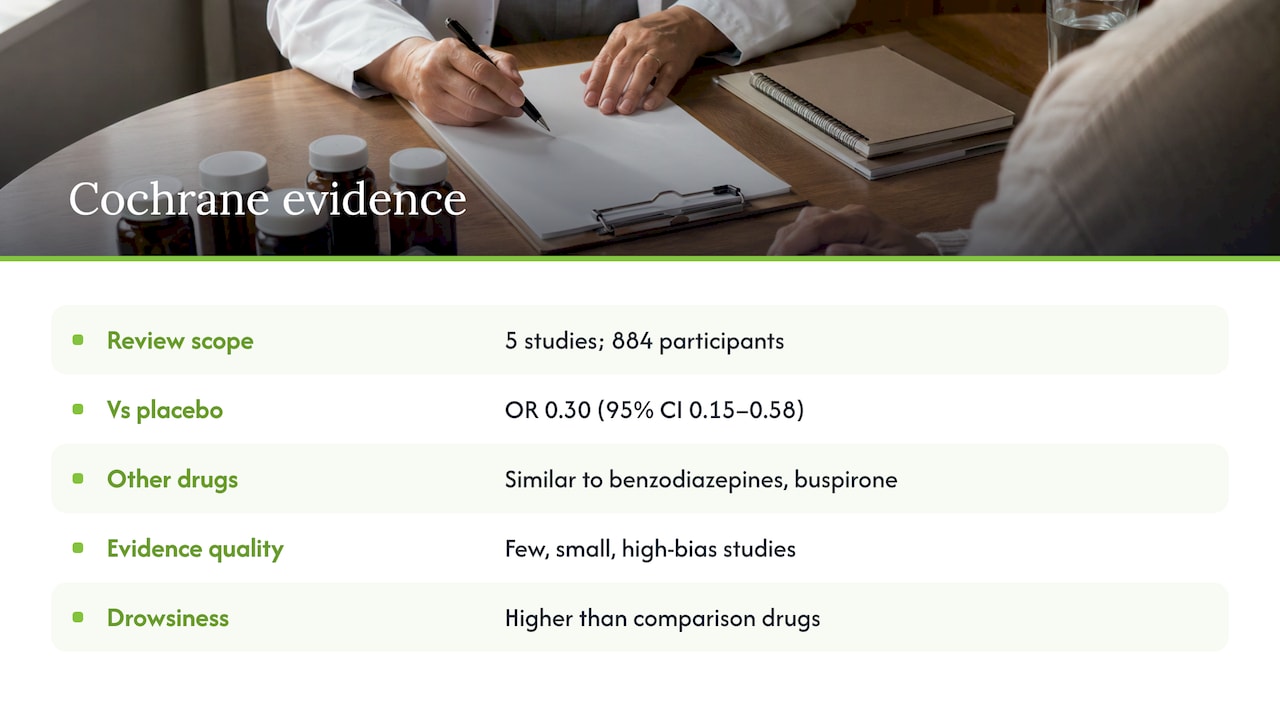
Hydroxyzine has real evidence behind it, and also real limits. A Cochrane systematic review of five studies with 884 participants found it was more effective than placebo for generalized anxiety disorder (odds ratio 0.30, 95% CI 0.15 to 0.58), with efficacy similar to benzodiazepines and buspirone. The reviewers also noted a higher rate of drowsiness than the comparison drugs. Because the studies were few, small and at high risk of bias, they did not conclude it could be recommended as a reliable first-line treatment for GAD.
We read that fairly. It is a useful medication, and the evidence is thinner than it is for the first-line choices. State guidance reflects this. Oregon’s published treatment algorithm for adults with GAD lists escitalopram or sertraline, or duloxetine or extended-release venlafaxine as first-line, and says hydroxyzine may be as effective but that sedation, anticholinergic effects and limited clinical experience are barriers to long-term use.
That is not a reason to feel discouraged if hydroxyzine was prescribed to you. It is a reason to understand its role. For many adults it is a bridge: something to help during the weeks while a longer-term treatment takes hold, or something for a defined stretch of acute stress.
Side effects you may notice
The most common ones are drowsiness, dry mouth and headache, and they are usually mild. Drowsiness often eases after a few days or when the dose is lowered, per Drugs.com. NAMI’s overview adds dizziness, fatigue, blurred vision, urinary retention, confusion and irritability to the list of common effects.
Here is how we usually sort them for patients.
Tell us at the next visit:
- Sleepiness that interferes with work or parenting
- Dry mouth that is bothersome
- Trouble urinating
- Feeling foggy or unusually irritable
Call the office or your prescriber promptly:
- Palpitations, a racing or irregular heartbeat, or fainting
- Confusion or hallucinations
- A new skin rash, especially with pustules or fever
Seek emergency care:
- Swelling of the face or throat, difficulty breathing, or a seizure
The heart rhythm issue deserves a plain explanation. Hydroxyzine can rarely cause QT prolongation, an electrical change in the heart. WebMD notes that risk is higher in people who are older, have a family history of these conditions, have low potassium or magnesium, or take other medicines that prolong the QT interval. This is why we ask about your heart history and your full medication list before prescribing, and why you should tell any prescriber if you have ever been told you have a long QT.
The rare skin reaction AGEP is also worth knowing. If you have had AGEP or another allergic reaction to hydroxyzine, Drugs.com advises avoiding cetirizine and levocetirizine as well, because a similar reaction can occur.
Safety points for everyday life
A few things come up again and again in the exam room.
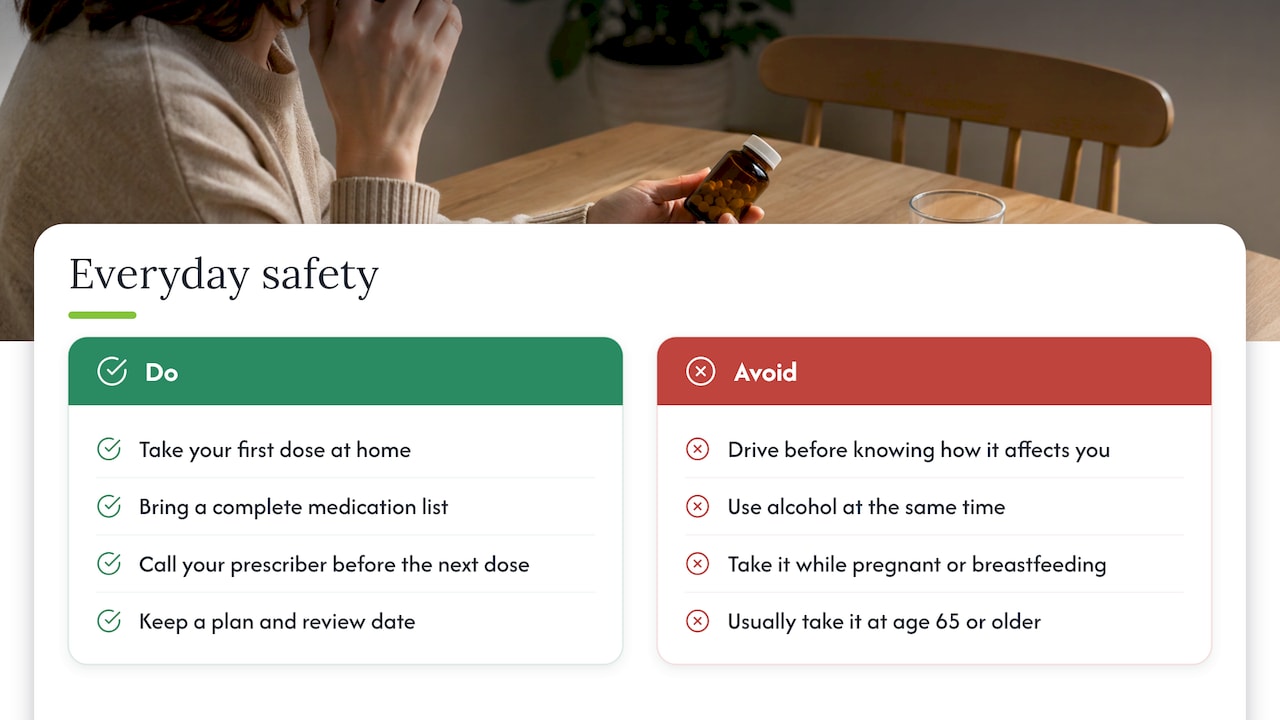
Driving and alertness. The sedation can slow reaction time and impair attention, especially in the first hours after a dose. People are generally advised not to drive or operate machinery until they know how it affects them. Take your first dose at home, at a time when you do not have to be anywhere.
Alcohol and other sedating drugs. The prescribing information warns that hydroxyzine potentiates CNS depressants such as narcotic and non-narcotic pain medicines and barbiturates, and that patients should be cautioned against using alcohol at the same time. Bring a complete list to every appointment, including sleep aids and over-the-counter products.
Pregnancy and breastfeeding. MedlinePlus advises against taking hydroxyzine if you are pregnant or breastfeeding. If you are planning a pregnancy or become pregnant, call your prescriber before the next dose and do not just stop on your own without a conversation.
Age 65 and older. MedlinePlus says adults 65 or older should not usually take it because other medications may be safer. Verywell Health’s pharmacist-reviewed precautions list points to dizziness and falling risk, and also names kidney problems and long QT syndrome.
Dependence. NAMI states that hydroxyzine is not a controlled substance and does not carry the addiction risk of benzodiazepines such as lorazepam, alprazolam or clonazepam. Many patients find that reassuring. It still deserves a plan and a review date.
Where hydroxyzine fits among anxiety treatments
We tend to think of anxiety treatment in layers. One layer is what helps tonight. Another is what builds steadier ground over months.
Hydroxyzine sits in the first layer. SSRIs and SNRIs such as sertraline, escitalopram, fluoxetine and venlafaxine sit in the second, and they usually take 4 to 8 weeks to reach full effect. Cognitive behavioral therapy is part of that second layer too, and for many people the combination does more than either piece alone. If you want help weighing these, our guide to therapy vs. medication for adults walks through how people choose. Another medication we write about is buspirone, which works differently and is not sedating in the same way.
On duration, the guidance is consistent. Hydroxyzine has not been studied for long-term anxiety use, and studies have not assessed whether it still works as an anti-anxiety medicine beyond four months, per Drugs.com. A pharmacist-reviewed summary adds that use beyond roughly four months is off-label, and that for ongoing management providers typically recommend an SSRI or CBT. That is the honest frame: use it for a purpose, review it, and have a next step ready.
Our perspective
We have learned that the question behind “hydroxyzine for anxiety” is rarely about hydroxyzine. It is usually “why am I still feeling like this?” People arrive after weeks or months of trying to get through it, and a quick-acting pill is often the first thing someone offered them.
In our work we often notice that hydroxyzine helps most when we are clear about its job. It can steady a rough stretch, help with sleep onset during a spike of worry, or bridge the weeks before an SSRI settles in. It helps least when it quietly becomes the whole plan.
What we try to do is slow the conversation down. What is the anxiety attached to? Is there depression underneath it, or ADHD, trauma, poor sleep, a thyroid problem? Anxiety that does not fit neatly in one box gets a fuller look before we change anything. Sometimes the answer is a medication adjustment. Sometimes it is therapy. And for people whose depression or anxiety has not responded to standard medications, we offer interventional options, including TMS, Spravato and ketamine therapy, and stellate ganglion block for PTSD and anxiety, each with its own indications and screening.
We would rather you leave with a plan you understand than a prescription you are unsure about. Recovery is a journey, not a straight line, and a good plan expects some detours.
Felix
If hydroxyzine isn’t enough
Some people take it as prescribed and still feel anxious most days. Others feel only sleepy. Neither means you are doing it wrong. Drugs.com advises calling your doctor if your anxiety does not improve or gets worse, and your doctor may adjust the dose depending on how you respond.
Here is what we usually walk through together:
- Timing and dose. When do you take it, and what does the day look like around it? Small changes in timing sometimes matter more than people expect.
- Diagnosis. If anxiety stays severe despite treatment, it is worth revisiting the picture and checking for contributors such as thyroid disorders, hormonal changes or cardiac conditions, as Ubie Health notes.
- A longer-term medication. An SSRI or SNRI, started with a plan for the first few weeks. Our overview of anxiety medication, science and personalization explains how we choose.
- Therapy. CBT is one of the most researched treatments for anxiety, and for some people it reduces the need for medication over time.
- A structured plan. If you want the whole sequence in one place, see our step-by-step anxiety treatment guide for adults.
If anxiety and ADHD overlap for you, as they often do, the approach changes. We cover that in anxiety and ADHD management steps. And if you are a parent asking about a teenager, read anxiety medication for teens first, since the considerations are different.
When depression is part of the picture
Anxiety and depression travel together more often than not. If you have tried several medications and still feel stuck, it may be time to ask about treatments that work differently. At Nortex Psychiatry in Allen, Texas, we serve patients across Frisco, McKinney, Plano and the rest of North Dallas, in person and by telehealth, and we offer Transcranial Magnetic Stimulation (TMS), Spravato for treatment-resistant depression, and ketamine therapy. Not every option fits every person, and an evaluation is how we find out which ones are worth considering. You can start from our home page to reach the office.
Questions to bring to your prescriber
A short list helps, especially if you are new to this.
- What is this prescribed for, and for how long do you expect me to take it?
- Should I take it only when anxious, or on a schedule?
- What should I avoid taking with it, including alcohol and sleep aids?
- Is my heart history a concern, and would an ECG make sense?
- What is the plan if it does not help in a few weeks?
The last question is the one people skip. It is the most useful.
FAQ
Is hydroxyzine a good medication for anxiety?
It can be, for the right purpose. It is FDA-approved for symptomatic relief of anxiety and tension, acts quickly, and is not a controlled substance. The research shows it beats placebo in generalized anxiety disorder, though the evidence base is smaller than for SSRIs and SNRIs, which is why it is often used short term.
How long does hydroxyzine take to work for anxiety?
Most people feel an effect in about 15 to 60 minutes, and sedation typically lasts four to six hours. Trials of daily dosing found anxiety scores improved within the first week. If you feel nothing after a few days of a prescribed schedule, contact your prescriber instead of changing the dose yourself.
Can I take hydroxyzine every day?
Some prescribers do prescribe it daily for a defined period. It has not been studied for anxiety beyond about four months, so ongoing use should be reviewed with your doctor from time to time. If you need it for longer, ask about adding or switching to a long-term option.
Can I drink alcohol while taking hydroxyzine?
It is best to avoid it. Alcohol can worsen side effects such as drowsiness and dizziness, and the prescribing information specifically cautions against using alcohol at the same time. Check with your prescriber about your own situation.
What should I do if I miss a dose or want to stop?
If you take it on a schedule, ask your prescriber how to handle missed doses, since the answer depends on your plan. Do not stop or change a long-running regimen without talking to them first. They can tell you whether to taper and how to cover the anxiety that comes back.
Sources
- Hydroxyzine: MedlinePlus Drug Information
- Atarax: Package Insert / Prescribing Information
- Hydroxyzine: Uses, Dosage, Side Effects (Drugs.com)
- hydroxyzine hydrochloride (GLOWM)
- How Long Does Hydroxyzine Last? (Verywell Health)
- How long does hydroxyzine last? (Drugs.com)
- Hydroxyzine for generalised anxiety disorder (Cochrane)
- Medication Treatment for Adults with Generalized Anxiety Disorder (Oregon Health Authority)
- Hydroxyzine (Vistaril) (NAMI)
- Hydroxyzine (Atarax, Vistaril, and others) (WebMD)
- How long does it take for hydroxyzine to work? (Drugs.com)
- Comparing Vistaril (Hydroxyzine) vs. Xanax (Alprazolam) (Verywell Health)
- Can Hydroxyzine be Taken Long-term For Anxiety? (Drugs.com)
- Hydroxyzine and anxiety: next steps (Ubie Health)