


Mental health improvement is defined as the active, ongoing process of building habits that strengthen emotional resilience, reduce stress, and support your ability to manage conditions like anxiety and depression. This is not about eliminating hard days. It is about giving yourself a reliable foundation to return to when things get difficult. Research consistently shows that daily physical activity, quality sleep, social connection, and mindfulness are the core behaviors that move the needle. Knowing how to improve mental health means understanding which actions matter most and how to make them stick in a real life, not a perfect one.
What daily habits most effectively improve mental health?
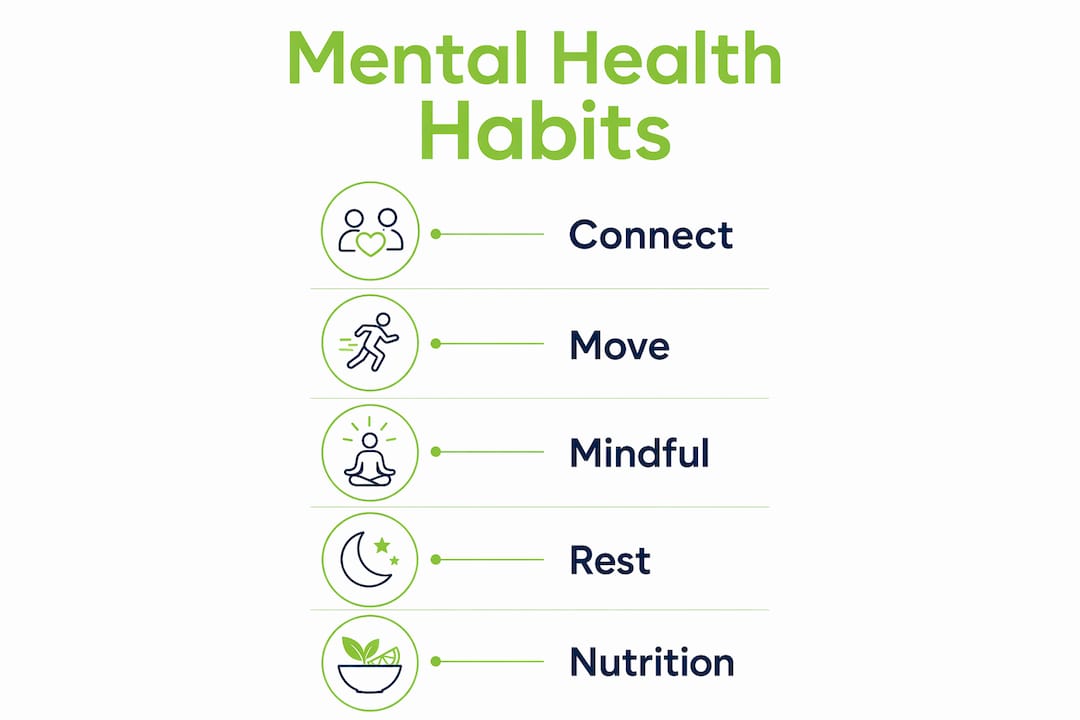
The most effective daily habits for mental well-being are social connection, physical activity, mindfulness, sleep, and nutrition. These are not suggestions. A study of over 100 adults identified these as nine key protective behaviors for mental health. That finding matters because it tells us the path forward is not one big change. It is several small, consistent ones.
Physical activity is one of the fastest-acting mood regulators available to you. Even a 20-minute walk raises endorphin levels and reduces cortisol. You do not need a gym membership or a structured program to get this benefit.

Mindfulness and meditation work like strength training for the brain. Regular practice builds present-moment awareness, which directly reduces the grip that anxiety and depression have on daily thinking. Starting with five minutes a day is enough to notice a difference within a few weeks.
Sleep and nutrition are often underestimated. Poor sleep amplifies every emotional difficulty you face. Nutrition matters too, particularly because roughly 90% of the body’s serotonin is produced in the gut. What you eat affects how you feel in ways that most people do not connect until they start paying attention. Reading is another low-effort tool worth knowing about. Reading for just 6 minutes can reduce stress levels by up to 68%. That is a meaningful return on a very small investment of time.
| Habit | Mental Health Benefit |
|---|---|
| Daily social contact | Reduces isolation, improves mood stability |
| Physical activity (20+ min) | Lowers cortisol, raises endorphins |
| Mindfulness or meditation | Decreases anxiety and depression symptoms |
| 7–9 hours of quality sleep | Improves emotional regulation and focus |
| Balanced nutrition | Supports serotonin production via gut-brain axis |
| Reading (6+ minutes) | Reduces stress by up to 68% |
Pro Tip: Attach new habits to existing ones. If you already make coffee every morning, add five minutes of quiet reading or a short breathing exercise immediately after. This “habit stacking” approach, described by behavioral researchers, dramatically increases follow-through without requiring extra willpower.
How does family support shape your mental well-being?
Family is not a passive backdrop to mental health. It is an active part of the system. Distress in one family member often spreads to others in measurable ways. This means that supporting family mental health is not just a kind thing to do. It is a practical strategy for protecting everyone in the household.
Early detection matters more than most people realize. When emotional changes are noticed and addressed early, recovery is faster and less disruptive. Waiting until a crisis point makes everything harder. The role of family in mental wellness is partly about creating an environment where it is safe to say something is wrong before it becomes unmanageable.
Open communication is the most direct way to build that environment. This does not mean scheduled family meetings or formal check-ins, though those can help. It means making small, regular conversations about feelings normal rather than awkward. Shared routines, like evening walks or meals without screens, create natural openings for those conversations.
Here are practical ways to support family mental health at home:
- Establish a low-stimulation space in the home where anyone can decompress without judgment.
- Practice brief family mindfulness together, even just two or three minutes before dinner.
- Normalize talking about stress and emotions as part of daily conversation, not crisis management.
- Watch for behavioral changes in family members, including withdrawal, sleep disruption, or irritability, and name what you observe with care.
- Consider family psychiatric care when one person’s struggles are visibly affecting the whole household.
Pro Tip: When you notice a family member pulling back or acting differently, lead with curiosity rather than concern. “You seem quieter than usual. How are you doing?” opens a door. “I’m worried about you” can feel like pressure and sometimes closes it.
When should you seek professional mental health help?
Daily habits and family support carry you a long way. They are not always enough. When mental health symptoms begin to interfere with work, relationships, or basic daily functioning, that is the signal to seek a professional evaluation. Reaching out to a primary care physician for screening and a possible referral is the standard first step. It is not a dramatic one. It is just the next practical move.
Therapy options vary, and the differences matter. Cognitive Behavioral Therapy (CBT) is the most researched treatment for anxiety and depression. Family therapy addresses the relational patterns that sustain distress. Motivational interviewing is a technique that works by aligning treatment goals with what the patient already wants, rather than pushing a predetermined plan. That distinction is more important than it sounds.
Medication is not a last resort, and therapy is not always sufficient on its own. For many people, a combination of both produces the best outcomes. For treatment-resistant depression, newer options like Transcranial Magnetic Stimulation (TMS) and ketamine therapy have shown real results where standard approaches have not.
Mental health care is also tiered, and knowing the care levels prevents a lot of confusion. The table below outlines the main options.
| Care Level | What It Involves | Best For |
|---|---|---|
| Outpatient therapy | Weekly or biweekly sessions | Mild to moderate symptoms |
| Intensive Outpatient Program (IOP) | Multiple sessions per week, structured | Moderate symptoms needing more support |
| Partial Hospitalization Program (PHP) | Daily structured care, no overnight stay | Significant impairment, not crisis level |
| Inpatient care | 24/7 supervised psychiatric care | Acute crisis or safety concerns |
If you are in crisis right now, the 988 Suicide and Crisis Lifeline is available 24 hours a day, 7 days a week, by call or text. You do not have to be suicidal to use it. Serious distress qualifies.
How to overcome common mistakes when improving mental health
The most common mistake people make when trying to improve their mental well-being is attempting too much at once. Overhauling sleep, diet, exercise, and social life simultaneously is not sustainable. It creates a cycle of effort and burnout that leaves people feeling worse than when they started.
Small, consistent behaviors are stronger predictors of mental well-being than large, irregular efforts. This is one of the clearest findings in behavioral health research. A ten-minute daily walk beats a two-hour weekend workout for mood regulation over time.
Another underappreciated barrier is the “righting reflex.” This is the instinct to push advice on someone who is struggling, telling them what they should do or how they should feel. Motivational interviewing research shows this approach reliably triggers resistance, even when the advice is correct. Listening first and aligning with a person’s own goals produces far better outcomes.
Common pitfalls to watch for:
- Skipping social contact when you feel low. Isolation feels like relief but accelerates decline.
- Treating sleep as negotiable. Sleep deprivation compounds every other mental health challenge.
- Ignoring subtle stress signals in yourself or family members until they become crises.
- Setting goals that depend on motivation rather than routine. Motivation fluctuates. Routine does not.
- Expecting linear progress. Setbacks are part of the process, not evidence of failure.
For teens specifically, the role of family in teen mental health is especially significant. Adolescents rarely seek help on their own. Parents and caregivers who stay connected and notice early changes are often the reason a teen gets support before things escalate. Learning ways to support teen mental health at home is one of the highest-value things a parent can do.
Key takeaways
Consistent, small daily actions combined with strong social support and timely professional care form the most reliable path to lasting mental health improvement.
| Point | Details |
|---|---|
| Daily habits are the foundation | Social connection, sleep, activity, and mindfulness each contribute independently to mental well-being. |
| Family is part of the system | Distress spreads within families; early communication and shared routines reduce that risk. |
| Professional help has clear triggers | Seek evaluation when symptoms interfere with daily functioning, not only during a crisis. |
| Small steps beat big overhauls | Consistent low-effort behaviors predict better outcomes than intensive but irregular efforts. |
| Avoid the righting reflex | Pushing advice triggers resistance; aligning with personal goals produces genuine engagement. |
What i’ve learned after years of watching people get better
The patients who make the most durable progress are rarely the ones who do the most. They are the ones who do something small, consistently, and without expecting immediate results. That observation has shaped how we approach care at Nortexpsychiatry more than any single clinical framework.
We have also learned that the framing matters enormously. When someone comes in convinced they are broken, the first job is not to prescribe or diagnose. It is to help them see that mental health is something you cultivate, not something you either have or do not have. That shift in perspective changes what feels possible.
Family dynamics come up in almost every adult case we see. A person can do everything right in terms of habits and therapy, and still struggle if they return home to an environment that is chronically stressful or emotionally dismissive. The role of family in mental health is not secondary. It is often central.
One more thing worth saying plainly: seeking professional help is not an admission that you have failed at self-care. It is a recognition that some problems require more than willpower and good habits. The two approaches work together, not in competition. The people who combine both tend to do the best.
— Felix
How Nortexpsychiatry can support your next step
If you have been working on daily habits and still feel like anxiety, depression, or stress is getting in the way of your life, that is worth taking seriously. Nortexpsychiatry serves adults and families across Allen, Frisco, McKinney, Plano, and the broader North Dallas area with personalized, evidence-based psychiatric care. Services include medication management, therapy for anxiety and depression, and advanced options like TMS versus medication for those who have not responded to standard treatments. Both in-person and telehealth appointments are available. If you are not sure where you stand, a mental health self-assessment is a good place to start before booking a consultation.
FAQ
What are the most effective daily habits for mental health?
Physical activity, quality sleep, social connection, and mindfulness are the most consistently supported habits in research. A study of over 100 adults identified these as key protective behaviors for mental well-being.
When should i seek professional help for mental health?
Seek a professional evaluation when symptoms interfere with work, relationships, or daily functioning. A primary care physician can provide initial screening and referral to a psychiatrist or therapist.
How does family support affect mental health outcomes?
Distress in one family member measurably affects others in the household. Early communication, shared routines, and a supportive home environment reduce that spread and accelerate recovery.
What is the difference between outpatient therapy and an IOP?
Outpatient therapy involves weekly or biweekly sessions for mild to moderate symptoms. An Intensive Outpatient Program (IOP) provides multiple structured sessions per week for people who need more support without hospitalization.
How do i support a teen’s mental health at home?
Stay connected through regular, low-pressure conversations and watch for behavioral changes like withdrawal or sleep disruption. Teens rarely seek help independently, so parental awareness and early action are the most reliable protective factors.