


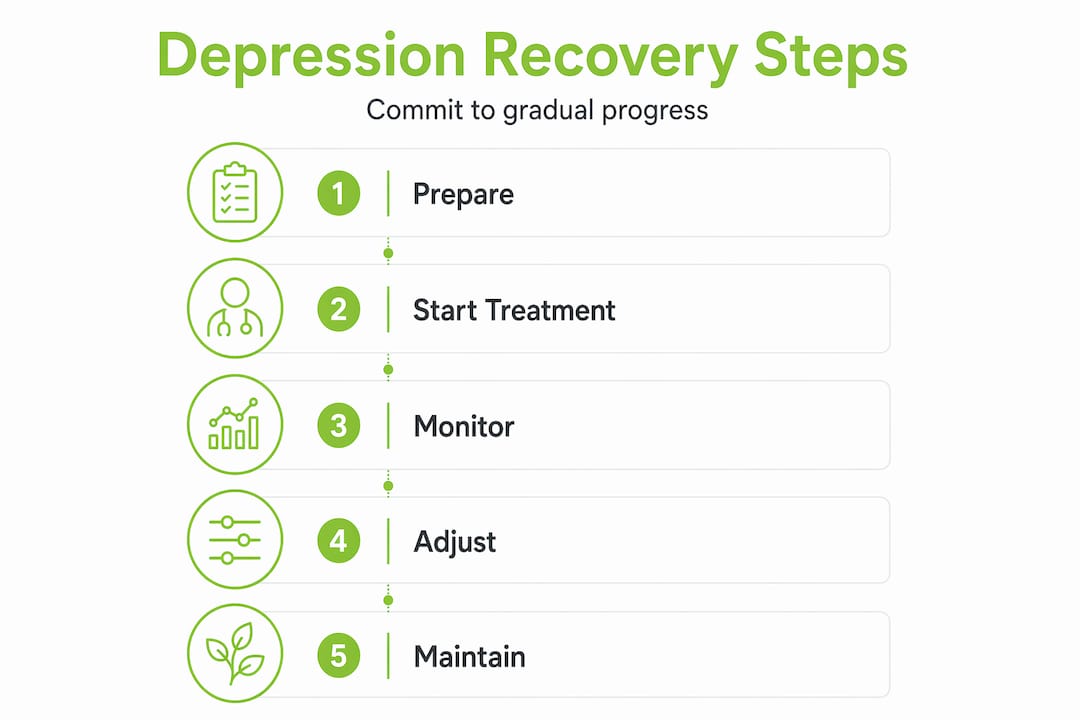
Depression doesn’t look the same for everyone. For some people in North Dallas, it shows up as an inability to get out of bed. For others, it’s a persistent gray fog that makes work, relationships, and even simple decisions feel impossible. This depression treatment guide will walk you through what actually works: how to prepare for treatment, which therapies and medications are worth considering, what to do when first attempts fall short, and how to track your progress so recovery keeps moving forward. Your options are broader than you might think, and knowing them is the first step toward feeling like yourself again.
Table of Contents
- Understanding depression and preparing for treatment
- Therapy options and medication choices: finding what fits you
- Advanced and alternative treatments for resistant cases
- Monitoring your progress and avoiding common pitfalls
- A psychiatrist’s perspective: why personalized, flexible treatment wins
- Explore personalized depression treatment at Nortex Psychiatry
- Frequently asked questions
Key Takeaways
| Point | Details |
|---|---|
| Personalized treatment | Your depression treatment should be tailored to your symptoms, preferences, and severity for best results. |
| Combination approach | Therapy combined with medication often provides stronger improvement than either alone. |
| Advanced options exist | If first treatments fail, brain stimulation and medication adjustments offer effective alternatives. |
| Active monitoring | Regularly track progress with your provider to adjust treatments and manage side effects timely. |
| Provider guidance | Always discuss supplements or complementary treatments with your healthcare team before starting them. |
Understanding depression and preparing for treatment
Depression is not just sadness. It affects your mood, concentration, sleep, appetite, energy, and your ability to function at work or at home. Two people with the same diagnosis can look very different, which is exactly why depression treatment must be tailored to your specific symptoms, values, and preferences, according to the American Psychological Association.
Before any treatment begins, an accurate assessment matters enormously. A good evaluation looks at your symptom severity, how long you’ve been experiencing symptoms, your medical history, and personal factors like stress, relationships, and previous treatment attempts. This information shapes what kind of care will actually help you.
Understanding the difference between mild, moderate, and severe depression isn’t just clinical jargon. It directly determines treatment intensity:
- Mild depression may respond well to psychotherapy alone, lifestyle changes, and close monitoring.
- Moderate depression often benefits from combining therapy with medication.
- Severe depression typically requires more intensive intervention, sometimes including advanced treatment options.
Setting realistic expectations from the start helps you stay committed. Recovery is a journey, not a straight line. There will be weeks that feel better and weeks that feel harder. Keeping open, honest communication with your care team throughout the process makes a real difference. Exploring evidence-based depression therapy options early gives you a clearer picture of what to expect.
Pro Tip: Before your first appointment, write down your symptoms, when they started, what seems to make them better or worse, and any treatments you’ve tried before. Your provider can move faster and more accurately when you walk in prepared.
Therapy options and medication choices: finding what fits you
With preparation in place, let’s look at specific therapies and medications, and how to figure out what suits you best.
Multiple evidence-based psychotherapies and second-generation antidepressants, often combined, are the standard approach for adults with depression, according to the APA. There is no single best choice. What works depends heavily on your symptom profile, lifestyle, and personal preferences.
Common therapies for depression:
| Therapy type | Best suited for | Key focus |
|---|---|---|
| Cognitive-behavioral therapy (CBT) | Negative thought patterns | Changing unhelpful thinking and behavior |
| Interpersonal therapy (IPT) | Relationship or life transition issues | Improving communication and relationships |
| Psychodynamic therapy | Deeper emotional patterns | Exploring past experiences and emotions |
| Mindfulness-based cognitive therapy | Recurrent depression | Building awareness and preventing relapse |
| Supportive therapy | General distress and coping | Providing validation and practical guidance |
On the medication side, first-line options include SSRIs (selective serotonin reuptake inhibitors), SNRIs (serotonin-norepinephrine reuptake inhibitors), and NDRIs (norepinephrine-dopamine reuptake inhibitors). No single antidepressant is universally superior. Your provider will weigh factors like potential side effects, other health conditions, medications you already take, and what matters most to you.
- SSRIs such as sertraline and escitalopram are widely used as a starting point due to their tolerability profile.
- SNRIs like venlafaxine or duloxetine may also help when anxiety is a major component of your depression.
- NDRIs such as bupropion can be helpful when fatigue and low motivation are prominent and for people concerned about sexual side effects.
One finding that often surprises people: combination therapy of antidepressants plus CBT usually works better than either approach alone for moderate to severe depression, according to NHS guidance. If you’ve only tried medication or only tried therapy before, that combination approach may unlock progress you haven’t yet seen.
Exploring psychotherapy for depression alongside a review of medication versus other treatments helps you make a truly informed decision with your provider.
Pro Tip: Don’t judge a therapy by the first two sessions. Research on CBT consistently shows that the therapeutic relationship takes a few sessions to develop, and real gains often start around week four or five.
Advanced and alternative treatments for resistant cases
If initial therapies aren’t delivering results, that doesn’t mean you’ve run out of options. Understanding what comes next is important, and it’s more encouraging than most people expect.
Treatment-resistant depression is generally defined as insufficient improvement after two or more adequate trials of antidepressant medications. It’s more common than many realize. The right response is not to give up but to adapt.
Here are the primary next steps your provider may recommend, in a logical order of consideration:
- Switch antidepressants to a different class or medication within the same class to see if another option produces better results with fewer side effects.
- Augment your current medication by adding a second agent. This often includes second-generation antipsychotics (such as aripiprazole or quetiapine), lithium, or thyroid hormone, all of which have evidence supporting their use in boosting antidepressant effects.
- Intensify or add psychotherapy alongside medication changes, because therapy and medication work through different mechanisms and can reinforce each other.
- Consider brain stimulation therapies, which are among the most effective tools for treatment-resistant cases.
Shared decision-making and options like switching, augmentation, and neuromodulation (treatments that act on the brain’s electrical activity) are all recommended approaches for treatment-resistant depression, according to UpToDate.
On the brain stimulation side, ECT and TMS are both proven options for severe or difficult-to-treat depression, as described by Mayo Clinic. Electroconvulsive therapy (ECT) remains one of the most effective treatments ever developed for severe depression but carries more logistical requirements. Transcranial Magnetic Stimulation (TMS) is non-invasive, requires no anesthesia, and is performed in an outpatient setting, making it far more accessible. You can learn more about TMS therapy options and review the differences between brain stimulation approaches to understand what each involves.
Complementary methods with some evidence:
- Omega-3 fatty acids (specifically EPA) show modest evidence as an add-on approach.
- Acupuncture may reduce symptom severity in some individuals when used alongside standard care.
- Music therapy and exercise programs have shown real benefit, particularly for mild to moderate depression.
These are not substitutes for core treatments. They can support your recovery when added thoughtfully. Read more about advanced depression treatments to see how these options compare.
Pro Tip: If a second antidepressant trial hasn’t worked, bring that history clearly to your next appointment. Your provider needs that information to make the case for augmentation or a referral for TMS, and insurers often require documentation of prior trials.
Monitoring your progress and avoiding common pitfalls
Understanding how to monitor progress and avoid common mistakes keeps your recovery moving and helps you get more from your care team.
Close follow-up when starting antidepressants, including monitoring for effectiveness and side effects every one to two weeks for at least four weeks, is recommended by NHS guidelines. That early period is when most people either start seeing progress or run into issues that need addressing quickly.
Key things to track during treatment:
- Changes in your mood, sleep, energy, and concentration week by week
- Any new side effects from medications, including headaches, nausea, sleep changes, or sexual side effects
- Your attendance and engagement with therapy sessions
- Life stressors that may be interfering with treatment response
- Any thoughts of self-harm, which should always be communicated immediately
One of the most common mistakes is stopping medication too early. When you start to feel better, it’s tempting to conclude you no longer need the medication. But stopping abruptly can trigger withdrawal symptoms and a return of depression. Most guidelines recommend continuing antidepressants for at least six to nine months after you feel well, sometimes longer.
“Many people feel well after four to six weeks on medication and wonder if they still need it. That feeling of wellness is often the medication working, not a sign it’s no longer needed.” This perspective from clinical practice reflects what psychiatrists across the field consistently observe.
Consulting your provider before starting natural or complementary treatments is important, as these can interact with medications and their effects are gradual, according to Cleveland Clinic guidance. Natural depression remedies like St. John’s wort, for example, can cause dangerous interactions with SSRIs. Your provider is your partner in safely integrating these options.
Using self-monitoring tools for depression between appointments gives you and your provider a more accurate picture of how treatment is progressing over time.

Pro Tip: Keep a simple daily log on your phone rating your mood on a scale of 1 to 10, noting your sleep hours and energy level. A week of that data is far more useful to your psychiatrist than trying to remember how you felt over the past month.
A psychiatrist’s perspective: why personalized, flexible treatment wins
Here’s something we want to be honest with you about: depression treatment does not follow a clean, predictable path. We have seen patients who respond beautifully to the first medication we try. We have also seen patients who require three or four adjustments before finding something that works. Neither experience is unusual, and neither reflects on the severity of your illness or your strength as a person.
What we focus on at every step is your context. Your work schedule, your side effect tolerability, your history, your values, what you are willing to try and what you are not. That information shapes every recommendation we make. The research on how to treat depression provides a framework, but the real work happens in understanding depression treatment options through the lens of who you actually are.
The cases that have taught us the most are the ones labeled treatment-resistant. Those patients pushed us to think more carefully, to look at augmentation strategies, to consider TMS, to revisit life factors we might have overlooked. They also reminded us that persistence matters as much as clinical precision. Effective coping strategies for depression are not just about what happens in a clinic. They include sleep, movement, connection, and meaning, and those elements don’t show up in a prescription pad.
We also want to push back gently on the idea that a good treatment plan is one that never changes. Flexibility is a feature, not a flaw. Revisiting and revising your plan as your life and symptoms evolve is exactly how evidence-based care is supposed to work. Exploring personalized mood disorder treatment approaches with your provider means building a plan that grows with you, not one that stays fixed while you change.
Explore personalized depression treatment at Nortex Psychiatry
If you’re ready to take the next step, we’re here to help. At Nortex Psychiatry in Allen, Texas, we serve adults across North Dallas, including Frisco, McKinney, Plano, and surrounding communities, with personalized, evidence-based depression care. Our team combines psychotherapy coordination, medication management, and advanced options like TMS into plans built around your goals and preferences. We prioritize shared decision-making because your voice matters in every treatment choice. Whether you are starting for the first time or navigating a case that hasn’t responded to previous treatment, we provide the ongoing support and clinical expertise you need. Explore our approach to personalized mood disorder care, compare TMS and medication options, or learn about our psychiatry-focused care approach to see how we work. Both in-person and telehealth appointments are available.
Frequently asked questions
What types of psychotherapy are effective for adult depression?
Multiple evidence-based psychotherapies for adults include cognitive-behavioral therapy, interpersonal therapy, psychodynamic therapy, supportive therapy, and mindfulness-based cognitive therapy, with the best choice depending on your specific symptoms and circumstances.
How long does it usually take for antidepressants to start working?
Most people begin noticing improvement within four weeks of starting antidepressants, though symptoms typically improve more fully after six to eight weeks of consistent use.
What should I do if my depression treatment isn’t working?
Talk openly with your provider about your lack of response, as switching or augmentation strategies with shared decision-making are well-supported next steps, along with exploring advanced options like TMS.
Are natural supplements effective for depression?
Evidence for natural supplements like omega-3s, SAMe, and St. John’s wort is uncertain, and you should always consult your provider before use, as some can interact dangerously with prescription antidepressants.
What is the role of brain stimulation therapies in depression treatment?
ECT and TMS are effective options for severe or treatment-resistant depression, typically recommended when medications and therapy have not produced adequate improvement.