


Atypical depression is a form of major depression, not a rare or milder one. Your mood can lift when something good happens, yet you still sleep too much, eat more, feel heavy in your limbs and take rejection hard. In our work, people often wait years to hear this has a name. A careful psychiatric evaluation can recognize the pattern, and treatment can be matched to it, including options for when the first medications have not been enough.
TL;DR
- Atypical depression is major depressive disorder with atypical features: mood that brightens with positive events, plus at least two of increased appetite or weight gain, oversleeping, leaden paralysis and long-standing sensitivity to rejection.
- It is not rare. A 2025 scoping review put pure atypical features at 15% to 30% of people with depression, and it is more common in women and young adults.
- Diagnosis rests on a clinical interview, with some basic labs to rule out medical causes such as thyroid problems.
- Treatment may be medication, psychotherapy or both. MAOIs have the strongest track record for this subtype, and other options exist if standard medications fall short.
Table of Contents
- What atypical depression actually means
- Symptoms: what it looks and feels like
- How we diagnose it
- Treatment: what the evidence supports
- When the first medications are not enough
- Perspective
- Care options in North Dallas
- FAQ
- Sources
What atypical depression actually means
The word “atypical” is misleading. It describes the pattern of symptoms, not how often it occurs. The term goes back to the late 1940s and 1950s, and the current DSM-5-TR definition has been unchanged since 1994. In the DSM, the manual psychiatrists use to define diagnoses, it appears as a “specifier”: a label added to a major depressive episode.
In a 2018 analysis of a national U.S. survey, about 20% of new major depression cases in the sample were atypical. So if you read the symptoms below and recognize yourself, you are in large company.
Symptoms: what it looks and feels like
The core feature is mood reactivity. A good phone call, a plan with a friend or some good news can lift your mood for a while, even though you are depressed. People sometimes take this as proof they are “not really depressed.” It is not.
Then come at least two of these, per the DSM-5-TR criteria described in a 2026 review:
- Increased appetite or weight gain. Often cravings, especially for carbohydrates.
- Hypersomnia. Sleeping far more than usual and still feeling unrefreshed.
- Leaden paralysis. Arms or legs feel heavy, as if weighted down.
- Rejection sensitivity. A long-standing pattern, not just during episodes, of being badly hurt by perceived criticism or rejection, enough to affect work or relationships.
Typical melancholic depression tends to look different: a constant low mood, loss of appetite and trouble sleeping. Medscape’s clinical summary notes that symptoms must last at least two weeks and that melancholic and catatonic features are excluded.
There is also emerging research linking atypical depression with emotion dysregulation, meaning stronger emotional reactions to interpersonal stress. If that pattern is familiar, our piece on emotional dysregulation explains how it can overlap with ADHD, which is worth sorting out in the same evaluation.
It also helps to understand how stress responses differ between people. Stress response types in the workplace can show how some people react more strongly to interpersonal pressure, though that is not a diagnostic tool.
How we diagnose it
There is no blood test or scan for atypical depression. UpToDate notes that diagnosis of depression in adults rests on a clinical interview and examination, with focused tests, such as a blood count or thyroid function, often used to rule out medical causes. Thyroid trouble and sleep disorders can mimic several of these symptoms, which is why we look at the whole picture.
In the room, we usually spend time on things patients do not think to mention:
- How your mood behaves across a normal week, not only on your worst day.
- Sleep and appetite over months and years, not just recent weeks.
- Whether you have ever had periods of unusually high energy, because bipolar disorder can look similar and is treated differently.
- How you handle criticism and closeness, and whether that has been true since your teens.
- Alcohol, caffeine, other medications and any other conditions.
Because atypical depression often starts earlier in life and can last longer, as Cleveland Clinic’s summary reflected in the 2026 review describes, parents of teens and young adults should know it can look like laziness or oversensitivity. It is neither.
Treatment: what the evidence supports
Psychotherapy
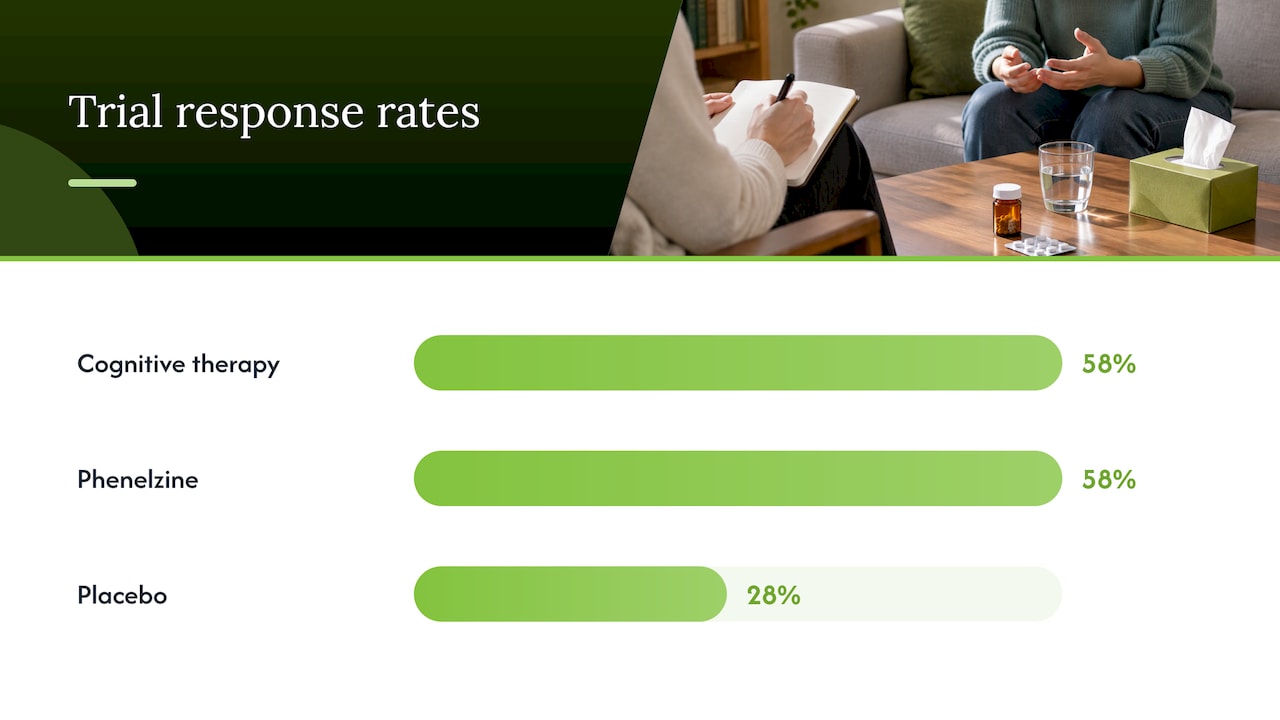
In a 1999 double-blind trial of 108 outpatients with atypical features, 58% responded to cognitive therapy and 58% to the MAOI phenelzine, versus 28% on placebo. The 2022 VA/DoD guideline recommends either psychotherapy or medication on its own according to patient preference, and found no listed therapy clearly better than another. That puts your preference at the center, which is how we approach it. For more on weighing the two, see therapy vs. medication for adults.
Medication
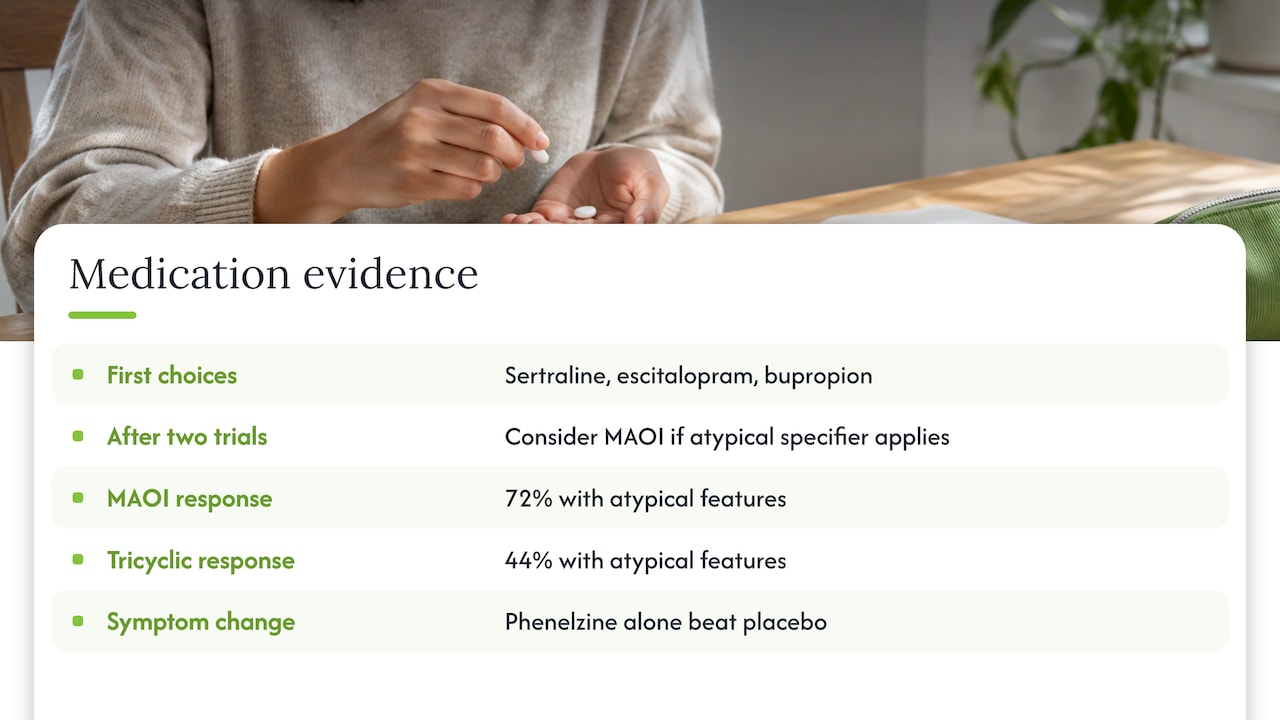
For most outpatients with depression, a Harvard-affiliated algorithm project lists sertraline, escitalopram and bupropion as reasonable first choices. If two trials do not help and the atypical specifier applies, an MAOI (monoamine oxidase inhibitor, an older class of antidepressant) could be considered.
That last point matters. A review by Dr. Frederic Quitkin of Columbia found that people with atypical features responded to MAOIs 72% of the time, compared with 44% for tricyclic antidepressants. Dr. Michael Thase, writing in Psychiatric Annals, called this MAOI advantage one of the most consistent validators of the subtype.
A 2025 network meta-analysis of 21 randomized trials found phenelzine the only drug to beat placebo on symptom change, while phenelzine, sertraline, moclobemide, fluoxetine and imipramine all beat placebo on response. The authors rated confidence in these results low, so treatment is individualized rather than formulaic.
A note on bupropion
People often ask about bupropion because it is not sedating and does not usually cause weight gain. It is FDA-approved for major depression generally. The same label lists common side effects: agitation, dry mouth, constipation, headache, nausea, dizziness, sweating, tremor and insomnia. It carries a boxed warning that antidepressants raised suicidal thoughts and behavior in ages 18 to 24 in short-term trials, with no increase beyond age 24. Anyone starting an antidepressant, especially a young adult, should be closely followed in the first weeks, and should call us or seek emergency care right away if thoughts of self-harm appear. In the U.S., you can also call or text 988.
Some medications change appetite and weight, and your prescriber should track that with you. If you are also using weight-management medication, mood changes on GLP-1 drugs are worth tracking, and you should tell your psychiatrist about everything you take. MAOIs in particular interact with certain foods and many drugs, so they need careful supervision and a complete medication list.
When the first medications are not enough
Depression is a journey, not a straight line. If you have tried two adequate medications without relief, that has a name, treatment-resistant depression, and it is a reason to widen the options, not to lose hope. Our overview of treatment-resistant depression covers the steps, and our page on combination therapy looks at pairing treatments.
Perspective
In our practice, the most common thing we hear from people with atypical depression is, “I kept thinking I couldn’t be depressed, because I still enjoyed things sometimes.” We have learned to hear that as a clue, not a contradiction.
We often notice that sleeping ten hours and still feeling flattened, or taking one critical email as a verdict on your whole worth, gets explained away for years. A careful history, and time, usually makes the pattern clear.
What we have come to believe is that treatment works best when it is matched to the person and revisited. Medication management and therapy form the base. When that is not enough, we offer interventional options such as TMS, ketamine therapy, Spravato and stellate ganglion block, with minimal downtime for many patients. None of this is a straight line, and we plan to walk it with you.
Felix
Care options in North Dallas
Our practice in Allen, Texas, serves adults and families across Frisco, McKinney, Plano and surrounding areas, in person and by telehealth. We begin with a psychiatric evaluation and medication management, and we also provide Transcranial Magnetic Stimulation (TMS), Spravato for treatment-resistant depression and ketamine therapy. To see how our approach fits together, read how psychiatry treats depression, or start from our home page to request a visit.
FAQ
Is atypical depression milder than other depression?
No. It is a subtype of major depression, and it can be just as disabling. It is also often chronic, with high relapse rates once medication is stopped, which is why ongoing follow-up matters.
Can you have atypical depression if you feel better when good things happen?
Yes. That brightening, called mood reactivity, is the defining feature, not a sign you are fine. It usually fades, and the other symptoms remain.
Is bupropion a treatment for atypical depression?
Bupropion is approved for major depression and is a reasonable first choice for many people. Evidence specific to atypical depression is mixed, so we choose based on your symptoms, history and other medications.
Who is more likely to have it?
A 2025 review found it more common in women and young adults. Anyone can have it, though, and teens and adults alike deserve a full evaluation.
Sources
- Manifestation and Measurement of Atypical Depression (2025 scoping review)
- Cardiovascular risk factors as differential predictors of atypical MDD
- Atypical depression: state of the art and future directions
- Depression clinical presentation, Medscape
- Unipolar depression in adults: assessment and diagnosis, UpToDate
- Treatment of atypical depression with cognitive therapy or phenelzine, JAMA Psychiatry
- VA/DoD MDD Clinical Practice Guideline, 2022
- Psychopharmacology Algorithm Project at the Harvard South Shore Program
- Depression with atypical features: diagnostic validity
- Recognition and diagnosis of atypical depression, Psychiatric Annals
- Pharmacological treatments for atypical depression: network meta-analysis
- DailyMed: bupropion hydrochloride tablet