

Rejection sensitive dysphoria, or RSD, is the term people use for sudden, intense emotional pain after real or perceived rejection, criticism or failure. It is most often described by adults with ADHD. It is not a formal diagnosis, but the experience behind it is real, and in our work we take it seriously. If a short text reply or a mild comment from your boss can flatten you for a day, that pattern is worth sorting out with a psychiatrist who understands ADHD, anxiety and mood together, because the cause is often one of those, or a mix.
TL;DR
- RSD describes overwhelming emotional pain after perceived rejection or criticism. It is not listed in the DSM-5 or ICD-11, so no clinician can diagnose “RSD” as such.
- It is most often discussed alongside ADHD, but similar reactions can come from anxiety, depression, trauma or other conditions, which is why an evaluation matters.
- Treatment usually targets what sits underneath: ADHD, emotional dysregulation, anxiety or depression, through medication management, therapy and daily skills.
- If low mood or distress lasts two weeks or more and gets in the way of daily life, NIMH advises talking to a health care provider. In a crisis, call or text 988.
Table of Contents
- What rejection sensitive dysphoria feels like
- Is RSD real, and is it the same as ADHD?
- Why an evaluation matters more than a label
- What tends to help
- If you love someone with RSD
- When to get help
- Our perspective
- Getting started with us
- FAQ
- Sources
What rejection sensitive dysphoria feels like
Most people who describe RSD to us don’t start with the word. They start with a story. A friend answered “fine” and they spent the evening convinced they had ruined the friendship. A manager said “can we talk later?” and the afternoon was gone.
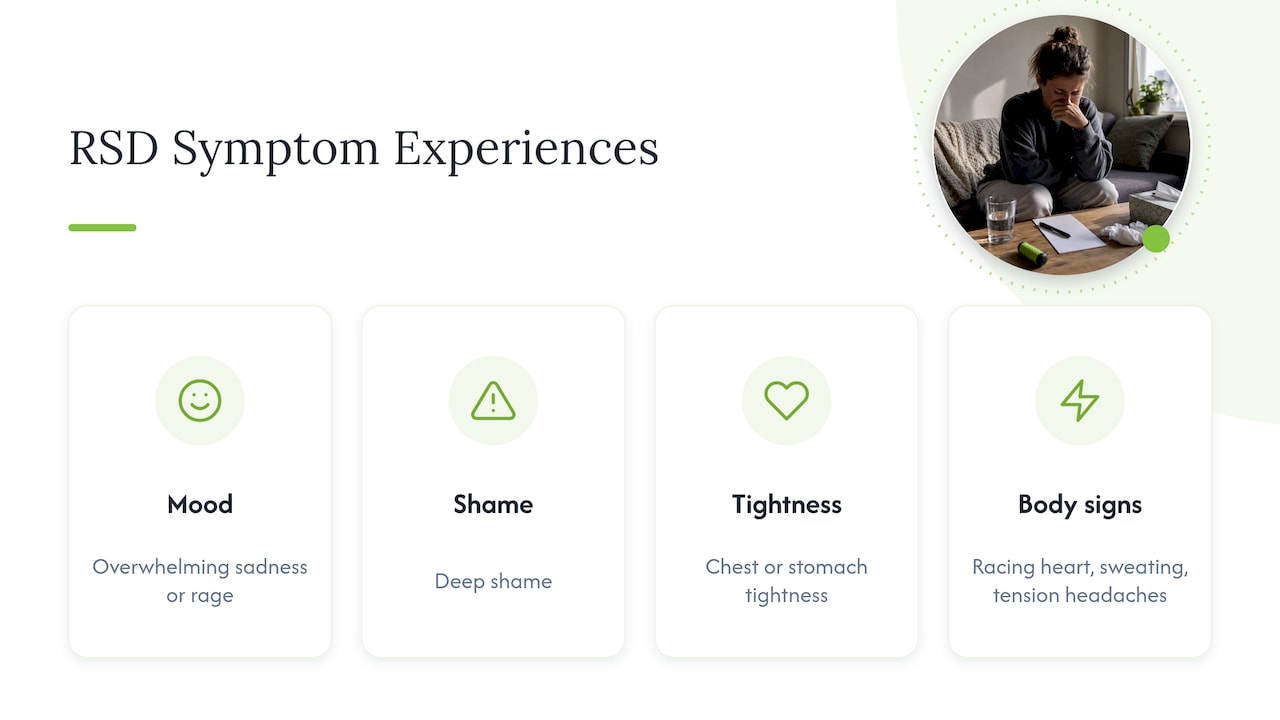
The literature describes it much the same way. ADDA lists overwhelming sadness or rage, deep shame, and body sensations such as chest or stomach tightness, a racing heart, sweating and tension headaches. In a 2024 case series, patients described the pain as being hit in the chest with great force, and often called it a wound. The authors noted that they could only describe how bad it was, not what it was like, and that “dysphoric” comes from a Greek word meaning unbearable.
The same case series makes two points that match what we hear in the office. The mood shift is nearly instant rather than gradual. And it can go two ways. Turned inward, it can look like a full major depressive episode, sometimes with thoughts of suicide. Turned outward, it tends to come out as anger at the person or the situation.
If you want a plain-language list of the emotional and physical signs, this overview of RSD symptoms in people with ADHD is a reasonable companion read.
Common triggers
A toolkit from a NAMI-affiliated group names triggers that line up with what patients tell us:
- Neutral or short replies such as “ok,” “fine” or “never mind”
- Overthinking or misreading a social interaction
- Reminders of past rejection
- Real, imagined or anticipated criticism
- A sudden change in how a loved one acts
- A real or perceived failure at a task
Notice how many of these are ambiguous. Ambiguity is where the reaction tends to do its work. The mind fills the gap with the worst reading, and the body responds as if the worst reading were true.
Is RSD real, and is it the same as ADHD?
Both questions deserve a careful answer.
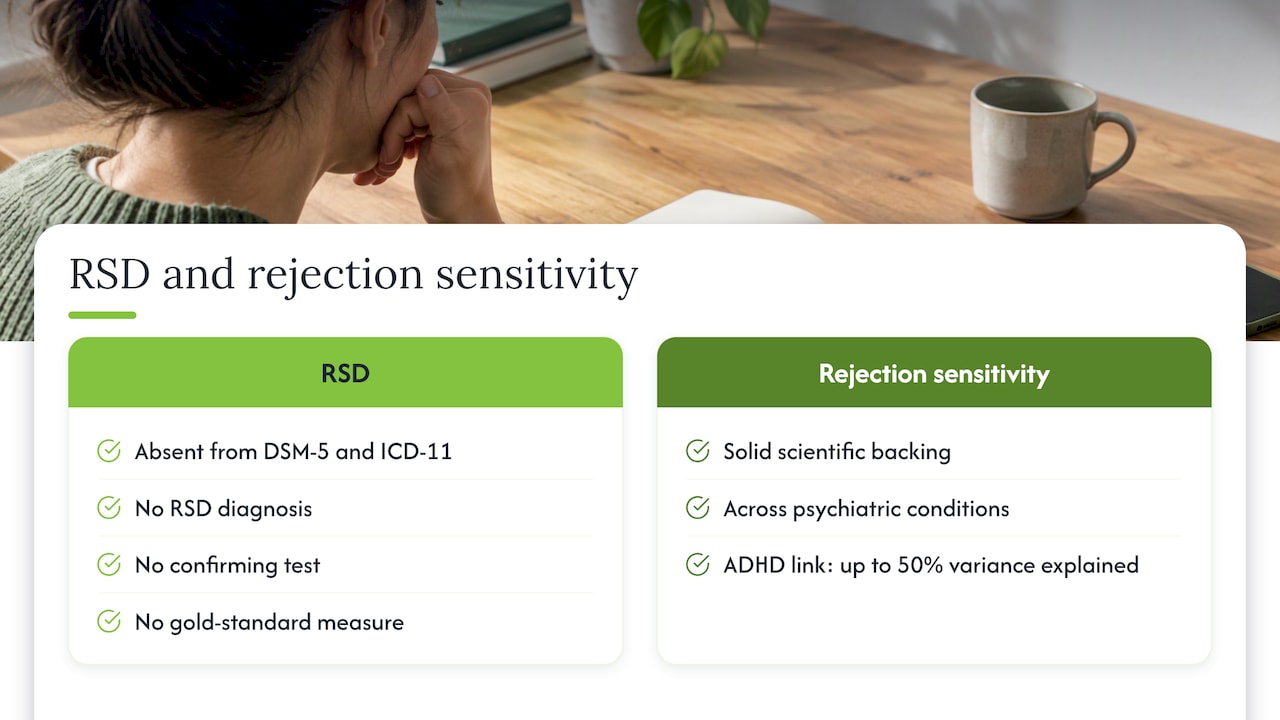
The term was popularized by psychiatrist William Dodson to describe extreme emotional pain after perceived rejection in people with ADHD. A 2026 scoping review notes that RSD is absent from the DSM-5 and ICD-11, and that direct research is still limited, even though the idea has gained a lot of ground among neurodivergent people online. So there is no RSD diagnosis to be handed, and no test that confirms it. A UK clinical psychology thesis found there is no gold-standard measure for capturing it.
That does not make your experience imaginary. Rejection sensitivity, the broader tendency to expect, notice and react strongly to rejection, has solid scientific backing and shows up in several psychiatric conditions, not only ADHD. One 2024 study of 304 Hungarian college students found that ADHD symptoms and rejection sensitivity were associated, with the model explaining up to 50% of the variance in rejection sensitivity scores.
So here is where we land. Strong rejection sensitivity does not mean you have ADHD. And ADHD does not guarantee you will have it. What it does tell us is that something about how you regulate emotion deserves a closer look. The NAMI toolkit frames RSD as rooted in emotional dysregulation, where a feeling becomes so intense it takes over, and notes that people who faced more rejection early in life are more likely to feel anxious about it later. We wrote more about that overlap in our piece on ADHD emotional dysregulation.
Why an evaluation matters more than a label
We have learned to be a little cautious when someone arrives with “I have RSD” as the whole picture. Often it is the most visible part of something larger. The Dodson case series itself says the authors saw hundreds of patients whose pattern they could not attribute to mood, anxiety, personality or other developmental disorders, which is a useful reminder that clinicians do try to rule those out first.
The reverse is also true. Anxiety can look like ADHD, and ADHD can look like anxiety, and a rejection-driven crash can sit on top of either. A good evaluation untangles them. It usually covers:
- When the reactions began. A UK study of six women diagnosed with ADHD in adulthood found their rejection-pain experiences were lifelong, even though they only learned the term as adults.
- Whether attention, organization and restlessness problems were present in childhood.
- Mood, sleep, anxiety, trauma history and substance use.
- How the reactions affect work, parenting, friendships and your own opinion of yourself.
That same thesis found that participants often masked their reactions to avoid further episodes and to avoid stigma, which in turn fed negative beliefs about themselves. If you have spent years hiding it, you may find it hard to describe at first. That is normal. Bring examples rather than a verdict. Our guide to what to bring to an anxiety versus ADHD evaluation walks through it, and our page on adult ADHD diagnosis in North Dallas explains what to expect from the visit.
What tends to help
Be wary of anyone who promises a quick fix. Recovery here is a journey, not a straight line. Still, there is a lot that can be done, and it usually comes in layers.
Treating what sits underneath
When RSD-type reactions come with ADHD, treating the ADHD itself is often the first step. Some patients notice that emotional reactions soften when attention and impulse control are better managed, though that is not true for everyone. Our overview of ADHD treatment options for adults lays out the choices, and medication versus therapy for ADHD explains how the two fit together.
If anxiety or depression is driving the reactions, those get treated directly. Medication management is part of what we do at Nortex Psychiatry for depression, anxiety, ADHD and mood disorders, and it can include adjusting a plan over time rather than expecting the first choice to be the last. Our page on switching ADHD medications describes what that process looks like.
What clinicians report about medication
No medication is approved specifically for RSD. In their case series, Dodson and colleagues note that people with RSD have tended to respond favorably to alpha-2 agonists, a class of non-stimulant medicines. That is clinical experience from a small body of reports, not a settled trial result, and a clinical discussion of treatment approaches reported for ADHD-associated RSD makes the same point about needing more research. Whether any medication makes sense for you depends on your history, other conditions and what else you take. That is a conversation for a prescriber, not a decision to make from an article.
Skills you can start now
Some things help regardless of the cause. We suggest them as practice, not as a test you can fail.
- Name the moment. “This is the rejection feeling, and it may not match the facts.” It sounds small. It buys a few seconds.
- Slow the body first. Slow breathing, a walk, cold water on the hands. The reaction is physical before it is a thought.
- Delay the reply. Wait before answering the text, email or comment that set you off. Most of the damage we hear about happens in the first ten minutes.
- Check the story. Ask what else could explain the short reply. Tired, busy, distracted. Better still, ask the person directly.
- Tell people close to you. A partner or friend who knows the pattern can be explicit, which brings us to the next section.
For more on this, see our coping strategies for ADHD and the steps that help when anxiety and ADHD overlap.
If you love someone with RSD
Parents of teens and young adults ask us this often, and so do partners. The NAMI toolkit’s advice is practical: communicate clearly and explicitly, offer extra reassurance, say something positive before constructive criticism, don’t minimize their feelings, and remind them they are loved. It also points out that clipped answers like “ok” or “fine” can be misread, so being consistent in how you respond helps prevent a spiral.
In plain terms: say the warm thing out loud. Don’t assume it is understood. And when an episode hits, skip the debate about whether the reaction is fair. Wait until it passes.
When to get help
Self-care is a fair place to begin when symptoms are mild and recent. NIMH suggests regular exercise, 7 to 9 hours of sleep, time with loved ones and meditation, and says to talk to a health care provider if those don’t help or symptoms get worse.
Book an evaluation if any of this fits:
- Distress that lasts two weeks or more, with trouble sleeping, concentrating, or finishing usual tasks. NIMH lists these among the signs that warrant professional help.
- Reactions that are costing you jobs, relationships or your sense of self.
- Avoiding people, or avoiding opportunities, to protect yourself from being judged. SAMHSA names avoiding friends and family among the signs it may be time to ask for help.
- Anger that frightens you or the people around you.
If you are having thoughts of suicide or urges to self-harm, do not wait for an appointment. Call or text 988 (the 988 Suicide and Crisis Lifeline, or chat at 988lifeline.org), any hour. In a life-threatening emergency, call 911.
Our perspective
When someone sits down and tells us a short text ruined their week, we don’t hear drama. We hear someone who has been braced for a long time.
We have learned to be slow with labels. RSD is a useful word for the feeling, and it helps many people feel less alone. But the work is in finding what is underneath: ADHD that was never recognized, anxiety that has been running for years, depression that hides behind irritability. Sometimes it is more than one of those.
We often notice that people have spent years assuming they were simply too sensitive. That belief does its own harm. A careful evaluation, and a plan that is adjusted as we learn how you respond, tends to change the conversation you have with yourself.
At Nortex Psychiatry we offer medication management, psychiatric evaluations and telehealth visits for adults in Allen, Frisco, McKinney, Plano and across North Dallas. For patients whose depression has not responded to earlier treatment, we also offer TMS, ketamine therapy and Spravato. We don’t promise quick answers. We do promise to listen first.
Felix
Getting started with us
If this article sounded like you, the first step is a conversation about your history, not a commitment to any treatment. We see adults in person at our Allen practice and by telehealth across Texas. You can learn more and reach us through the Nortex Psychiatry home page, or read how psychiatrists approach ADHD care for adults before you call.
FAQ
Is rejection sensitive dysphoria a real diagnosis?
Not as a stand-alone diagnosis. It appears in neither the DSM-5 nor the ICD-11, and research is still limited. The experience itself is well described, and a clinician can evaluate the ADHD, anxiety or mood condition that may be behind it.
What does an RSD meltdown look like?
It usually starts with a perceived slight and moves to intense pain within moments. Some people turn it inward and feel crushed, ashamed or hopeless. Others turn it outward as anger at the person or situation. Afterward many feel exhausted or embarrassed.
How do I get over rejection sensitivity?
Most people do better by treating the underlying condition and building skills: pausing before replying, calming the body, and checking the story you told yourself. Some find that medication or therapy helps. A psychiatrist can help you decide what fits your situation.
How do I talk to someone who has RSD?
Be clear and explicit, say something positive before criticism, and avoid brushing off their feelings. Short replies like “fine” are easy to misread, so add a few warm words. Reassurance helps more than arguing about whether the reaction is fair.
Sources
- ADHD Rejection Sensitivity and How to Manage It, ADDA
- Rejection Sensitivity Dysphoria case series, Acta Scientific Neurology (2024)
- Rejection Sensitivity Dysphoria in Autistic Adults, SAGE Journals (2026)
- Rejection Sensitive Dysphoria Toolkit, NAMI Mercer (2024)
- Rejection Sensitivity Dysphoria with ADHD, NHS Library (2025)
- Doctoral thesis on RSD in women with adult ADHD, University of Hertfordshire
- Caring for Your Mental Health, NIMH
- My Mental Health: Do I Need Help?, NIMH
- Signs You Need To Seek Help, SAMHSA