
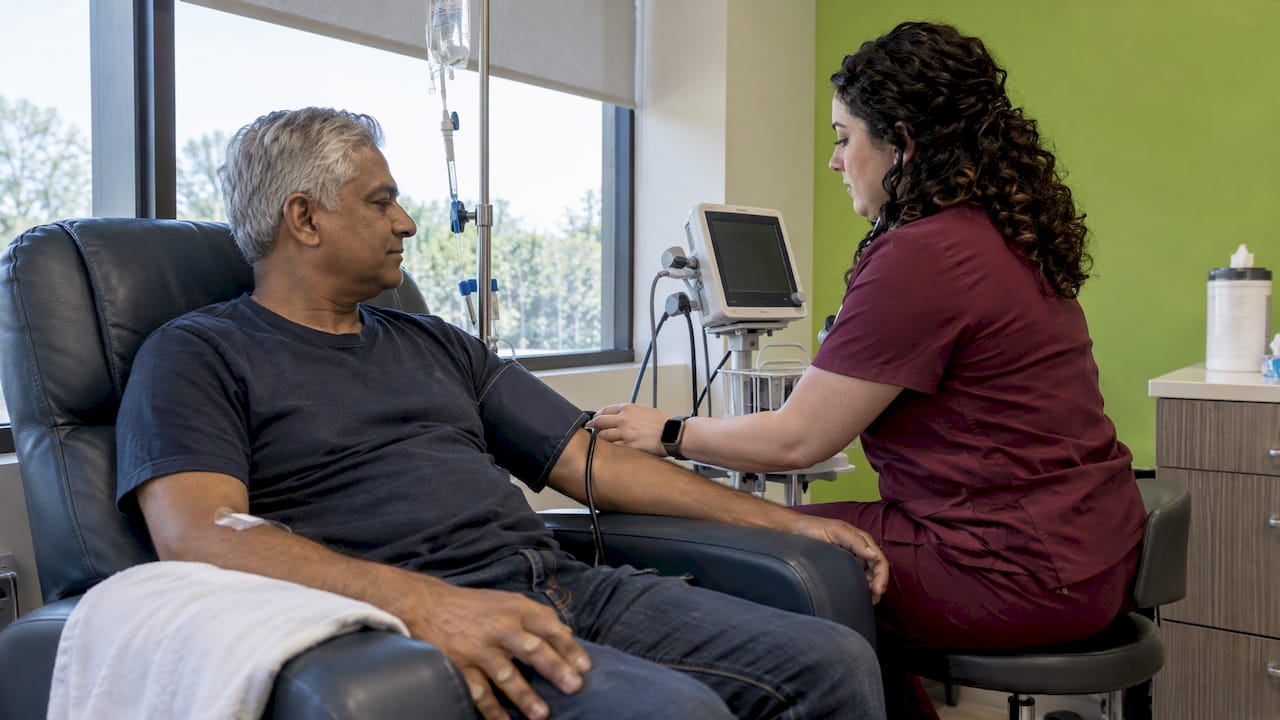
Yes, ketamine raises blood pressure, usually by a modest amount and for a short time. The rise begins during the treatment session, peaks within the first hour, and fades over the next few hours. In our work, this is one of the most common questions people ask before a first ketamine or Spravato visit, and it deserves a straight answer. The effect is expected and well studied. It is also the reason a careful clinic checks your numbers before, during and after every session.
If you live in Allen, Frisco, McKinney or Plano and you are weighing ketamine therapy or Spravato, this page explains what the research shows and what it means for you.
TL;DR
- Sub-anesthetic ketamine and esketamine raise systolic blood pressure by about 12.6 mmHg on average, and the change is transient.
- With Spravato, the FDA label says pressure peaks about 40 minutes after a dose and lasts about 4 hours.
- People with high blood pressure, heart or vascular disease, or stimulant use need a closer look before starting, and treatment of high blood pressure usually comes first.
- Monitoring is routine: a reading before the dose, readings during it, and observation afterward.
- Chest pain, shortness of breath, a sudden severe headache, vision changes or a seizure after a dose need emergency care right away.
Table of Contents
- How much does ketamine raise blood pressure?
- How long does the rise last?
- Spravato, IV ketamine and the route question
- Other effects on the heart
- Who needs extra care before starting
- How monitoring works before, during and after
- When to get emergency help
- Where this leaves you
- Talking with us about ketamine or Spravato
- FAQ
- Sources
How much does ketamine raise blood pressure?
The best overall picture comes from a 2021 meta-analysis in Frontiers in Psychiatry. It pooled 15 studies covering 2,252 treatments with ketamine or esketamine at sub-anesthetic doses (0.5 mg/kg or less, the range used for depression). On average, systolic pressure, the top number, rose by 12.61 mmHg. Diastolic pressure, the bottom number, rose by 8.49 mmHg, and heart rate rose by about 4 beats per minute. All of these changes were transient, and the authors found no significant difference between ketamine and esketamine or between age groups.
Here is what that looks like in a real reading. Someone who sits at 118/76 might see something like 130/84 at the peak. The same analysis reported that the average highest reading in psychiatric patients was 132/83 mmHg, with a peak heart rate near 78. That is in the Stage 1 hypertension range by definition, and a long way from the levels that count as a hypertensive urgency (above 180 systolic or 110 diastolic). Heart rate stayed in the normal adult range.
Averages hide individuals, though. We have learned to treat the average as a starting point and your own numbers as the thing that matters.
A closer look at infusions
A Yale Psychiatry Hospital chart review looked at 138 patients who received 2,342 ketamine infusions for depression. Blood pressure peaked about 40 minutes after the infusion started, with mean rises of 16.0 mmHg systolic and 11.0 mmHg diastolic. Severe hypertension showed up in 17 patients (12.5%), but it happened in under 1% of sessions overall, and it was more likely in the first three infusions. Age was associated with bigger surges.
That last point is useful for planning. The first few sessions are when your body is showing us how it responds, so that is when we pay the most attention.
How long does the rise last?
Short. Most reviews describe pressure climbing soon after the dose, peaking somewhere between 30 and 50 minutes, and settling within roughly two to four hours. A review in Psychiatria Danubina describes these rises as dose-dependent, generally without symptoms, and repeating on each dosing day. Pooled infusion data discussed in a 2022 clinical paper put the return to baseline at about 60 to 70 minutes after the infusion.
The repeating part matters. A smaller rise at your second session does not guarantee a small rise at your sixth. The Spravato label says a substantial increase can occur after any dose, even if earlier doses caused smaller effects. So we check every time, not just at the start.
Spravato, IV ketamine and the route question
The two treatments we offer in this family act on the same system, and both can lift blood pressure. The route and dose differ. IV ketamine for depression is given slowly over about 40 minutes at a weight-based dose. Spravato is the nasal spray form of esketamine, taken in the clinic. If you want the full comparison, our page on the difference between ketamine and esketamine covers it. For blood pressure purposes, the pooled data did not separate the two.
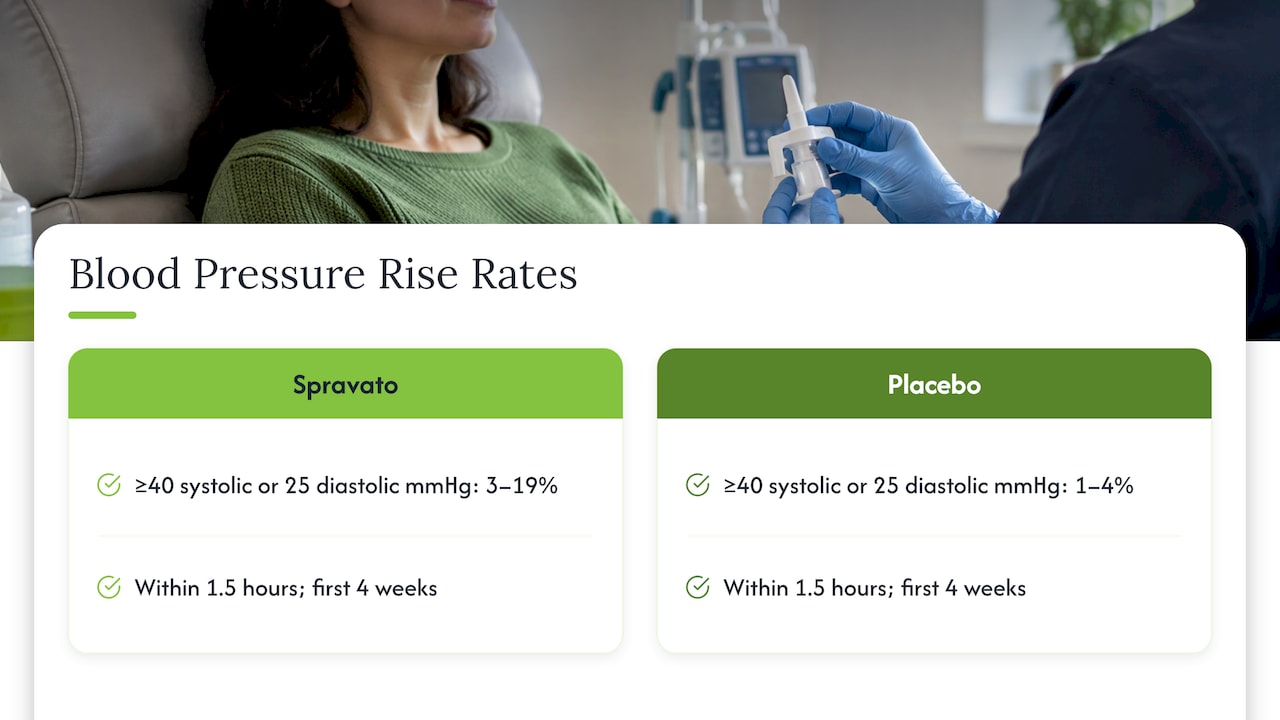
For Spravato, the FDA label gives clear numbers. Between 3% and 19% of treated patients had a rise of at least 40 mmHg systolic or 25 mmHg diastolic within the first 1.5 hours at least once during the first four weeks, compared with 1% to 4% on placebo. The FDA’s labeling-change record shows that this incidence language was added to the Warnings section in January 2025, and that bradycardia, a slow heart rate, was added to the postmarketing reports that April.
What do these percentages mean for you? Most people never reach those thresholds, and those who do usually feel pressure, a pounding head or just nothing at all, and it passes. The point of the label language is that clinicians watch for it, and that is what we do.
Other effects on the heart
Blood pressure is the headline, but ketamine’s effect on the cardiovascular system is broader. The FDA label for ketamine notes that transient increases in blood pressure, heart rate and cardiac output are frequently observed, while drops in pressure and heart rate and rhythm changes have also been seen. The label tells prescribers to monitor vital signs and cardiac function during administration.
A 2026 review in JACC Advances explains the mechanism in plain terms: ketamine has sympathomimetic properties, meaning it stimulates the same body systems adrenaline does, which raises heart rate, vascular resistance and cardiac output. It also notes that in very sick patients with severely weakened hearts, ketamine can depress the heart muscle directly. That is an intensive care situation, far from an outpatient depression visit, but it is a good reminder of why we ask about your heart history before anything else.
Who needs extra care before starting
Some people can still be treated, but their plan looks different. The VA’s October 2025 guidance for ketamine infusion in treatment-resistant depression flags these as higher-risk or needing individual assessment: blood pressure above 140/90 at screening, a history of hypertension, stimulant use, heart or lung disease, cerebrovascular disease, a recent heart attack, symptomatic ischemic heart disease, or poor exercise capacity. It also says high blood pressure should be treated before ketamine begins.
The Spravato label draws firmer lines. It contraindicates esketamine in people with aneurysmal vascular disease (in the aorta, brain or peripheral arteries), arteriovenous malformation, or a history of intracerebral hemorrhage (bleeding in the brain). Other heart and blood vessel conditions need a careful weighing of benefit and risk. It also asks for close blood pressure monitoring with psychostimulants or MAOIs, and more intensive monitoring for anyone with a history of hypertensive encephalopathy, which is brain dysfunction caused by very high pressure. All of this is in the Spravato label.
The Yale review adds a practical caution. Every patient with a history of hypertension in that study had a surge during their infusions. That is not a reason to give up on treatment. It is a reason to get your blood pressure well controlled first and to be open with us about it.
If you take a stimulant for ADHD, tell us. Many of the adults who come to see us for ADHD care are also asking about ketamine or Spravato for depression, and the combination is something we plan around together, not something to hide.
What to bring to your evaluation
- Your recent home or pharmacy blood pressure readings, if you have them
- A full list of medications, including stimulants, MAOIs and over-the-counter products
- Supplements and any peptide products, since a lot of things can nudge your numbers (the background on peptides and blood pressure shows how varied those effects can be)
- Any history of heart attack, stroke, aneurysm, or head bleeding
- Your family history of heart disease
How monitoring works before, during and after
A good ketamine program does not guess. It measures.
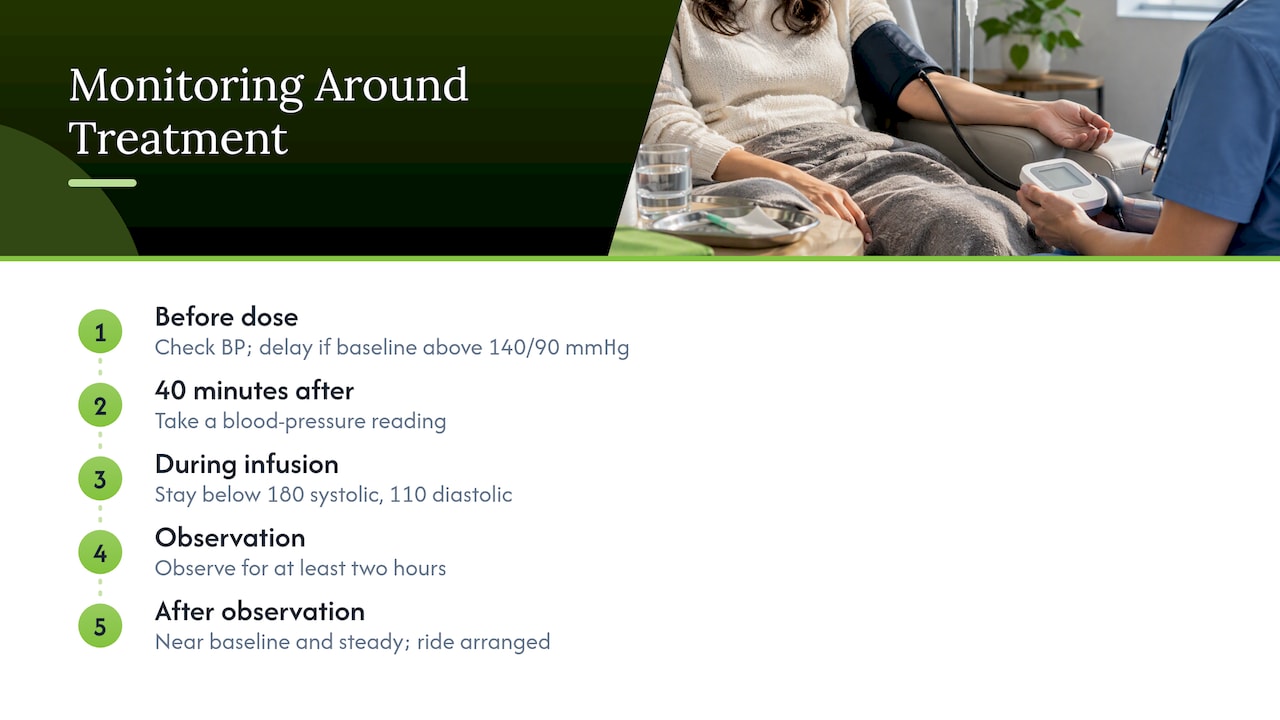
Before the dose. For Spravato, the label says to check blood pressure before dosing and to delay treatment if the baseline is above 140/90 mmHg, weighing benefit against risk. The prescribing information also calls for a reading about 40 minutes after the dose and observation for at least two hours. That is why our Spravato visits include a two-hour monitoring window in the clinic.
During an infusion. The VA guidance sets stop parameters: pressure should stay under 180 systolic and 110 diastolic, heart rate below an age-adjusted ceiling (for example, under 126 beats per minute at age 40), and the infusion stops for pallor, bluish skin, breathing symptoms, chest, jaw or arm pain, or if you ask. It also notes that stopping the infusion often brings pressure down quickly. Other guidance discussed in the 2022 clinical paper suggests pausing, stopping or treating with a blood pressure medicine when readings go above 160 systolic or 100 diastolic. You can read how we approach this in our outpatient ketamine infusion protocol.
After. Once the numbers are back near your baseline and you feel steady, you go home with a ride arranged. Our ketamine aftercare guide covers the next 24 to 72 hours.
One point from the 2022 paper stays with us. The authors argue that numbers alone are not enough, and that staff should watch for symptoms: severe chest pressure, acute shortness of breath, severe abdominal pain, or a markedly lowered level of consciousness. A patient can look fine on the monitor and still tell us something is wrong, so we keep asking you how you feel.
When to get emergency help
Most blood pressure rises are quiet. A few signs are not, and they need action.
- Chest pain or shortness of breath
- A sudden, severe headache
- Vision changes
- Seizure, or a drop in alertness
- Weakness or trouble speaking
The Spravato label directs that these be treated as possible hypertensive crisis or hypertensive encephalopathy and referred immediately for emergency care. The Medication Guide tells patients to tell their provider right away about chest pain, shortness of breath, sudden severe headache, vision changes or seizures after a dose. If you are in the clinic, tell the nearest staff member. If symptoms show up after you have gone home, call 911.
Where this leaves you
The numbers reassure us more than they worry us, as long as someone is looking at them. Pressure rises in a predictable window, usually a few hours, and then returns to your baseline. The people who do best are those who have their blood pressure checked, treated if needed, and tracked during every visit.
Our view on this
We have learned that patients rarely come in asking about blood pressure first. They ask whether the treatment will work, whether it will feel strange, and whether they will be okay afterward. Blood pressure comes up a little later, often in the parking lot or by message the night before. We would rather have that conversation early.
In our work with ketamine and Spravato, we treat monitoring as part of the treatment, not as a hurdle in front of it. The rise is expected. What matters is knowing your baseline, watching the peak, and being in the room when it passes. For many people with depression that has not responded to several medications, that is a trade that makes sense.
Interventional psychiatry is what we focus on: TMS, ketamine, Spravato, and stellate ganglion block. We do not pretend they are the same, and we do not assume one fits everybody. If your heart or blood pressure history makes one option a poor fit, we would rather talk through the others with you than push ahead.
Felix
Talking with us about ketamine or Spravato
If you are in North Dallas and want to know whether ketamine therapy or Spravato is a fit given your blood pressure and health history, we start with an evaluation and go from there. You can read about ketamine therapy and Spravato therapy, then contact us through our website to set up a visit. For background, how ketamine works for depression is a good next read.
FAQ
Does ketamine raise blood pressure every time?
On average, yes, a little, and it tends to recur at each dosing session. The pooled data show a mean systolic rise of about 12.6 mmHg that is transient. Some people barely move and a few rise more, which is why we take a reading each visit.
Can I have ketamine therapy if I already have high blood pressure?
Possibly. Guidance from the VA says patients with readings above 140/90 at screening are higher risk and that hypertension should be treated before ketamine starts. The Spravato label says to delay dosing if baseline pressure is above 140/90 and weigh benefit and risk. Bring your readings and medication list to your evaluation and we will plan from there.
How long does the blood pressure increase last?
For Spravato, the label says the increase peaks about 40 minutes after the dose and lasts about 4 hours. Reviews of infusions describe a similar window, with pressure usually back near baseline within a couple of hours.
Should I take my blood pressure medicine on treatment days?
This is a question for your prescriber before your first session, not something to adjust on your own. Tell us exactly what you take and when, and we will give you specific instructions for treatment days.
Sources
- Meta-Analysis: Hemodynamic Responses to Sub-anesthetic Ketamine and Esketamine (PMC)
- Meta-Analysis: Hemodynamic Responses, Frontiers in Psychiatry
- FDA Spravato label, 2025
- Blood pressure changes during ketamine infusion (PubMed)
- Short-term ketamine administration in treatment-resistant depression, Psychiatria Danubina
- Intravenous ketamine for depression: a clinical discussion (PMC)
- FDA Drug Safety-related Labeling Changes for Spravato
- FDA Ketalar label, 2026
- Hemodynamic Effects of Anesthetics, Sedatives, and Analgesics, JACC Advances 2026
- VA Formulary Advisor: Ketamine Infusion for Treatment Resistant Depression, October 2025
- Spravato prescribing information, DailyMed