


Most antidepressants take about 4 to 8 weeks to work, according to the National Institute of Mental Health. Some people notice small changes sooner, often within the first two or three weeks. A few need longer than eight. If you are in week two and feel nothing, that is common, and it does not mean the medication has failed.
We talk with patients about this wait almost every day. It is one of the hardest parts of starting treatment, because you are asking for help while feeling at your worst, and then you are told to wait. Below is what we have learned to tell people, along with what the published guidance says.
TL;DR
- Antidepressants usually need 4 to 8 weeks for their full effect, and some people need up to 12 weeks, per UpToDate.
- Sleep, appetite, energy and concentration often improve before mood does.
- SSRIs and SNRIs follow a similar timeline. Neither is meaningfully “faster” for most people.
- If you notice no improvement by about 6 weeks, call your prescriber. Do not stop the medication on your own.
- If several well-run trials have not helped, other options exist, including TMS and Spravato.
Table of Contents
- The short answer, and why it is not one number
- A realistic timeline, week by week
- How long do SSRIs take to work?
- How long do SNRIs take to work?
- Why your friend felt better in two weeks and you did not
- What to do if you feel nothing after several weeks
- When waiting weeks is not the only path
- A few things that help during the wait
- FAQ
- Sources
The short answer, and why it is not one number
Sources vary a little, and that is honest. MedlinePlus and the NIMH say 4 to 8 weeks. UpToDate patient education says most antidepressants begin working within 2 weeks, that the full effect usually takes at least 4 to 6 weeks, and that in some cases it can take as long as 12 weeks. The VA patient guide describes 2 to 3 weeks before you start noticing a reduction in symptoms, and 4 to 8 weeks for symptoms to fully subside.
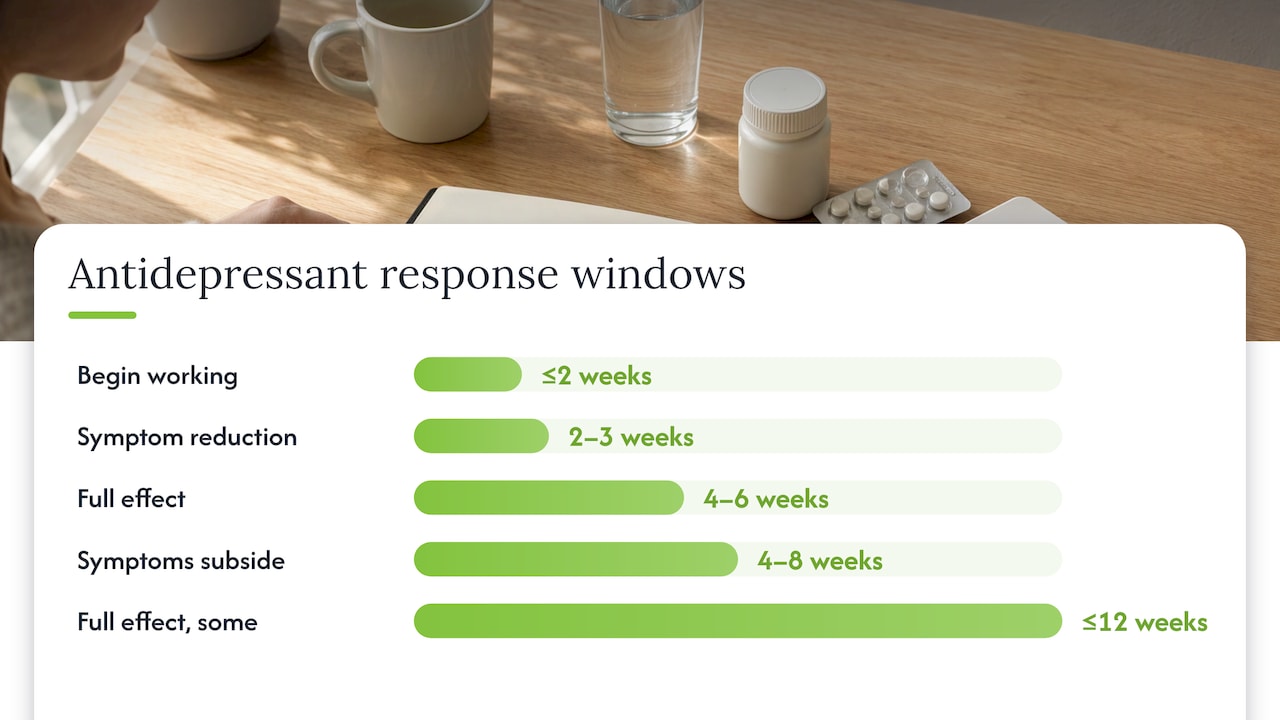
Those ranges overlap, which tells you something. There is a first signal, often subtle, and then a slower build. The number you land on depends on the medication, the dose, how long it took to reach a dose that is right for you, and how your body responds.
One detail we stress: the clock for “full effect” generally starts once you are on a workable dose, not on the day of the first pill. Cleveland Clinic describes SSRIs as taking four to six weeks after reaching a therapeutic dose, and sometimes nine to 12 weeks. If your dose was raised at week three, the count can effectively restart.
A realistic timeline, week by week
No two people follow this exactly. Still, a rough map helps, because it keeps you from judging the medication too early or too late. The ranges below come from NAMI, with the VA and NIMH guidance noted where they add to it.
| When | What people often notice |
|---|---|
| First few days | Sleep and eating habits may begin to improve. Side effects, if any, tend to show up here too. |
| Weeks 1 to 3 | More energy, less anxiety, and sometimes better memory, self-care and interest in sex, according to NAMI. The VA guide lists improved sleep, less fatigue and a little more control over emotions. |
| Weeks 2 to 4 | Mood starts to lift, hopelessness eases, and for some people suicidal thoughts become less frequent (NAMI). |
| Weeks 4 to 8 | The range where most sources place the full effect. The VA Veterans Health Library says it can take as many as 6 to 8 weeks to see a great deal of improvement. |
| Weeks 8 to 12 | Some people are still improving. UpToDate notes that 12 weeks is possible in some cases. |
What tends to change first
The NIMH notes that problems with sleep, appetite, energy and concentration often improve before mood lifts. In our experience this surprises people. They expect to feel happier first. Instead a spouse says “you seem less on edge,” or you realize you slept through the night, and your mood has not caught up yet.
We encourage patients to track those small things. A simple note on your phone each evening, rating sleep, energy and mood from 1 to 10, is enough. At week four, a trend across the page tells us far more than how you feel on one bad Tuesday.
Why mood is usually last
The VA guide explains that antidepressants act mostly on the physical symptoms of depression, and that low mood and low sense of self-worth may respond only partially. They are not “happy pills” that erase sadness. We think this is a fair and useful way to frame it. Medication often makes the ground steadier so that you can do the other work: therapy, routine, movement, getting back to people.
As for why it takes time at all, Cleveland Clinic says the medication needs time to change connections in the brain. The older idea of a quick chemical boost followed by a wait is a simplification. The change you feel is gradual, because the brain adapts gradually.
How long do SSRIs take to work?
SSRIs, such as sertraline (Zoloft), escitalopram (Lexapro) and fluoxetine (Prozac), are usually the first medicines prescribed for depression, per UpToDate. Cleveland Clinic puts the usual onset at four to six weeks once you reach a therapeutic dose, with nine to 12 weeks possible in some individuals.
So if you are on week three of sertraline and feel only a faint difference, you are well within the normal window. If you are at week three and feel worse, or have new thoughts of harming yourself, do not wait it out. Call your prescriber, or call or text 988 in the US.
Early side effects deserve a mention here. Mayo Clinic notes that it may take several weeks or more for an SSRI to be fully effective and for early side effects to ease. Nausea, jitteriness or a change in sleep in the first couple of weeks are common reasons people want to quit. Tell your prescriber before you do. A dose adjustment or a change in timing often helps. We cover this in more detail in our guide to antidepressant side effects, and if sleep is the main trouble, in sleep and antidepressants.
How long do SNRIs take to work?
SNRIs include venlafaxine (Effexor), duloxetine (Cymbalta) and desvenlafaxine (Pristiq). UpToDate describes them as working in a similar way to SSRIs but with other effects, and as sometimes suggested when SSRIs do not help enough. The NIH MedlinePlus Magazine says that commonly prescribed antidepressants, SNRIs included, may need a few weeks, often four to eight, to fully work.
In practice, we plan the same patience window for an SNRI as for an SSRI. We do not tell patients one class will be faster. What differs more is the side effect profile and which symptoms we are trying to reach, such as pain alongside depression.
Why your friend felt better in two weeks and you did not
People differ, and the research is clear on that. The NIMH says people respond to medications in different ways, and it may take several tries to find the one that works best with the fewest side effects. The American Psychiatric Association guideline reports that response rates in clinical trials typically fall between 50 and 75 percent.
The STAR*D study, as described in a 2013 review, found that only about one third of patients reached complete remission after a single antidepressant trial, with the remission rate reaching up to 60 percent after four trials. We find this reassuring when we share it. It means a first medication that does not do enough is an expected part of the process for many people, not a verdict on you.
A large JAMA Psychiatry meta-analysis of 91 trials found no evidence of more variability in response to antidepressants than to placebo. Its authors suggested that future personalization should focus on individual symptoms or biomarkers instead of total depression scores. We read that as a reminder to look closely at your particular symptoms, not just a score on a questionnaire.
Factors we weigh when timing seems slow:
- Whether you reached a full, adequate dose or are still being titrated.
- Missed doses. This is more common than people admit, and we ask without judgment.
- Sleep, alcohol, and other medications or health conditions that blunt the effect.
- Whether the diagnosis is the right one, since bipolar-spectrum mood problems, ADHD and anxiety can overlap with depression.
- Whether therapy is part of the plan.
What to do if you feel nothing after several weeks
UpToDate advises asking your doctor or nurse what to do if you do not feel any better after 2 to 4 weeks. The options it lists include waiting longer, a higher dose, a different medicine, adding counseling or CBT, more exercise, or adding yoga, bright light therapy or a support group. The VA Veterans Health Library suggests talking with your provider if you notice no improvement by 6 weeks.
Here is how we usually sequence it in the office:
- Weeks 1 to 2. Check tolerability. Are side effects manageable? Are you taking it consistently?
- Weeks 3 to 4. Look for any early signal: sleep, anxiety, energy. If there is none, we often discuss a dose increase.
- Weeks 6 to 8 at a good dose. If there is still little change, we talk about switching, or adding something. Mental Health America lists the same menu: adjust the amount, try different medicines, take more than one, or add psychotherapy.
- After more than one adequate trial. We step back and look at the whole picture, including treatment-resistant depression.
If you are already at that stage, our pages on when your antidepressant isn’t working and combination therapy for depression go through the next moves. Changing drugs also has its own rules, and switching antidepressants explains how we try to make that smoother.
Please do not stop on your own
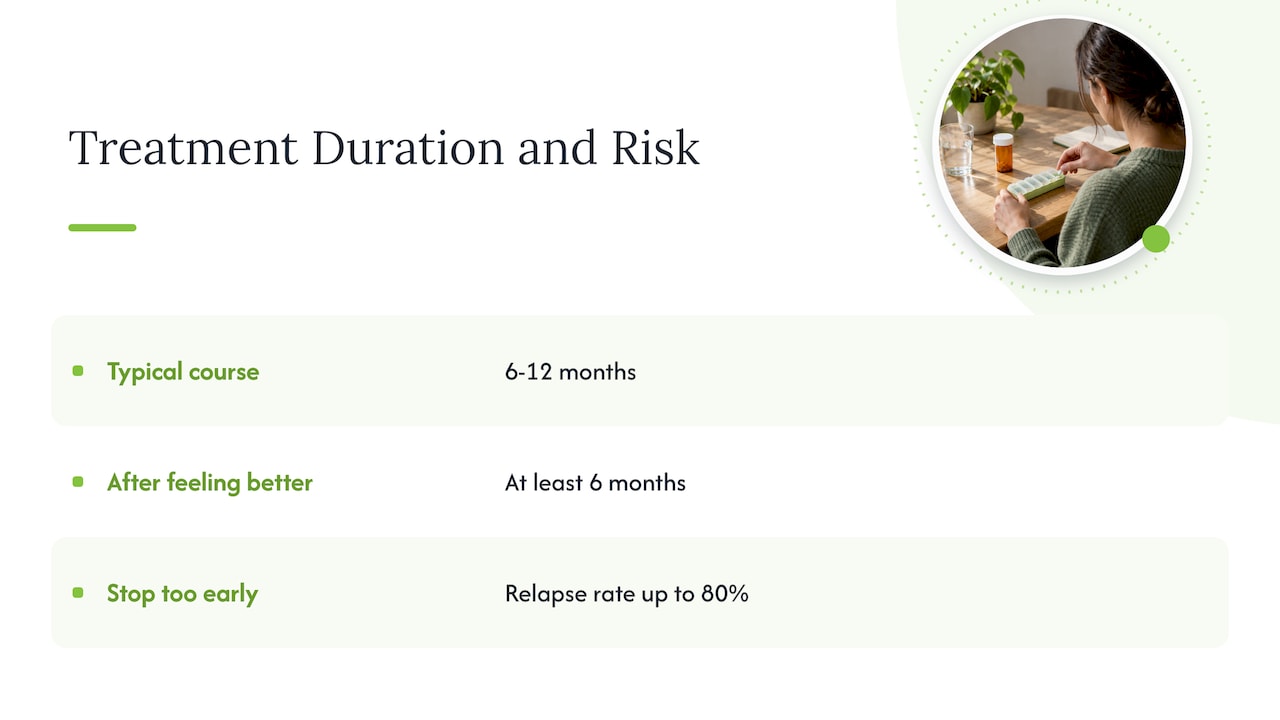
The NIMH is direct about this: do not stop a prescribed medication, even if you feel better, without a health care provider’s help, because stopping too soon may cause unpleasant or harmful side effects. We see two versions of this. One is quitting at week three because nothing has happened. The other is quitting at month three because things are finally good.
On length of treatment, MedlinePlus says the typical course is 6 to 12 months, and some people stay on much longer. Cleveland Clinic says most people continue for at least six months after they start feeling better, and longer if depression is long-term, recurs often or is severe. The VA guide notes that the relapse rate when people stop too early is as high as 80 percent. Tapering, when the time comes, is something we plan together.
Perspective
When someone sits across from me in week three and says the pills are not doing anything, I try not to rush to a conclusion in either direction. Sometimes the answer really is to wait. Sometimes it is to adjust. What I have learned is that the waiting itself is a clinical problem, because hope runs thin around week four, and that is when people leave treatment.
So we plan the wait with you. We agree on what to watch for, when we will speak again, and what the next step is if the answer is still no. In our work, medication management is not a prescription handed over and forgotten. It is a series of small, honest check-ins.
And we do not think the story ends with a first or second medication. Recovery is a journey, not a straight line. For people who have given reasonable trials a fair chance, we offer interventional options such as TMS, Spravato and ketamine therapy, along with careful medication adjustments, because we have seen how much it matters to have more than one door to open.
Felix
When waiting weeks is not the only path
Standard antidepressants build slowly. Some other treatments are designed differently. The NIMH notes that esketamine is an FDA-approved medication for treatment-resistant depression, which may be diagnosed when symptoms do not improve after trying at least two antidepressants, and that it often acts rapidly, typically within a couple of hours. It is given in a clinical setting, not at home.
That is not a reason to skip a first-line medication. For many people an SSRI or SNRI is the right place to begin, and it works. But if you have been through two or more adequate trials without enough relief, it is reasonable to ask about the next tier. Our page on treatment-resistant depression lays out what that looks like, and Spravato versus traditional antidepressants compares how they differ in practice.
Care at Nortex Psychiatry
We are a psychiatric practice in Allen, Texas, serving patients across North Dallas, including Frisco, McKinney and Plano, with in-person and telehealth visits. Beyond medication management and evaluation, we offer Spravato therapy, TMS therapy and ketamine therapy. Not every option fits every person, and an evaluation is how we work out which does. You can reach us through the Nortex Psychiatry home page to book.
A few things that help during the wait
None of this replaces the medication. These are small supports that make weeks two through six more bearable.
- Take it at the same time daily. Link it to something you already do, like brushing your teeth.
- Keep a short log. Sleep, energy, mood, side effects. Bring it to your follow-up.
- Move a little. UpToDate lists exercise among the things that can help alongside medicine. A twenty-minute walk counts.
- Ask about therapy. CBT is a recognized add-on, and starting it early can fill the gap while the medication builds.
- Tell someone. One person who knows you started something new and may be having a rough stretch.
- Know your warning signs. New agitation, worsening mood or thoughts of self-harm, especially in the first weeks or after a dose change, need a same-day call to your prescriber. In a crisis, call or text 988.
Rough days will happen even when the medication is working. We tell patients to expect a bumpy line that trends upward, not a smooth one.
FAQ
How long do antidepressants take to work for anxiety?
The timeline is similar to depression for most people. Some benefits, such as less anxiety and better sleep, may show up in the first one to three weeks according to NAMI, with fuller effects over several more weeks. Your prescriber can tell you what to expect for the specific medicine you are on.
Can an antidepressant work in a week?
Sometimes people notice better sleep or a little more energy within the first week or two, and UpToDate says most antidepressants start to work within 2 weeks. A full effect on mood usually takes longer. Feeling nothing in week one is normal.
How do I know if my antidepressant is not working?
No change at all after about 6 weeks at a good dose is the point where the VA suggests talking with your provider. Earlier, call if side effects are hard to tolerate or you feel worse. Do not stop or change the dose without guidance.
How long will I need to stay on an antidepressant?
MedlinePlus gives a typical treatment length of 6 to 12 months, and some people stay on longer. Cleveland Clinic says most people continue for at least six months after feeling better. Your prescriber will help you decide when and how to taper.
What if I have tried several antidepressants and still feel depressed?
That can be treatment-resistant depression, which the NIMH says may be diagnosed after at least two antidepressants without improvement. Options include medication changes, augmentation, TMS and esketamine. A psychiatric evaluation is the next step.
Sources
- Mental Health Medications, National Institute of Mental Health
- Antidepressants, MedlinePlus
- Using Antidepressant Medications Successfully, Department of Veterans Affairs
- Medicines for Depression, Veterans Affairs
- What to Expect From Your Medications, NAMI
- Patient education: Commonly used medicines for depression, UpToDate
- Selective Serotonin Reuptake Inhibitors, Cleveland Clinic
- Commonly prescribed antidepressants and how they work, NIH MedlinePlus Magazine
- SSRIs, Mayo Clinic
- American Psychiatric Association guideline for major depressive disorder
- Mechanisms of antidepressant resistance, PMC
- Individual Differences in Response to Antidepressants, JAMA Psychiatry
- Dealing with treatment-resistant depression, Mental Health America