


There is no single Spravato success rate. The percentage you see depends on which study, which phase of treatment, and which outcome was counted. In the main trials, roughly half to three quarters of adults with treatment-resistant depression responded, and a smaller share, often between about 47% and 61%, reached remission. Those figures describe specific studies, not a promise for any one person. Below we walk through what the numbers measure, where they come from, and how we think about them in our own practice in Allen.
TL;DR
- “Success” is not one official number. The FDA label reports specific outcomes (symptom-score change, response, remission, relapse) within named studies.
- Response means at least a 50% drop in depression scores. Remission means a low absolute score. You can respond well and still not remit.
- In the SUSTAIN-2 study, response was 78.4% and remission 47.2% at the end of induction. Those figures rose to 76.5% and 58.2% at the end of the maintenance phase. That study had no control group.
- Continuing treatment mattered: in the FDA maintenance trial, relapse was lower with Spravato than with a switch to placebo.
- The first four weeks are an evaluation window. The label says to assess benefit at the end of induction.
Table of Contents
- Why there is no single success rate
- Response, remission and relapse: three different words
- What the clinical trials found
- Does the benefit last?
- What the schedule looks like
- What affects whether it works for you
- Side effects and safe use
- Is Spravato worth discussing for your situation?
- Spravato at Nortex Psychiatry
- FAQ
- Sources
Why there is no single success rate
People search for one percentage, and we understand why. When you have tried several medications and still feel flat, you want to know the odds. But the honest answer is that the odds depend on how you define success.
The FDA prescribing information does not give one overall success rate. It reports efficacy as specific outcomes within a named study, treatment phase and population. A number from a four-week controlled trial is not the same thing as a number from a year-long open-label study. A number from adults who had failed at least two antidepressants is not the same as a number from the general depressed population.
When a website tells you Spravato works “70% of the time,” ask three things. Which trial? Which outcome? Over what period? If the page cannot answer, the number is not much use to you.
Response, remission and relapse: three different words
We spend a lot of time with patients on this, because the words get blurred.
Response is generally defined as at least a 50% decrease from baseline on a standardized depression scale. If your score was 36 and it drops to 18, you responded. You may still have symptoms, and they may still bother you.
Remission means the score falls below a set cutoff, which indicates few or no depressive symptoms. The FDA label uses a stable-remission criterion of MADRS 12 or lower for at least 3 of 4 weeks. That is a higher bar than response, so remission percentages are almost always lower.
Relapse is the return of significant symptoms after improvement. It matters because Spravato is not a one-time event. How well people hold their gains is a large part of the real story.
In our experience, patients often care less about the scale and more about a simpler question: can I get through a Tuesday without dread? The scales are a way to measure that, not a replacement for it.
What the clinical trials found
The FDA’s evidence base
The FDA medical review for adult treatment-resistant depression rested on two positive phase 3 studies: a short-term controlled trial and a randomized-withdrawal trial looking at relapse prevention. Both mattered. The first asked whether Spravato helps. The second asked whether the benefit holds if you keep going.
In the short-term trial, as summarized in a peer-reviewed review, Spravato plus a newly started oral antidepressant lowered average MADRS scores by 19.8 points over four weeks, compared with 15.8 points for placebo nasal spray plus the same kind of antidepressant. Most of that treatment effect was already visible by 24 hours.
That last detail is worth sitting with. People who have been depressed for years rarely get news that something might shift in a day. It does not mean everyone feels better overnight. It does mean that a lack of change in the first weeks is information we can work with early, rather than something to wait out for two months.
SUSTAIN-2: longer follow-up
SUSTAIN-2 followed people for longer. A systematic review reports that response and remission were 78.4% and 47.2% at the end of induction, then 76.5% and 58.2% at the end of the optimization and maintenance phase. The study was uncontrolled, meaning there was no placebo group, and sustained improvement was reported among responders who stayed in treatment for up to a year.
Because there was no comparison group, we read those figures as encouraging, not as proof of a rate you should expect. People who stay in a long study are also a particular group.
SUSTAIN-3 and age groups
Interim results from SUSTAIN-3, as submitted to Oregon’s Pharmacy and Therapeutics Committee, show how response builds. The share responding during induction rose from 15% at day 8 to 50.6% at day 28, with endpoint response of 49.2%. The same document reports that at the end of the week-12 phase, response and remission were 81% and 56% in patients aged 18 to 64, and 79% and 61% in patients 65 or older. These are phase-specific subgroup results, and the testimony was submitted by the manufacturer, so we treat them as one data point among several.
Spravato on its own
Most patients take Spravato alongside an oral antidepressant, which is how it is labeled. A 2025 randomized trial of esketamine monotherapy found response rates about twice as high, and remission rates two to three times as high, as placebo at day 28. The number needed to treat for response was 6.5 for the 56 mg dose and 7.1 for 84 mg. For remission it was 12.3 and 6.7.
A number needed to treat sounds abstract, so here is how we explain it. If you treated about seven people, one of them would respond who would not have responded to placebo. That is not the same as saying one in seven people benefit. Many people respond to placebo too, and some respond to Spravato for reasons both groups share.
A quick reference
| Study or source | What was measured | Result |
|---|---|---|
| SUSTAIN-2 (uncontrolled) | Response / remission, end of induction | 78.4% / 47.2% |
| SUSTAIN-2 (uncontrolled) | Response / remission, end of maintenance | 76.5% / 58.2% |
| SUSTAIN-3 interim | Response during induction | 15% at day 8, 50.6% at day 28 |
| Monotherapy trial, 2025 | Number needed to treat for response | 6.5 (56 mg), 7.1 (84 mg) |
| FDA maintenance trial | Relapse, stable remitters | 26.7% vs 45.3% on placebo spray |
| FDA maintenance trial | Relapse, stable responders | 25.8% vs 57.6% on placebo spray |
Does the benefit last?
This is the part we think gets the least attention online, and it is the part that changes how we plan care.
In the randomized-withdrawal maintenance trial, people who had reached stable remission or stable response either continued Spravato plus an oral antidepressant or switched to placebo spray. According to the peer-reviewed summary, relapse occurred in 26.7% of stable remitters who continued versus 45.3% who switched, and in 25.8% of stable responders who continued versus 57.6% who switched. The FDA review called this trial important evidence of maintenance of effect in people who first reached stable response or remission.
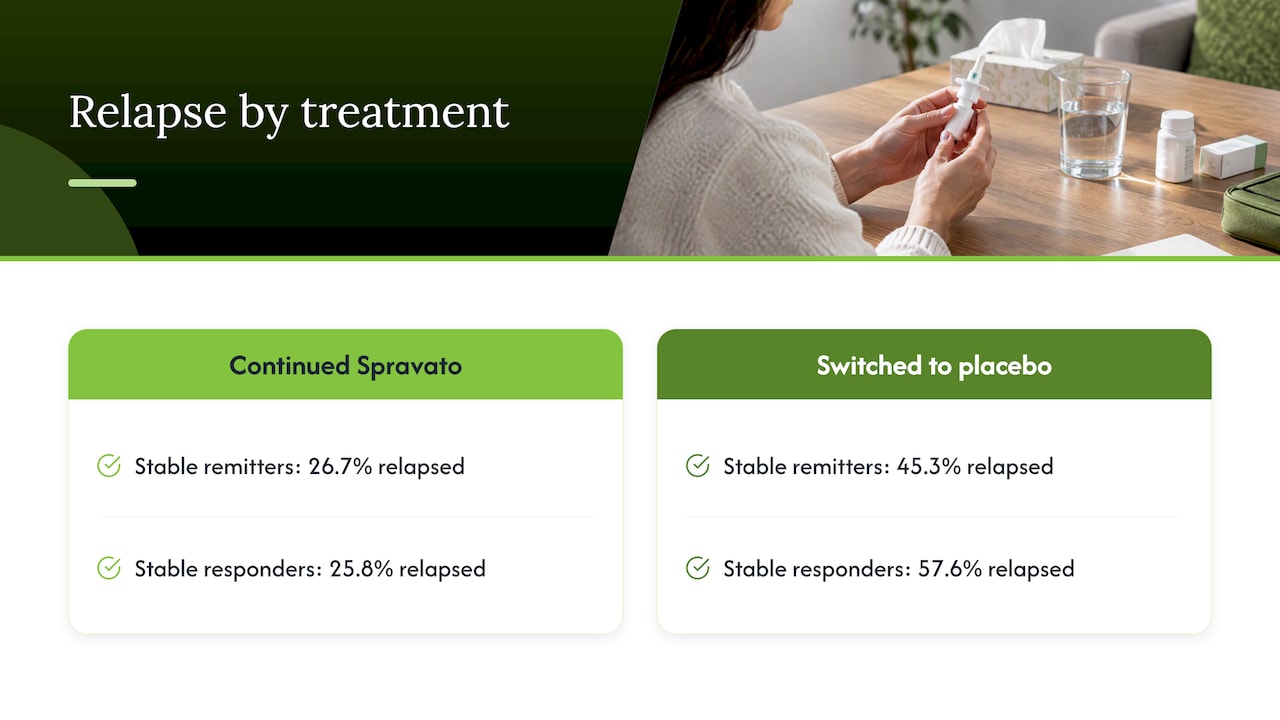
In plain terms, if Spravato works for you, stopping abruptly carries a real risk of losing ground. That is why we talk about maintenance at the very start, not as an afterthought.
What the schedule looks like
The current FDA label recommends twice-weekly dosing in weeks 1 to 4, weekly dosing in weeks 5 to 8, and weekly or every-two-week dosing from week 9, individualized to the least frequent schedule that keeps response or remission. The label also says to evaluate therapeutic benefit at the end of the four-week induction phase to decide whether to continue.
So the first month is partly a test. We check in, look at your scores and, more importantly, at how your days are going. If there is no meaningful change, we talk honestly about next options. If there is, we start the longer work of finding your lowest effective frequency. For the practical details, our guide to how Spravato schedules actually work goes session by session.
What affects whether it works for you
We cannot predict your result from a spreadsheet. But the label and trial designs show some things that shape outcomes.
- Who was studied. The pivotal studies enrolled adults with defined treatment-resistant depression, measured on structured MADRS thresholds, and required continuing or starting an antidepressant. If your situation differs, the numbers fit less well.
- Consistency. Missed sessions in the early weeks make it harder to judge whether treatment is helping.
- The rest of the plan. Sleep, alcohol, other medications and therapy all matter. Our post on tips for enhancing Spravato outcomes covers the things we ask patients to look at.
- Real-world conditions. The trials ran in specialized centers under strict supervision. A review notes that this is why long-term randomized trials are still called for. We follow the same supervision requirements in our clinic, which is part of why the monitoring is not optional.
Side effects and safe use
A success rate means little if you cannot get through the session, so here is what to expect, and how safe use is built in.
The label lists common adverse reactions: dissociation, dizziness, nausea, sedation, vertigo, increased blood pressure, vomiting, feeling drunk and headache. It requires at least two hours of monitoring after dosing, and warns about respiratory depression, abuse and misuse, and rare respiratory arrest. That is the reason Spravato is given in a certified setting and not at home. We explain the reasoning in why two hours of clinic monitoring are required and the REMS requirements.
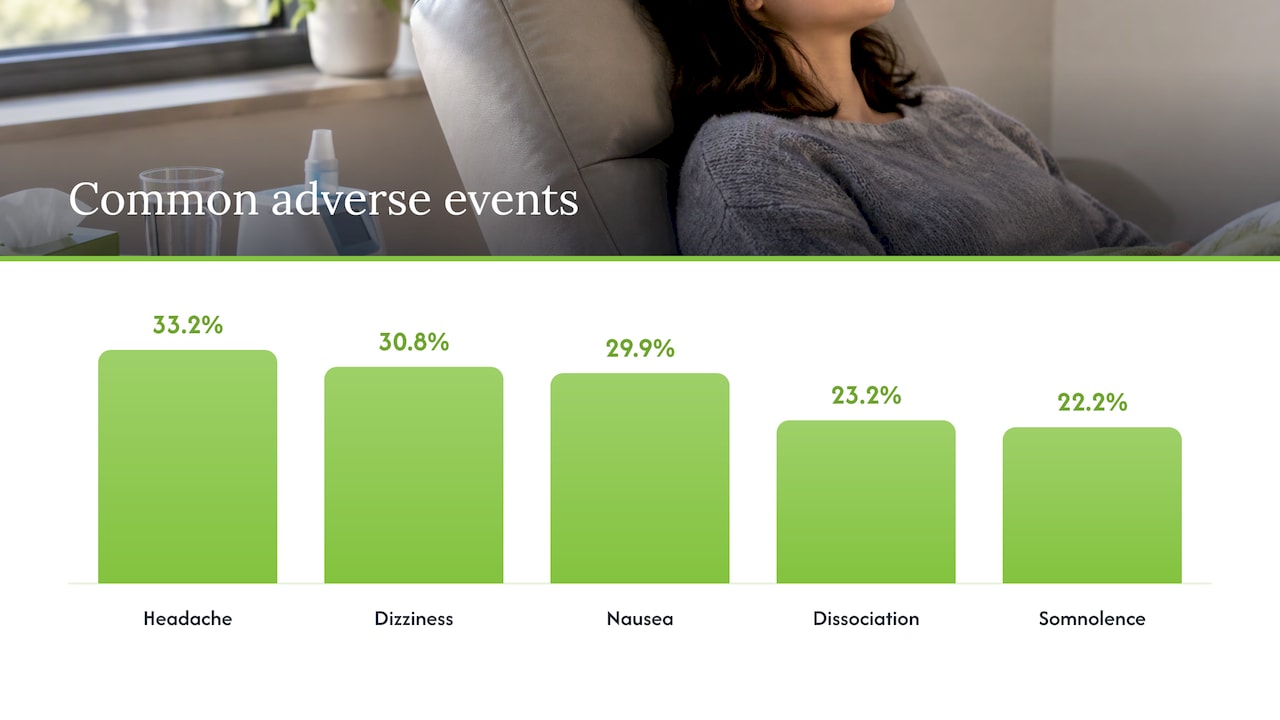
In SUSTAIN-2’s maintenance phase, the most frequent events were headache (33.2%), dizziness (30.8%), nausea (29.9%), dissociation (23.2%) and somnolence (22.2%). Of all adverse events, 96.8% were mild or moderate, and 5.8% led to discontinuation. The systematic review likewise describes these effects as generally mild to moderate and often resolving the same day.
A few practical points we give everyone:
- Arrange a ride home. You should not drive until the next day after a restful sleep.
- Tell us about your blood pressure, heart conditions, and any substances you use before your first session, not after.
- Skip heavy meals right before dosing, and follow the fasting instructions we give you.
- If a side effect feels worse than we described, say so in the room. We would rather adjust than have you quietly dread the next visit.
If you want a walk-through of the visit itself, see what to expect during Spravato therapy.
Our perspective
When someone asks us for the success rate, we usually answer with a question: what would a good result look like for you? For one person it is getting out of bed. For another it is finishing a work week without crying in the car.
We have learned to be careful with big percentages. The trials are real and the signal is real, and we have seen patients who had been stuck for years begin to move. But we have also seen slower starts, partial responses, and people who needed us to adjust the plan around them. None of that is failure. It is how treatment-resistant depression tends to go.
What we notice most is that the people who do best are rarely the ones with the best odds on paper. They are the ones who show up for the early sessions, tell us the truth about how it feels, and stay with a maintenance plan once it is working. We would rather set that expectation on day one than promise a number.
Spravato is one tool in our interventional program, alongside TMS and ketamine. If it is not the right fit, we will say so, and we will talk about what else could be.
Felix
Is Spravato worth discussing for your situation?
Spravato is approved for adults with treatment-resistant depression, and the trials enrolled people who had not gotten enough relief from other antidepressants. If that sounds like you, it is reasonable to ask about it. If you are earlier in the process, our comparison of Spravato and traditional antidepressants may help you see where each fits.
You might also be wondering how it differs from ketamine. We cover that in the difference between ketamine and esketamine. Coverage questions come up in nearly every first visit, and our step-by-step insurance guide is a good place to start before you call.
Spravato at Nortex Psychiatry
We offer Spravato therapy at our practice in Allen, Texas, for adults from Frisco, McKinney, Plano and across North Dallas. We start with an evaluation of your history and what you have already tried, so we can tell you honestly whether Spravato is a reasonable next step. You can also read about our 2-hour monitored Spravato program before booking. Pricing is not published on our site, so please contact us for details.
FAQ
What is the success rate of Spravato?
There is no single official rate. In SUSTAIN-2, response was 78.4% and remission 47.2% at the end of induction, and 76.5% and 58.2% at the end of maintenance. That study had no control group, so we read it as encouraging and not as a prediction for you.
How long do people typically stay on Spravato?
That varies. The label calls for twice-weekly dosing for four weeks, weekly for weeks 5 to 8, then weekly or every other week, using the least frequent schedule that keeps your improvement. Benefit is evaluated at the end of the first four weeks to decide whether to continue.
What are the downsides of Spravato?
The common ones are dissociation, dizziness, nausea, sedation, vertigo, higher blood pressure and headache. Most are mild to moderate and often pass the same day. You also need to commit to at least two hours of monitoring per session and have a safe ride home.
What does it feel like to be on esketamine?
Most people describe feeling detached, lightheaded or drowsy for a while after dosing, sometimes with nausea. It tends to ease over the monitoring period. We stay nearby, and you can tell us if anything feels wrong.
Sources
- FDA prescribing information for Spravato, revised April 2025
- FDA prescribing information for Spravato, 2025 (dosing and adverse reactions)
- FDA medical review of Spravato, 2019
- Esketamine (Spravato) nasal spray clinical policy, response and remission definitions
- Efficacy and Safety of Intranasal Esketamine in Treatment-Resistant Depression (systematic review)
- Role of Ketamine in the Treatment of Psychiatric Disorders
- Esketamine Monotherapy in Adults With Treatment-Resistant Depression, JAMA Psychiatry 2025
- SPRAVATO written testimony, Oregon Pharmacy and Therapeutics Committee, December 2023