


Healthy daily habits are one of the most direct and modifiable influences on mental health outcomes. The role of lifestyle in mental health is not a peripheral concern. 1 in 5 US adults report mental illness, costing the country over $280 billion annually. That scale makes prevention and lifestyle-based protection more relevant than ever. Lifestyle psychiatry, the clinical field that formally integrates behavioral medicine into psychiatric care, now recognizes diet, physical activity, sleep, social connection, and stress management as core treatment components, not optional add-ons. What you do each day shapes how your brain functions, how you regulate emotion, and how resilient you are when stress arrives.
Which lifestyle factors most impact mental health and anxiety management?
Physical activity is the most consistently supported lifestyle factor in mental health research. Aerobic exercise, resistance training, and mind-body practices like Tai Chi and yoga all reduce symptoms of depression and anxiety. They do this by improving mood, sharpening cognition, and building the kind of mental resilience that makes stress feel more manageable. A review synthesizing 17 recent studies confirmed that sedentary behavior, excessive screen time, and poor sleep quality increase psychological vulnerability, while physical activity and social support protect mental health, particularly in younger populations.
Nutrition is the second major domain. The gut-brain axis, the communication network between your digestive system and your brain, means that what you eat directly influences how you feel emotionally. Diets high in processed foods and low in fiber disrupt this system. Diets rich in whole foods, vegetables, and healthy fats support it. Expert consensus among Major Depressive Disorder specialists now places gut health and nutrition alongside physical activity and sleep hygiene as critical components of treatment.

Sleep quality and social connectedness round out the core lifestyle domains. Chronic poor sleep does not just leave you tired. It raises cortisol, disrupts emotional regulation, and increases vulnerability to anxiety and depression. Social isolation compounds this. Meaningful relationships buffer psychological stress in ways that no supplement or app can replicate.
Key lifestyle factors that protect mental health include:
- Regular physical activity: Even 20–30 minutes of moderate aerobic exercise most days reduces anxiety symptoms measurably.
- Whole-food nutrition: Mediterranean and MIND diet patterns support brain function and reduce inflammation.
- Consistent sleep schedule: Going to bed and waking at the same time each day stabilizes mood and cognition.
- Social engagement: Regular contact with people you trust lowers psychological vulnerability.
- Stress management practices: Mindfulness, Tai Chi, and yoga reduce cortisol and improve emotional regulation.
- Reduced screen time: Limiting passive screen use, especially before bed, improves sleep quality and reduces anxiety.
Pro Tip: If you are not sure where to start, pick one habit from this list and practice it consistently for two weeks before adding another. Stacking too many changes at once is one of the most common reasons people abandon lifestyle programs.
How does lifestyle biology explain the connection to mental health?
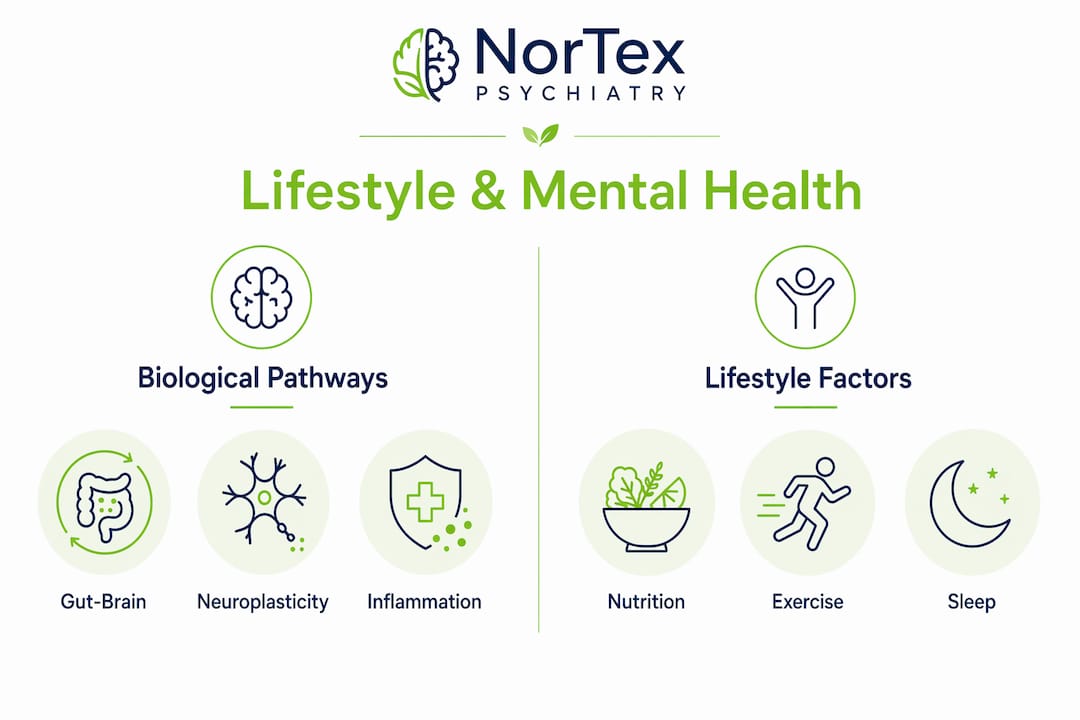
The connection between lifestyle and mental wellness is not just psychological. It is biological. Lifestyle behaviors influence neuro-immune health, cardiovascular function, and the gut-brain axis. These are the physical systems that underlie mood, cognition, and stress response. When these systems are disrupted, psychiatric distress follows.
Chronic psychosocial stress triggers immune system dysregulation and gut microbiome disruption. Both worsen mental health outcomes. Lifestyle changes, particularly diet and exercise, address these pathways directly. Physical activity reduces systemic inflammation, which is increasingly recognized as a driver of depression. The FINGER and POINTER clinical trials, both large-scale European studies, confirmed that aerobic exercise and diet improve neuroplasticity and reduce inflammation in older adults, with measurable effects on mood and cognition.
“Physical health indicators, including cardiovascular fitness, sleep quality, and inflammatory markers, function as vital signs for mental wellness, not separate concerns.” — Framework from Frontiers in Psychology, 2026
Chronic insomnia and cardiovascular strain often precede psychiatric distress rather than follow it. This matters clinically. It means that addressing physical health is not just supportive care. It is often primary care for mental health.
| Biological pathway | Lifestyle factor | Mental health effect |
|---|---|---|
| Gut-brain axis | Diet quality, fiber intake | Improved emotional regulation |
| Neuroinflammation | Aerobic exercise | Reduced depression symptoms |
| HPA axis (stress response) | Sleep hygiene | Lower cortisol, better mood stability |
| Cardiovascular function | Physical activity | Reduced anxiety, improved cognition |
| Neuroplasticity | Exercise and nutrition combined | Stronger stress resilience |
What are effective lifestyle interventions and how do they compare?
Not all lifestyle interventions produce the same results, and the format matters as much as the content. Aerobic exercise produces the strongest evidence base for reducing depression and anxiety. Resistance training adds benefits for self-efficacy and physical confidence. Mind-body practices like Tai Chi and yoga are particularly effective for older adults and people with high anxiety, partly because they combine movement with breath regulation and focused attention.
Nutrition interventions show the clearest results when they follow structured dietary patterns. The Mediterranean diet and the MIND diet both reduce cognitive decline and support emotional stability. The MIND diet, which combines Mediterranean and DASH principles with a specific focus on brain health foods, has shown particular promise in populations at risk for depression.
Group-based exercise programs consistently outperform solitary exercise for long-term adherence. Group exercise improves adherence by adding social accountability and connection, two factors that independently protect mental health. That said, individual preference determines what someone will actually sustain. A person who finds group settings stressful will do better with a solo walking routine they enjoy.
Here is how the major intervention types compare:
- Aerobic exercise (walking, cycling, swimming): Strongest evidence for reducing depression and anxiety; accessible and low cost.
- Resistance training: Improves self-efficacy and physical health; moderate evidence for mood benefits.
- Tai Chi and yoga: Particularly effective for anxiety and stress; combines movement with mindfulness.
- Mediterranean and MIND diets: Support brain health and reduce inflammation; require planning but are sustainable long term.
- Mindfulness-based stress reduction (MBSR): Reduces anxiety and improves emotional regulation; works well alongside other interventions.
Pro Tip: Pairing a dietary change with a social activity, like cooking a Mediterranean meal with a friend or joining a group fitness class, gives you two protective lifestyle factors at once and makes both more likely to stick.
A unified behavioral change framework for lifestyle psychiatry, developed by 43 international experts, now exists to help clinicians apply these interventions consistently. The lack of such a framework had previously caused inconsistent advice and fragmented care. That gap is closing.
How can you apply lifestyle changes sustainably to improve mental health?
Sustainable lifestyle change requires a person-centered approach. What works for one person may not work for another, and that is not a failure of motivation. It is a signal to adjust the plan. The most effective lifestyle programs are built around individual preferences, existing routines, and realistic goals.
Start with physical activity because the evidence for its mental health benefits is the strongest and the entry point is low. A 20-minute daily walk is a legitimate clinical intervention. Build from there. Add dietary changes gradually, focusing first on what you can add (vegetables, whole grains, water) rather than what you must eliminate. Restriction-focused approaches tend to fail faster.
Sleep hygiene deserves specific attention because it is often the first thing to deteriorate under stress and the last thing people prioritize. Set a consistent bedtime. Reduce screen exposure in the hour before sleep. Keep your bedroom cool and dark. These are not suggestions. They are evidence-based practices that directly affect next-day mood and anxiety levels.
Practical steps for building sustainable lifestyle habits:
- Anchor new habits to existing ones: Exercise after your morning coffee, not at a time you have to carve out separately.
- Use social support actively: Tell someone your goal. Better yet, do the activity with them.
- Track progress simply: A paper habit tracker or a basic app is enough. You do not need sophisticated tools.
- Expect setbacks: Adopting multiple healthy behaviors leads to consistent long-term benefits, but the path is not linear.
- Integrate with professional care: Lifestyle change works best alongside, not instead of, clinical treatment for anxiety and depression.
For a structured approach to combining lifestyle changes with professional support, the step-by-step mental health care guide from Nortexpsychiatry offers a practical framework. Managing expectations matters too. Lifestyle modification is a long-term process, and the benefits accumulate over months, not days.
Pro Tip: If you are managing anxiety specifically, stress and anxiety release techniques like progressive muscle relaxation and diaphragmatic breathing can be practiced in under five minutes and pair well with any exercise or mindfulness routine.
Key takeaways
Daily lifestyle habits directly shape mental health outcomes, and combining physical activity, quality nutrition, consistent sleep, and social connection produces the strongest and most lasting protection against anxiety and depression.
| Point | Details |
|---|---|
| Physical activity is primary | Aerobic exercise, Tai Chi, and yoga reduce anxiety and depression symptoms with strong clinical evidence. |
| Diet affects brain function | Mediterranean and MIND diet patterns reduce inflammation and support emotional regulation through the gut-brain axis. |
| Sleep is not optional | Chronic poor sleep raises cortisol and increases vulnerability to anxiety; consistent sleep schedules stabilize mood. |
| Group formats improve adherence | Group-based exercise adds social connection, which independently protects mental health and sustains habit formation. |
| Lifestyle works alongside treatment | Lifestyle psychiatry is most effective when integrated with clinical care, not used as a replacement for it. |
What we have learned about lifestyle and mental health care
After years of working with patients across North Texas, one pattern stands out clearly. The people who make the most meaningful progress are rarely the ones who overhaul everything at once. They are the ones who pick one or two habits, build them slowly, and treat setbacks as information rather than failure.
Lifestyle change is genuinely hard. Not because people lack willpower, but because behavior change runs against the grain of stress, fatigue, and the demands of daily life. We see this regularly. A patient starts exercising, feels better, then a difficult week at work disrupts the routine, and they feel like they have failed. They have not. They have just encountered the normal, nonlinear nature of recovery.
What I find most clinically significant is how often physical health issues, particularly poor sleep and low cardiovascular fitness, show up before psychiatric symptoms become severe. Addressing those physical factors early changes the trajectory. It does not replace medication or therapy when those are needed. But it creates a biological foundation that makes every other treatment more effective.
The evidence-based psychiatry model we follow at Nortexpsychiatry treats lifestyle as a core clinical variable, not an afterthought. That shift in perspective changes what we ask patients about, what we recommend, and how we measure progress. Lifestyle is not a soft intervention. It is a foundational one.
— Felix
Mental health care that includes lifestyle at Nortexpsychiatry
Nortexpsychiatry serves patients across Allen, Frisco, McKinney, Plano, and the broader North Dallas area with personalized, evidence-based psychiatric care. Our approach to anxiety and depression treatment incorporates lifestyle factors alongside medication management and therapy, because the research is clear that behavior and biology are inseparable. If you are ready to understand how your daily habits connect to your mental health, our anxiety care for adults resource is a strong starting point. For a broader look at how psychiatric care and lifestyle work together, the step-by-step mental health care guide walks through the process clearly. Both in-person and telehealth appointments are available.
FAQ
What is the role of lifestyle in mental health?
Lifestyle behaviors, including physical activity, diet, sleep, and social connection, directly influence brain function, inflammation, and stress response. Healthy habits reduce the risk of anxiety and depression and support recovery when mental health conditions are already present.
How does exercise help with anxiety and depression?
Aerobic exercise reduces anxiety and depression symptoms by lowering inflammation, improving neuroplasticity, and regulating the stress response system. Even moderate activity, like a daily 20-minute walk, produces measurable mood benefits.
Can diet really affect mental health?
Diet affects mental health through the gut-brain axis, the communication network between the digestive system and the brain. Mediterranean and MIND diet patterns reduce inflammation and support emotional regulation, with clinical evidence backing their use in depression treatment.
How long does it take for lifestyle changes to improve mental health?
Lifestyle changes produce gradual benefits that accumulate over weeks and months rather than days. Consistent adherence to multiple healthy behaviors, including exercise, diet, and sleep, leads to the most significant and lasting mental health improvements.
Should lifestyle changes replace psychiatric treatment?
Lifestyle changes work best alongside clinical treatment, not as a replacement for it. Lifestyle psychiatry is an integrative component of psychiatric care, and combining behavioral changes with medication or therapy produces better outcomes than either approach alone.