


Step by step depression recovery is a systematic process that combines lifestyle changes, evidence-based therapy, and medical treatment to restore mental health in a measurable, repeatable sequence. The clinical term for this structured approach is major depressive disorder management, though most people simply call it a recovery plan. What matters most is that recovery is achievable. PHQ-9 tracking every four weeks gives you objective proof of progress, even when your mood tells you otherwise. A solid depression recovery plan addresses sleep, movement, therapy, social connection, and medication in a specific order. Skipping steps or treating them as optional slows everything down.
What foundational habits must you build first in step by step depression recovery?
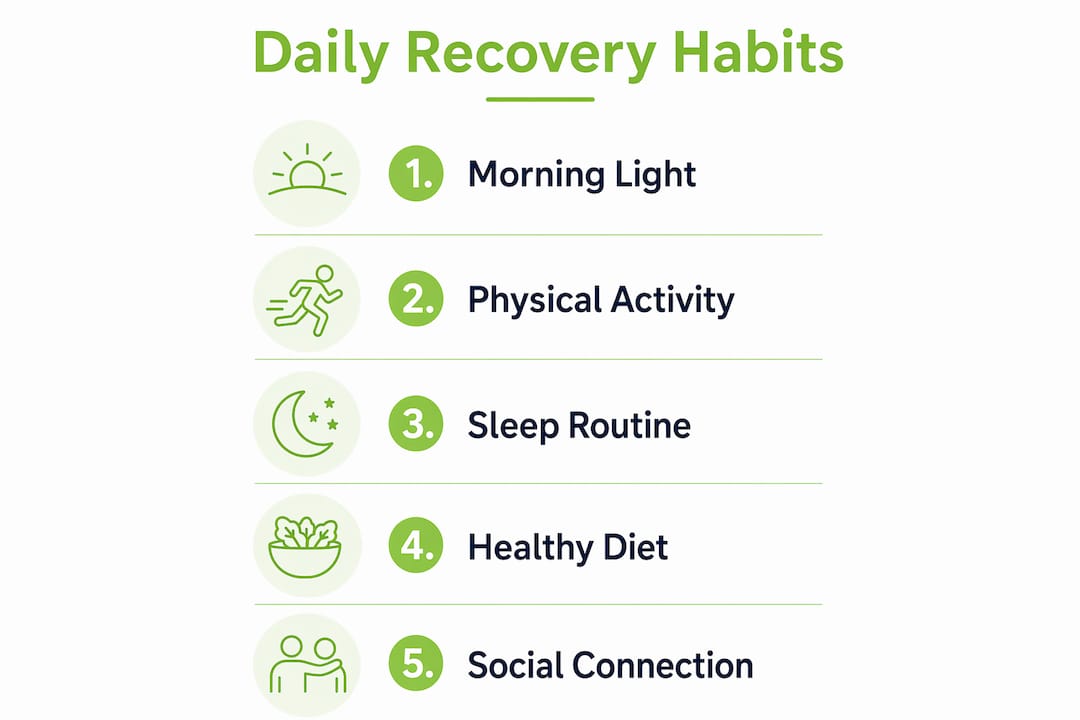
The first phase of any depression recovery plan is not medication. It is lifestyle stabilization. Without a regulated nervous system, therapy is harder to absorb and medication is harder to evaluate. These habits are not optional extras. They are the clinical floor everything else rests on.

The two most important daily habits are morning light exposure of 10–30 minutes and physical movement for 10–20 minutes. Both regulate circadian rhythms and support mood chemistry. You do not need a gym membership. A walk outside before 9 a.m. covers both at once.
Sleep is equally non-negotiable. A fixed wake time, even on weekends, anchors your circadian rhythm faster than any supplement. Irregular sleep schedules are one of the most common ways people accidentally extend their depression without realizing it.
Diet matters more than most people expect. A whole-food diet with reduced processed sugar supports gut health, and emerging research links gut microbiome function to mood regulation. Probiotic supplementation is worth discussing with your doctor, particularly if your diet has been poor during the depressive episode.
Ending isolation is one of the most powerful early interventions available. Identify at least one trusted, non-medical support person from day zero. Social connection acts as a stabilizer of nervous system activity. You do not need to explain everything to this person. You just need to not be alone.
Pro Tip: Set a single fixed wake time and commit to it for two weeks before adding anything else. Consistency in sleep timing produces faster mood stabilization than almost any other single habit change.
Here is a quick reference for the foundational habits and their primary function:
| Habit | Daily Target | Primary Benefit |
|---|---|---|
| Morning outdoor light | 10–30 minutes | Circadian rhythm regulation |
| Physical movement | 10–20 minutes | Mood and energy support |
| Fixed wake time | Same time daily | Sleep architecture stabilization |
| Social contact | At least one interaction | Nervous system stabilization |
| PHQ-9 self-assessment | Every 4 weeks | Objective progress tracking |
How do CBT and behavioral activation support your recovery?
Cognitive behavioral therapy (CBT) and behavioral activation are the two most studied psychological treatments for depression. CBT targets the thought patterns that sustain depression. Behavioral activation targets the withdrawal and inactivity that deepen it. Both are effective. Together, they address depression from two directions at once.
Behavioral activation works on a simple principle: action precedes motivation in depression, not the other way around. Waiting to feel motivated before doing something is a trap. Small bursts of activity of five minutes can initiate momentum and break cycles of inertia. The activity does not need to be meaningful or enjoyable at first. It just needs to happen.
Here is a practical sequence for applying these techniques week by week:
- Choose one small activity you used to find neutral or pleasant. A short walk, making coffee, or reading one page of a book all count.
- Schedule it at a fixed time rather than waiting until you feel like doing it. Scheduling removes the decision and reduces resistance.
- Log your mood before and after the activity on a scale of 1–10. Most people notice a small but real improvement after, even when they expected nothing.
- Add one more activity the following week. Build gradually rather than overhauling your entire schedule at once.
- Track micro-milestones. Getting out of bed at the same time three days in a row is a real win. Micro-milestones prevent the paralysis that comes from measuring progress only against full recovery.
CBT adds a second layer by helping you identify automatic negative thoughts and test them against evidence. A trained therapist guides this process most effectively, but CBT workbooks like Mind Over Mood by Dennis Greenberger and Christine Padesky provide a solid self-directed starting point. You can find a broader overview of evidence-based therapy approaches that complement these techniques.
Optional additions at this stage include mindfulness practice, structured breathwork such as box breathing, and cold water exposure. These are not replacements for CBT or behavioral activation. They are supplementary tools that some people find helpful for managing acute anxiety and low energy alongside depression.
Pro Tip: Before dismissing an activity as pointless, try it three times and log your mood each time. One data point is not enough. Three gives you a pattern.
When should you add supplements or medication to your plan?
Supplements and medication belong in the plan, but timing and sequencing matter. Adding them before lifestyle habits are in place makes it harder to know what is actually working.
The supplements with the strongest evidence base for depression support are:
- Vitamin D: Low levels are common in people with depression. A blood test confirms deficiency before supplementing.
- Magnesium glycinate: Supports sleep quality and nervous system regulation.
- Omega-3 fatty acids (EPA-dominant): Anti-inflammatory effects with consistent evidence in mood research.
- Zinc: Deficiency is linked to depressive symptoms in multiple studies.
- L-methylfolate: Particularly relevant if standard folate metabolism is impaired, which a genetic test like MTHFR screening can identify.
Checking vitamin and thyroid levels through a basic lab panel is a standard part of comprehensive depression management. Thyroid dysfunction, low B12, and low folate can all mimic or worsen depression. Treating an underlying deficiency sometimes produces significant improvement on its own.
When lifestyle changes and therapy are not enough, SSRIs (selective serotonin reuptake inhibitors) such as sertraline or escitalopram, and SNRIs (serotonin-norepinephrine reuptake inhibitors) such as venlafaxine or duloxetine, are the most commonly prescribed first-line medications. Most people notice meaningful improvement within four to eight weeks of starting at a therapeutic dose.
| Treatment Type | Typical Onset | Key Consideration |
|---|---|---|
| SSRI (e.g., sertraline) | 4–8 weeks | Start low, titrate slowly |
| SNRI (e.g., venlafaxine) | 4–8 weeks | Useful when anxiety co-occurs |
| L-methylfolate | 2–4 weeks | Augments antidepressant response |
| Omega-3 (EPA-dominant) | 4–8 weeks | Anti-inflammatory support |
Consistency in medication and therapy is what prevents relapse. Stopping medication abruptly when you start feeling better is one of the most common mistakes we see. Feeling better is evidence the treatment is working, not evidence you no longer need it. Discuss any changes with your prescribing doctor before making them. If your plan has plateaued after eight weeks, changing or augmenting therapies is the appropriate clinical response, not giving up.
What advanced treatments exist for severe or treatment-resistant depression?
Some people follow every step correctly and still do not respond adequately to standard treatments. This is not personal failure. It is a clinical reality that affects a meaningful portion of people with major depressive disorder, and there are effective options designed specifically for this situation.
The main advanced interventions include:
- Transcranial Magnetic Stimulation (TMS): A non-invasive procedure that uses magnetic pulses to stimulate underactive areas of the brain. No anesthesia is required. You can read a detailed TMS vs. ECT comparison to understand how these two modalities differ.
- Ketamine therapy: Administered in a clinical setting, ketamine produces rapid antidepressant effects, often within hours to days. It is particularly useful when suicidal ideation is present and a fast response is needed. Research on ketamine for treatment-resistant depression continues to grow.
- Electroconvulsive therapy (ECT): The most effective treatment for severe, treatment-resistant depression. Modern ECT is safe, precise, and performed under general anesthesia. The stigma around it is largely outdated.
- Psychedelic-assisted therapy: Psilocybin-assisted therapy is in late-stage clinical trials and showing strong results for treatment-resistant cases. It is not yet widely available outside research settings.
Advanced interventions like TMS, ketamine, and ECT are effective options for severe or treatment-resistant depression, not signs of personal failure. They are sophisticated clinical tools. Using them when standard treatments are insufficient is sound medical judgment, not a last resort.
“Seeking advanced treatment is not an admission of weakness. It is a recognition that depression is a medical condition, and some medical conditions require more than first-line care.”
Partial hospitalization programs (PHP) and intensive outpatient programs (IOP) are also worth knowing about. These structured programs provide daily clinical support without full inpatient admission. They are appropriate when outpatient care is not providing enough stabilization but hospitalization is not yet necessary.
Key takeaways
Structured, consistent action across lifestyle, therapy, and medical treatment is the most reliable path through depression recovery.
| Point | Details |
|---|---|
| Start with lifestyle habits | Fixed wake time, morning light, and daily movement form the clinical foundation before adding therapy or medication. |
| End isolation from day one | Identifying one trusted support person immediately stabilizes the nervous system and reduces symptom severity. |
| Track progress with PHQ-9 | Reassessing every four weeks provides objective data that mood alone cannot give you. |
| Use therapy and medication together | CBT and behavioral activation combined with SSRIs or SNRIs produce better outcomes than either approach alone. |
| Advanced treatments are valid tools | TMS, ketamine, and ECT are appropriate clinical options for treatment-resistant cases, not signs of failure. |
What i’ve learned watching people move through recovery
Recovery from depression is not a straight line. We have worked with patients who made real progress in weeks and others who needed months of careful adjustment before things shifted. Both outcomes are normal. The non-linear nature of recovery is one of the most important things to understand early, because misreading a temporary setback as permanent failure is what causes people to abandon plans that were actually working.
The single most underrated step is ending isolation on day zero. Not day seven, not after you feel a little better. Day zero. We have seen this one action change the trajectory of a recovery more than almost anything else. You do not need a therapist or a support group immediately. You need one person who knows what you are going through.
The other pattern we notice consistently is that people who track their PHQ-9 scores every four weeks stay in treatment longer and adjust more effectively when something is not working. Mood is a poor judge of progress. The PHQ-9 is not. Objective data keeps you anchored when your internal experience feels chaotic.
One mistake worth naming directly: stopping medication when you start feeling better. Feeling better is the medication working. Stopping it at that point is like stopping antibiotics because your fever broke on day three. The role of ongoing mental health support in preventing relapse is well established, and it is a conversation worth having with your prescriber before you make any changes.
If your plan has stalled after eight weeks, that is clinical information, not a verdict on your future. It means the plan needs adjusting, not abandoning.
— Felix
How Nortexpsychiatry can support your recovery plan
Nortexpsychiatry serves individuals across Allen, Frisco, McKinney, Plano, and the broader North Dallas area with personalized, evidence-based psychiatric care. If you are working through a depression recovery plan and need professional guidance on medication, therapy, or advanced treatment options, our team can help you build a structured approach that fits your specific situation. We offer both in-person and telehealth appointments, so access is not a barrier. Our medication management services are designed to complement therapy and lifestyle work, not replace them. If you are unsure where you stand right now, our self-assessment tool is a good place to start.
FAQ
What is the first step in recovering from depression?
The first step is stabilizing your daily routine with a fixed wake time, morning light exposure, and at least one social connection. These lifestyle habits regulate the nervous system and create the foundation for therapy and medication to work effectively.
How long does step by step depression recovery take?
Most people notice measurable improvement within four to eight weeks of consistent treatment, though full recovery varies by individual. Using the PHQ-9 every four weeks provides objective tracking so you can see progress even when your mood fluctuates.
Can you recover from depression without medication?
Some people recover through therapy and lifestyle changes alone, particularly in mild to moderate cases. For moderate to severe depression, medication significantly improves outcomes and reduces relapse risk when combined with therapy.
What should you do if your depression treatment stops working?
If your plan has plateaued after eight weeks, the appropriate response is to adjust the approach, not abandon it. This may mean switching therapy modalities, augmenting medication, or investigating physical health factors like thyroid function or vitamin deficiencies.
When is it time to consider advanced treatments like TMS or ketamine?
TMS and ketamine are appropriate when two or more adequate medication trials have not produced sufficient improvement. Both are evidence-based, clinically supervised options for treatment-resistant depression and are not signs of personal failure.