


Step by step mental health care is a structured, methodical approach to managing conditions like anxiety, depression, and stress through sequential, evidence-based actions rather than overwhelming life overhauls. Think of it as the clinical equivalent of a treatment roadmap: you start with immediate safety, move through information gathering, then build sustainable daily habits that support long-term wellness. This guide walks you through each phase, from the first 24 hours of recognizing you need support to the daily practices that keep you stable. We reference tools like the 988 Suicide and Crisis Lifeline, mood tracking apps, and evidence-based self-care strategies throughout. The goal is to give you something you can actually use, not just read.
What do you need before starting mental health care?
Preparation matters more than most people realize. Walking into a first appointment without any groundwork often means slower, less precise care. A few practical steps before you even book a session can meaningfully improve your outcomes.
Symptom tracking is the single most useful thing you can do first. Keeping a symptom log for at least 7 days before your intake appointment gives your clinician real data instead of relying on your memory under pressure. Log your mood, sleep quality, energy, appetite, and any specific triggers each day. A simple notes app works fine.
Here is what else to gather before your first appointment:
- Insurance and coverage details. Call your insurance provider and ask specifically which mental health providers are in-network, what your copay is for psychiatric visits, and whether telehealth is covered. Many people skip this and face surprise bills.
- A list of current medications. Include dosages and how long you have been taking each one. Your prescriber needs this to avoid interactions.
- Crisis resources saved in your phone. The 988 Suicide and Crisis Lifeline is free, confidential, and available 24/7. The Crisis Text Line connects you with a counselor typically within minutes. Having these ready before you need them is part of responsible safety planning.
- A short list of your top three concerns. Clinicians see many patients. Knowing your priorities helps them focus the intake session on what matters most to you.
Pro Tip: Ask every clinic you contact whether they have a cancellation list. Joining multiple cancellation lists can get you seen weeks earlier than the standard waitlist. Most clinics do not advertise this, but they will add you if you ask.
How do you take the first steps toward getting care?
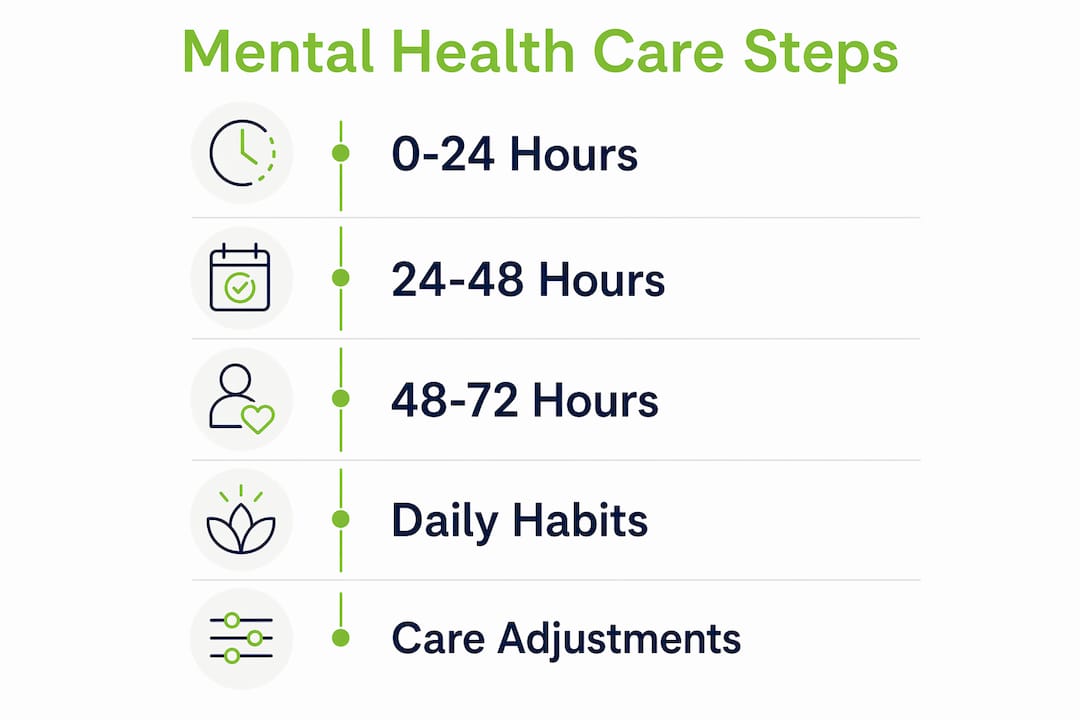
The first 72 hours after deciding to seek help are the most important. This is when most people either build momentum or stall out. A clear sequence prevents that stall.

Hours 0–24: stabilize and assess safety
Your first priority is safety, not scheduling. If you are in crisis or having thoughts of self-harm, contact the 988 Suicide and Crisis Lifeline by calling or texting 988. If you are not in crisis, use this window to start your symptom log and write down what has been happening over the past few weeks. Do not try to solve everything at once.
Maintaining basic self-care routines during this phase, including regular meals, adequate sleep, and gentle movement, helps stabilize your nervous system while you gather information. This is not a placeholder activity. It is clinically meaningful.
Hours 24–48: research your options
Use this window to identify 3–5 providers or clinics that accept your insurance. Check whether they offer telehealth, which removes geographic barriers and often has shorter wait times. Look at starting psychiatric treatment resources to understand what an intake appointment typically involves so you are not caught off guard.
- Search your insurance provider’s online directory for in-network psychiatrists and therapists.
- Check Psychology Today’s therapist finder as a secondary source.
- Note each provider’s specialty. A psychiatrist who focuses on anxiety and depression is a better fit than a general practitioner if those are your primary concerns.
- Write down each clinic’s phone number, website, and whether they have a cancellation list.
Hours 48–72: schedule and confirm
Call or message your top choices and book the earliest available appointment. If waitlists are long, ask about telehealth platforms, which often have faster availability. Confirm your appointment in writing and set a calendar reminder.
“Recovery is not a straight line. Getting on a waitlist is still progress. The act of scheduling is itself a meaningful step forward.”
Pro Tip: If your first appointment is weeks away, use that time productively. Start your symptom log, read about anxiety and ADHD management steps, and practice the daily habits in the next section. You will arrive at your first session with better data and more self-awareness.
What daily habits actually support mental wellness?
Professional treatment works best when your daily life supports it. The research on this is clear, and the habits themselves are not complicated. The challenge is consistency, not complexity.
Physical exercise is one of the most reliable mental health tools available. A 2018 review of 1.2 million U.S. adults confirmed that exercise, whether walking, yoga, or weightlifting, is meaningfully associated with better self-reported mental health. You do not need a gym membership. A 20-minute walk three times a week is a legitimate starting point.
Here are the core daily habits worth building:
- Sleep hygiene. Short naps of 5–15 minutes improve mental performance for up to 3 hours. Consistent sleep habits can delay brain aging by 3–6 years. Set a consistent bedtime, limit screens 30 minutes before sleep, and keep your room cool and dark.
- Present-moment focus. Reducing social media and news consumption lowers stress load significantly. Clinicians recommend making your world smaller during overwhelming periods. Focus on the one task in front of you rather than the full scope of what feels wrong.
- Hydration and nutrition. Dehydration worsens mood and cognitive function. Eating regular, balanced meals stabilizes blood sugar, which directly affects emotional regulation. These are not soft suggestions.
- A daily anchor. Pick one small, repeatable activity that signals stability to your brain. This could be morning coffee without your phone, a short walk at noon, or five minutes of quiet before bed. Consistency matters more than duration.
Small, consistent daily changes outperform drastic lifestyle overhauls for long-term mental wellness. Mental Health America’s 2026 Action Guide reinforces this: sustained minor wins build real resilience over time.
Pro Tip: Pair a new habit with an existing one. If you already make coffee every morning, add two minutes of slow breathing while it brews. Habit stacking reduces the friction of starting something new.
How do you know when to adjust your care plan?
Mental health care is not static. Your needs change, your symptoms shift, and what worked at month one may not be enough at month six. Knowing when and how to adapt is part of effective self-advocacy.
| Signal | What It Means | Recommended Action |
|---|---|---|
| No improvement after 6–8 weeks | Current treatment may need adjustment | Ask your provider to review your plan |
| Worsening symptoms | Possible medication or therapy mismatch | Contact your provider promptly, do not wait for next scheduled visit |
| Poor rapport with provider | Therapeutic alliance is suffering | Consider switching providers |
| Frequent appointment cancellations | Access barrier affecting continuity | Ask about telehealth or different scheduling options |
| New life stressor | Care plan may be outdated | Request a check-in session to reassess |
The therapeutic alliance between patient and clinician is one of the strongest predictors of treatment success. If you do not feel heard, respected, or understood by your provider, that is clinically significant. Switching providers is not giving up. It is good clinical judgment.
Tracking your symptoms consistently gives you real data for these conversations. Bring your mood log to appointments. Show your provider patterns rather than relying on how you feel in the moment. This shifts the conversation from subjective to data-driven, which leads to better treatment decisions.
Pro Tip: Before each appointment, write down your top two concerns and one thing that has improved. This keeps sessions focused and gives your provider a clearer picture of your trajectory.
When symptoms escalate to crisis level, contact 988 or go to your nearest emergency room. Do not wait for your next scheduled appointment. Effective support in crisis moments relies on presence and clear communication, not perfect solutions.
What i have learned about sustainable mental health care
After years of working with patients managing anxiety, depression, and mood disorders, the pattern I see most often is this: people expect mental health care to feel like a light switch. They want to start treatment and feel better within weeks. When that does not happen, they assume the treatment is failing.
What actually works looks much quieter. It is the patient who shows up to appointments even when they do not feel like it. It is the person who starts a symptom log and keeps it going for three months. It is someone who sets mental health goals that are specific and realistic rather than vague and ambitious.
Self-compassion is not a soft skill. It is a clinical variable. Patients who treat setbacks as data rather than failures tend to stay in care longer and get better outcomes. We often tell patients: the goal is not a perfect week. The goal is a slightly better month than the last one.
Support networks matter too, but boundaries within those networks matter equally. Empathy and clear communication protect both the person receiving care and the people supporting them. Overextension on either side creates burnout, not healing.
Mental health care is not a problem you solve once. It is a practice you maintain, adjust, and return to. That framing tends to reduce the pressure people put on themselves, and that reduction in pressure is itself therapeutic.
— Felix
How Nortexpsychiatry can support your mental health care
If you are ready to move from reading to acting, Nortexpsychiatry offers personalized, evidence-based psychiatric care for adults and families across Allen, Frisco, McKinney, Plano, and surrounding North Dallas communities. Services include medication management, psychiatric evaluations, and treatment for anxiety, depression, ADHD, and mood disorders. Both in-person and telehealth appointments are available, so access fits your schedule and location. You can start with a self-assessment to clarify what kind of support you need before your first visit. If you are unsure whether psychiatry is the right fit, the guide on why to see a psychiatrist walks you through the signs and benefits clearly.
Key takeaways
Effective step by step mental health care requires preparation, consistent daily habits, and a willingness to adjust your plan as your needs evolve.
| Point | Details |
|---|---|
| Start with a symptom log | Track mood, sleep, and triggers for 7 days before your first appointment to give clinicians accurate data. |
| Use crisis resources proactively | Save 988 and the Crisis Text Line before you need them as part of your safety plan. |
| Build daily stabilizing habits | Exercise, sleep hygiene, and reduced media consumption support treatment outcomes meaningfully. |
| Monitor and advocate for yourself | Bring mood data to appointments and switch providers if the therapeutic alliance is not working. |
| Expect gradual, not instant, progress | Small consistent changes outperform drastic overhauls for long-term mental wellness. |
FAQ
What is step by step mental health care?
Step by step mental health care is a structured approach to managing mental health conditions through sequential, evidence-based actions. It moves from immediate safety and information gathering to professional treatment and sustainable daily habits.
How do i start mental health care if i am on a waitlist?
Ask every clinic about their cancellation list, since joining multiple lists can secure earlier appointments. While waiting, start a symptom log, maintain basic self-care routines, and use telehealth platforms, which often have faster availability.
How long before i see improvement with mental health treatment?
Most clinicians look for meaningful change within 6–8 weeks of starting a new treatment. If symptoms are not improving or are worsening, contact your provider to review your plan rather than waiting for the next scheduled visit.
When should i switch mental health providers?
The therapeutic alliance is a key predictor of treatment success, so switching providers when rapport or approach is not a good fit is normal and recommended. Poor rapport is a clinical signal, not a personal failure.
What daily habits most support mental wellness?
Regular physical exercise, consistent sleep hygiene, reduced social media consumption, and present-moment focus are the most research-supported daily habits for mental wellness. Small, consistent efforts outperform large, unsustainable changes over time.