


Anxiety and ADHD management steps are structured, evidence-based practices that reduce symptom overlap, improve daily functioning, and address the executive dysfunction that drives much of the distress adults with both conditions experience. Co-occurring anxiety and ADHD affect a significant portion of adults, and the two conditions reinforce each other in ways that make treating only one largely ineffective. What works is an integrated approach: consistent lifestyle structure, adapted cognitive behavioral therapy (CBT), low-friction coping tools, and, when needed, professional psychiatric support. We have seen, in our work at Nortex Psychiatry, that adults who understand how these pieces connect make faster, more lasting progress than those chasing symptom relief alone.
What are the key anxiety and ADHD management steps for daily life?
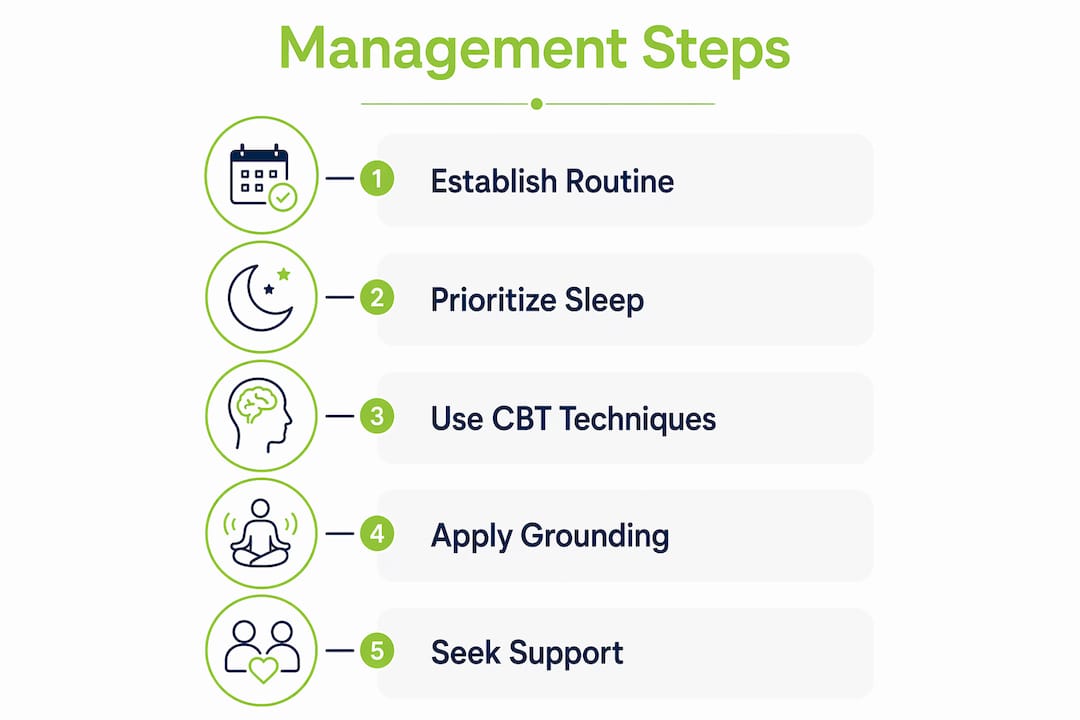
Structure is the single most powerful lifestyle intervention for adults managing both conditions. When your environment does the thinking for you, your brain has less to fight against. That means consistent wake times, predictable meal windows, and a simplified daily schedule you can follow without deliberating each morning.
Sleep is not optional. One night of poor sleep measurably raises next-day anxiety, and chronic sleep deprivation correlates directly with anxiety disorder prevalence. Clinically, 7 to 9 hours of quality sleep functions as a first-line intervention, not a lifestyle preference. Protecting that window means setting a hard stop on screens 60 minutes before bed and treating your sleep schedule with the same firmness you would a medical appointment.
Physical activity is the other non-negotiable. 20 to 30 minutes of moderate exercise daily, whether brisk walking, cycling, or swimming, regulates stress hormones and improves dopamine availability. This means it addresses both the anxiety and the ADHD neurochemistry at the same time. You do not need a gym membership or a structured program. You need consistency more than intensity.
Here is what the lifestyle foundation looks like in practice:
- Morning anchor: Wake at the same time daily, even on weekends. This stabilizes your circadian rhythm and reduces morning anxiety spikes.
- Movement first: Schedule exercise before the day’s demands accumulate. Afternoon willpower is unreliable for most adults with ADHD.
- Simplified defaults: Use a single shared calendar, one task list, and automated bill payments. Reduce the number of decisions your brain has to make.
- Nutrition basics: Limit caffeine after noon, reduce alcohol (which fragments sleep and worsens anxiety the following day), and eat regular meals to avoid blood sugar drops that mimic anxiety symptoms.
- Environmental design: A tidy, low-clutter workspace reduces cognitive load. This is not about aesthetics. It is about reducing the number of competing stimuli your attention system has to filter.
Pro Tip: Make your routine boringly accessible. The best system is the one you will actually use on a hard day. If your morning routine requires 12 steps, it will collapse under stress. Aim for three anchors: wake time, movement, and one planned task.
How can you apply coping strategies and cognitive techniques?
The most common mistake adults make is applying generic anxiety strategies to what is actually ADHD-driven anxiety. These are different. ADHD-driven anxiety typically stems from executive dysfunction: missed deadlines, disorganization, and the chronic sense of falling behind. Primary anxiety disorders involve threat-based thinking that exists independently of task performance. Knowing which you are dealing with shapes which techniques you reach for first.
Adapted CBT for ADHD and anxiety integrates executive function scaffolding alongside traditional cognitive restructuring. Standard CBT asks you to challenge distorted thoughts. ADHD-adapted CBT also builds the time management and task initiation skills that generate those thoughts in the first place. This combination prevents the overwhelm that makes anxiety exposure work feel impossible.
For acute anxiety relief, body-based techniques work faster than thought-based ones. Vagus nerve stimulation through cold water on your face, humming, or slow exhale breathing shifts your nervous system out of fight-or-flight in one to two minutes. The physiological sigh, two quick inhales through the nose followed by a long exhale through the mouth, deflates the air sacs in your lungs and activates the parasympathetic response almost immediately.
The 5-4-3-2-1 grounding technique is worth keeping in your back pocket for moments when anxiety spikes and your thoughts start spiraling:
- Name 5 things you can see around you right now.
- Name 4 things you can hear in your environment.
- Name 3 things you can physically feel, such as your feet on the floor or your hands on a surface.
- Name 2 things you can smell, even faintly.
- Name 1 thing you can taste.
This grounding technique pulls your attention out of catastrophic thinking and into present sensory experience. It works because it gives your ADHD brain a structured task to complete at the exact moment anxiety is trying to hijack your focus.
Pro Tip: Pair a body-based technique with a cognitive one. Use the physiological sigh first to lower your arousal level, then challenge the anxious thought. Trying to restructure a thought while your nervous system is in overdrive rarely works.
What ADHD coping strategies improve daily functioning and reduce anxiety triggers?
Task paralysis is one of the most anxiety-generating experiences adults with ADHD face. It looks like avoidance but it is not a motivation problem. It is an emotional barrier. Breaking tasks into absurdly small steps bypasses that barrier by making the entry point so low that refusal feels unreasonable. “Write the report” becomes “open the document.” “Open the document” becomes the only task. Behavioral momentum builds from there.
Complex planning systems fail in ADHD because they demand the very executive functioning that is impaired. A color-coded planner with five categories and daily reviews sounds organized. In practice, maintaining it becomes another task to avoid. Low-friction defaults, a single timer, one must-do item per day, and a two-minute startup ritual, outperform elaborate systems consistently.
The Premack principle is underused in ADHD management. It states that a high-probability behavior can reinforce a low-probability one. In plain terms: pair a task you avoid with something you genuinely enjoy. Work on the difficult task for 25 minutes, then take a 5-minute break doing something rewarding. This is the mechanism behind the Pomodoro Technique, and it works particularly well for adults with ADHD because it provides a predictable reward without requiring sustained motivation.
| Coping method | Practical format | Best for |
|---|---|---|
| Micro-step task entry | “Open document” as the only first task | Task paralysis and avoidance |
| 5-minute timer start | Set a timer before beginning any task | Low motivation and procrastination |
| Premack pairing | 25 min work, 5 min preferred activity | Sustaining effort on difficult tasks |
| Single daily priority | One non-negotiable task per day | Overwhelm and decision fatigue |
| External alarms | Phone alerts for transitions and deadlines | Time blindness and missed commitments |
The tools that support these strategies include apps like Todoist for single-task focus, Google Calendar for time blocking, and the built-in timer on any phone. The specific tool matters less than the friction level. If it takes more than 10 seconds to access, most adults with ADHD will not use it consistently.
When and how to seek professional help for combined anxiety and ADHD
Self-directed strategies have real limits. When anxiety is interfering with work, relationships, or sleep despite consistent effort, or when ADHD symptoms are causing significant functional impairment, professional evaluation is the appropriate next step. Waiting longer rarely improves outcomes and often deepens the secondary anxiety that builds around repeated failures.
Signs that professional support is warranted include:
- Persistent anxiety that does not respond to lifestyle changes or coping techniques after four to six weeks of consistent effort
- Difficulty maintaining employment, relationships, or basic self-care due to ADHD symptoms
- Avoidance patterns that are expanding rather than shrinking
- Depressive symptoms layered on top of anxiety and ADHD
- A history of starting and abandoning multiple self-help systems
Treating ADHD first often reduces secondary anxiety more effectively than treating anxiety alone. AADPA and NICE guidelines both recommend this sequencing when ADHD is the primary diagnosis. Stimulant medications improve executive function, which removes the chronic disorganization and underperformance that generates anxiety in the first place.
Concerns about stimulants worsening anxiety are common and worth addressing directly. About 15 to 20% of patients experience increased anxiety initially, but this typically resolves with dose adjustments or a switch to non-stimulant options like atomoxetine. A psychiatrist experienced with both conditions will titrate slowly and monitor closely. The goal is not to suppress anxiety with medication but to reduce the executive dysfunction that is feeding it.
“Treating anxiety alone without addressing underlying ADHD leads to incomplete symptom relief and repeated relapses in adults.” — Anxiety and ADHD overlap research
For therapy, CBT adapted for both conditions balances exposure-based anxiety work with executive function support. Finding a provider who understands this integration matters. A therapist trained only in anxiety disorders may inadvertently overlook the ADHD-specific scaffolding that makes progress sustainable.
Key takeaways
Managing anxiety and ADHD together requires treating executive dysfunction as the root driver, not a secondary concern, because addressing ADHD directly reduces the anxiety it generates.
| Point | Details |
|---|---|
| Sleep and exercise are clinical tools | 7 to 9 hours of sleep and 20 to 30 minutes of daily exercise measurably reduce both anxiety and ADHD symptoms. |
| Low-friction strategies outperform complex systems | Simple defaults like one daily priority and a 5-minute timer work better than elaborate planners for ADHD brains. |
| Body-based techniques calm anxiety faster | Vagus nerve techniques and the physiological sigh reduce acute anxiety in one to two minutes, before cognitive tools can take effect. |
| ADHD treatment often resolves secondary anxiety | Treating ADHD first, through medication or adapted CBT, addresses the executive dysfunction that generates chronic anxiety. |
| Professional help has clear indicators | Persistent functional impairment after consistent self-directed effort is a signal to seek psychiatric evaluation, not a personal failure. |
What I have learned from treating both conditions together
I want to be honest about something we see regularly in practice. Most adults who come to us have already tried managing anxiety alone. They have done the breathing exercises, downloaded the meditation apps, maybe completed a course of standard CBT. And they feel better for a while, then slide back. What they often have not addressed is the ADHD underneath.
The anxiety is real. It is not imagined or exaggerated. But in many adults, it is downstream of chronic executive dysfunction: the missed appointments, the unfinished projects, the constant sense of being behind. When you treat only the anxiety, you are managing the symptom while the cause keeps running. That is why the integrated treatment approach matters so much.
We also notice that adults with ADHD tend to build elaborate management systems when they are motivated, then abandon them when life gets hard. The systems that stick are almost always the boring, simple ones. One task. One timer. One anchor in the morning. That is not a failure of ambition. That is working with your neurology instead of against it.
Progress with these conditions is not linear. There will be weeks where the structure holds and weeks where it collapses. What matters is how quickly you rebuild, and whether you have the right support in place when things get difficult.
— Felix
Get personalized support for anxiety and ADHD at Nortex Psychiatry
If you have been working through these strategies and still feel stuck, you do not have to figure out the next step alone. At Nortex Psychiatry, we work with adults across Allen, Frisco, McKinney, and Plano who are managing both anxiety and ADHD, and we understand how these conditions interact. Whether you are weighing medication vs. therapy for ADHD or looking for a psychiatric evaluation that accounts for both conditions, we offer in-person and telehealth appointments designed around your schedule. Our approach is practical, evidence-based, and judgment-free. Reach out to Nortex Psychiatry to schedule an evaluation and start building a plan that actually fits your life.
FAQ
What is the first step in managing anxiety and ADHD together?
The most effective starting point is establishing a consistent daily routine that includes regular sleep, physical activity, and a simplified task structure. Addressing ADHD-driven executive dysfunction first often reduces secondary anxiety without additional intervention.
Can stimulant medication make anxiety worse?
Stimulants can increase anxiety in roughly 15 to 20% of patients initially, but this typically resolves with dose adjustments. Non-stimulant options like atomoxetine are available for those who remain sensitive to stimulant side effects.
How does CBT differ for people with both ADHD and anxiety?
Adapted CBT for ADHD and anxiety combines standard cognitive restructuring with executive function scaffolding, including time management and task initiation support. Standard anxiety CBT alone does not address the organizational deficits that generate much of the anxiety in ADHD adults.
What are the fastest anxiety relief techniques for adults with ADHD?
Vagus nerve stimulation techniques, including cold water on the face, humming, and the physiological sigh, reduce acute anxiety in one to two minutes. The 5-4-3-2-1 grounding technique also works quickly by redirecting attention to present sensory experience.
When should you see a psychiatrist for anxiety and ADHD?
Seek professional evaluation when symptoms are causing significant functional impairment at work or in relationships, when self-directed strategies have not produced improvement after four to six weeks, or when depressive symptoms are present alongside anxiety and ADHD.