


Professional mental health guidance is defined as structured, evidence-based care delivered by licensed clinicians, including psychiatrists, psychologists, therapists, and counselors, to assess, treat, and support individuals experiencing emotional or psychological distress. The World Health Organization reports that mental disorders account for 1 in 6 years lived with disability worldwide, and untreated conditions can reduce life expectancy by 10 to 20 years. That is not a background statistic. It means that what you are experiencing right now, whether anxiety that won’t quit, depression that flattens your days, or stress that has become your baseline, carries real long-term weight. The National Alliance on Mental Illness (NAMI) consistently emphasizes that early, professional intervention changes outcomes. In North Dallas communities like Frisco, McKinney, and Plano, access to that kind of care is closer than most people realize.
Why professional mental health guidance is different from other support
Professional mental health guidance encompasses a range of licensed practitioners and evidence-based methods that informal support simply cannot replicate. Understanding who these professionals are and what they actually do helps you make a more informed decision about your care.
The main types of mental health professionals you are likely to encounter include:
- Psychiatrists: Medical doctors who can diagnose mental health conditions, prescribe and manage medications, and provide psychiatric evaluations. They are trained to assess the biological, psychological, and social factors behind conditions like depression and anxiety.
- Psychologists: Doctoral-level clinicians who specialize in psychological testing, assessment, and psychotherapy. They do not typically prescribe medication but provide deep diagnostic and therapeutic expertise.
- Licensed Professional Counselors (LPCs) and Licensed Clinical Social Workers (LCSWs): These clinicians deliver talk therapy, help clients build coping skills, and address life stressors through structured sessions.
- Therapists: A broad term covering various licensed practitioners who use specific therapeutic models, including Cognitive Behavioral Therapy (CBT), Dialectical Behavior Therapy (DBT), and trauma-focused approaches.
Each professional type serves a distinct function. A psychiatrist managing your medication works best alongside a therapist providing weekly CBT sessions. That combination, often called collaborative or integrated care, reflects how evidence-based psychiatry actually operates in practice. The assessment process itself, which typically begins with a comprehensive intake evaluation, is where a clinician maps your symptoms, history, and functioning before any treatment begins. That foundation matters more than most people expect.
How professional care compares to self-help and AI tools

The rise of AI chatbots and wellness apps has made it tempting to treat mental health like a search problem. You describe your symptoms, the tool reflects them back, and you feel briefly understood. The problem is that feeling understood is not the same as receiving care.
1 in 8 Americans aged 12 to 21 now use AI chatbots for mental health advice, yet clinical experts warn these tools lack the diagnostic structures and accountability that real therapy requires. This matters because a chatbot that validates your anxiety without ever challenging the thought patterns driving it is not helping you get better. It is keeping you comfortable while the problem persists.
| Feature | Professional guidance | AI tools and self-help |
|---|---|---|
| Diagnosis and assessment | Licensed clinicians conduct structured evaluations | No clinical diagnosis capability |
| Accountability | Scheduled sessions create structure and follow-through | No accountability mechanism |
| Evidence-based treatment | DBT, CBT, medication management, and more | Generic psychoeducation at best |
| Crisis response | Clinicians can intervene, refer, or adjust care | No crisis protocol or safety planning |
| Personalization | Treatment adapts to your history and response | Responses are generalized |
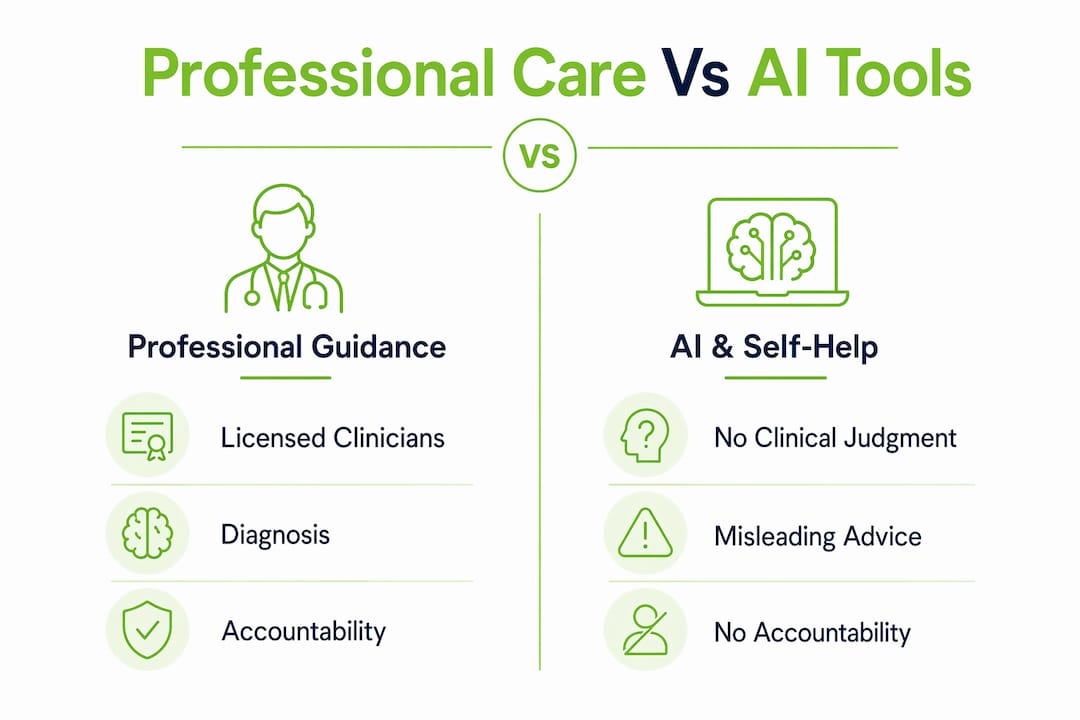
AI chatbots often violate ethical standards, provide misleading support, and lack the accountability that protects vulnerable users. That is not a minor limitation. It is a structural failure. Real therapy, particularly DBT-based approaches, reduces suicide attempts and self-harm precisely because it combines validation with genuine challenge. A trained clinician will push back when your thinking is distorted. An algorithm will not.
Pro Tip: If you have been using a wellness app or chatbot and feel like you are not improving, that is useful information. It may mean your symptoms need a level of care the tool was never designed to provide.
Family support and close friendships are genuinely valuable. They reduce isolation and provide emotional warmth. But they are not a substitute for structured mental health support systems. A loved one cannot conduct a diagnostic evaluation, identify a medication interaction, or apply a trauma-focused protocol. Knowing the difference protects both you and the people around you.
How therapy and psychiatry address anxiety, depression, and stress
The clinical benefits of professional mental health counseling are well-documented across the three conditions that most commonly bring adults in North Dallas to seek help: anxiety, depression, and chronic stress.
For anxiety, CBT is the most studied and replicated intervention. It works by identifying the cognitive distortions that fuel anxious thinking and replacing them with more accurate, less reactive patterns. Most patients see measurable improvement within 12 to 20 sessions. For generalized anxiety disorder or panic disorder, a psychiatrist may also recommend medication, often an SSRI or SNRI, to reduce baseline physiological arousal while therapy addresses the behavioral patterns.
Depression responds well to a combination of psychotherapy and, when clinically indicated, antidepressant medication. The psychiatric care benefits for depression extend beyond symptom relief. Patients report improved sleep, restored motivation, better relationships, and a return to activities they had stopped enjoying. Those are not small gains. They represent a return to functioning.
Chronic stress, which is often dismissed as “just life,” carries real clinical consequences when left unaddressed. The American Hospital Association notes that behavioral health is inseparable from physical health, meaning untreated stress contributes to cardiovascular disease, immune dysfunction, and metabolic disruption. A clinician treating your stress is also protecting your physical health.
Key outcomes that professional mental health support consistently produces include:
- Reduced symptom severity in anxiety and depression within weeks of beginning structured treatment
- Improved daily functioning, including work performance, sleep quality, and relationship stability
- Development of lasting coping skills that remain effective after formal treatment ends
- Lower risk of relapse when therapy includes a maintenance or follow-up phase
- Better management of co-occurring conditions, such as ADHD alongside anxiety
Early support also reduces the risk of long-term workforce disengagement caused by untreated mental health conditions. That means getting help now is not just about feeling better. It protects your career, your relationships, and your long-term capacity to function.
How to find and start professional mental health care in North Dallas
Knowing you need help and knowing how to access it are two different things. Here is a practical path forward for adults in the Frisco, McKinney, Plano, and Allen areas.
- Recognize the signal. Professional counseling is recommended when distress lasts longer than two weeks and disrupts daily functioning. If your anxiety is affecting your sleep, your work, or your relationships, that threshold has been crossed.
- Decide on the type of provider. If you suspect medication may be part of your care, start with a psychiatrist who can evaluate and prescribe. If you are primarily seeking talk therapy, an LPC or LCSW may be your first contact. Many people benefit from both.
- Consider telehealth. Online counseling removes geographic and scheduling barriers. Research supports its effectiveness for anxiety and depression, and online counseling advantages include greater flexibility and reduced stigma for first-time patients.
- Prepare for the first session. The initial appointment is an assessment, not a test. Your clinician will ask about your symptoms, history, and goals. You do not need to have everything figured out. Honesty matters more than preparation.
- Commit to the process. Many patients underestimate the therapeutic process, which begins with assessment and alliance-building before symptom relief. Expecting immediate results in session two sets you up for unnecessary discouragement.
Pro Tip: If cost or insurance coverage is a barrier, ask your provider directly about sliding-scale fees or telehealth options. Many practices in North Dallas, including those serving Allen and Plano, offer both.
The stigma around seeking mental health care is real, but it is also shrinking. In our experience at Nortex Psychiatry, the patients who arrive earliest tend to recover fastest. Early action in mental health produces faster, more lasting relief than waiting until a crisis forces the issue. That is not an opinion. It is what the clinical data consistently shows.
Key takeaways
Professional mental health guidance delivers structured, accountable, evidence-based care that self-help tools and informal support cannot replicate, making it the most effective path to lasting recovery from anxiety, depression, and stress.
| Point | Details |
|---|---|
| Professional care is defined and structured | Licensed clinicians assess, diagnose, and treat using evidence-based methods like CBT and DBT. |
| AI tools are not a clinical substitute | Chatbots lack diagnostic ability, accountability, and the capacity to challenge distorted thinking. |
| Early intervention changes outcomes | Seeking help before a crisis reduces long-term disability, lost productivity, and relationship damage. |
| Behavioral and physical health are linked | Untreated mental health conditions contribute to physical illness, making professional care doubly important. |
| North Dallas access is practical | In-person and telehealth options in Allen, Frisco, McKinney, and Plano make starting care straightforward. |
What we have learned from working with adults who waited
The patients who sit across from us at Nortex Psychiatry and say “I should have come sooner” are not rare. They are, honestly, the majority. Most adults in North Dallas who finally seek care have been managing symptoms for months or years before making an appointment. They tried the apps. They talked to friends. They pushed through. And the symptoms did not resolve. They compounded.
What I have noticed over years of clinical work is that the biggest barrier is rarely cost or access. It is the belief that what you are experiencing is not serious enough to warrant professional attention. That belief is almost always wrong. Mental health conditions cause invisible costs long before a formal diagnosis, including lost productivity, strained relationships, and physical health decline. By the time those costs become visible, recovery takes longer.
The other misconception worth naming directly: therapy is not just talking about your feelings. At its best, it is a structured, sometimes uncomfortable process of examining and changing the patterns that are keeping you stuck. That is why a skilled therapist is irreplaceable. Not because they are warm, though they should be, but because they are trained to challenge you in ways that actually produce change. Recovery is not a straight line. But it does require a real clinician walking it with you.
If you are on the fence, take the mental health self-assessment and see where you land. The data you gather about yourself is the first step toward doing something with it.
— Felix
How Nortex Psychiatry supports adults across North Dallas
At Nortex Psychiatry, we work with adults in Allen, Frisco, McKinney, Plano, and surrounding communities who are dealing with anxiety, depression, stress, and mood disorders. Our approach combines psychiatric evaluation, medication management when appropriate, and coordinated care that fits your schedule, whether you prefer in-person visits or telehealth. We do not believe in one-size-fits-all treatment. We build a plan around your specific history, symptoms, and goals. If you are ready to take the first step, our self-assessment tool is a good place to start. Or explore how our psychiatrists transform anxiety care for adults in North Dallas with personalized, evidence-based support.
FAQ
What is professional mental health guidance?
Professional mental health guidance is structured care delivered by licensed clinicians, including psychiatrists, psychologists, therapists, and counselors, using evidence-based methods to assess and treat conditions like anxiety, depression, and stress. It differs from informal support by including formal diagnosis, accountability, and treatment protocols.
When should I seek professional mental health counseling?
Seek professional counseling when distress lasts longer than two weeks and disrupts your daily functioning, including sleep, work, or relationships. Waiting for a crisis to force the issue typically extends recovery time and increases long-term costs.
Can AI chatbots replace therapy for mental health support?
No. AI chatbots lack clinical judgment, cannot diagnose mental health conditions, and often reinforce negative beliefs without challenging them. Clinical experts consistently identify these tools as unreliable substitutes for licensed professional care.
What types of therapy are used in professional mental health care?
Common evidence-based approaches include Cognitive Behavioral Therapy (CBT) for anxiety and depression, Dialectical Behavior Therapy (DBT) for emotional regulation and suicidality, and trauma-focused therapies for PTSD. Psychiatrists may also integrate medication management alongside these methods.
Does Nortex Psychiatry offer telehealth for North Dallas residents?
Yes. Nortex Psychiatry provides both in-person and telehealth appointments for adults across North Dallas, including Frisco, McKinney, Plano, and Allen, making it easier to access care that fits your schedule and comfort level.