


Mood disorders are defined as persistent disruptions to a person’s emotional state that interfere with daily functioning, relationships, and overall quality of life. Dealing with mood disorders effectively requires combining medication, evidence-based psychotherapy, and structured lifestyle changes rather than relying on any single approach. Nearly 1 in 10 adults in the United States experience a mood disorder at some point, which means you are far from alone in this. At Nortex Psychiatry, we have worked with many adults across Allen, Frisco, McKinney, and Plano who felt overwhelmed before they understood what was actually happening and what could genuinely help. This article walks you through the full coping process, from understanding your diagnosis to building daily habits that support long-term stability.
What are mood disorders and how do they affect you?
Mood disorders are a category of psychiatric conditions characterized by significant, prolonged changes in emotional state that go well beyond ordinary sadness or stress. The most recognized types include major depressive disorder (MDD), bipolar disorder I and II, persistent depressive disorder (dysthymia), and cyclothymic disorder. Each presents differently, but all share one common thread: your emotional state stops matching your circumstances in a way that disrupts your life.
Common symptoms across mood disorders include:
- Prolonged sadness or emptiness lasting two weeks or more, even without an obvious cause
- Mood swings that shift between depression and elevated or irritable states, as seen in bipolar disorder
- Fatigue and loss of motivation that make ordinary tasks feel impossible
- Irritability or agitation, particularly in mixed mood states
- Changes in sleep, appetite, and concentration that compound daily impairment
- Feelings of worthlessness or hopelessness, which can escalate to suicidal thinking
The functional impact is significant. People with mood disorders often struggle to maintain employment, sustain relationships, and manage physical health. Approximately 4.4% of U.S. adults experience bipolar disorder at some point in their lifetime, and the combined burden of all mood disorders accounts for a large share of disability-related lost productivity in the country. People with major depressive or bipolar disorder face 8 to 9 times higher suicide risk than the general population. That statistic underscores why getting an accurate diagnosis and starting structured treatment is not optional. It is a medical priority.
How can medication help in managing mood disorders?
Medication does not cure mood disorders, but it does something critical: it creates a neurobiological baseline stable enough for therapy and lifestyle changes to take hold. Without that baseline, many people find that even the best coping strategies fail to stick because the brain’s chemistry is working against them.
The main medication classes used in mood disorder treatment include:
| Medication Class | Primary Use | Examples |
|---|---|---|
| SSRIs / SNRIs | First-line for major depression and anxiety | Sertraline, Escitalopram, Venlafaxine |
| Mood stabilizers | Bipolar disorder, preventing episode recurrence | Lithium, Valproate, Lamotrigine |
| Atypical antipsychotics | Bipolar disorder, treatment-resistant depression | Quetiapine, Aripiprazole, Lurasidone |
| Bupropion | Depression, especially with fatigue or low motivation | Wellbutrin |
Medication establishes stability that makes psychotherapy and lifestyle interventions more effective for long-term change. This is why we often tell patients that medication is the foundation, not the finish line. Among mood stabilizers, lithium carries particularly strong evidence. Lithium is the gold standard for bipolar disorder management and has demonstrated a meaningful reduction in suicide risk, a benefit not matched by most other psychiatric medications.
Side effects are real and worth monitoring closely. Weight changes, sexual dysfunction, sedation, and cognitive dulling are common reasons people stop medication prematurely. We always recommend discussing these concerns openly rather than stopping on your own, because abrupt discontinuation can trigger rebound episodes. Exploring the real role of medication in mental wellness can help you set realistic expectations before you start.
Pro Tip: Keep a brief daily log of mood, sleep, and any side effects during the first 6 to 8 weeks on a new medication. This gives your prescriber concrete data to adjust the dose or switch agents faster than relying on memory alone.
What therapies effectively support coping with mood disorders?
Psychotherapy is not a backup plan when medication falls short. It is a core treatment that addresses the thought patterns, relational dynamics, and emotional regulation skills that medication cannot touch on its own. Cognitive Behavioral Therapy (CBT), Interpersonal Therapy (IPT), and Mindfulness-Based Cognitive Therapy (MBCT) are the three most evidence-supported approaches for adults with mood disorders.
Here is what each approach targets:
- CBT identifies and restructures distorted thinking patterns, such as catastrophizing or all-or-nothing thinking, that fuel depressive and anxious states. It also builds behavioral activation, which means gradually re-engaging with activities that provide meaning and reward.
- IPT focuses on the relationship between mood and interpersonal stress. Grief, role transitions, and conflict with close relationships are common triggers for mood episodes, and IPT addresses these directly.
- MBCT combines mindfulness meditation with cognitive therapy techniques. It is especially effective for people with recurrent depression, reducing relapse risk by teaching you to observe thoughts without being pulled into them.
Therapy works best when it runs alongside medication, not after it. We have seen patients who waited until they felt “stable enough” to start therapy, only to find that the delay cost them months of progress. Starting both at the same time, even if sessions are brief at first, tends to produce faster and more durable results. For practical guidance on how these approaches apply to depression specifically, the evidence-based approaches we use at Nortex Psychiatry reflect current clinical standards.
Day-to-day application matters as much as the therapy session itself. Practicing thought records between sessions, using grounding techniques during anxiety spikes, and applying communication skills from IPT in real conversations all extend the benefit of therapy into your daily life.

How do lifestyle changes contribute to managing mood disorders?
Lifestyle adjustments are not soft add-ons to a treatment plan. Exercise and lifestyle changes function as core clinical interventions, and structured habits can produce effects comparable to medication for some depressive symptoms. That does not mean you should replace medication with exercise. It means you should take lifestyle changes as seriously as you take your prescriptions.
The most clinically supported lifestyle interventions, in order of impact, are:
- Regular aerobic exercise. Thirty minutes of moderate activity, such as brisk walking, cycling, or swimming, at least four days per week has demonstrated antidepressant effects in multiple controlled trials. Exercise increases brain-derived neurotrophic factor (BDNF), which supports neuroplasticity and mood regulation.
- Consistent sleep schedule. Sleep disruption is both a symptom and a trigger for mood episodes. Going to bed and waking at the same time every day, including weekends, stabilizes circadian rhythms that directly influence mood chemistry.
- Balanced nutrition. Diets high in processed foods and sugar are associated with higher rates of depression. A Mediterranean-style diet, rich in vegetables, whole grains, fish, and healthy fats, supports brain health and reduces systemic inflammation linked to mood disorders.
- Social connection. Isolation amplifies depressive symptoms. Maintaining at least one or two regular social contacts, even brief ones, provides emotional regulation support that no medication fully replicates.
- Avoiding alcohol and cannabis. Both substances disrupt sleep architecture and mood regulation, even when they feel temporarily calming. For people managing mood disorders, regular use significantly increases relapse risk.
Pro Tip: Start with one lifestyle change at a time rather than overhauling everything at once. Adding a 20-minute walk three times a week is more sustainable than a complete diet and exercise overhaul that collapses within two weeks.
How to recognize early warning signs and prevent relapse?
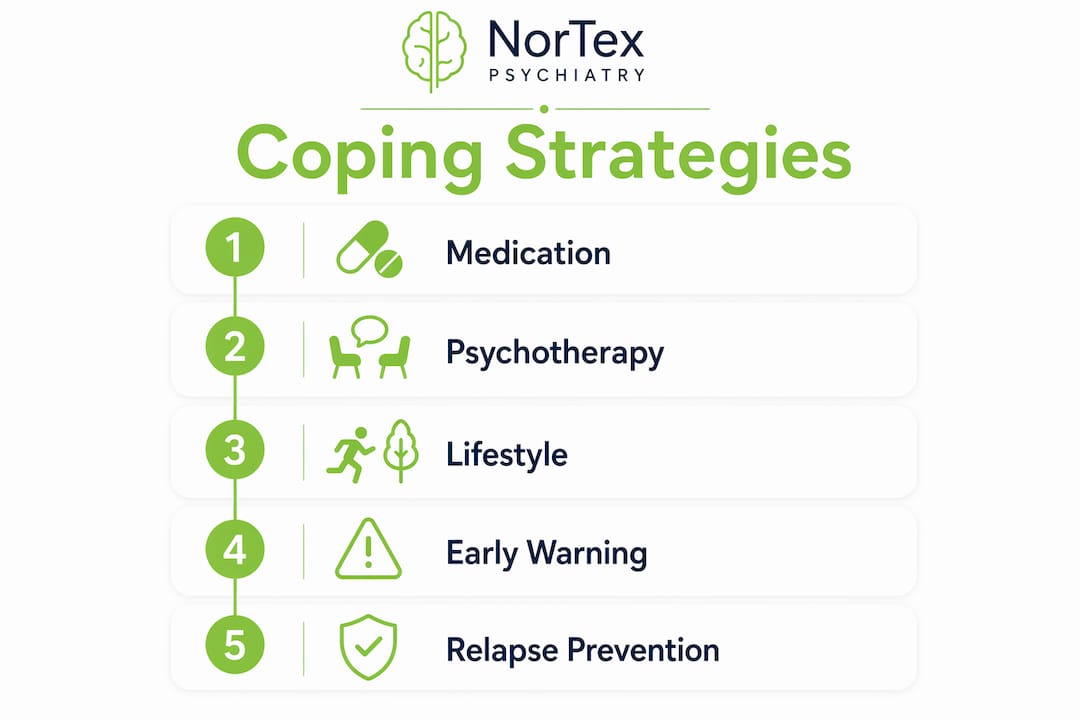
Relapse prevention is one of the most underused tools in mood disorder management. Most people wait until a full episode is underway before seeking help, but mood episodes rarely appear without warning. The early signs, called prodromes, are personal and consistent. Learning yours is one of the most protective things you can do.
Personalized warning sign maps allow you to anticipate and act on prodromes before they escalate into full episodes. A warning sign map is a written list of your personal early signals, organized by how early they appear and how severe they are.
| Warning Sign Stage | Common Examples | Recommended Response |
|---|---|---|
| Early (1 to 2 weeks before episode) | Sleep changes, increased irritability, social withdrawal | Increase therapy check-ins, review sleep hygiene |
| Mid (days before episode) | Racing thoughts, significant appetite change, low motivation | Contact prescriber, activate support network |
| Late (episode beginning) | Inability to function, suicidal thoughts, severe mood shift | Seek immediate clinical support or crisis line |
Early recognition and response to prodromes reduces both the severity and duration of mood episodes. Building a written relapse prevention plan with your treatment team, including who to call, what to adjust, and what to avoid, gives you a clear protocol when your judgment is most compromised. We recommend reviewing this plan at least twice a year, even when you feel well.
Key takeaways
Dealing with mood disorders requires a structured combination of medication, psychotherapy, lifestyle habits, and proactive relapse prevention rather than any single treatment approach.
| Point | Details |
|---|---|
| Medication creates the foundation | SSRIs, mood stabilizers, and atypical antipsychotics establish neurobiological stability that makes other treatments work. |
| Therapy addresses what medication cannot | CBT, IPT, and MBCT change thought patterns and relational dynamics that sustain mood disorder cycles. |
| Lifestyle changes carry clinical weight | Regular exercise, consistent sleep, and social connection produce measurable improvements in mood symptoms. |
| Early warning signs are personal and learnable | Building a personalized warning sign map reduces episode severity when acted on promptly. |
| Combined treatment outperforms any single approach | Medication plus therapy plus lifestyle adjustment produces the most durable long-term outcomes. |
What I have learned from working with mood disorders over time
Over years of working with adults across North Texas, one pattern stands out clearly: the people who do best are not the ones who find the perfect medication or the perfect therapist. They are the ones who stop expecting a single solution and start building a system.
We often see patients arrive having tried one antidepressant, felt partial relief, and concluded that medication “doesn’t work for them.” What they actually experienced was an incomplete treatment plan. Medication without therapy leaves cognitive distortions intact. Therapy without medication can feel like trying to rewire a house with the power still off. Neither alone is the standard of care.
The other thing worth saying plainly: recovery from a mood disorder is not a straight line. There will be periods of stability followed by setbacks, and that is not failure. It is the nature of a condition that responds to stress, sleep, relationships, and biology all at once. What matters is having a plan you return to rather than starting over from scratch each time.
Patient education is genuinely protective. When you understand your diagnosis, your medications, and your personal warning signs, you become a more effective participant in your own care. That knowledge does not replace clinical support, but it changes the dynamic from passive to active. That shift alone tends to improve outcomes.
— Felix
How Nortex Psychiatry can support your mood disorder treatment
At Nortex Psychiatry, we build individualized treatment plans for adults managing depression, bipolar disorder, and related mood conditions across Allen, Frisco, McKinney, and Plano. Our approach integrates medication management, evidence-based therapy coordination, and options like TMS therapy for patients who need more than standard medication. If you are unsure where to start, our mood disorder treatment guide walks through personalized steps for relief based on your specific presentation. We also offer a side-by-side comparison of TMS and medication for those exploring all available options. Both in-person and telehealth appointments are available. Reach out to us directly to schedule an evaluation and get a clear plan in place.
FAQ
What is a mood disorder exactly?
A mood disorder is a psychiatric condition defined by persistent, disruptive changes in emotional state that impair daily functioning. Common types include major depressive disorder, bipolar disorder, and persistent depressive disorder.
Can mood disorders be managed without medication?
Some mild cases respond to therapy and lifestyle changes alone, but moderate to severe mood disorders typically require medication to establish the neurobiological stability that makes other treatments effective. A psychiatrist can help determine the right combination for your situation.
How long does treatment for depression or bipolar disorder take?
Treatment is ongoing rather than time-limited for most people. Many patients stabilize within 3 to 6 months of starting a combined treatment plan, but long-term maintenance, including continued medication and periodic therapy, significantly reduces relapse risk.
What is the most effective therapy for managing mood swings?
CBT and MBCT have the strongest evidence base for reducing mood instability and preventing depressive relapse. IPT is particularly effective when mood episodes are tied to relationship stress or major life transitions.
When should I seek professional help for mood changes?
Seek professional support when mood changes persist for two or more weeks, interfere with work or relationships, or include thoughts of self-harm. Early intervention consistently produces better outcomes than waiting for symptoms to resolve on their own.