


Mental health support for parents is defined as the clinical, social, and practical care that helps caregivers manage stress, mood disorders, and emotional strain so they can function well in their own lives and in their children’s lives. This is not a luxury or a self-care trend. Research analyzing 5,501 Australian children found that 10 to 15 percent of children showed severe mental health symptoms directly linked to parental stress factors including financial strain, housing instability, and family conflict. That finding reframes everything. Supporting your mental health is not separate from parenting well. It is parenting well.
Why mental health support for parents shapes the whole family
The connection between parental mental health and child development is one of the most consistent findings in psychiatric research. When a parent carries untreated depression, chronic anxiety, or unmanaged stress, the effects do not stay contained. They move through the household in the form of withdrawn interactions, inconsistent routines, and emotional unavailability. Children are extraordinarily sensitive to these signals, even when they cannot name what they are picking up.
A JAMA Network Open cohort study found that parental depression, particularly maternal prenatal depression, strongly correlates with offspring psychiatric symptoms including depression, anxiety, and psychosis from childhood through young adulthood. The timing matters too. Exposure during pregnancy appears to be a particularly sensitive window, meaning that the impact of untreated maternal depression can begin before a child is even born.
The table below summarizes how specific parental stressors connect to child outcomes based on current evidence.
| Parental stressor | Observed child impact |
|---|---|
| Financial strain | Higher rates of anxiety and behavioral problems |
| Housing instability | Disrupted attachment and developmental delays |
| Parental depression (prenatal) | Elevated risk of depression, anxiety, and psychosis in offspring |
| Family conflict | Increased emotional dysregulation in children |
| Chronic parental stress | Reduced quality of parent-child interaction |
What this data makes clear is that the family system functions as a unit. Treating parental mental health is not a separate track from supporting children. It is the same track.
The quality of the parent-child relationship is one of the strongest predictors of a child’s long-term emotional development. When you are regulated, present, and emotionally available, your child has a model for how to manage their own internal world. That relational environment shapes developmental trajectories in ways that no school program or enrichment activity can fully replicate.
What mental health challenges do parents actually face?
Parents face a specific set of mental health pressures that are often underrecognized precisely because they are wrapped inside the role of caregiver. The expectation is that caring for others comes naturally and that struggling with it reflects a personal failure. That framing is both inaccurate and harmful.
Perinatal mood and anxiety disorders affect approximately 1 in 5 women in the period surrounding birth, and fathers and partners are also affected at significant rates. These conditions are underdetected and undertreated across the board. Many parents dismiss their symptoms as normal exhaustion or adjustment, and many clinicians do not screen thoroughly enough.
The most common challenges parents report include:
- Persistent low mood or loss of interest in activities they previously enjoyed
- Anxiety that feels disproportionate to the situation, often centered on the child’s safety or their own adequacy as a parent
- Sleep deprivation that compounds emotional dysregulation and reduces cognitive flexibility
- Social isolation, particularly in the early years of parenting or after a family move
- Guilt and shame that prevent parents from seeking help, because asking for support feels like admitting failure
Beyond individual symptoms, there is a structural problem. Healthcare systems divide child and adult mental health services, which means many parents fall into a gap. Dr. Priya Raj describes this as mothers being “visible to everyone and held by no one.” The pediatrician monitors the baby. The obstetrician closes the case at six weeks postpartum. No one is consistently tracking the parent as a person with their own mental health needs. That gap is real, and it costs families.
Pro Tip: If you are unsure whether what you are feeling is clinical depression or normal parenting fatigue, a brief mental health self-assessment can help you identify whether professional support is warranted. You do not need to wait until things feel unbearable.
When does parental mental health support matter most?
Timing is not everything, but it matters more than most people realize. The period from pregnancy through the first year postpartum is the most studied window, and the evidence for early intervention is strong. Parenting-centered therapy starting during pregnancy improves both maternal symptoms and the quality of the mother-infant relationship, which has downstream benefits for family resilience that extend well beyond the newborn phase.

But the conversation about timing cannot stop at the early postpartum period. A Swedish JAMA Network Open study reported approximately a 30 percent increase in paternal depression and stress disorders toward the end of the first postpartum year. This means fathers are often at their highest risk precisely when the system has stopped looking. Routine screening that ends at six weeks postpartum misses this entirely.
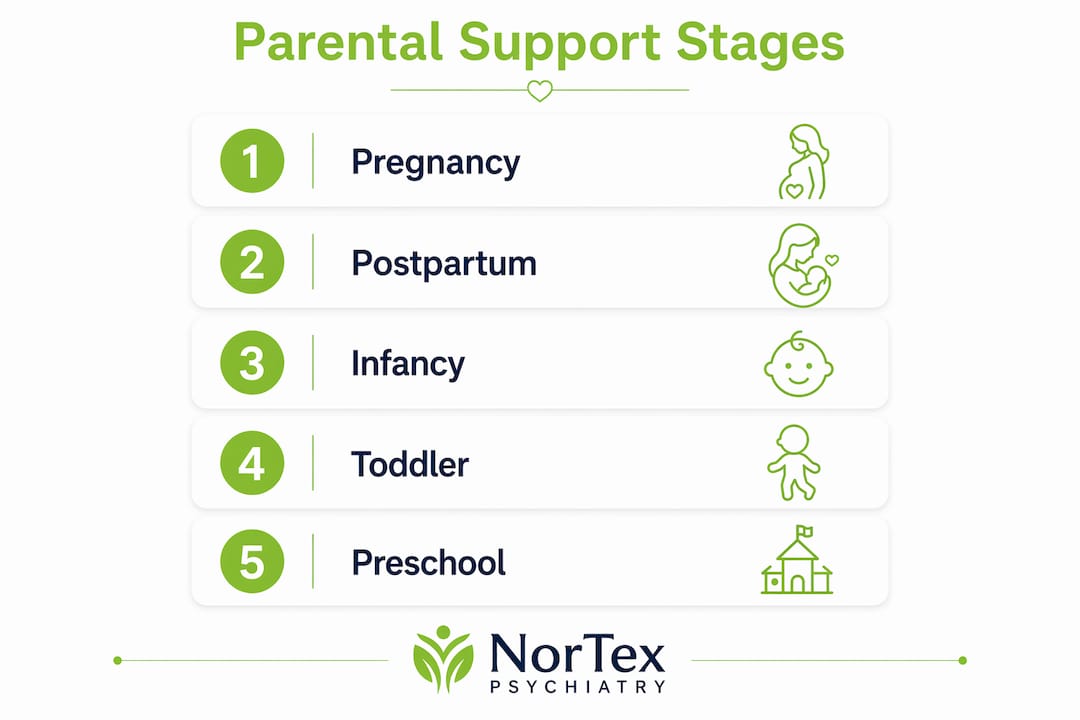
The comparison below shows how support needs shift across different parenting stages.
| Parenting stage | Primary mental health focus | Recommended support type |
|---|---|---|
| Pregnancy | Maternal depression screening, stress reduction | Therapy, social support, financial counseling |
| Early postpartum (0 to 3 months) | Both parents, mood and anxiety monitoring | Perinatal therapy, peer support groups |
| Late postpartum (6 to 12 months) | Paternal depression, relationship strain | Ongoing monitoring, couples counseling |
| Toddler and school years | Parenting stress, burnout, identity shifts | Individual therapy, parenting programs |
The pattern here is consistent. Support needs do not end. They shift. A system that treats parental mental health as a postpartum checkbox will miss the majority of parents who need help.
Effective support must also address social determinants like sleep, finances, and housing. Therapy alone cannot resolve the mental health impact of financial precarity or chronic sleep deprivation. The most effective interventions coordinate across mental health care, social services, and practical support.
Pro Tip: If you are in the Allen, Frisco, McKinney, or Plano area and have been managing parenting stress for more than a few weeks without relief, early action in mental health consistently leads to faster and more lasting improvement than waiting.
How to support your mental health as a parent
Knowing that support matters is one thing. Knowing where to start is another. The good news is that the range of options available to parents has expanded significantly, and you do not need to navigate it alone.
Here are the most evidence-supported approaches for parents seeking to improve their mental health:
- Therapy and counseling: Individual therapy, cognitive behavioral therapy (CBT), and parenting-centered approaches like the Cool Little Kids program address both symptoms and relational patterns. Telehealth options through practices like Nortexpsychiatry make access far more practical for parents managing childcare and work schedules.
- Medication management: For moderate to severe depression or anxiety, medication evaluated and managed by a psychiatrist can provide the stability needed to engage in therapy and daily life. The benefits of psychiatric care for anxiety and depression are well-documented and often underutilized by parents who worry about stigma.
- Social connection: Isolation amplifies every other mental health challenge. Structured peer support groups for parents, whether in-person or online, reduce the sense of being alone in the experience.
- Sleep prioritization: Sleep deprivation is not a badge of honor. It is a clinical risk factor. When possible, rotating nighttime responsibilities with a partner or accepting help from family directly reduces emotional dysregulation.
- Movement and mindfulness: Regular physical activity and brief mindfulness practices, even ten minutes daily, measurably reduce cortisol and improve mood. These are not replacements for clinical care but reliable complements to it.
- Integrated family care: Clinical psychologist Eynav Accortt, PhD, emphasizes that supporting both parents is the most effective way to build strong family bonds and positively influence children’s development. Treating parental mental health as a shared responsibility, not just a maternal one, changes outcomes.
Practical self-care strategies that are grounded in evidence rather than wellness culture can make a real difference when applied consistently. The goal is not perfection. It is stability.
Key takeaways
Parental mental health support is a family health strategy, not a personal indulgence, and the evidence consistently shows that treating parents improves outcomes for children, relationships, and the entire household.
| Point | Details |
|---|---|
| Parental stress affects children directly | Financial strain, housing instability, and depression in parents raise children’s risk of severe mental health symptoms. |
| Pregnancy is a critical intervention window | Prenatal maternal depression correlates with psychiatric symptoms in offspring through young adulthood. |
| Fathers need monitoring beyond early postpartum | Paternal depression rises approximately 30% toward the end of the first postpartum year, often after screening ends. |
| Support must address social determinants | Therapy alone is insufficient; effective care also addresses sleep, finances, and housing. |
| Both parents benefit from mental health care | Supporting both caregivers strengthens family bonds and improves children’s developmental outcomes. |
What I have learned from working with parents in psychiatric care
I have sat across from a lot of parents over the years, and the pattern I notice most often is not the severity of their symptoms. It is how long they waited before coming in. Most parents I see have been managing quietly for months, sometimes years, telling themselves that what they are feeling is just part of the job. By the time they arrive, the weight they are carrying has already shaped their relationships, their sleep, and their sense of who they are outside of being a parent.
What strikes me about the research is how clearly it confirms what we observe clinically. The impact of parental mental health on family dynamics is not subtle. It is structural. And yet the system we have built treats parental mental health as secondary to child mental health, when the two are inseparable.
The framing I find most useful with parents is this: getting support is not about stepping away from your family. It is about showing up for them more fully. That reframe tends to reduce the guilt that keeps people from asking for help. It also happens to be accurate. The evidence on parenting-centered therapy shows that when parents improve, the relational environment improves, and children benefit directly.
If you are reading this and recognizing yourself in any of it, that recognition matters. It is not just reassuring. It is the first step toward doing something about it.
— Felix
How Nortexpsychiatry supports parents through personalized care
At Nortexpsychiatry, we work with parents across Allen, Frisco, McKinney, Plano, and the broader North Dallas area who are managing depression, anxiety, mood disorders, and the compounding stress of caregiving. Our approach is personalized and evidence-based, which means we do not apply a one-size-fits-all protocol. We evaluate your specific situation, your history, and your goals.
If you are trying to decide between treatment options, our mood disorder treatment guide walks through personalized steps for relief in plain language. For parents weighing medication against other approaches, the TMS vs. medication comparison provides a clear side-by-side breakdown. Both in-person and telehealth appointments are available, so scheduling around your family’s needs is realistic. You do not have to figure this out alone.
FAQ
Why does parental mental health affect children so much?
Children’s emotional development depends heavily on the relational environment at home. Parental depression and chronic stress reduce the quality of parent-child interaction, which directly shapes a child’s ability to regulate emotions, form attachments, and develop resilience.
When should a parent seek professional mental health support?
If you have experienced persistent low mood, anxiety, or emotional exhaustion for more than two weeks, professional evaluation is appropriate. Waiting for symptoms to become severe before seeking help consistently leads to longer recovery times.
Are fathers at risk for postpartum depression too?
Yes. Paternal depression rises notably toward the end of the first postpartum year, a period when most screening programs have already ended. Fathers and partners should be monitored throughout the full first year, not just in the early weeks.
What types of therapy work best for parents?
Cognitive behavioral therapy, parenting-centered therapy, and perinatal-focused approaches have the strongest evidence base. Parenting-centered therapy that addresses both symptoms and the parent-child relationship produces the most durable improvements.
Can telehealth work for parental mental health care?
Telehealth is an effective and practical option for parents, particularly those managing childcare, work schedules, or transportation barriers. Evidence supports telehealth delivery of therapy and psychiatric medication management for depression and anxiety at outcomes comparable to in-person care.