


Most people assume mental health care is something you pursue only after things fall apart. You push through the worry, ride out the low moods, and tell yourself it will pass. But research keeps telling a very different story. Mild anxiety or sadness left unaddressed does not simply fade with time. It quietly grows, reshapes how your brain handles stress, and makes everyday life harder to manage. The good news is that acting early, even before symptoms feel “serious,” can change your entire recovery timeline and improve long-term outcomes in ways that waiting simply cannot.
Table of Contents
- The hidden cost of waiting: why early mental health care matters
- What research says: tangible benefits of early intervention
- How early care is personalized: beyond one-size-fits-all solutions
- What to expect: results and limits of early intervention
- The truth most overlook: early care works best when it’s both timely and truly personalized
- Take the next step: early, personalized care starts here
- Frequently asked questions
Key Takeaways
| Point | Details |
|---|---|
| Act early for better results | Seeking help at the first sign of trouble can stop symptoms from worsening and leads to faster recovery. |
| Personalization matters | Treatment tailored to your needs and symptom severity delivers better and longer-lasting outcomes. |
| Flexible care adapts to you | Modern approaches adjust in real time as your needs change, so support intensifies if necessary. |
| Prevention beats crisis care | It’s far easier and less stressful to address mental health early than to wait for things to get serious. |
The hidden cost of waiting: why early mental health care matters
Here is what most people do not realize: anxiety and depression are not static. They follow a pattern. What starts as occasional worry or a few weeks of low energy can, without support, become something that touches every part of your life, from your relationships to your performance at work to your physical health.
When anxiety goes unchecked, the brain adapts. The nervous system becomes more reactive. Thought patterns that were once occasional grow into habits. Depression works similarly. Untreated low mood rewires how you process reward, motivation, and connection. The longer these patterns sit, the more entrenched they become, and the more intensive the care needed later to address them.

As one key body of research confirms, anxiety and depression, if left untreated, carry serious long-term consequences for adults across all stages of life. And yet, the average person waits years before ever speaking to a professional.
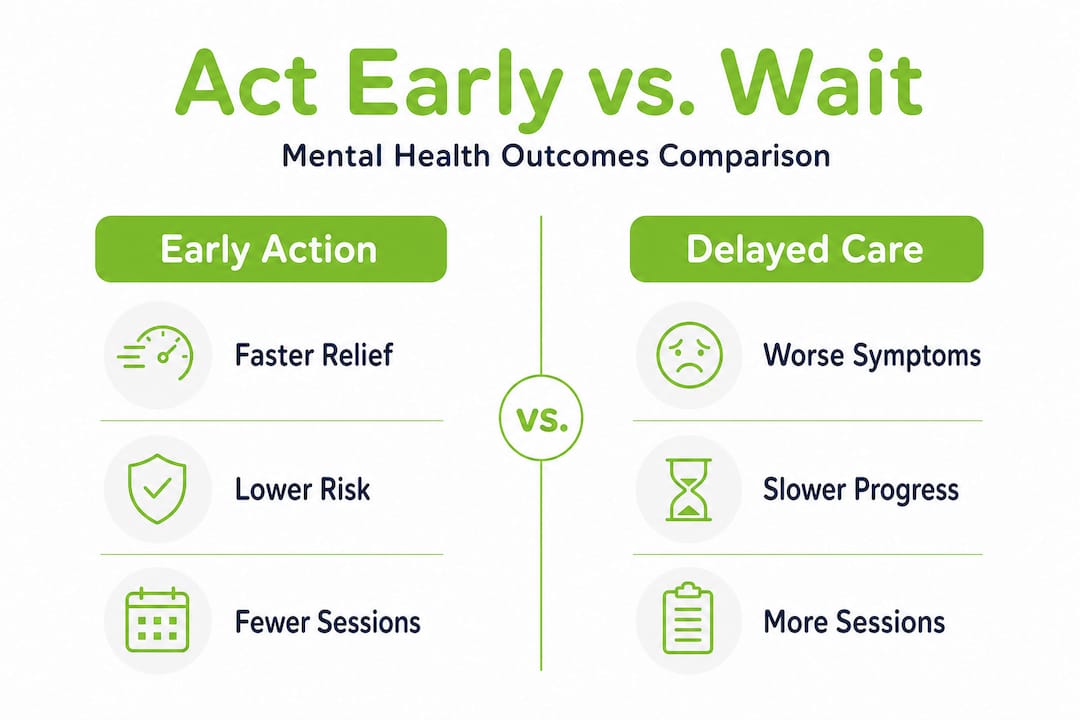
Consider what happens depending on when you act:
Acting early (mild or subthreshold symptoms):
- Shorter treatment duration
- Higher likelihood of full symptom remission
- Lower risk of developing a full clinical disorder
- Less disruption to work, family, and social life
- Greater range of treatment options available
Waiting until symptoms are severe:
- Increased risk of chronic, recurring episodes
- Greater reliance on intensive interventions
- Longer path to recovery
- Higher likelihood of secondary issues such as sleep disorders or substance use
- Reduced treatment responsiveness in some cases
“Anxiety and depression are highly prevalent and, if untreated, carry serious long-term impact for young and emerging adults.”
That quote captures something important. The impact is not just clinical. It is life impact. It is the job you could not keep, the relationship that frayed, the years spent managing something that could have been addressed much sooner with the right support.
What research says: tangible benefits of early intervention
Now that we have established why the “wait and see” approach is risky, the next question is practical: what does early action actually produce? The research is encouraging, though it also comes with nuance worth understanding.
A large-scale systematic review found that early mental health intervention can improve care access, short-term outcomes, and reduce burden on other services, though results vary across program models. In other words, early care works. But the design of that care matters.
One of the most striking findings comes from research on prevention rather than treatment. Adults who are experiencing what researchers call “subthreshold symptoms,” meaning distress and impairment that does not yet meet full diagnostic criteria, can benefit enormously from targeted early support. A randomized controlled trial found that indicated prevention for adults with subthreshold symptoms cut the risk of developing a full anxiety or depressive disorder by nearly 40% over the following year.
That is a meaningful number. It means that getting help while your symptoms are still mild could protect you from a significantly harder road ahead.
| Outcome area | Early intervention | Delayed care |
|---|---|---|
| Risk of full disorder onset | Reduced by up to 40% | Substantially higher |
| Access to appropriate services | Improved, more options | Often limited by severity |
| Short-term symptom relief | Strong evidence of benefit | Slower and less predictable |
| Treatment duration | Often shorter | Typically longer |
| Disruption to daily life | Minimized | Often significant |
“Indicated prevention at subthreshold symptom levels can cut disorder risk by nearly 40% over one year.”
This data should shift how you think about “readiness” for care. You do not need to be in crisis to benefit from professional support. In fact, acting before crisis is exactly when the support is most effective.
Pro Tip: If you have been telling yourself “it is not bad enough yet,” that is often the moment to reach out. Acting while symptoms are mild typically means a quicker, less intensive treatment experience and better results overall. You can also explore evidence-based depression therapy and practical anxiety relief strategies to understand what options look like before you even book an appointment.
How early care is personalized: beyond one-size-fits-all solutions
A common misconception is that early mental health care means light-touch, generic support. Something like a pamphlet, a breathing exercise app, or a brief group workshop. While those tools can help, truly effective early intervention is far more dynamic.
Modern psychiatric care uses what is called a stepped-care or stratified care model. This approach matches the intensity of your care to the severity and trajectory of your symptoms. It is not a fixed plan. It is a responsive system.
Here is how it typically works in practice:
- Initial assessment: Your provider evaluates your current symptoms, history, and daily functioning to understand where you are right now.
- Matched starting point: Based on that assessment, you begin at an appropriate level of support, which might be structured self-management, regular check-ins, or more active therapy or medication management.
- Ongoing symptom tracking: Your progress is monitored consistently, often using validated symptom scales, so your provider can see exactly how you are responding.
- Flexible escalation or de-escalation: If symptoms improve, care can become lighter. If they persist or worsen, intensity is stepped up. Nothing is assumed. Everything is based on your actual data.
- Long-term planning: Goals are adjusted over time to reflect your real-life needs, not a textbook timeline.
Research confirms that stepped and measurement-based approaches guide treatment intensity and escalation based on actual symptom change, allowing higher-intensity support to be introduced as needed without delay.
Fixed standard care vs. stepped or stratified personalized care:
| Feature | Fixed standard care | Stepped or stratified care |
|---|---|---|
| Treatment intensity | Set from the start | Adjusted based on progress |
| Symptom monitoring | Periodic or informal | Ongoing, structured tracking |
| Escalation pathway | Often unclear | Built into the model |
| Fit to individual needs | Limited | High, adapts over time |
| Efficiency | Variable | Generally more efficient |
This matters for adults in North Dallas who are balancing careers, families, and full schedules. You need care that meets you where you are and grows with you if needed.
Pro Tip: When exploring providers, ask directly whether they use structured symptom tracking and whether the intensity of your care can be adjusted as you progress. Programs that answer yes to both tend to produce better outcomes and a more satisfying experience. You can also learn more about what personalized psychiatric care looks like in practice and explore a personalized mood disorder guide tailored for people navigating exactly these kinds of decisions.
What to expect: results and limits of early intervention
Understanding what early intervention can realistically deliver is just as important as knowing its benefits. Hope and clarity are not opposites. You deserve both.
The research paints a genuinely encouraging picture for short-term outcomes. Adults who engage in early, structured care, particularly approaches like cognitive behavioral therapy (CBT) delivered in blended or stepped formats, often experience meaningful symptom relief, improved functioning, and better quality of life within weeks or months. The benefits of psychiatric care for anxiety and depression are well documented in both clinical trials and real-world settings.
What early intervention often improves:
- Anxiety symptom frequency and intensity
- Mood stability and emotional regulation
- Sleep quality and daily energy
- Ability to concentrate and make decisions
- Sense of control over your own mental well-being
Where more data is still needed:
- Long-term durability of certain program designs
- Which specific formats work best for which individuals
- How to maintain gains after formal treatment ends
- Outcomes for adults with multiple overlapping conditions
Research on real-world CBT outcomes notes that blended or stepped CBT is often efficient and effective, but gaps remain and not all benefits hold at a statistically significant level over the long term. Similarly, systematic reviews acknowledge that program designs vary widely, and more robust long-term studies are still needed.
“Evidence-based blended and stepped care approaches show real promise in reducing symptoms, but results vary and ongoing research continues to refine what works best for whom.”
This honesty is not meant to discourage you. It is meant to help you walk into care with realistic expectations and the right questions. Recovery is a journey, not a straight line, and the best providers will prepare you for that reality while staying actively engaged in your progress. Learn more about how psychiatrists help adults navigate this journey in practical, ongoing ways.
The truth most overlook: early care works best when it’s both timely and truly personalized
Here is something we think deserves more honest conversation in mental health care: early intervention is not automatically effective just because it happens early. Timing is necessary, but not sufficient.
Off-the-shelf programs, generic group modules, or brief check-ins that do not adapt to your actual response are common in early intervention settings. And while they are better than nothing, they often leave people frustrated. You follow the steps, you show up, and you still feel like the care was not quite built for you. That frustration is valid, and it is also very preventable.
What we have seen is this: the adults who benefit most from early care are those who receive support that is both timely and genuinely individualized. That means a provider who listens beyond the symptoms, who tracks how you are actually responding, and who is willing to adjust the plan when something is not working. It means not waiting until you are in crisis to escalate care, and not sticking rigidly to a protocol when your situation calls for something different.
Personalized psychiatric care insights consistently point to this combination as the foundation of lasting change. Generic checklists do not account for your specific work stress, your family dynamics, your history, or your goals. Real progress happens when your provider treats you as a whole person, not a set of symptoms to be managed.
We encourage you to ask the hard questions when choosing where to get care. How will you know if I am improving? What happens if my symptoms do not respond? How does this plan account for my life outside the clinic? Those questions tell you a lot about whether a program is truly built for you.
Take the next step: early, personalized care starts here
If this article has helped you see that waiting is not a neutral choice, you are already thinking in the right direction. At Nortex Psychiatry, we serve adults across Allen, Frisco, McKinney, Plano, and the surrounding North Dallas area with care that is both early-focused and deeply individualized. Whether you are dealing with persistent worry, low mood, or everyday stress that is starting to interfere with your life, we are here to meet you at whatever stage you are in.
Start by exploring psychiatrist-led anxiety care to understand what a clinical approach looks like, or take our confidential mental health self-assessment to get a clearer picture of where you are right now. If mood is your primary concern, our personalized mood disorder care guide walks you through what targeted, individualized treatment can offer. You do not have to figure this out alone.
Frequently asked questions
How early should I get help for anxiety or depression?
You should consider reaching out as soon as distress or symptoms start affecting your daily life, even when they are still mild. Research shows that indicated prevention at the subthreshold symptom level dramatically reduces the risk of escalation into a full disorder.
Does early intervention really prevent mental health problems from getting worse?
Yes. Clinical studies show that early intervention significantly reduces the likelihood of anxiety and depression turning into long-term, harder-to-treat conditions, while also improving access to appropriate care sooner.
What if early care doesn’t work for me?
Modern early care is built to adapt. If your symptoms continue or worsen, stepped measurement-based approaches allow treatment intensity to be increased, so you are never left without a clear path forward.
Is early intervention always enough, or will I still need long-term therapy?
Early action often means fewer sessions and faster relief, but some people do benefit from longer-term support. Research on blended and stepped care shows that not all responses are equally lasting, so ongoing support may be part of the plan for some individuals.
What makes personalized early care different from standard approaches?
Personalized early care uses structured symptom tracking and adapts treatment intensity to match your unique needs over time, rather than following a fixed plan that stays the same regardless of how you are responding.