


You might have a name for what you’re feeling. Anxiety. Depression. ADHD. But having a diagnosis doesn’t automatically mean you have a clear path forward. Psychiatric treatment is genuinely complex, and what works well for one person may barely move the needle for another. That’s not a failure of medicine. It’s the reality of how the brain works. In this article, we’ll walk you through how modern psychiatry approaches mental health care, what evidence-based treatment actually looks like in practice, and how to get the kind of personalized support that makes a real difference.
Table of Contents
- Understanding the evolving role of psychiatry in mental health care
- Diagnosis and classification: Why psychiatric frameworks matter
- Evidence-based treatment options: Medication, therapy and beyond
- Personalized care: Navigating complexity for North Dallas adults
- Our perspective: Real-world lessons that most guides miss
- Connect with personalized psychiatric care in North Dallas
- Frequently asked questions
Key Takeaways
| Point | Details |
|---|---|
| Integrated care improves outcomes | Team-based psychiatry is more effective for depression and anxiety than solo practitioner models. |
| Diagnosis requires nuance | Different psychiatric classification systems mean diagnoses aren’t a simple one-to-one map to treatment. |
| Evidence guides treatment | Medication and psychotherapy are best combined for most adults, with treatment adjusted based on response. |
| Personalization is critical | Effective psychiatric care in North Dallas hinges on tailored approaches, not just diagnosis-driven protocols. |
| Guidelines evolve with science | Treatment standards change as new research and clinical evidence emerge, so staying informed is vital. |
Understanding the evolving role of psychiatry in mental health care
For a long time, seeing a psychiatrist meant sitting in an office alone with one doctor who managed everything. That model still exists, but it’s changing. Modern psychiatric care increasingly looks like a team effort, and that shift is producing better outcomes for people dealing with depression, anxiety, and other conditions.
Psychiatry’s role is increasingly integrated into team-based models of care, including collaborative care, shifting practice away from psychiatrist-only silos and toward coordinated management for conditions such as depression and anxiety. In practical terms, this means your psychiatrist might work alongside your primary care provider, a therapist, and even a case manager, all communicating with each other to keep your treatment on track.
Here’s why that matters for you. Mental health conditions rarely exist in isolation. Anxiety often co-occurs with depression. ADHD can look like mood instability. Physical health problems can trigger psychiatric symptoms. When providers work together, they catch things that solo practitioners sometimes miss.
What collaborative psychiatric care typically includes:
- Regular communication between your prescribing provider and therapist
- Shared treatment goals reviewed at each visit
- Screening tools used across the care team to track your progress
- Clear escalation paths when symptoms worsen or don’t improve
- Flexible scheduling with telehealth options so you stay consistent
“The goal of integrated psychiatric care isn’t just to prescribe the right medication. It’s to make sure the whole system around you is working in your favor.” This is exactly the approach we take at Nortex Psychiatry, where psychiatrists and collaborative care work together to build something more effective than any single intervention alone.
Consider a real-world example. An adult in Frisco, Texas, has been struggling with low motivation, poor concentration, and persistent worry for several months. A solo psychiatrist might prescribe an antidepressant and schedule a follow-up in four weeks. A collaborative care team would track symptom scores, coordinate therapy referrals, check in mid-cycle, and adjust the plan based on early response data. The difference in outcomes can be significant. That’s what personalized psychiatry in North Dallas looks like when it’s done well.
Diagnosis and classification: Why psychiatric frameworks matter

Getting a diagnosis can feel like a relief. But here’s something your doctor may not have had time to explain: the diagnosis is a starting point, not a finish line.
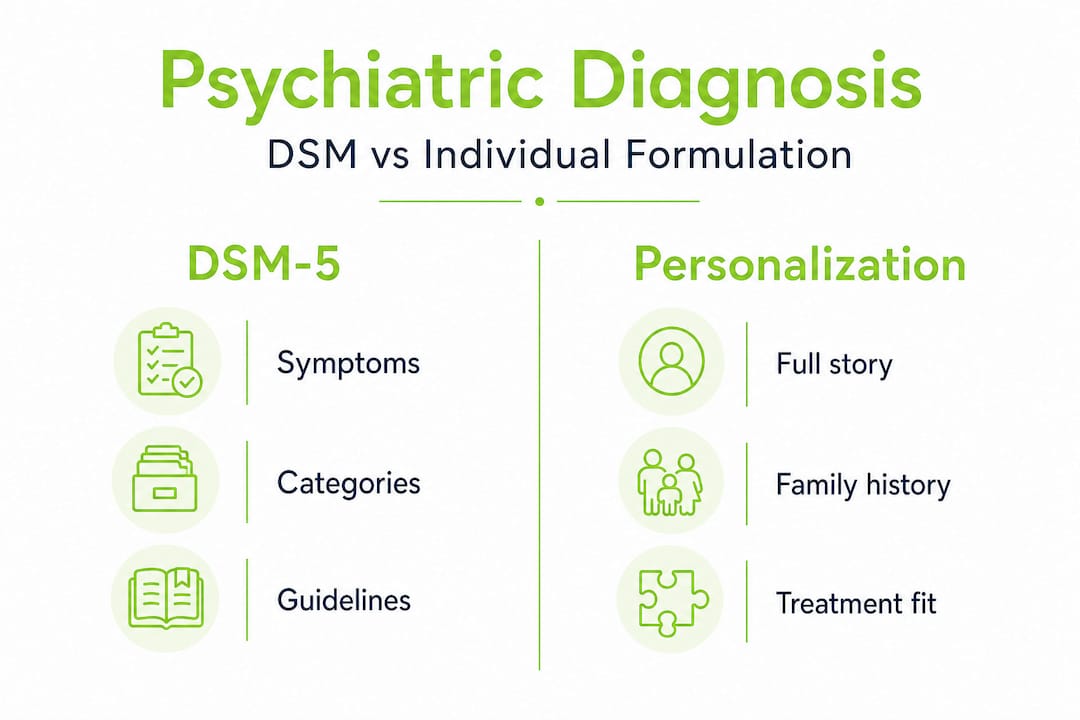
Psychiatric diagnoses come primarily from the DSM (Diagnostic and Statistical Manual of Mental Disorders). It’s a useful tool. But it doesn’t always tell us why someone has a condition or exactly how their brain is involved. The validity of psychiatric classifications depends heavily on what standard of validity is used, and different frameworks can produce different forms of “validity,” which complicates the translation from a diagnosis to the biological mechanisms and treatment response behind it.
What this means in plain language: two people can both have a DSM diagnosis of major depressive disorder and respond very differently to the same medication. The label describes the symptom pattern, not the underlying biology.
| Classification framework | Primary focus | Strength | Limitation |
|---|---|---|---|
| DSM-5 | Symptom clusters and duration | Widely accepted, standardized | Limited biological specificity |
| ICD-11 | Global clinical utility | International compatibility | Similar diagnostic limitations |
| RDoC (Research Domain Criteria) | Neurobiology and behavior dimensions | Mechanism-focused | Less practical for daily clinical use |
| Individualized formulation | Patient-specific history, biology, context | Highly personalized | Time-intensive |
This is why we emphasize individualized formulation alongside formal diagnosis. Your history, family background, past treatment responses, lifestyle factors, and even how your symptoms have changed over time all feed into a more accurate clinical picture than a DSM code alone provides.
Pro Tip: When you meet with a psychiatrist, ask specifically about your individualized formulation, not just your diagnosis. A good provider will be able to explain why they think your symptoms are presenting the way they are and how that guides your specific personalized psychiatric frameworks for treatment.
Evidence-based treatment options: Medication, therapy and beyond
Here’s the good news: we have more effective, well-studied treatment options for anxiety, depression, and ADHD today than at any other point in history. The challenge is matching the right option to the right person at the right time. That’s where evidence-based guidance becomes critical.
Evidence-based care for depression and anxiety commonly combines medication and psychotherapy, with treatment selection and dose adjustments guided by the expected time course and individual symptom response. This isn’t one-size-fits-all. It’s a dynamic process.
How psychiatrists typically approach treatment decisions:
- Assess severity. Mild depression might start with structured psychotherapy alone. Moderate to severe depression usually warrants combined medication and therapy from the outset.
- Start with first-line options. SSRIs (selective serotonin reuptake inhibitors) and SNRIs (serotonin-norepinephrine reuptake inhibitors) remain the most prescribed first-line medications because of their balance of effectiveness and tolerability.
- Evaluate early response. A meaningful rule of thumb: if a patient hasn’t shown at least 20% symptom reduction by week four, it’s time to reassess the dose or treatment approach.
- Adjust systematically. This might mean increasing the dose, switching to a different medication, adding an augmenting agent, or intensifying the therapy component.
- Track measurable outcomes. Tools like the PHQ-9 for depression and GAD-7 for anxiety help track changes over time, not just subjective impressions.
| Treatment type | Best evidence for | Typical timeline | Notable consideration |
|---|---|---|---|
| SSRI/SNRI medication | Depression, anxiety, panic disorder | 4 to 8 weeks for full effect | Requires dose titration and monitoring |
| Cognitive behavioral therapy (CBT) | Anxiety, depression, ADHD | 12 to 20 sessions | Skills-based, requires active engagement |
| Combined medication and therapy | Moderate to severe depression | Ongoing, flexible | Often more effective than either alone |
| Stimulant medication (ADHD) | ADHD in adults | Days to weeks | Requires careful monitoring and follow-up |
| TMS (transcranial magnetic stimulation) | Treatment-resistant depression | 6 weeks of daily sessions | Non-invasive, no systemic side effects |
| Ketamine or esketamine | Severe, treatment-resistant depression | Rapid, within hours to days | Administered in clinical settings |
Exercise deserves a special mention here. It’s easy to dismiss physical activity as a soft recommendation, but research consistently shows that regular aerobic exercise can reduce depressive symptoms with effect sizes comparable to antidepressants in some populations. We often recommend it as part of a broader treatment plan, not as a substitute for clinical care.
To learn more about personalized mood disorder care, including how medication and therapy work together for complex cases, we have detailed guidance available. You might also find it helpful to complete a mental health self-assessment before your first appointment so you can discuss your symptom picture in more detail. For a thorough look at how different approaches stack up, our TMS vs. medication comparison breaks down the key differences.
A key statistic worth knowing: For adults starting antidepressant treatment, roughly 50 to 60% will respond to the first medication tried. That sounds encouraging. But it also means a significant number of people need a second, third, or modified approach before finding real relief. This is normal and expected in psychiatric care, not a sign that treatment isn’t working.
Personalized care: Navigating complexity for North Dallas adults
Knowing that treatments exist is one thing. Feeling confident that your treatment is tailored to you is something else entirely. Here’s how real personalization works in practice, and what to look for when evaluating your care.
Even when symptoms map onto DSM diagnoses, scientific validity can differ by classification framework. This motivates careful, individualized formulation rather than assuming a one-to-one mapping between diagnostic labels and biological mechanisms or treatment response. In short, your psychiatrist should be thinking about you, not just your diagnosis code.
What genuinely personalized psychiatric care looks like:
- A detailed intake that covers your full medical history, family psychiatric history, past medication trials and responses, and current life context
- Ongoing reassessment at every visit, not just a quick check-in before refilling prescriptions
- Transparent explanations of why a particular medication or therapy approach is being recommended for your specific situation
- Openness to adjusting the plan based on what you’re experiencing, including side effects, partial response, or life changes
- Attention to comorbidities, for example, treating anxiety that underlies ADHD-like concentration problems differently than treating primary ADHD
Questions worth asking your psychiatrist:
- Why is this specific treatment recommended for me, not just for my diagnosis?
- What response should I realistically expect, and by when?
- What are the next steps if this doesn’t work as planned?
- How will we measure whether things are improving?
- Are there lifestyle factors I should address alongside medication or therapy?
Individualized psychiatric care in North Dallas is available across the area, from Allen and Plano to Frisco and McKinney. Location shouldn’t be a barrier to quality care, especially with telehealth options that make it easier to stay consistent with appointments.
Pro Tip: Personalized care is an ongoing process, not a one-time match. Your treatment plan should evolve as your symptoms, life circumstances, and response to treatment change. If your care hasn’t been reassessed in over three months, that’s worth raising with your provider. For complex or treatment-resistant cases, newer options like ketamine therapy personalization may also be worth exploring with your care team.
Our perspective: Real-world lessons that most guides miss
Most articles about mental health care walk you through symptoms and treatment options and leave it there. We want to go further, because the patients who struggle most are often not those with the most severe diagnoses. They’re the ones who followed the standard path and still didn’t get better.
Here’s what we’ve seen repeatedly: when someone is told “you have depression, take this medication,” and it doesn’t work, they often blame themselves. They wonder if their condition is hopeless or if they’re just not trying hard enough. That’s a painful and completely inaccurate conclusion.
The truth is that psychiatry is still catching up with the complexity of the brain. Guidelines keep evolving because new evidence continuously updates what’s considered best practice. Debates persist about whether psychotherapy or pharmacotherapy should lead treatment in specific populations, and some emerging interventions don’t yet have enough evidence to be recommended strongly. That’s not a failure of psychiatry. That’s science working as it should.
But it does mean something important for you: the “diagnosis first, medication second” approach, applied rigidly, can miss the forest for the trees. What you need is a provider who uses diagnosis as a map, not a destination. Someone who asks not just “what do you have” but “who are you, and what’s happening in your life right now?”
We believe strongly in a fresh perspective on psychiatric personalization that puts your full story at the center of care. Recovery isn’t a straight line. Some weeks you’ll feel worse before you feel better. Some treatments will need adjusting. That’s expected. What makes the difference is a care team that stays engaged throughout the process and treats you like a whole person.
Connect with personalized psychiatric care in North Dallas
If this article has made one thing clear, it’s that navigating mental health care takes more than a quick diagnosis and a prescription. It takes thoughtful, ongoing, personalized support from providers who understand the science and see you as an individual.
At Nortex Psychiatry, we serve adults across Allen, Frisco, McKinney, Plano, and surrounding North Dallas communities with exactly that kind of care. Whether you’re dealing with transforming anxiety care needs, looking for personalized mood disorder relief, or simply ready to understand your options better, we’re here to help. A great first step is to start your assessment today so we can begin building a picture of where you are and where you want to be.
Frequently asked questions
How does psychiatry differ from psychology in mental health care?
Psychiatrists are medical doctors who can prescribe medication and address the biological aspects of mental health conditions, while psychologists typically provide therapy focused on emotional and behavioral interventions. In many cases, working with both leads to the best outcomes.
What’s the collaborative care model in psychiatry?
Collaborative care is a team-based approach that coordinates psychiatrists, primary care providers, and therapists to treat conditions like depression and anxiety together. This integrated model consistently produces better outcomes than care delivered in isolation.
How are treatments chosen for anxiety or depression?
Treatment selection combines medication and therapy based on symptom severity, individual history, and early response patterns, with adjustments made systematically as the care unfolds. Your psychiatrist should explain the reasoning behind each recommendation.
Why do treatment guidelines keep changing?
Guidelines evolve as new evidence from clinical trials and outcome studies refines what works best, and ongoing debates about the balance between therapy and medication continue to shape recommendations. Updated guidelines reflect progress, not instability.
Can psychiatric care be personalized for ADHD?
Yes, ADHD treatment in adults is highly individualized, combining medication evaluation, behavioral strategies, and regular reassessment to address how ADHD is specifically affecting your focus, mood, and daily functioning. A thorough evaluation helps distinguish ADHD from other overlapping conditions.