


You already manage demanding deadlines, high-stakes decisions, and the kind of schedule that leaves little room for anything that feels slow or uncertain. When anxiety, depression, or ADHD starts affecting your focus and energy, seeking help shouldn’t add more friction to your life. The good news is that it doesn’t have to. Time-efficient multidisciplinary outpatient models can reduce wait times and still produce meaningful symptom improvements, meaning professionals in North Dallas now have access to discreet, structured psychiatric care that actually fits their lives.
Table of Contents
- Why professionals need specialized psychiatric care
- Comprehensive evaluation: Getting the right diagnosis up front
- Personalized treatment: Options that fit your lifestyle
- How to identify a clinic that prioritizes access, privacy, and quality
- The uncomfortable truth: Personalization is real, but it’s not magic
- Ready to start your journey? Discreet care options in North Dallas
- Frequently asked questions
Key Takeaways
| Point | Details |
|---|---|
| Fast, discreet access | Specialized clinics in North Dallas offer appointments for professionals within weeks, prioritizing privacy at every step. |
| Comprehensive diagnostic process | Expect a thorough evaluation that screens for ADHD, anxiety, depression, and medical contributors up front. |
| Personalized, flexible treatments | Treatment plans blend therapy, medication, and remote options, all tailored to your lifestyle and needs. |
| Outcome measurement matters | Clinics should track your progress with rating scales and adjust treatment to maximize improvement. |
| Beware personalization hype | Personalized care works best when grounded in evidence and transparent outcome tracking, not just buzzwords. |
Why professionals need specialized psychiatric care
The pressures you face at work are categorically different from those most people encounter. You carry responsibility for teams, clients, and outcomes. Confidentiality isn’t just a preference for you—it’s often a professional necessity. Standard psychiatric clinics weren’t built with your schedule or your privacy concerns in mind.
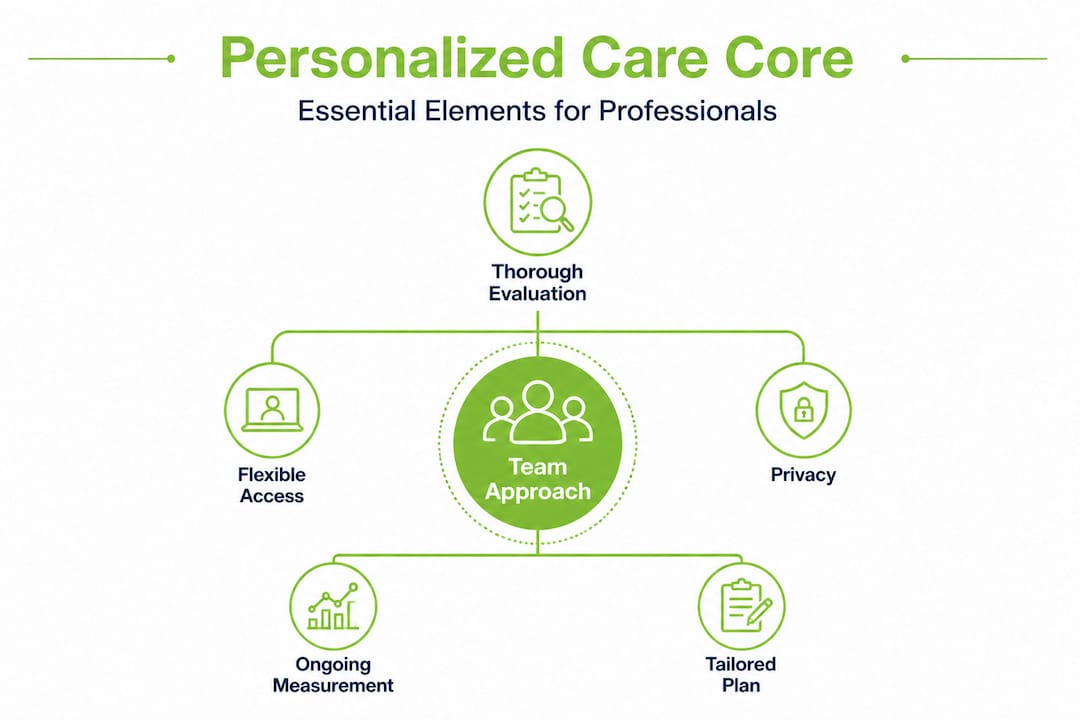
Specialized psychiatric care addresses exactly those gaps. Here’s what makes it different:
- Flexible scheduling: Evening and weekend appointments, plus telehealth sessions, remove the need to block out a weekday afternoon.
- Privacy safeguards: Discreet billing options, private waiting areas, and secure digital communication protect your personal health information.
- Faster access: Time-efficient multidisciplinary outpatient models show that patients waited on average just 17 days to see a therapist and 20 days to see a psychopharmacologist, far shorter than typical community mental health timelines.
- Integrated care teams: A psychiatrist, therapist, and care coordinator working together streamlines your assessment and follow-up into one coherent plan.
“Evidence-based, time-efficient models exist that deliver both speed and results—you don’t have to choose between getting in quickly and getting good care.”
That last point matters more than it might seem. When your care team shares notes and coordinates your treatment plan, you don’t waste appointments repeating your history. Every visit builds on the last. If you’re finding the best clinic to meet these standards, it helps to understand what that structure should actually look like before you start calling around.
Comprehensive evaluation: Getting the right diagnosis up front
Many professionals spend years managing symptoms they’ve partially labeled and partially ignored. You might assume the relentless mental chatter is just drive, or that the difficulty focusing is stress. In reality, conditions like ADHD, anxiety, and depression frequently overlap, and without a thorough evaluation, you risk being treated for the wrong target.
A quality psychiatric evaluation follows a clear, stepwise process:
- Detailed history review: This covers your current symptoms, how long they’ve been present, your medical and developmental background, and any prior mental health treatment.
- Standardized rating scales: Tools like the Adult ADHD Self-Report Scale, PHQ-9, and GAD-7 give your clinician objective data rather than relying solely on self-report.
- Medical screening: Thyroid dysfunction, sleep apnea, and vitamin deficiencies can mimic or worsen psychiatric symptoms. A good evaluation rules these out.
- Psychiatric comorbidity review: Adult ADHD treatment typically involves a comprehensive evaluation including review of past and current symptoms, medical and developmental history, psychiatric comorbidities, and use of adult ADHD rating scales. Skipping any of these steps risks misdiagnosis.
Why does this stepwise approach matter for you specifically? Because professionals are especially vulnerable to being misdiagnosed with generalized anxiety when ADHD is actually the primary driver—or vice versa. The two conditions share symptoms like racing thoughts and difficulty completing tasks, but the treatments differ significantly. Adults with ADHD commonly have comorbid anxiety and depressive disorders, complicating both diagnosis and treatment and pointing toward integrated pharmacologic plus psychotherapy approaches as the current standard.
“Getting the diagnosis right the first time isn’t just efficient—it protects you from months of ineffective treatment.”
Pro Tip: Before your first appointment, keep a brief symptom journal for one to two weeks. Note when anxiety peaks, when focus drops, and what you were doing at the time. This gives your clinician patterns rather than vague impressions, shortening the diagnostic process considerably. You can also explore what ADHD treatment research looks like for adults to arrive better informed.
Personalized treatment: Options that fit your lifestyle
Once your evaluation is complete, the real work of personalization begins. This isn’t about picking from a short menu of options. It’s about building a plan that accounts for your diagnosis, your schedule, your personal preferences, and the specific way your symptoms show up in your professional life.
Treatment for professionals typically draws from several evidence-based approaches:
- Medication management: Stimulants and non-stimulant medications for ADHD, SSRIs and SNRIs for anxiety and depression, and mood stabilizers where indicated.
- Targeted psychotherapy: Cognitive-behavioral therapy (CBT) is especially well-suited for anxiety and depression and can be delivered in shorter, focused formats designed for busy schedules.
- Digital tools: Apps for mood tracking, structured CBT exercises, and sleep hygiene programs extend your care between appointments.
- Blended care models: These combine digital tools with regular sessions, either in-person or via telehealth, offering maximum flexibility.
The research on blended models is particularly encouraging. Reliable improvement rates on the PHQ-9 or GAD-7 were above 81% across follow-up periods for blended care therapy, which means more than four in five people showed meaningful relief from anxiety and depression symptoms. That’s not a modest effect—that’s a strong signal that flexible, technology-supported care delivers real results.

| Treatment approach | Best suited for | Format options |
|---|---|---|
| Medication management | ADHD, depression, anxiety | In-person or telehealth |
| CBT psychotherapy | Anxiety, depression | In-person, video, or blended |
| Digital tools only | Mild symptoms, maintenance | Fully remote |
| Blended care | Moderate to severe symptoms | Mixed in-person and remote |
| Combination (medication + therapy) | Comorbid conditions | Flexible, team-coordinated |
Adult ADHD and comorbid conditions are most effectively managed with medication combined with psychotherapy and cognitive-behavioral strategies, particularly when anxiety or depression is also present. This combined approach tends to outperform either treatment alone, especially for professionals navigating high-stakes environments where cognitive performance matters as much as mood.
For professionals dealing with treatment-resistant symptoms, more advanced options are also available. Ketamine-assisted psychotherapy represents one of the more innovative combinations in current psychiatric practice, and understanding how to approach combining TMS with other treatments or combining ketamine therapy and other treatments may open options you weren’t aware existed.
Pro Tip: Ask your clinician to use measurement-based care from the start. This means completing a standardized rating scale like the PHQ-9 or GAD-7 at every appointment. It turns your treatment into a trackable process rather than a series of conversations that are hard to evaluate objectively.
How to identify a clinic that prioritizes access, privacy, and quality
Not every clinic that advertises “personalized care” actually delivers it in a structured, testable way. Before committing, ask direct questions that separate substance from marketing language.
Here’s a practical framework for vetting any psychiatric clinic:
- Ask about wait times: How long until you can see a therapist? A prescriber? A coordinated team? Evidence-based, time-efficient multidisciplinary outpatient models exist that target both access and outcomes—expect and demand them.
- Ask about measurement-based care: Do clinicians use standardized rating scales at follow-up appointments? Can you see your progress over time?
- Ask about privacy protocols: Is there a discreet intake option? Can you request telehealth to avoid in-person visits? How is your billing handled?
- Ask about team structure: Is there coordination between your prescriber and therapist, or do they operate independently?
- Ask what happens if treatment plateaus: A quality clinic has a clear escalation plan when initial approaches don’t produce results, not just an invitation to continue the same protocol indefinitely.
| Clinic quality indicator | Strong signal | Weak signal |
|---|---|---|
| Wait time | Under 21 days | No clear timeline given |
| Measurement-based care | Rating scales at every visit | Symptom check-ins only verbal |
| Team coordination | Shared records, case review | Independent providers only |
| Privacy options | Telehealth, discreet billing | In-person only, standard billing |
| Treatment adjustment policy | Defined escalation protocol | “Let’s try this and see” |
A note of caution: personalized mental health care using biomarkers, neuroimaging, and machine learning decision support is emerging and promising, but it is not yet standard of care. Be skeptical of clinics making sweeping claims about precision psychiatry without being able to describe the specific, testable tools they use. The most meaningful personalization right now still comes from thorough evaluation, measurement, and a care team that communicates well. For more on clinic quality, exploring clinic quality insights can sharpen your instincts before you make any decisions.
Pro Tip: When you call a clinic for the first time, notice how long it takes for someone to respond and how clearly they answer your questions about wait times. That first interaction often mirrors exactly what your ongoing care experience will feel like.
The uncomfortable truth: Personalization is real, but it’s not magic
Here’s something we rarely say out loud: the word “personalized” is used so frequently in mental health marketing that it has nearly lost its meaning. If you’ve seen it on every clinic’s homepage, you’re right to be skeptical.
True personalization in psychiatry isn’t about the color scheme of your care plan or receiving a custom wellness kit. It’s about three things that are concrete and verifiable. First, your clinician uses structured tools to measure your symptoms at regular intervals. Second, they explain clearly why they’re recommending one treatment over another for you specifically. Third, they adjust the plan when the data shows it isn’t working.
That’s it. And honestly, that process is more valuable than any emerging technology claiming to predict your ideal medication based on a saliva sample. Treating claims of precision psychiatry as a spectrum and requesting concrete, testable elements in your care plan is the most practical thing you can do as an informed patient.
What we’ve seen is that professionals who ask the hard questions up front, who want to know how progress will be measured and what happens if things plateau, tend to get better outcomes. Not because asking questions magically improves the medication, but because it signals to your care team that you want accountability built into the process. And accountability is what drives treatment forward. Reviewing bipolar treatment insights can also help you understand how measurement-based approaches apply across a range of mood presentations.
Mental health treatment is a journey, not a straight line. Progress sometimes stalls, plans sometimes shift, and that’s not failure—that’s normal clinical practice. What matters is that when things stall, your team has a transparent, structured process for figuring out what to try next. That’s the standard worth holding any clinic to.
Ready to start your journey? Discreet care options in North Dallas
If you’re a professional in Frisco, McKinney, Plano, or anywhere across North Dallas, you don’t have to navigate this alone or settle for care that feels inconvenient and generic. Nortex Psychiatry offers confidential, evidence-based psychiatric care specifically designed for people with real schedules and real privacy concerns. From medication management to advanced options like TMS therapy for anxiety, we build treatment plans around your diagnosis and your life. Both telehealth and in-person appointments are available, with prompt access and a team-based approach that keeps your care coordinated from the first evaluation forward. Reaching out is the first step, and we make that step as straightforward as possible.
Frequently asked questions
How quickly can I get an appointment at a specialized psychiatric clinic?
At well-structured multidisciplinary clinics, you can typically be seen within 17 days for therapy and 20 days for a psychopharmacologist, which is significantly faster than most standard community mental health timelines.
What privacy safeguards are common for professionals seeking psychiatric care?
Quality clinics offer private scheduling, telehealth options that eliminate in-person visibility, secure messaging platforms, and discreet billing arrangements tailored to professionals with confidentiality concerns.
Can psychiatric care address both ADHD and anxiety/depression in professionals?
Yes. ADHD in adults often co-occurs with anxiety and depression, so a thorough evaluation and integrated treatment plan combining medication with psychotherapy is the current clinical standard for managing all three conditions together.
How do clinics personalize psychiatric treatment plans for busy professionals?
Clinics personalize care using measurement-based care and team-based models that include regular rating scale assessments, outcome tracking, and a blend of telehealth and in-person sessions designed to fit demanding schedules.
Are digital or blended treatment models actually effective for anxiety and depression?
Yes. Blended care therapy shows reliable improvement and recovery rates above 81% on standardized measures like the PHQ-9 and GAD-7, making it one of the stronger evidence-backed options for adult anxiety and depression.
Recommended
- Home Page – Nortex Psychiatry
- Discover the Best Ketamine Therapy Near Garland, TX: Personalized Care for Mental Wellness – Nortex Psychiatry
- TMS Therapy vs. Neurofeedback: Which Is Better for Mental Health Treatment? – Nortex Psychiatry
- Top-Rated TMS Therapy Near Garland, TX: Advanced Treatment for Lasting Mental Health Relief – Nortex Psychiatry
- Why offer mental health benefits? Boost retention and ROI