


In psychiatry, a life transition is a sharp discontinuity from your previous life pattern — one with an identifiable beginning, a turning point, and an eventual resolution. That definition matters because it separates transitions from ordinary daily stress. We are talking about changes that reorganize your roles, your relationships, and often your sense of who you are. Most people move through transitions with temporary distress that resolves on its own. When symptoms persist, impair your ability to work or connect with others, or cross into clinical territory, that is when psychiatric care becomes relevant.
Three things to do right now if you are in the middle of a transition:
- Self-monitor: Track sleep, appetite, mood, and daily function weekly. Decline in two or more areas for longer than two weeks warrants attention.
- Lean on social ties: Maintaining existing group memberships during change is one of the strongest buffers against transition-related distress, according to SIMIC research.
- Seek care if red flags appear: Suicidal thoughts, inability to function at work or home, or substance use to cope are signals to contact a clinician promptly.
Table of Contents
- What psychiatrists mean by “life transitions” in clinical practice
- Common types of life transitions you might recognize
- How transitions affect your mental health and when to be concerned
- Evidence-based treatments clinicians use during transitions
- Practical steps you can use right now to manage a transition
- When to get psychiatric care instead of waiting it out
- How a psychiatrist approaches transition-focused care: a clinical example
- Key Takeaways
- What we have learned working with patients through transitions
- Nortexpsychiatry can help you through what you are facing
- Useful sources
- FAQ
What psychiatrists mean by “life transitions” in clinical practice
Clinical transition theory defines a life transition as a process with three distinct phases: entry, turning point, and resolution. Entry is the moment the old structure breaks down. The turning point is the period of active reorganization, often the most distressing phase. Resolution is when a new, stable pattern takes hold. What makes this clinically meaningful is that the turning point phase can last weeks to months, and the distress during it is not a sign of weakness or disorder — it is the expected cost of psychological reorganization.
Clinicians look for four measurable attributes when assessing a transition:
- Onset pattern: Was the change expected (retirement, graduation) or sudden (job loss, bereavement)? Unexpected transitions tend to produce more acute distress.
- Duration: How long has the person been in the turning-point phase? Persistence beyond four to six weeks with functional impairment shifts the clinical picture.
- Functional impact: Is the person still meeting core responsibilities at work, school, or home?
- Social identity changes: Has the transition altered group memberships, roles, or the person’s sense of belonging?
The social identity piece is often underweighted in clinical conversations. The Social Identity Model of Identity Change (SIMIC) shows that people who hold multiple group memberships before a major change are better protected, because they have more social continuity to draw on when one identity is disrupted.
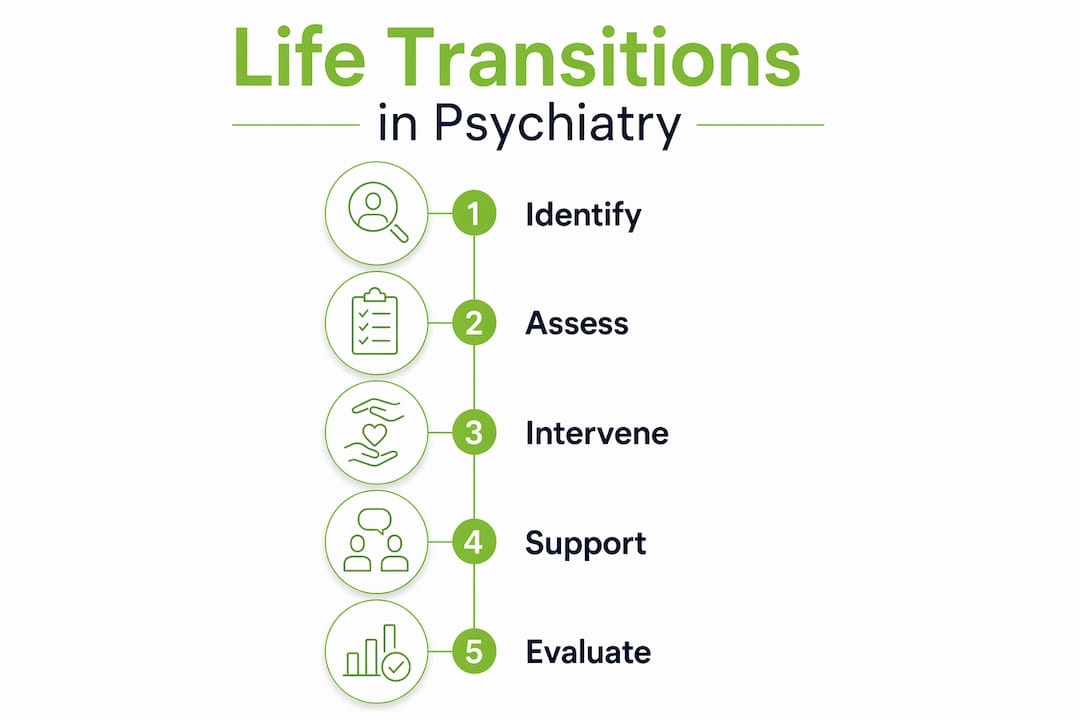
Common types of life transitions you might recognize
Life transitions cluster into a few broad domains. Recognizing which type you are facing helps clarify what kind of support is most useful.
- Developmental transitions: Adolescence, leaving home, retirement. These are expected, but predictability does not eliminate distress.
- Situational transitions: Job change, relocation, financial crisis. Often sudden, with little preparation time.
- Relational transitions: Marriage, divorce, becoming a parent, losing a close relationship.
- Health and loss transitions: A new diagnosis, chronic illness, bereavement. These often carry grief alongside practical disruption.
- Identity transitions: Coming out, gender transition, religious change, immigration. These reorganize core self-concept, not just circumstances.
Expected transitions tend to allow some psychological preparation, which softens the entry phase. Unexpected transitions compress that preparation time to near zero, which is why sudden job loss or an unexpected diagnosis often produces more acute distress than, say, a planned retirement.
A quick clinical note on each domain: developmental transitions destabilize identity even when they look positive from the outside. Relational transitions almost always involve grief, even when the change is chosen. Health transitions add a layer of uncertainty about the future self that other transitions do not. Identity transitions can be profoundly liberating and simultaneously isolating, particularly when social networks do not shift alongside the internal change.

Pro Tip: If you are not sure whether what you are experiencing qualifies as a “transition,” ask yourself: has something changed that means the old version of your daily life no longer exists? If yes, you are in one.
How transitions affect your mental health and when to be concerned
The most common emotional responses to transitions include grief, anxiety, rumination, sleep disruption, appetite changes, identity confusion, and social withdrawal. These are normal. They become clinically significant when they persist or when they impair functioning.
Several factors increase vulnerability:
- Limited social identities before the change (fewer group memberships to fall back on)
- Prior trauma or untreated mental health conditions
- Concurrent losses happening simultaneously
- Socioeconomic stressors that limit access to support or resources
- Absence of predictable daily structure
Research on young adult transitions from the Great Smoky Mountains Study found that each additional positive life transition between early adulthood ages was associated with a reduction in adult emotional symptoms with statistical significance, suggesting transitions can serve as genuine turning points for mental health when navigated well.
Red-flag checklist — seek care if you notice any of the following:
- Suicidal thoughts or thoughts of self-harm
- Inability to meet basic responsibilities at work, school, or home for more than two weeks
- Substance use to manage distress
- Severe sleep disruption (less than four hours per night consistently) or appetite changes causing significant weight change
- Panic attacks or dissociation
- Complete social withdrawal lasting more than a week
Typical transitional distress resolves within one to three months as the new structure stabilizes. When symptoms persist beyond that window with no sign of resolution, or when any red flag above is present, the clinical picture has likely shifted from adjustment to a diagnosable condition such as major depression, generalized anxiety disorder, or adjustment disorder.
Evidence-based treatments clinicians use during transitions
The evidence base for transition-focused care includes several well-studied psychotherapy modalities, each addressing a different aspect of the transition process.
- Cognitive Behavioral Therapy (CBT): Targets negative thought patterns that amplify distress. Particularly useful for rumination and catastrophic thinking about the future.
- Mindfulness-Based Approaches: Build present-moment awareness and emotional regulation. Useful when anxiety about the future or grief about the past dominates. Mayo Clinic mindfulness guidance supports breathing and meditation exercises as practical tools.
- Solution-Focused Therapy: Concentrates on present-moment problem-solving rather than exploring the past. Often the fastest route to restoring a sense of agency.
- Acceptance and Commitment Therapy (ACT): Builds psychological flexibility and values-based action. Particularly effective when the transition involves irreversible loss.
- DBT-Informed Skills Training: Distress tolerance and interpersonal effectiveness skills are directly applicable to the turning-point phase of transitions.
A clinician’s goal during transition work is not to eliminate uncertainty — it is to increase your capacity to tolerate it while taking values-aligned steps forward. That distinction matters clinically because trying to resolve uncertainty prematurely often prolongs distress.
| Therapy | Primary goal | Typical format | Evidence level |
|---|---|---|---|
| CBT | Reframe negative thoughts | Individual | Strong |
| Mindfulness-based | Emotional regulation | Group or individual | Moderate–strong |
| Solution-focused | Present-moment problem-solving | Individual, 4 sessions | Moderate |
| ACT | Values-based action, flexibility | Individual | Strong |
| DBT skills | Distress tolerance | Group skills training | Strong |

Medication becomes part of the plan when a co-occurring condition is present: major depression, a diagnosable anxiety disorder, severe sleep disturbance that does not respond to behavioral intervention, or bipolar disorder. Medication in these cases supports the psychotherapy work — it does not replace it. For a fuller picture of how medication fits into mental wellness care, this overview is worth reading.
Pro Tip: Ask your clinician to name the specific therapy modality they are using and why they chose it for your situation. A good clinician can answer that in one sentence.
Practical steps you can use right now to manage a transition
These steps follow the sequence clinicians typically recommend: stabilize first, then build forward.
- Stabilize your routine. Sleep and wake at consistent times. Eat at regular intervals. These are not trivial — they are the physiological foundation everything else rests on.
- Take small exposures to the new role. If you just retired, spend one hour doing something that reflects your new identity. If you relocated, walk one new block per day. Small contact reduces avoidance.
- Use structured problem-solving. Write down one concrete obstacle you are facing. List three possible responses. Choose one and act on it this week.
- Activate a social identity. Identify one existing group you belong to — a faith community, a professional network, a hobby group — and make contact this week. SIMIC research consistently shows that maintaining group membership during change predicts better health outcomes.
- Make one values-based micro-choice daily. Ask yourself: “What matters to me, and did I act on it today?” This keeps you oriented when circumstances feel chaotic.
Useful daily skills to layer in alongside those steps:
- Grounding exercises (5-4-3-2-1 sensory technique) when anxiety spikes
- Mental health self-care practices such as behavioral activation and brief journaling
- Cognitive restructuring prompts: “What evidence supports this thought? What evidence contradicts it?”
- Sleep hygiene: no screens 60 minutes before bed, consistent wake time even on weekends
Pro Tip: Mark the ending of what you are leaving behind — a small ritual, a letter you do not send, a deliberate goodbye. Clinical transition theory shows that patients who skip this step often experience prolonged role confusion because the old role’s psychological space stays occupied.
When to get psychiatric care instead of waiting it out
Waiting out distress is reasonable for a few weeks. It stops being reasonable when functioning declines and stays declined. Here is a concrete checklist for when to contact a clinician:
- Symptoms have persisted for more than four weeks with no improvement
- You have missed work, school, or important responsibilities more than twice in a month
- Relationships are deteriorating because of your emotional state
- You are using alcohol, cannabis, or other substances to sleep or manage anxiety
- Any red flag from the earlier checklist is present
What to expect from an initial psychiatric evaluation: a clinician will take a full history of the transition, your prior mental health background, current symptoms, sleep, appetite, and substance use. They will conduct a risk assessment. From there, they will outline a treatment plan that may include therapy referral, medication, or both. The evaluation itself is not a commitment to any particular treatment — it is information gathering.
In the US, two resources are worth knowing:
- 988 Suicide and Crisis Lifeline: Call or text 988 for immediate support.
- SAMHSA National Helpline: 1-800-662-4357, free and confidential, available 24/7 for mental health and substance use referrals.
Telehealth has meaningfully expanded access to psychiatric care, particularly for people in the middle of transitions that disrupt their schedule or location. It works well for medication management, follow-up visits, and many forms of therapy. It is less suited to situations requiring in-person physical assessment or crisis stabilization. If you are considering telehealth as your entry point, this guide to telepsychiatry outlines what to expect practically.
How a psychiatrist approaches transition-focused care: a clinical example
Consider a 34-year-old professional who presents after relocating across the country for a new position. She reports three weeks of poor sleep, difficulty concentrating at work, and a persistent sense of not knowing “who she is” outside her previous city and social network. She denies suicidal ideation. Her history is notable for one prior episode of depression in her mid-20s, treated successfully with a short course of antidepressants and therapy.
The assessment identifies a transition with multiple simultaneous losses: geographic community, professional identity within a familiar context, and daily social structure. Her prior depression history increases vulnerability. The plan includes a referral for CBT focused on cognitive restructuring and behavioral activation, sleep hygiene coaching, and a watchful-waiting approach on medication given that symptoms are sub-threshold at three weeks. A two-week follow-up is scheduled with explicit targets: sleep averaging six or more hours, one social contact initiated per week, and return to baseline work output.
At Nortexpsychiatry, we commonly support patients through transitions with:
- Comprehensive psychiatric evaluation to clarify diagnosis and rule out co-occurring conditions
- Medication management when indicated, with clear goals and regular monitoring
- Short-term therapy referrals with specific modality recommendations
- Telehealth follow-ups that fit around disrupted schedules
- Measurable, proximal goals tracked at each visit (sleep hours, social contact frequency, one values-based action per week)
Pro Tip: At each follow-up, we ask patients to rate three things: sleep quality, social engagement, and whether they took one values-based action that week. Those three markers tell us more about trajectory than any symptom checklist alone.
Key Takeaways
Life transitions are clinically defined discontinuities that reorganize roles and identity, and most resolve within one to three months when supported by routine, social connection, and evidence-based coping skills.
| Point | Details |
|---|---|
| Clinical definition | A life transition has an identifiable beginning, turning point, and resolution — distinct from ordinary daily stress. |
| Social identity matters | Holding multiple group memberships before a change predicts better health outcomes, per SIMIC research. |
| Red flags require care | Persistent functional impairment beyond four weeks, suicidal thoughts, or substance use to cope warrant psychiatric assessment. |
| First-line treatments | CBT, mindfulness-based approaches, ACT, and solution-focused therapy are the primary evidence-based options. |
| Nortexpsychiatry | Offers psychiatric evaluation, medication management, and telehealth follow-up for adults navigating life transitions across North Dallas. |
What we have learned working with patients through transitions
The most common misconception we see is that struggling through a transition means something is wrong with you. It does not. Transitions are periods of necessary psychological reorganization, and distress during them is not a symptom of failure — it is the expected cost of change. We have found that patients who understand this reframe early tend to engage more actively with coping strategies and recover faster.
What we also notice is that people underestimate how much of their identity is tied to roles and groups they did not consciously choose. Losing a job is not just a financial event. Retiring is not just a schedule change. The grief that follows is real, and it deserves the same clinical attention as any other loss.
Progress in transition work looks different from progress in, say, treating a phobia. We measure it in restored function: Are you sleeping? Are you showing up? Did you make one choice this week that reflects what matters to you? Those are the markers we track. They are quieter than dramatic symptom reduction, but they are the ones that hold.
Nortexpsychiatry can help you through what you are facing
If you are in the middle of a transition and the distress is not lifting, a psychiatric evaluation is a reasonable and practical next step — not a last resort. At Nortexpsychiatry, we work with adults across Allen, Frisco, McKinney, Plano, and the broader North Dallas area who are navigating exactly these kinds of changes. An initial evaluation covers your full history, current symptoms, and a clear treatment plan. We offer both in-person and telehealth appointments, so access does not have to be another obstacle.
Our services most relevant to life transitions include psychiatric evaluation, medication management when clinically indicated, therapy referrals with specific modality guidance, and telehealth follow-ups that fit around disrupted schedules. If you are unsure whether what you are experiencing warrants care, our psychiatric evaluation overview explains exactly what an initial visit covers and what you can expect to walk away with.
Ready to take that step? Schedule an evaluation with Nortexpsychiatry and get a clear picture of where you stand and what comes next.
Useful sources
These are the most authoritative resources cited in this article, along with a brief note on why each is worth consulting.
| Source | Why consult it | URL |
|---|---|---|
| Annual Reviews: Life Change, Social Identity, and Health | Best available review of SIMIC and how group membership protects health during transitions | Link |
| Springer: Coping with Life Transitions | Original clinical transition theory; defines the entry-turning point-resolution model | Link |
| Cambridge Core: Young Adult Life Transitions and Mental Health | Propensity-score study showing transitions can be turning points for emotional symptoms | Link |
| PMC: Life Transitions and Mental Wellbeing in the Digital Age | Reviews digital support options and their integration with formal clinical care | Link |
| Indiana Wesleyan: The Role of Counseling in Navigating Life Transitions | Accessible overview of therapy modalities used in transition counseling | Link |
| Mayo Clinic: Mindfulness Exercises | Practical guidance on mindfulness and breathing techniques for emotional regulation | Link |
| SAMHSA National Helpline | Free, confidential US referral service for mental health and substance use; 1-800-662-4357 | samhsa.gov |
| Nortexpsychiatry: Evidence-Based Therapies | Explains CBT, ACT, DBT, and mindfulness approaches used in clinical care | Link |
FAQ
What is a life transition in psychiatry?
In psychiatry, a life transition is a sharp discontinuity from a previous life pattern, with an identifiable beginning, turning point, and resolution. It reorganizes roles, relationships, and identity, and typically produces temporary distress that resolves within one to three months.
What are examples of life transitions?
Common examples include adolescence, leaving home, marriage, divorce, parenthood, job change, relocation, retirement, bereavement, a new health diagnosis, and identity transitions such as coming out. Both expected and unexpected changes qualify, though sudden transitions tend to produce more acute distress.
What are the four types of life transitions in psychology?
Psychological frameworks typically group transitions into developmental (age-related milestones), situational (unexpected external events), relational (changes in close relationships), and health or loss transitions. Some models add identity transitions as a fifth category covering changes in core self-concept.
How long do life transitions typically affect mental health?
Most transitional distress resolves within one to three months as a new stable pattern takes hold. When functional impairment persists beyond four weeks with no improvement, or when red flags such as suicidal thoughts or substance use appear, a psychiatric evaluation is warranted.
When should I seek psychiatric help for a life transition?
Seek care when symptoms have lasted more than four weeks without improvement, when you are missing work or responsibilities consistently, when you are using substances to cope, or when any safety concern is present. Nortexpsychiatry offers evaluations and telehealth appointments for adults across North Dallas navigating these situations.
This article provides general clinical information, not personalized medical advice. Please consult a qualified mental health professional or your primary care provider for guidance specific to your situation.